Cooling Towers
AN EXTENSIVE APPROACH
Outline
 Overview of heat transfer through evaporation
 Overview of relevant terms related to cooling operations
 Introduction to cooling towers
 Basic working principle of a cooling tower
 Classification of cooling towers
 Major components of a cooling tower
 Design of natural draft cooling tower with numerical example
 Strategies to improve cooling tower performance
 Importance of cooling towers in Chemical Process Industry
 References
Evaporation
 Evaporation is the conversion of a liquid phase of a material or
substance to a vapor phase at a specific temperature and pressure.
 At normal temperature and pressure, all liquids posses a liquid and
vapor phase, which are in equilibrium with each other, if the
temperature and pressure conditions remain the same.
 Rate of evaporation of a liquid is affected by the change in
ambient temperature and pressure conditions.
 The change affects the vapor pressure of the liquid, causing an
increase or decrease in rate of evaporation.
Why evaporation causes cooling ?
 Evaporation results in vapor escaping from the surface of the liquid.
 The vapors require energy to escape.
 That energy is heat.
 As vapors escape the surface, they carry with them some heat
content of the liquid, and thus cause the liquid surface to cool.
Terminologies relevant to cooling
operations
 Humidity – Amount of vapor associated with a unit mass of dry gas.
 Relative humidity – Ratio of partial pressure of vapor in gas to the partial
pressure of vapor in same gas at saturation.
 Humidification – Process of increasing the amount of vapor in a gas
stream.
 De-humidification – The opposite of humidification i.e. the process of
decreasing the amount of vapor in a gas stream.
 Wet-bulb temperature – The lowest temperature that water
theoretically can reach by evaporation.
Factors affecting rate of
evaporation
 Some major factors include
 Temperature and pressure of the liquid being evaporated.
 Temperature and pressure of the ambient gas which will accept the
vapors from incoming liquid.
 Humidity of the ambient gas.
 Flow conditions for liquid and gas.
 Weather conditions in case of open-air evaporation generally
describing the temperature, pressure, and velocity of ambient air e.g.,
water evaporating from a pond.
Cooling towers
 As per the definition of Cooling Technology Institute (CTI), USA
“A cooling tower is a heat rejection device,
which extracts waste heat to the atmosphere
though the cooling of a water stream
to a lower temperature.”
 Cooling towers are used in process industries to cool off effluent water from various heat transfer
equipment e.g., condensate from a condenser.
 Cooling towers, in general, cool the water to a temperature below the dry-bulb and above the
wet-bulb temperature of air at the present conditions.
 The cooled water is sent back to the process for reuse, thus emphasizing conservation of water.
Basic working principle of a cooling
tower
 Considering an example of an air-water system, the basic working
principle of a cooling tower can be listed as,
1. Hot water and relatively cool ambient air enter the cooling tower.
2. Heat transfer between the air stream and the water stream occurs.
3. Hot water transfers its heat to the ambient air and becomes cool.
4. Cool water is removed from the cooling tower and sent back to the
process plant.
5. The resulting hot air rises and is, generally, removed from the top of the
tower by virtue of its low density.
Classification of cooling towers
 Cooling towers are generally classified based on the following
factors,
1. Method by which air is introduced into the tower.
2. Flow configuration inside the tower.
3. Method of heat transfer / heat removal.
1. Air Introduction Method
NO. TYPE DESCRIPTION
1 Natural draft cooling
towers
Air movement is regulated without any help of
a mechanical fan or regulator and is
dependent on the height and size of the
tower
2 Mechanical draft
cooling towers
Air is regulated by means of mechanical fans.
It has two further types based on the
positioning of the fan
 Induced mechanical draft where the fan is
positioned on the top side of the tower
 Forced mechanical draft where the fan is
positioned at the bottom side of the tower
2. Flow configuration
NO. TYPE DESCRIPTION
1 Cross flow configuration The air stream enters the tower in a direction
perpendicular to that of flow of water e.g., air
entering from the sides of the cooling tower in
association with the water stream entering
from the top of the tower
2 Counter-current flow
configuration
The air stream and water stream flow in
parallel but opposite direction inside the
tower e.g., air entering from below and water
entering from the top of the tower
3 Co-current flow
configuration
The air stream and water stream flow in
parallel and same direction inside the tower
2. Flow Configuration (contd.)
3. Method of Heat Transfer
NO. TYPE DESCRIPTION
1 Dry cooling towers Transfer heat through a surface which
separates the working fluid from ambient air
e.g., tube to air heat exchanger. No
evaporation occurs in dry cooling towers
2 Wet cooling towers Transfer heat on the principle of evaporative
cooling e.g., hyperbolic natural draft cooling
towers used in power plants
3 Wet-dry hybrid cooling
towers
Combination of an air-cooled heat
exchanger and a wet cooling tower to cool
off the required fluid
4 Evaporative condenser
cooling tower
Principle of wet cooling tower is applied to
cool a process fluid which remains isolated
from the cooling tower fluids (usually air and
water)
3. Method of Heat Transfer (contd.)
Evaporative condenser cooling tower
Wet-dry cooling tower
Major components of a cooling
tower
NO. NAME OF
COMPONENT
FUNCTION MATERIAL OF
CONSTRUCTION
1 Frame and
casing
Supports exterior enclosures SS 316/304,
Concrete, Fiber glass
2 Fill Increases contact between air
and water, facilitating heat
transfer. Has two types; Splash fill
and Film fill
PVC, wood,
Polypropylene
3 Cold water basin Receives water at the bottom of
the tower
SS 316, Concrete
4 Drift eliminators Reduce loss of water due to
windage/drift
PVC, Polypropylene
Major components of a cooling
tower (contd.)
NO. NAME OF COMPONENT FUNCTION
5 Air inlet Enables air to enter the tower
6 Louvers Louvers equalize air flow into the fill and
retain the water within the tower
7 Nozzles / Spray tree Distributes water to wet the fill
8 Fans Regulate air flow in case of mechanical
draft towers
Design of a cooling tower
 Design procedure of a hyperbolic natural draft cooling tower is
taken as reference.
Design of a cooling tower (contd.)
 Important parameters prerequisite to design,
CLASS NO. NAME SYMBOL UNITS
MEASUREDPARAMETERS 1 Wet bulb
temperature of air
𝑇 𝑤 K
2 Dry bulb
temperature of air
𝑇𝑑 K
3 Inlet water
temperature
𝑇𝑖𝑛 K
4 Outlet water
temperature
𝑇𝑜𝑢𝑡 K
5 Water mass flow
rate / Water load
𝑊𝐿 kg/sec
6 Enthalpy change
(air passing through
tower)
∆𝐻′
kJ/kg
Design of a cooling tower (contd.)
CLASS NO. NAME SYMBOL DESCRIPTION UNITS
PERFORMANCEPARAMETERS
1 Range ∆𝑇 ∆𝑇 = 𝑇𝑖𝑛 − 𝑇𝑜𝑢𝑡 K
2 Approach ∆𝑇∗ ∆𝑇∗ = 𝑇𝑜𝑢𝑡 − 𝑇 𝑤 K
3 Effectiveness 𝐸𝑐
𝐸𝑐 =
∆𝑇
∆𝑇 + ∆𝑇∗
∗ 100
%
4 Cooling capacity 𝑄 𝑄 = 𝑊𝐿 ∗ 𝐶 𝑝 𝑤𝑎𝑡𝑒𝑟
∗ ∆𝑇 kW
5 Performance
coefficient
𝐶𝑡 Value is usually 5.2 or
lower
--
Design of a cooling tower (contd.)
CLASS NO. NAME SYMBOL DESCRIPTION UNITS
DESIGNPARAMETERS
1 Duty coefficient 𝐷𝑡 𝑊𝐿
𝐷𝑡
= 0.00369 ∗
∆𝐻′
∆𝑇
∗ (∆𝑇∗ + 0.0752∆𝐻′)
0.5 --
2 Base area of tower 𝐴 𝑏
𝐷𝑡 =
19.5 ∗ 𝐴 𝑏 ∗ 𝑧𝑡
0.5
𝐶𝑡
1.5
m2
3 Height of tower 𝑧𝑡 Assumed values are used during
calculations to confine to a height to
diameter ratio of 3:2; in case of
hyperbolic natural draft towers
m
4 Diameter of tower 𝑑 𝑏
𝑑 𝑏 =
4 ∗ 𝐴 𝑏
𝜋
m
Design of a cooling tower –
Numerical example
 Numerical example, with reference to Coulson & Richardson, Chemical
Engineering Vol.1, 6th Edition.
 Q. (a) Determine the diameter and height of a hyperbolic natural draft
cooling tower handling 6500 kg/s of water under the following
conditions.
Inlet water temperature = 318 K
Outlet water temperature = 313 K
Dry bulb temperature of air = 301 K
Wet bulb temperature of air = 295 K
(b) Determine the effectiveness and cooling capacity for the specified
tower.
Design of a cooling tower –
Numerical solution
Available values Required values
𝑇 𝑤 = 295 K ∆𝐻′
𝑇𝑑 = 301 K ∆𝑇
𝑇𝑖𝑛 = 318 K ∆𝑇∗
𝑇𝑜𝑢𝑡 = 313 K 𝐷𝑡
𝑊𝐿 = 6500 kg/s 𝐴 𝑏
𝑧𝑡
𝐸𝑐
𝑄
Design of a cooling tower –
Numerical solution (contd.)
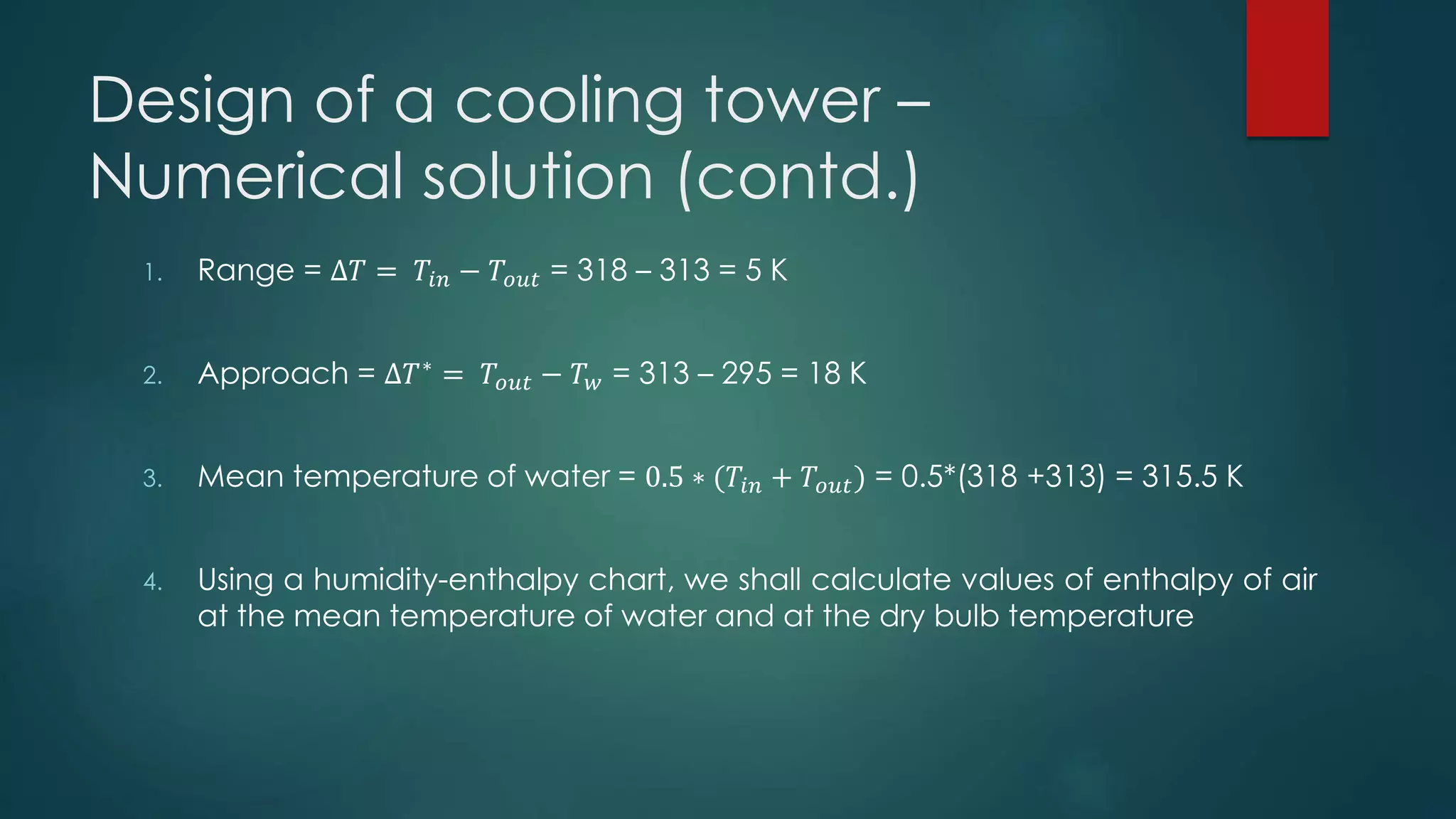
1. Range = ∆𝑇 = 𝑇𝑖𝑛 − 𝑇𝑜𝑢𝑡 = 318 – 313 = 5 K
2. Approach = ∆𝑇∗
= 𝑇𝑜𝑢𝑡 − 𝑇 𝑤 = 313 – 295 = 18 K
3. Mean temperature of water = 0.5 ∗ (𝑇𝑖𝑛 + 𝑇𝑜𝑢𝑡) = 0.5*(318 +313) = 315.5 K
4. Using a humidity-enthalpy chart, we shall calculate values of enthalpy of air
at the mean temperature of water and at the dry bulb temperature
Design of a cooling tower –
Numerical solution (contd.)
5. The corresponding values of enthalpies at mean water temperature and dry
bulb temperature are approximately 150 kJ/kg and 83 kJ/kg
6. Enthalpy change of passing air = ∆𝐻′ = 150 – 83 = 67 kJ/kg
7. Duty coefficient = 𝑊 𝐿
𝐷𝑡
= 0.00369 ∗ ∆𝐻′
∆𝑇
∗ (∆𝑇∗ + 0.0752∆𝐻′)
0.5
= 27388
Design of a cooling tower –
Numerical solution (contd.)
8. Assuming height 𝑧𝑡 by hit and trial method and taking 𝐶𝑡 as 5.2, the
base area, diameter, and conformity of the height to diameter
ratio of the tower is calculated as,
No. Height
𝑧𝑡 (m) 𝐴 𝑏 =
𝐷𝑡 ∗ 𝐶𝑡
1.5
19.5 ∗ 𝑧𝑡
0.5
(m2)
𝑑 𝑏 =
4 ∗ 𝐴 𝑏
𝜋
(m)
Height to diameter ratio
𝑧𝑡 / 𝑑 𝑏 ≈ 1.5
1 95 1709 46.6 2.04 ≠ 1.5
2 90 1755 47.3 1.90 ≠ 1.5
3 85 1806 47.9 1.77 ≠ 1.5
4 80 1862 48.7 1.64 ≠ 1.5
5 75 1923 49.5 1.51 ≈ 1.5
Design of a cooling tower –
Numerical solution (contd.)
9. The acceptable value of height and diameter for the specified
tower is 75 m and 49.5 m, respectively
10. Effectiveness of tower = 𝐸𝑐 =
∆𝑇
∆𝑇+∆𝑇∗ ∗ 100 =
5
5+18
∗ 100 = 21.74%
11. Cooling capacity
𝑄 = 𝑊𝐿 ∗ 𝐶 𝑝 𝑤𝑎𝑡𝑒𝑟
∗ ∆𝑇 = 4500 (kg/s) * 4.1815 (kJ/kg K ) * 5 (K)
𝑄 = 94083.75 kW
Strategies to improve cooling tower
performance
 When designing a cooling tower, always use the highest wet-bulb temperature
as reference.
 Monitor the range and approach carefully during the design.
 High range and low approach leads to good performance.
 Improve the quality of water to be cooled by the tower resulting in low utilization
of make-up water.
 Regularly monitor the tower for scale build-up and biological impurities.
 Regularly monitor the flow of water and air inside the tower
Importance of cooling tower in CPI
 Cooling towers are used to cool industrial processes and
applications to ensure that the correct temperature of the
environment and the process are maintained during manufacturing
or large industrial processes.
 Natural draft cooling towers require no power and are of key
importance in power plants.
References
 Literature:
 Dr. N.P. Cheremisinoff, Handbook of Chemical Processing Equipment, 1st
edition, Butterworth-Heinemann, USA, 2000.
 J. M. Coulson, J.F. Richardson, J.H Harker, J.R. Backhurst, Chemical
Engineering Volume 1 – Fluid Flow, Heat Transfer and Mass Transfer, 6th
edition, Butterworth-Heinemann, USA, 1999.
 San Diego County Water Authority, Technical Information for Cooling
Towers Using Recycled Water, San Diego, USA, 2009.
 Training Session on Energy Equipment, Cooling Towers, UNEP, 2006.
 Websites / URL’s:
 http://www.cti.org/whatis/coolingtowerdetail.shtml
 http://www.engineeringtoolbox.com/
 http://www.deltacooling.com/resources/principles-of-cooling-towers/
Cooling Towers - An Extensive Approach

Cooling Towers - An Extensive Approach

  • 1.
  • 2.
    Outline  Overview ofheat transfer through evaporation  Overview of relevant terms related to cooling operations  Introduction to cooling towers  Basic working principle of a cooling tower  Classification of cooling towers  Major components of a cooling tower  Design of natural draft cooling tower with numerical example  Strategies to improve cooling tower performance  Importance of cooling towers in Chemical Process Industry  References
  • 3.
    Evaporation  Evaporation isthe conversion of a liquid phase of a material or substance to a vapor phase at a specific temperature and pressure.  At normal temperature and pressure, all liquids posses a liquid and vapor phase, which are in equilibrium with each other, if the temperature and pressure conditions remain the same.  Rate of evaporation of a liquid is affected by the change in ambient temperature and pressure conditions.  The change affects the vapor pressure of the liquid, causing an increase or decrease in rate of evaporation.
  • 4.
    Why evaporation causescooling ?  Evaporation results in vapor escaping from the surface of the liquid.  The vapors require energy to escape.  That energy is heat.  As vapors escape the surface, they carry with them some heat content of the liquid, and thus cause the liquid surface to cool.
  • 5.
    Terminologies relevant tocooling operations  Humidity – Amount of vapor associated with a unit mass of dry gas.  Relative humidity – Ratio of partial pressure of vapor in gas to the partial pressure of vapor in same gas at saturation.  Humidification – Process of increasing the amount of vapor in a gas stream.  De-humidification – The opposite of humidification i.e. the process of decreasing the amount of vapor in a gas stream.  Wet-bulb temperature – The lowest temperature that water theoretically can reach by evaporation.
  • 6.
    Factors affecting rateof evaporation  Some major factors include  Temperature and pressure of the liquid being evaporated.  Temperature and pressure of the ambient gas which will accept the vapors from incoming liquid.  Humidity of the ambient gas.  Flow conditions for liquid and gas.  Weather conditions in case of open-air evaporation generally describing the temperature, pressure, and velocity of ambient air e.g., water evaporating from a pond.
  • 7.
    Cooling towers  Asper the definition of Cooling Technology Institute (CTI), USA “A cooling tower is a heat rejection device, which extracts waste heat to the atmosphere though the cooling of a water stream to a lower temperature.”  Cooling towers are used in process industries to cool off effluent water from various heat transfer equipment e.g., condensate from a condenser.  Cooling towers, in general, cool the water to a temperature below the dry-bulb and above the wet-bulb temperature of air at the present conditions.  The cooled water is sent back to the process for reuse, thus emphasizing conservation of water.
  • 8.
    Basic working principleof a cooling tower  Considering an example of an air-water system, the basic working principle of a cooling tower can be listed as, 1. Hot water and relatively cool ambient air enter the cooling tower. 2. Heat transfer between the air stream and the water stream occurs. 3. Hot water transfers its heat to the ambient air and becomes cool. 4. Cool water is removed from the cooling tower and sent back to the process plant. 5. The resulting hot air rises and is, generally, removed from the top of the tower by virtue of its low density.
  • 9.
    Classification of coolingtowers  Cooling towers are generally classified based on the following factors, 1. Method by which air is introduced into the tower. 2. Flow configuration inside the tower. 3. Method of heat transfer / heat removal.
  • 10.
    1. Air IntroductionMethod NO. TYPE DESCRIPTION 1 Natural draft cooling towers Air movement is regulated without any help of a mechanical fan or regulator and is dependent on the height and size of the tower 2 Mechanical draft cooling towers Air is regulated by means of mechanical fans. It has two further types based on the positioning of the fan  Induced mechanical draft where the fan is positioned on the top side of the tower  Forced mechanical draft where the fan is positioned at the bottom side of the tower
  • 11.
    2. Flow configuration NO.TYPE DESCRIPTION 1 Cross flow configuration The air stream enters the tower in a direction perpendicular to that of flow of water e.g., air entering from the sides of the cooling tower in association with the water stream entering from the top of the tower 2 Counter-current flow configuration The air stream and water stream flow in parallel but opposite direction inside the tower e.g., air entering from below and water entering from the top of the tower 3 Co-current flow configuration The air stream and water stream flow in parallel and same direction inside the tower
  • 12.
  • 13.
    3. Method ofHeat Transfer NO. TYPE DESCRIPTION 1 Dry cooling towers Transfer heat through a surface which separates the working fluid from ambient air e.g., tube to air heat exchanger. No evaporation occurs in dry cooling towers 2 Wet cooling towers Transfer heat on the principle of evaporative cooling e.g., hyperbolic natural draft cooling towers used in power plants 3 Wet-dry hybrid cooling towers Combination of an air-cooled heat exchanger and a wet cooling tower to cool off the required fluid 4 Evaporative condenser cooling tower Principle of wet cooling tower is applied to cool a process fluid which remains isolated from the cooling tower fluids (usually air and water)
  • 14.
    3. Method ofHeat Transfer (contd.) Evaporative condenser cooling tower Wet-dry cooling tower
  • 15.
    Major components ofa cooling tower NO. NAME OF COMPONENT FUNCTION MATERIAL OF CONSTRUCTION 1 Frame and casing Supports exterior enclosures SS 316/304, Concrete, Fiber glass 2 Fill Increases contact between air and water, facilitating heat transfer. Has two types; Splash fill and Film fill PVC, wood, Polypropylene 3 Cold water basin Receives water at the bottom of the tower SS 316, Concrete 4 Drift eliminators Reduce loss of water due to windage/drift PVC, Polypropylene
  • 16.
    Major components ofa cooling tower (contd.) NO. NAME OF COMPONENT FUNCTION 5 Air inlet Enables air to enter the tower 6 Louvers Louvers equalize air flow into the fill and retain the water within the tower 7 Nozzles / Spray tree Distributes water to wet the fill 8 Fans Regulate air flow in case of mechanical draft towers
  • 17.
    Design of acooling tower  Design procedure of a hyperbolic natural draft cooling tower is taken as reference.
  • 18.
    Design of acooling tower (contd.)  Important parameters prerequisite to design, CLASS NO. NAME SYMBOL UNITS MEASUREDPARAMETERS 1 Wet bulb temperature of air 𝑇 𝑤 K 2 Dry bulb temperature of air 𝑇𝑑 K 3 Inlet water temperature 𝑇𝑖𝑛 K 4 Outlet water temperature 𝑇𝑜𝑢𝑡 K 5 Water mass flow rate / Water load 𝑊𝐿 kg/sec 6 Enthalpy change (air passing through tower) ∆𝐻′ kJ/kg
  • 19.
    Design of acooling tower (contd.) CLASS NO. NAME SYMBOL DESCRIPTION UNITS PERFORMANCEPARAMETERS 1 Range ∆𝑇 ∆𝑇 = 𝑇𝑖𝑛 − 𝑇𝑜𝑢𝑡 K 2 Approach ∆𝑇∗ ∆𝑇∗ = 𝑇𝑜𝑢𝑡 − 𝑇 𝑤 K 3 Effectiveness 𝐸𝑐 𝐸𝑐 = ∆𝑇 ∆𝑇 + ∆𝑇∗ ∗ 100 % 4 Cooling capacity 𝑄 𝑄 = 𝑊𝐿 ∗ 𝐶 𝑝 𝑤𝑎𝑡𝑒𝑟 ∗ ∆𝑇 kW 5 Performance coefficient 𝐶𝑡 Value is usually 5.2 or lower --
  • 20.
    Design of acooling tower (contd.) CLASS NO. NAME SYMBOL DESCRIPTION UNITS DESIGNPARAMETERS 1 Duty coefficient 𝐷𝑡 𝑊𝐿 𝐷𝑡 = 0.00369 ∗ ∆𝐻′ ∆𝑇 ∗ (∆𝑇∗ + 0.0752∆𝐻′) 0.5 -- 2 Base area of tower 𝐴 𝑏 𝐷𝑡 = 19.5 ∗ 𝐴 𝑏 ∗ 𝑧𝑡 0.5 𝐶𝑡 1.5 m2 3 Height of tower 𝑧𝑡 Assumed values are used during calculations to confine to a height to diameter ratio of 3:2; in case of hyperbolic natural draft towers m 4 Diameter of tower 𝑑 𝑏 𝑑 𝑏 = 4 ∗ 𝐴 𝑏 𝜋 m
  • 21.
    Design of acooling tower – Numerical example  Numerical example, with reference to Coulson & Richardson, Chemical Engineering Vol.1, 6th Edition.  Q. (a) Determine the diameter and height of a hyperbolic natural draft cooling tower handling 6500 kg/s of water under the following conditions. Inlet water temperature = 318 K Outlet water temperature = 313 K Dry bulb temperature of air = 301 K Wet bulb temperature of air = 295 K (b) Determine the effectiveness and cooling capacity for the specified tower.
  • 22.
    Design of acooling tower – Numerical solution Available values Required values 𝑇 𝑤 = 295 K ∆𝐻′ 𝑇𝑑 = 301 K ∆𝑇 𝑇𝑖𝑛 = 318 K ∆𝑇∗ 𝑇𝑜𝑢𝑡 = 313 K 𝐷𝑡 𝑊𝐿 = 6500 kg/s 𝐴 𝑏 𝑧𝑡 𝐸𝑐 𝑄
  • 23.
    Design of acooling tower – Numerical solution (contd.) 1. Range = ∆𝑇 = 𝑇𝑖𝑛 − 𝑇𝑜𝑢𝑡 = 318 – 313 = 5 K 2. Approach = ∆𝑇∗ = 𝑇𝑜𝑢𝑡 − 𝑇 𝑤 = 313 – 295 = 18 K 3. Mean temperature of water = 0.5 ∗ (𝑇𝑖𝑛 + 𝑇𝑜𝑢𝑡) = 0.5*(318 +313) = 315.5 K 4. Using a humidity-enthalpy chart, we shall calculate values of enthalpy of air at the mean temperature of water and at the dry bulb temperature
  • 25.
    Design of acooling tower – Numerical solution (contd.) 5. The corresponding values of enthalpies at mean water temperature and dry bulb temperature are approximately 150 kJ/kg and 83 kJ/kg 6. Enthalpy change of passing air = ∆𝐻′ = 150 – 83 = 67 kJ/kg 7. Duty coefficient = 𝑊 𝐿 𝐷𝑡 = 0.00369 ∗ ∆𝐻′ ∆𝑇 ∗ (∆𝑇∗ + 0.0752∆𝐻′) 0.5 = 27388
  • 26.
    Design of acooling tower – Numerical solution (contd.) 8. Assuming height 𝑧𝑡 by hit and trial method and taking 𝐶𝑡 as 5.2, the base area, diameter, and conformity of the height to diameter ratio of the tower is calculated as, No. Height 𝑧𝑡 (m) 𝐴 𝑏 = 𝐷𝑡 ∗ 𝐶𝑡 1.5 19.5 ∗ 𝑧𝑡 0.5 (m2) 𝑑 𝑏 = 4 ∗ 𝐴 𝑏 𝜋 (m) Height to diameter ratio 𝑧𝑡 / 𝑑 𝑏 ≈ 1.5 1 95 1709 46.6 2.04 ≠ 1.5 2 90 1755 47.3 1.90 ≠ 1.5 3 85 1806 47.9 1.77 ≠ 1.5 4 80 1862 48.7 1.64 ≠ 1.5 5 75 1923 49.5 1.51 ≈ 1.5
  • 27.
    Design of acooling tower – Numerical solution (contd.) 9. The acceptable value of height and diameter for the specified tower is 75 m and 49.5 m, respectively 10. Effectiveness of tower = 𝐸𝑐 = ∆𝑇 ∆𝑇+∆𝑇∗ ∗ 100 = 5 5+18 ∗ 100 = 21.74% 11. Cooling capacity 𝑄 = 𝑊𝐿 ∗ 𝐶 𝑝 𝑤𝑎𝑡𝑒𝑟 ∗ ∆𝑇 = 4500 (kg/s) * 4.1815 (kJ/kg K ) * 5 (K) 𝑄 = 94083.75 kW
  • 28.
    Strategies to improvecooling tower performance  When designing a cooling tower, always use the highest wet-bulb temperature as reference.  Monitor the range and approach carefully during the design.  High range and low approach leads to good performance.  Improve the quality of water to be cooled by the tower resulting in low utilization of make-up water.  Regularly monitor the tower for scale build-up and biological impurities.  Regularly monitor the flow of water and air inside the tower
  • 29.
    Importance of coolingtower in CPI  Cooling towers are used to cool industrial processes and applications to ensure that the correct temperature of the environment and the process are maintained during manufacturing or large industrial processes.  Natural draft cooling towers require no power and are of key importance in power plants.
  • 30.
    References  Literature:  Dr.N.P. Cheremisinoff, Handbook of Chemical Processing Equipment, 1st edition, Butterworth-Heinemann, USA, 2000.  J. M. Coulson, J.F. Richardson, J.H Harker, J.R. Backhurst, Chemical Engineering Volume 1 – Fluid Flow, Heat Transfer and Mass Transfer, 6th edition, Butterworth-Heinemann, USA, 1999.  San Diego County Water Authority, Technical Information for Cooling Towers Using Recycled Water, San Diego, USA, 2009.  Training Session on Energy Equipment, Cooling Towers, UNEP, 2006.  Websites / URL’s:  http://www.cti.org/whatis/coolingtowerdetail.shtml  http://www.engineeringtoolbox.com/  http://www.deltacooling.com/resources/principles-of-cooling-towers/

Editor's Notes

  • #6 saturation (100% relative humidity) The rate of evaporation from the wet bandage on the bulb, and the temperature difference between the dry bulb and wet bulb, depends on the humidity of the air. The evaporation is reduced when the air contains more water vapor. The wet bulb temperature is always lower than the dry bulb temperature but will be identical with 100% relative humidity (the air is at the saturation line). The thermodynamic wet-bulb temperature is the lowest temperature which may be achieved by evaporative cooling of a water-wetted (or even ice-covered), ventilated surface. By contrast, the dew point is the temperature to which the ambient air must be cooled to reach 100% relative humidity assuming there is no evaporation into the air; it is the point where condensate (dew) and rain would form. For a parcel of air that is less than saturated (i.e., air with less than 100 percent relative humidity), the wet-bulb temperature is lower than the dry-bulb temperature, but higher than the dew point temperature. The lower the relative humidity (the drier the air), the greater the gaps between each pair of these three temperatures. Conversely, when the relative humidity rises to 100%, the three figures coincide. http://www.deltacooling.com/resources/principles-of-cooling-towers/
  • #7 Wind speed affects evaporation by speeding it up. If you are wet and you stand in a wind current, you will dry faster. A wet towel in a car will take hours to dry. Stick it out the window while driving and it will be dry before you pull in the driveway. Water molecules are bound together by their own force of attraction. In their natural state, they will tend to stick together. Even though spilled water moves like a liquid and can splash and run, the molecules hold together naturally. That is evident in the forming of rain drops in the sky and droplets on the inside of a water glass. It takes force to break apart these molecules. When they are broken apart, these droplets can turn into gas much faster. So wind speed causes disruption in the molecule bonds and helps to break up the water into smaller droplets, thus creating evaporation faster. The other element has to do with space. The air above a water mass is filled with air molecules and some water-gas molecules that have just evaporated and broken free. This creates a density in the air similar to humidity, which can slow evaporation. A wind current moving across this space is going to carry away these newly evaporated water molecules, allowing more water to evaporate into that space. The wind current will carry away more water molecules when the speed of that wind is higher, thus more evaporation in a shorter period of time. Read more : http://www.ehow.com/how-does_5009327_wind-speed-affect-evaporation.html
  • #8 http://www.cti.org/whatis/coolingtowerdetail.shtml
  • #16 Eliminators are used to remove water droplets from cooling tower discharge air by imparting several rapid directional changes. The heavier water particles collide against the eliminator and drain back into the tower. Superior eliminator designs limit escaping water droplets of the recirculated flow rate while imparting minimal pressure drop to the airstream.
  • #17 Air inlet. This is the point of entry for the air entering a tower. The inlet may take up an entire side of a tower (cross-flow design) or be located low on the side or the bottom of the tower (counter-flow design). Louvers. Generally, cross-flow towers have inlet louvers. The purpose of louvers is to equalize air flow into the fill and retain the water within the tower. Many counter flow tower designs do not require louvers. Nozzles. These spray water to wet the fill. Uniform water distribution at the top of the fill is essential to achieve proper wetting of the entire fill surface. Nozzles can either be fixed and spray in a round or square patterns, or they can be part of a rotating assembly as found in some circular cross-section towers. Fans. Both axial (propeller type) and centrifugal fans are used in towers. Generally, propeller fans are used in induced draft towers and both propeller and centrifugal fans are found in forced draft towers. Depending upon their size, the type of propeller fans used is either fixed or variable pitch. A fan with non-automatic adjustable pitch blades can be used over a wide kW range because the fan can be adjusted to deliver the desired air flow at the lowest power consumption. Automatic variable pitch blades can vary air flow in response to changing load conditions.
  • #20 Performance coefficient is dimensionless
  • #28 Effectiveness can be improved by improving the quality of water being cooled at the tower. Pre-treatment of water before entering it in the tower to remove TDS, pH, BOD’s can increase effectiveness
  • #29 During the design of a cooling tower, the wet-bulb temperature should be carefully monitored and selected as it may vary from season to season. Always use the highest temperature which occurs in summertime at high humidity. Pre-Treatment of water to remove BOD and TDS before sending to the tower.