A PRESENTATION ON
POWER PLANT ENGINEERING
TITLE OF PRESENTATION
COOLING TOWER AND COOLING WATER CIRCUIT
PRESENTED BY
SHAKIL HOSSAIN
(ROLL – 15001680
B. TECH. (ME), 8TH SEMESTER)
COOLING TOWER AND COOLING WATER CIRCUIT
PLAN OF PRESENTATION
Types of cooling system
Open cooling system
Closed cooling system
Mixed cooling system
Reason behind use of condenser in boiler
What is cooling tower?
Components of cooling tower
Types of cooling tower
Natural draught cooling tower
Forced draught cooling tower
Induced draught cooling tower
Liquid cooling system
Liquid to liquid cooling system
Closed loop dry cooling system
Open-loop evaporative cooling systems
Closed-loop evaporative cooling systems
Chilled water cooling systems
COOLING TOWER AND COOLING WATER CIRCUIT
TYPES OF COOLING SYSTEM
Open Cooling System
Closed Cooling System
Mixed Cooling System
COOLING TOWER AND COOLING WATER CIRCUIT
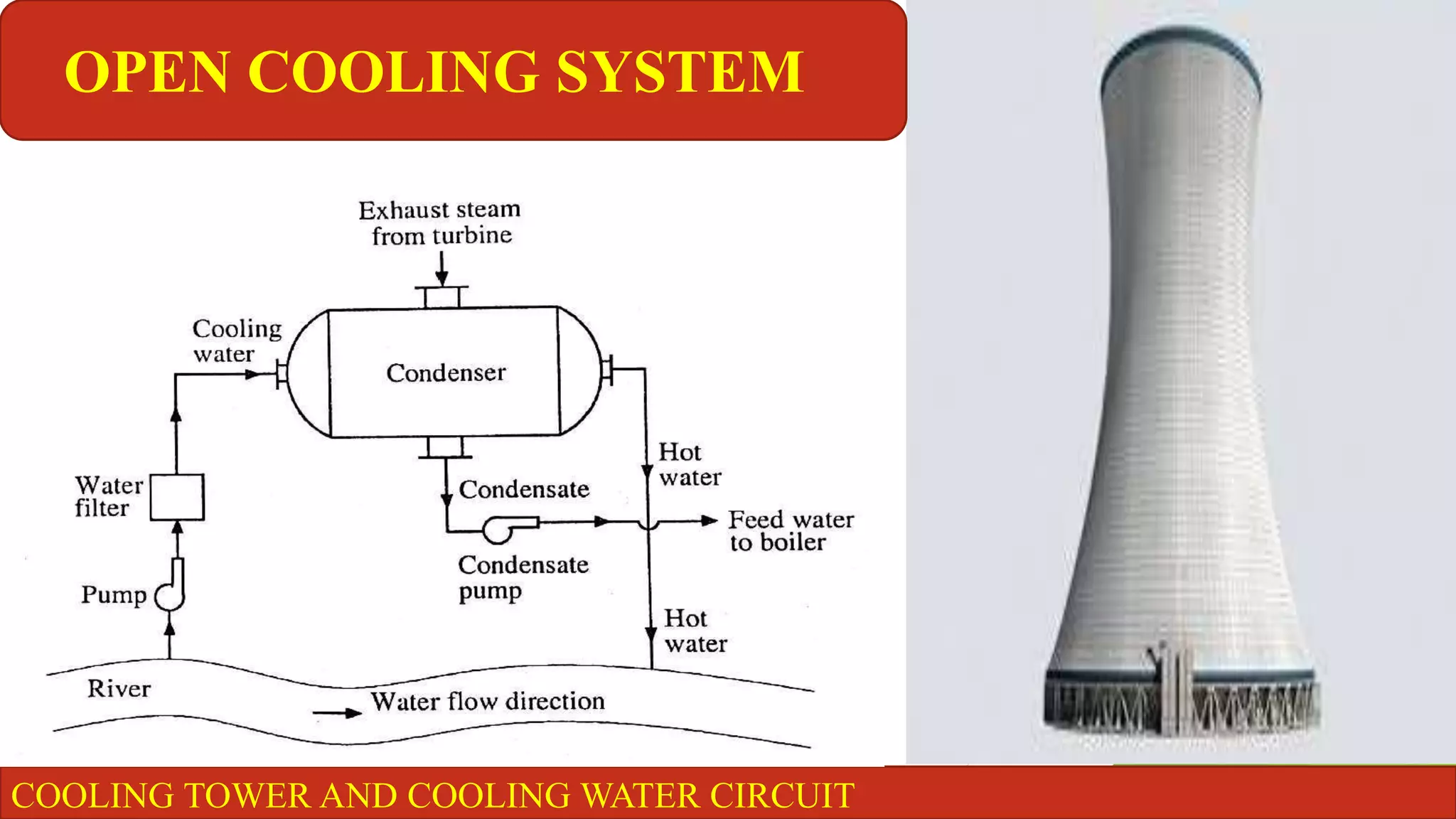
OPEN COOLING SYSTEM
COOLING TOWER AND COOLING WATER CIRCUIT
CLOSED COOLING SYSTEM
COOLING TOWER AND COOLING WATER CIRCUIT
MIXED COOLING SYSTEM
COOLING TOWER AND COOLING WATER CIRCUIT
WHY WE USE CONDENSER IN BOILER?
CAN WE FEED STEAM TO BOILER?
COOLING TOWER AND COOLING WATER CIRCUIT
WHAT IS COOLING TOWER?
The purpose of cooling tower is to cool relatively warm water by contacting
with unsaturated air. The evaporation of water mainly provides cooling.
In a typical water cooling water tower, warm water flows countercurrent to
an air stream. Typically, the warm water enters the top of packed tower and
cascades down through the packing, leaving at the bottom.
COOLING TOWER AND COOLING WATER CIRCUIT
COMPONENTS OF COOLING TOWER
Frame And Casing: Support exterior enclosures
Fill: Facilitates heat transfer by maximizing water/ air
contact
 Splash fill
 Film fill
Cold Water Basin: Receives water at bottom of tower.
Drift Eliminators: Capture droplets in air stream
Air Inlet: Entry point of air
Louvers: Equalize air flow into the fill and retain water
within tower
Nozzles: Spray water to wet the fill
Fans: Deliver air flow in the tower
COOLING TOWER AND COOLING WATER CIRCUIT
TYPES OF COOLING TOWER
Natural Draught Cooling Tower
Mechanical Cooling Tower
Forced Draught Cooling Tower
Induced Draught cooling Tower
COOLING TOWER AND COOLING WATER CIRCUIT
NATURAL DRAUGHT COOLING TOWER
COOLING TOWER AND COOLING WATER CIRCUIT
NATURAL DRAUGHT COOLING TOWER
Advantages
Its operating and maintenance costs are less since no
fans are needed.
It creates its own draft assuring efficient operation even when there is no wind.
Longer life.
Disadvantages
High capital cost
Performance varies with the seasonal changes
COOLING TOWER AND COOLING WATER CIRCUIT
FORCED DRAUGHT COOLING TOWER
COOLING TOWER AND COOLING WATER CIRCUIT
FORCED DRAUGHT COOLING TOWER
Advantages
More efficient.
Problems of blade erosion are avoided.
Fan is located at ground so more safe.
Vibration and noise are less as mechanical equipments are set on a solid foundation.
Disadvantages
Possibility of recirculation of hot humid exhaust air coming out from the top of the
tower.
Fan size is limited to 4 meters.
Possibility of ice formation on fan blades in cold weather.
COOLING TOWER AND COOLING WATER CIRCUIT
INDUCED DRAUGHT COOLING TOWER (COUNTER)
COOLING TOWER AND COOLING WATER CIRCUIT
INDUCED DRAUGHT COOLING TOWER (CROSS)
COOLING TOWER AND COOLING WATER CIRCUIT
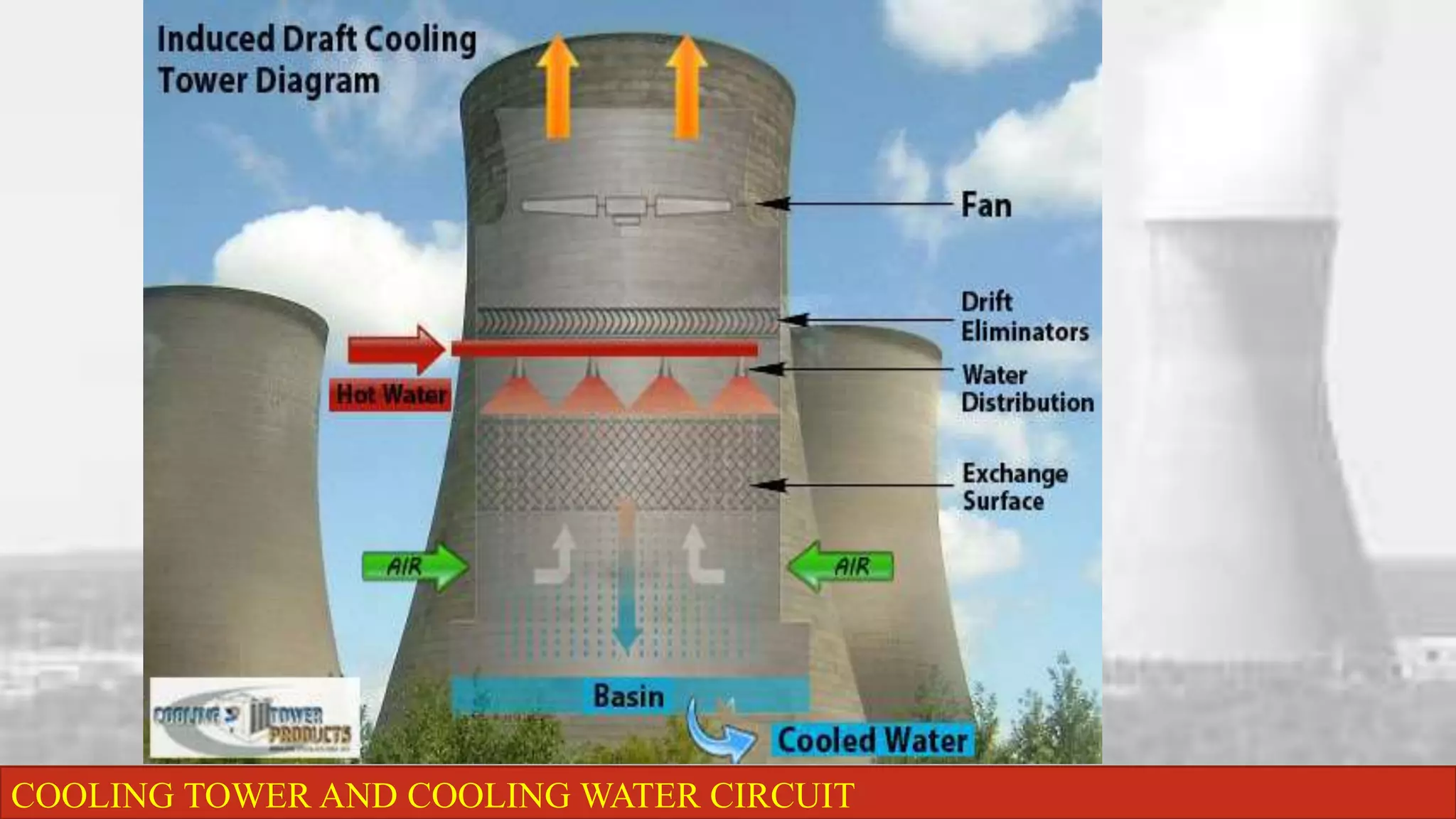
INDUCED DRAUGHT COOLING TOWER
Advantages
Coldest water comes in contact with the driest air and the warmest
water comes in contact with the most air.
The recirculation of hot humid air is not a major problem.
Larger fan size can be used.
Lower first cost due to the reduced pump capacity
Capable of cooling through a wide range
COOLING TOWER AND COOLING WATER CIRCUIT
INDUCED DRAUGHT COOLING TOWER
Disadvantages
Not economical up to the capacity of 15000 liters of water per
minute.
Higher power motor is required to drive the fan compared to forced
draught.
Maintenance cost is high.
Fan bearings need to be cooled.
COOLING TOWER AND COOLING WATER CIRCUIT
There are six basic types of liquid cooling systems:
 Liquid-to-liquid
 Closed-loop dry system
 Closed-loop dry system with trim cooling
 Open-loop evaporative system
 Closed-loop evaporative system
 Chilled water system
LIQUID COOLING SYSTEM
COOLING TOWER AND COOLING WATER CIRCUIT
LIQUID-TO-LIQUID COOLING SYSTEMS
The simplest of these systems is a liquid-to-liquid cooling system. In this type of
system your plant has an abundance of some type of cooling liquid already available
but you do not want to provide this coolant to the compressor. For example: you have
well water available but you do not want to put the well water through your new
compressor because the water quality is very poor (lots of dissolved solids like iron
and calcium etc.), and you have had trouble with the well water fouling your heat
exchanger/s in the past.
COOLING TOWER AND COOLING WATER CIRCUIT
LIQUID-TO-LIQUID COOLING SYSTEMS
COOLING TOWER AND COOLING WATER CIRCUIT
LIQUID-TO-LIQUID COOLING SYSTEMS
Liquid-to-Liquid Cooling Systems
COOLING TOWER AND COOLING WATER CIRCUIT
CLOSED-LOOP DRY COOLING SYSTEMS
A closed-loop dry cooling
system is very much like the
radiator in your car. The
system uses an air-cooled
fluid cooler to transfer the
heat from the closed-loop
coolant fluid pumped through
rows of finned tubes that have
ambient air blown/drawn
across them.
COOLING TOWER AND COOLING WATER CIRCUIT
CLOSED-LOOP DRY COOLING SYSTEMS
Closed-loop Dry Cooling Systems
COOLING TOWER AND COOLING WATER CIRCUIT
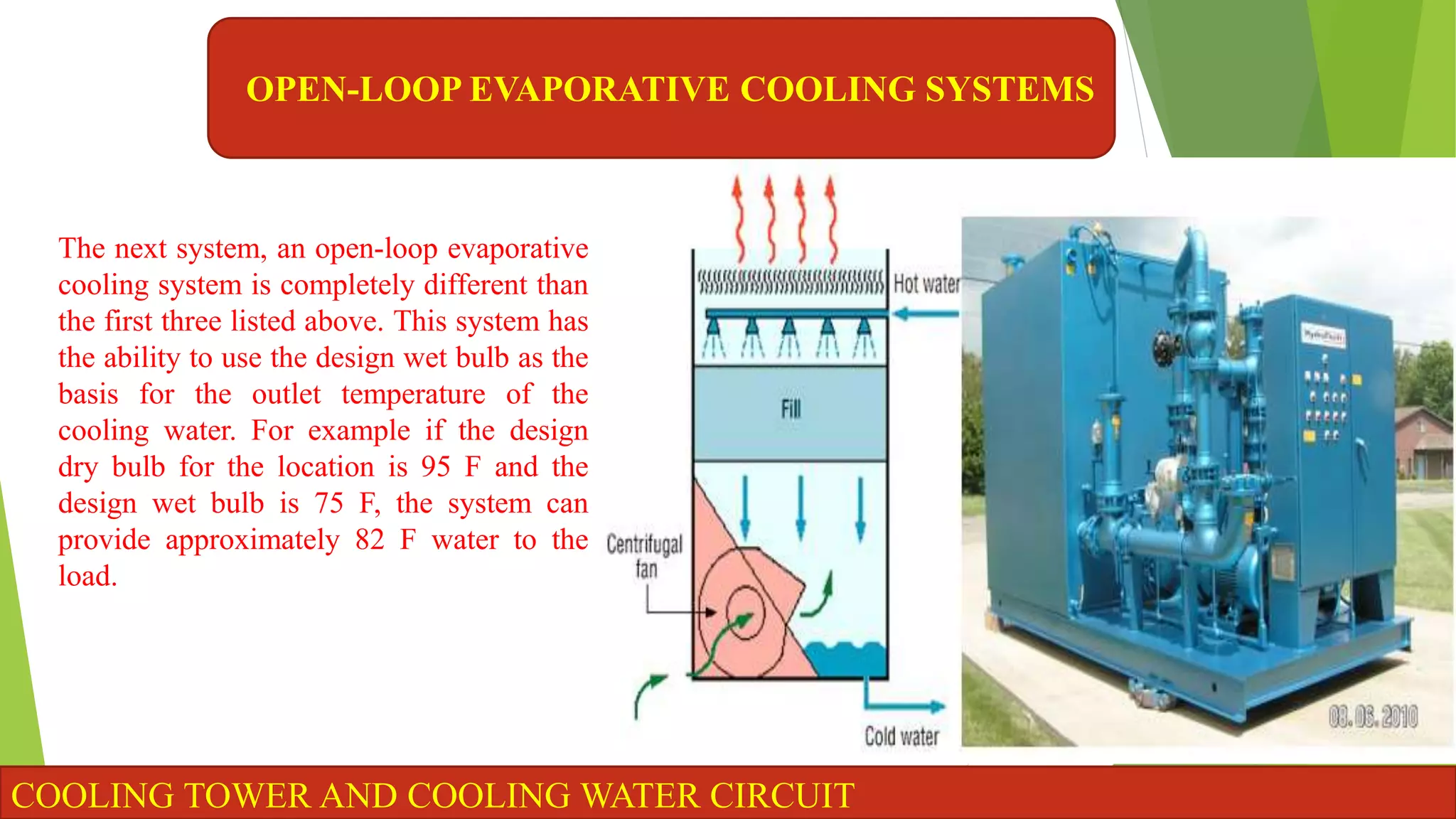
OPEN-LOOP EVAPORATIVE COOLING SYSTEMS
The next system, an open-loop evaporative
cooling system is completely different than
the first three listed above. This system has
the ability to use the design wet bulb as the
basis for the outlet temperature of the
cooling water. For example if the design
dry bulb for the location is 95 F and the
design wet bulb is 75 F, the system can
provide approximately 82 F water to the
load.
COOLING TOWER AND COOLING WATER CIRCUIT
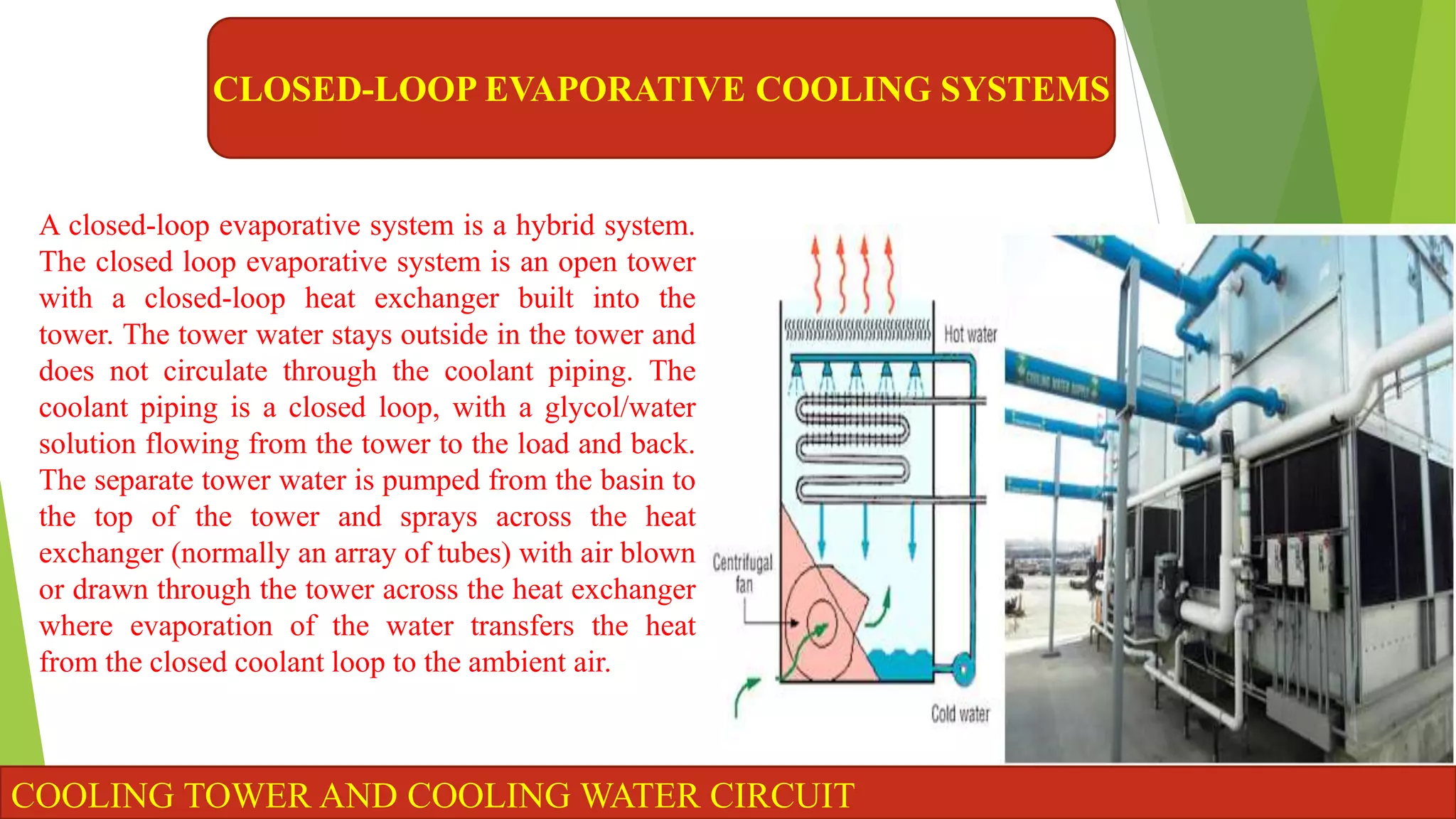
CLOSED-LOOP EVAPORATIVE COOLING SYSTEMS
A closed-loop evaporative system is a hybrid system.
The closed loop evaporative system is an open tower
with a closed-loop heat exchanger built into the
tower. The tower water stays outside in the tower and
does not circulate through the coolant piping. The
coolant piping is a closed loop, with a glycol/water
solution flowing from the tower to the load and back.
The separate tower water is pumped from the basin to
the top of the tower and sprays across the heat
exchanger (normally an array of tubes) with air blown
or drawn through the tower across the heat exchanger
where evaporation of the water transfers the heat
from the closed coolant loop to the ambient air.
COOLING TOWER AND COOLING WATER CIRCUIT
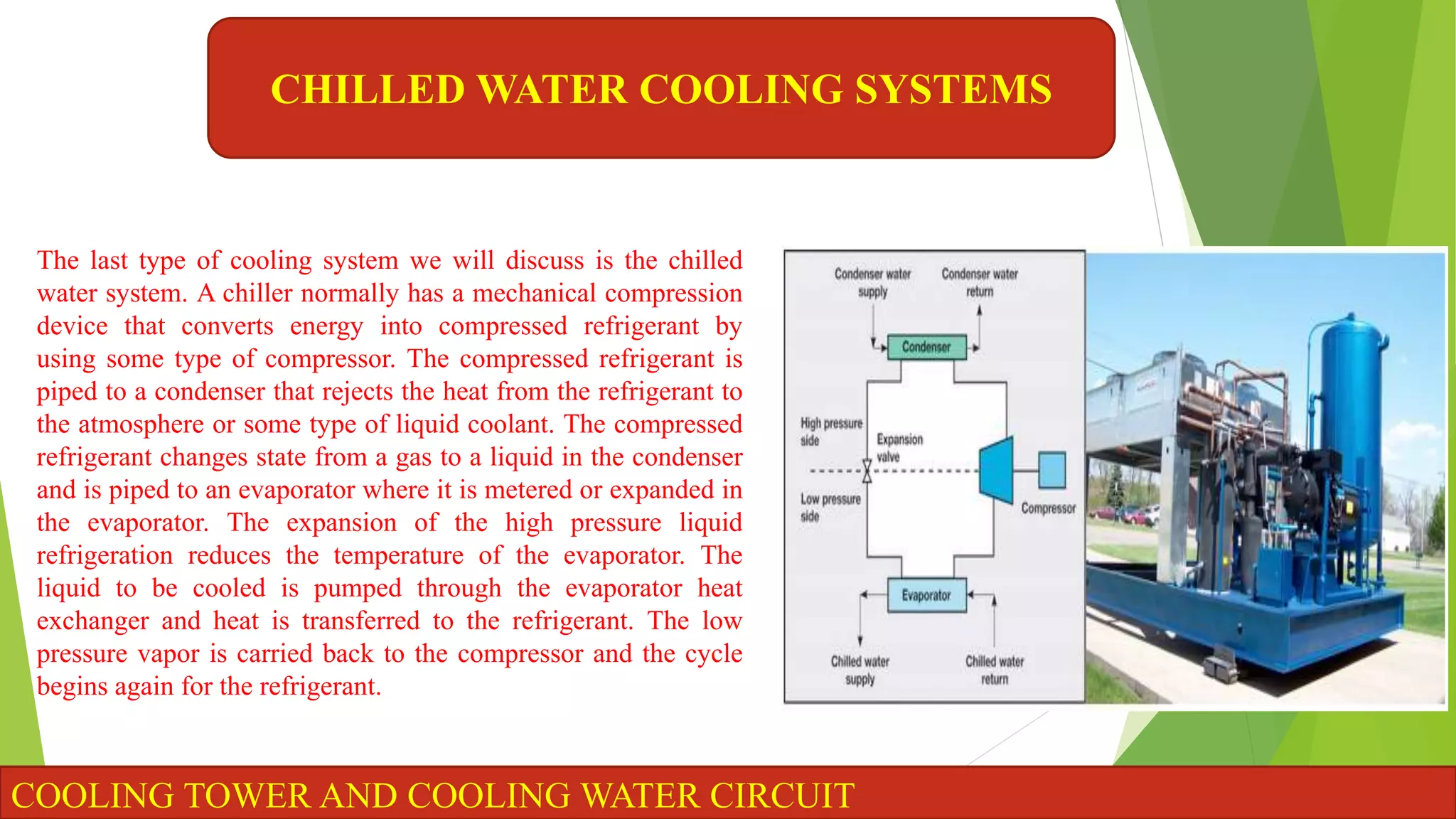
CHILLED WATER COOLING SYSTEMS
The last type of cooling system we will discuss is the chilled
water system. A chiller normally has a mechanical compression
device that converts energy into compressed refrigerant by
using some type of compressor. The compressed refrigerant is
piped to a condenser that rejects the heat from the refrigerant to
the atmosphere or some type of liquid coolant. The compressed
refrigerant changes state from a gas to a liquid in the condenser
and is piped to an evaporator where it is metered or expanded in
the evaporator. The expansion of the high pressure liquid
refrigeration reduces the temperature of the evaporator. The
liquid to be cooled is pumped through the evaporator heat
exchanger and heat is transferred to the refrigerant. The low
pressure vapor is carried back to the compressor and the cycle
begins again for the refrigerant.
COOLING TOWER AND COOLING WATER CIRCUIT PREPARED BY – SHAKIL HOSSAIN
THANK YOU

Cooling Tower and Cooling Water Circuit

  • 1.
    A PRESENTATION ON POWERPLANT ENGINEERING TITLE OF PRESENTATION COOLING TOWER AND COOLING WATER CIRCUIT PRESENTED BY SHAKIL HOSSAIN (ROLL – 15001680 B. TECH. (ME), 8TH SEMESTER) COOLING TOWER AND COOLING WATER CIRCUIT
  • 2.
    COOLING TOWER ANDCOOLING WATER CIRCUIT PLAN OF PRESENTATION Types of cooling system Open cooling system Closed cooling system Mixed cooling system Reason behind use of condenser in boiler What is cooling tower? Components of cooling tower Types of cooling tower Natural draught cooling tower Forced draught cooling tower Induced draught cooling tower Liquid cooling system Liquid to liquid cooling system Closed loop dry cooling system Open-loop evaporative cooling systems Closed-loop evaporative cooling systems Chilled water cooling systems
  • 3.
    COOLING TOWER ANDCOOLING WATER CIRCUIT TYPES OF COOLING SYSTEM Open Cooling System Closed Cooling System Mixed Cooling System
  • 4.
    COOLING TOWER ANDCOOLING WATER CIRCUIT OPEN COOLING SYSTEM
  • 5.
    COOLING TOWER ANDCOOLING WATER CIRCUIT CLOSED COOLING SYSTEM
  • 6.
    COOLING TOWER ANDCOOLING WATER CIRCUIT MIXED COOLING SYSTEM
  • 7.
    COOLING TOWER ANDCOOLING WATER CIRCUIT WHY WE USE CONDENSER IN BOILER? CAN WE FEED STEAM TO BOILER?
  • 8.
    COOLING TOWER ANDCOOLING WATER CIRCUIT WHAT IS COOLING TOWER? The purpose of cooling tower is to cool relatively warm water by contacting with unsaturated air. The evaporation of water mainly provides cooling. In a typical water cooling water tower, warm water flows countercurrent to an air stream. Typically, the warm water enters the top of packed tower and cascades down through the packing, leaving at the bottom.
  • 9.
    COOLING TOWER ANDCOOLING WATER CIRCUIT COMPONENTS OF COOLING TOWER Frame And Casing: Support exterior enclosures Fill: Facilitates heat transfer by maximizing water/ air contact  Splash fill  Film fill Cold Water Basin: Receives water at bottom of tower. Drift Eliminators: Capture droplets in air stream Air Inlet: Entry point of air Louvers: Equalize air flow into the fill and retain water within tower Nozzles: Spray water to wet the fill Fans: Deliver air flow in the tower
  • 10.
    COOLING TOWER ANDCOOLING WATER CIRCUIT TYPES OF COOLING TOWER Natural Draught Cooling Tower Mechanical Cooling Tower Forced Draught Cooling Tower Induced Draught cooling Tower
  • 11.
    COOLING TOWER ANDCOOLING WATER CIRCUIT NATURAL DRAUGHT COOLING TOWER
  • 12.
    COOLING TOWER ANDCOOLING WATER CIRCUIT
  • 13.
    COOLING TOWER ANDCOOLING WATER CIRCUIT NATURAL DRAUGHT COOLING TOWER Advantages Its operating and maintenance costs are less since no fans are needed. It creates its own draft assuring efficient operation even when there is no wind. Longer life. Disadvantages High capital cost Performance varies with the seasonal changes
  • 14.
    COOLING TOWER ANDCOOLING WATER CIRCUIT FORCED DRAUGHT COOLING TOWER
  • 15.
    COOLING TOWER ANDCOOLING WATER CIRCUIT
  • 16.
    COOLING TOWER ANDCOOLING WATER CIRCUIT FORCED DRAUGHT COOLING TOWER Advantages More efficient. Problems of blade erosion are avoided. Fan is located at ground so more safe. Vibration and noise are less as mechanical equipments are set on a solid foundation. Disadvantages Possibility of recirculation of hot humid exhaust air coming out from the top of the tower. Fan size is limited to 4 meters. Possibility of ice formation on fan blades in cold weather.
  • 17.
    COOLING TOWER ANDCOOLING WATER CIRCUIT INDUCED DRAUGHT COOLING TOWER (COUNTER)
  • 18.
    COOLING TOWER ANDCOOLING WATER CIRCUIT
  • 19.
    COOLING TOWER ANDCOOLING WATER CIRCUIT INDUCED DRAUGHT COOLING TOWER (CROSS)
  • 20.
    COOLING TOWER ANDCOOLING WATER CIRCUIT INDUCED DRAUGHT COOLING TOWER Advantages Coldest water comes in contact with the driest air and the warmest water comes in contact with the most air. The recirculation of hot humid air is not a major problem. Larger fan size can be used. Lower first cost due to the reduced pump capacity Capable of cooling through a wide range
  • 21.
    COOLING TOWER ANDCOOLING WATER CIRCUIT INDUCED DRAUGHT COOLING TOWER Disadvantages Not economical up to the capacity of 15000 liters of water per minute. Higher power motor is required to drive the fan compared to forced draught. Maintenance cost is high. Fan bearings need to be cooled.
  • 22.
    COOLING TOWER ANDCOOLING WATER CIRCUIT There are six basic types of liquid cooling systems:  Liquid-to-liquid  Closed-loop dry system  Closed-loop dry system with trim cooling  Open-loop evaporative system  Closed-loop evaporative system  Chilled water system LIQUID COOLING SYSTEM
  • 23.
    COOLING TOWER ANDCOOLING WATER CIRCUIT LIQUID-TO-LIQUID COOLING SYSTEMS The simplest of these systems is a liquid-to-liquid cooling system. In this type of system your plant has an abundance of some type of cooling liquid already available but you do not want to provide this coolant to the compressor. For example: you have well water available but you do not want to put the well water through your new compressor because the water quality is very poor (lots of dissolved solids like iron and calcium etc.), and you have had trouble with the well water fouling your heat exchanger/s in the past.
  • 24.
    COOLING TOWER ANDCOOLING WATER CIRCUIT LIQUID-TO-LIQUID COOLING SYSTEMS
  • 25.
    COOLING TOWER ANDCOOLING WATER CIRCUIT LIQUID-TO-LIQUID COOLING SYSTEMS Liquid-to-Liquid Cooling Systems
  • 26.
    COOLING TOWER ANDCOOLING WATER CIRCUIT CLOSED-LOOP DRY COOLING SYSTEMS A closed-loop dry cooling system is very much like the radiator in your car. The system uses an air-cooled fluid cooler to transfer the heat from the closed-loop coolant fluid pumped through rows of finned tubes that have ambient air blown/drawn across them.
  • 27.
    COOLING TOWER ANDCOOLING WATER CIRCUIT CLOSED-LOOP DRY COOLING SYSTEMS Closed-loop Dry Cooling Systems
  • 28.
    COOLING TOWER ANDCOOLING WATER CIRCUIT OPEN-LOOP EVAPORATIVE COOLING SYSTEMS The next system, an open-loop evaporative cooling system is completely different than the first three listed above. This system has the ability to use the design wet bulb as the basis for the outlet temperature of the cooling water. For example if the design dry bulb for the location is 95 F and the design wet bulb is 75 F, the system can provide approximately 82 F water to the load.
  • 29.
    COOLING TOWER ANDCOOLING WATER CIRCUIT CLOSED-LOOP EVAPORATIVE COOLING SYSTEMS A closed-loop evaporative system is a hybrid system. The closed loop evaporative system is an open tower with a closed-loop heat exchanger built into the tower. The tower water stays outside in the tower and does not circulate through the coolant piping. The coolant piping is a closed loop, with a glycol/water solution flowing from the tower to the load and back. The separate tower water is pumped from the basin to the top of the tower and sprays across the heat exchanger (normally an array of tubes) with air blown or drawn through the tower across the heat exchanger where evaporation of the water transfers the heat from the closed coolant loop to the ambient air.
  • 30.
    COOLING TOWER ANDCOOLING WATER CIRCUIT CHILLED WATER COOLING SYSTEMS The last type of cooling system we will discuss is the chilled water system. A chiller normally has a mechanical compression device that converts energy into compressed refrigerant by using some type of compressor. The compressed refrigerant is piped to a condenser that rejects the heat from the refrigerant to the atmosphere or some type of liquid coolant. The compressed refrigerant changes state from a gas to a liquid in the condenser and is piped to an evaporator where it is metered or expanded in the evaporator. The expansion of the high pressure liquid refrigeration reduces the temperature of the evaporator. The liquid to be cooled is pumped through the evaporator heat exchanger and heat is transferred to the refrigerant. The low pressure vapor is carried back to the compressor and the cycle begins again for the refrigerant.
  • 31.
    COOLING TOWER ANDCOOLING WATER CIRCUIT PREPARED BY – SHAKIL HOSSAIN THANK YOU