









A
Presentation
On
COOLING TOWERS
Submitted To:
Mr.Rajesh kumar
(Assistant Pro. Mechanical Engineering
Department)
Submitted By:
Ajeet kumar saini
ME 4TH Year
1Copyright Ajeet kumar saini10/2/2018
Contents
 Need of Cooling
 Principal of cooling
 Introduction
 Part of cooling tower
 Working of cooling tower
 Type of cooling tower
 Assessment of cooling Towers
 Losses in cooling tower
 Method to improve efficiency of cooling tower
2Copyright Ajeet kumar saini10/2/2018
Cooling towers
Cooling Tower
10/2/2018 Copyright Ajeet kumar saini 4
Components of cooling tower
 Frame and casing: support exterior enclosures
 Fill: facilitates heat transfer by maximizing water/ air
contact
 Splash fill
 Film fill
 Cold water basin: receives water at bottom of tower.
5Copyright Ajeet kumar saini10/2/2018
 Drift eliminators: capture droplets in air stream
 Air inlet: entry point of air
 Louvers: equalize air flow into the fill and retain water
within tower
 Nozzles: spray water to wet the fill
 Fans: deliver air flow in the tower
6Copyright Ajeet kumar saini10/2/2018
Types of Cooling Tower
Copyright Ajeet kumar saini 710/2/2018
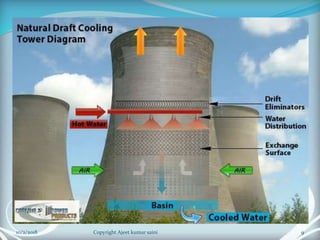
Natural Draft Cooling Towers
 Hot air moves through tower
 Fresh cool air is drawn into the tower from bottom
 No fan required
 Concrete tower<200m
 Used for large heat duties
8Copyright Ajeet kumar saini10/2/2018
9Copyright Ajeet kumar saini10/2/2018
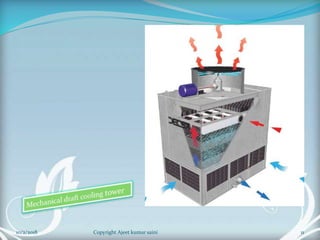
Mechanical Draft Cooling Towers
Large fan to force air through circulated water
Water falls over fill surfaces: maximum heat transfer
Cooling rate depends on many parameters
Large range of capacities
Can be grouped, e.g. 8-cell tower
10Copyright Ajeet kumar saini10/2/2018
11Copyright Ajeet kumar saini10/2/2018
Mechanical Draft Cooling Towers
 Three types:
 Forced draft
 Induced draft cross flow
 Induced draft counter flow
12Copyright Ajeet kumar saini10/2/2018
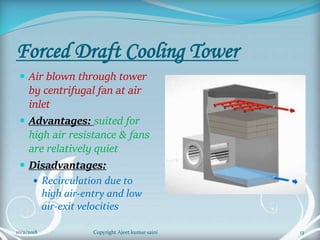
Forced Draft Cooling Tower
 Air blown through tower
by centrifugal fan at air
inlet
 Advantages: suited for
high air resistance & fans
are relatively quiet
 Disadvantages:
 Recirculation due to
high air-entry and low
air-exit velocities
13Copyright Ajeet kumar saini10/2/2018
Induced Draft Cooling Towers
 Two types:
 Cross flow
 Counter flow
 Advantages: less circulation than forced draft towers
 Disadvantage: fans and motor drive mechanism require
weather- proofinh
14Copyright Ajeet kumar saini10/2/2018
Induced Drat Counter Flow CT
 Hot water enters at the top
 Air enters at bottom and exits at top
 Uses force and induced draft fans
15Copyright Ajeet kumar saini10/2/2018
Induced Drat Cross Flow CT
 Water enters top and passes over fill
 Air enters on one side or opposite sides
 Induced draft fan draw air across fill
16Copyright Ajeet kumar saini10/2/2018
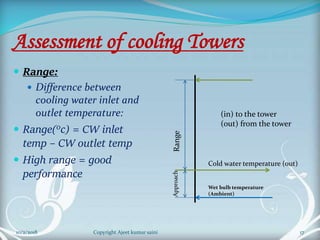
Assessment of cooling Towers
 Range:
 Difference between
cooling water inlet and
outlet temperature:
 Range(0c) = CW inlet
temp – CW outlet temp
 High range = good
performance
(in) to the tower
(out) from the tower
Cold water temperature (out)
Wet bulb temperature
(Ambient)
ApproachRange
17Copyright Ajeet kumar saini10/2/2018
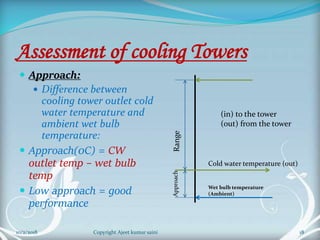
Assessment of cooling Towers
 Approach:
 Difference between
cooling tower outlet cold
water temperature and
ambient wet bulb
temperature:
 Approach(0C) = CW
outlet temp – wet bulb
temp
 Low approach = good
performance
(in) to the tower
(out) from the tower
Cold water temperature (out)
Wet bulb temperature
(Ambient)
ApproachRange
18Copyright Ajeet kumar saini10/2/2018
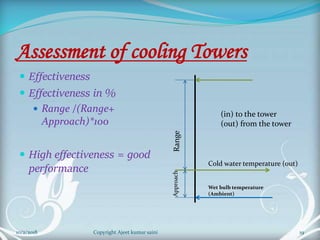
Assessment of cooling Towers
 Effectiveness
 Effectiveness in %
 Range /(Range+
Approach)*100
 High effectiveness = good
performance
(in) to the tower
(out) from the tower
Cold water temperature (out)
Wet bulb temperature
(Ambient)
ApproachRange
19Copyright Ajeet kumar saini10/2/2018
Calculation Of Efficiency of Cooling
Tower
 Data uses here was taken from AIS Glass
Company at Roorkee
 Let Hot water temperature is denoted as Ti
 Let Cold water temperature is denoted as To
& wet bulb temperature is denoted as Tw
20Copyright Ajeet kumar saini10/2/2018
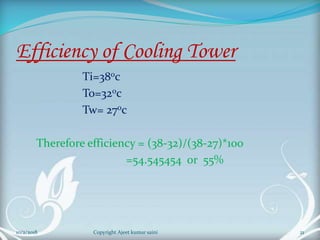
Efficiency of Cooling Tower
Ti=380c
To=320c
Tw= 270c
Therefore efficiency = (38-32)/(38-27)*100
=54.545454 or 55%
21Copyright Ajeet kumar saini10/2/2018
Factors that affect the performance of
cooling tower
 Blowdown Losses:
 Evaporation Loss.
 Drift loss:
22Copyright Ajeet kumar saini10/2/2018
23Copyright Ajeet kumar saini10/2/2018

Cooling tower

  • 1.
    A Presentation On COOLING TOWERS Submitted To: Mr.Rajeshkumar (Assistant Pro. Mechanical Engineering Department) Submitted By: Ajeet kumar saini ME 4TH Year 1Copyright Ajeet kumar saini10/2/2018
  • 2.
    Contents  Need ofCooling  Principal of cooling  Introduction  Part of cooling tower  Working of cooling tower  Type of cooling tower  Assessment of cooling Towers  Losses in cooling tower  Method to improve efficiency of cooling tower 2Copyright Ajeet kumar saini10/2/2018
  • 3.
  • 4.
  • 5.
    Components of coolingtower  Frame and casing: support exterior enclosures  Fill: facilitates heat transfer by maximizing water/ air contact  Splash fill  Film fill  Cold water basin: receives water at bottom of tower. 5Copyright Ajeet kumar saini10/2/2018
  • 6.
     Drift eliminators:capture droplets in air stream  Air inlet: entry point of air  Louvers: equalize air flow into the fill and retain water within tower  Nozzles: spray water to wet the fill  Fans: deliver air flow in the tower 6Copyright Ajeet kumar saini10/2/2018
  • 7.
    Types of CoolingTower Copyright Ajeet kumar saini 710/2/2018
  • 8.
    Natural Draft CoolingTowers  Hot air moves through tower  Fresh cool air is drawn into the tower from bottom  No fan required  Concrete tower<200m  Used for large heat duties 8Copyright Ajeet kumar saini10/2/2018
  • 9.
    9Copyright Ajeet kumarsaini10/2/2018
  • 10.
    Mechanical Draft CoolingTowers Large fan to force air through circulated water Water falls over fill surfaces: maximum heat transfer Cooling rate depends on many parameters Large range of capacities Can be grouped, e.g. 8-cell tower 10Copyright Ajeet kumar saini10/2/2018
  • 11.
  • 12.
    Mechanical Draft CoolingTowers  Three types:  Forced draft  Induced draft cross flow  Induced draft counter flow 12Copyright Ajeet kumar saini10/2/2018
  • 13.
    Forced Draft CoolingTower  Air blown through tower by centrifugal fan at air inlet  Advantages: suited for high air resistance & fans are relatively quiet  Disadvantages:  Recirculation due to high air-entry and low air-exit velocities 13Copyright Ajeet kumar saini10/2/2018
  • 14.
    Induced Draft CoolingTowers  Two types:  Cross flow  Counter flow  Advantages: less circulation than forced draft towers  Disadvantage: fans and motor drive mechanism require weather- proofinh 14Copyright Ajeet kumar saini10/2/2018
  • 15.
    Induced Drat CounterFlow CT  Hot water enters at the top  Air enters at bottom and exits at top  Uses force and induced draft fans 15Copyright Ajeet kumar saini10/2/2018
  • 16.
    Induced Drat CrossFlow CT  Water enters top and passes over fill  Air enters on one side or opposite sides  Induced draft fan draw air across fill 16Copyright Ajeet kumar saini10/2/2018
  • 17.
    Assessment of coolingTowers  Range:  Difference between cooling water inlet and outlet temperature:  Range(0c) = CW inlet temp – CW outlet temp  High range = good performance (in) to the tower (out) from the tower Cold water temperature (out) Wet bulb temperature (Ambient) ApproachRange 17Copyright Ajeet kumar saini10/2/2018
  • 18.
    Assessment of coolingTowers  Approach:  Difference between cooling tower outlet cold water temperature and ambient wet bulb temperature:  Approach(0C) = CW outlet temp – wet bulb temp  Low approach = good performance (in) to the tower (out) from the tower Cold water temperature (out) Wet bulb temperature (Ambient) ApproachRange 18Copyright Ajeet kumar saini10/2/2018
  • 19.
    Assessment of coolingTowers  Effectiveness  Effectiveness in %  Range /(Range+ Approach)*100  High effectiveness = good performance (in) to the tower (out) from the tower Cold water temperature (out) Wet bulb temperature (Ambient) ApproachRange 19Copyright Ajeet kumar saini10/2/2018
  • 20.
    Calculation Of Efficiencyof Cooling Tower  Data uses here was taken from AIS Glass Company at Roorkee  Let Hot water temperature is denoted as Ti  Let Cold water temperature is denoted as To & wet bulb temperature is denoted as Tw 20Copyright Ajeet kumar saini10/2/2018
  • 21.
    Efficiency of CoolingTower Ti=380c To=320c Tw= 270c Therefore efficiency = (38-32)/(38-27)*100 =54.545454 or 55% 21Copyright Ajeet kumar saini10/2/2018
  • 22.
    Factors that affectthe performance of cooling tower  Blowdown Losses:  Evaporation Loss.  Drift loss: 22Copyright Ajeet kumar saini10/2/2018
  • 23.