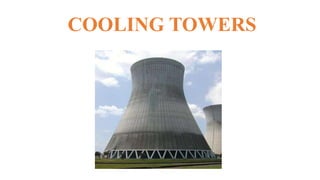
COOLING TOWERS
• A cooling tower is a heat rejection device that rejects waste heat to the
atmosphere through the cooling of a water stream to a lower
temperature.
• Applications include
a. HVAC systems
b. Thermal power plants
c. Oil refineries
d. Chemical plants
e. Electric power generation
INTRODUCTION
CLASSIFICATIONS
• Based on Heat Transfer method
• Base on Air flow generation
• Based on Air to Water flow
HEAT TRANSFER METHOD
Based on heat transfer mechanism
cooling towers are classified as
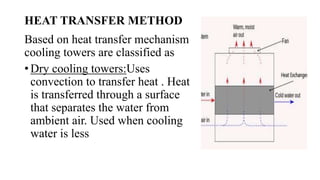
• Dry cooling towers:Uses
convection to transfer heat . Heat
is transferred through a surface
that separates the water from
ambient air. Used when cooling
water is less
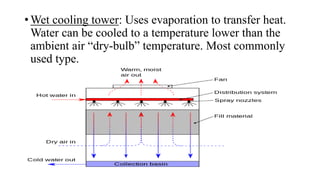
• Wet cooling tower: Uses evaporation to transfer heat.
Water can be cooled to a temperature lower than the
ambient air “dry-bulb” temperature. Most commonly
used type.
AIR FLOW GENERATION
NATURAL DRAFT
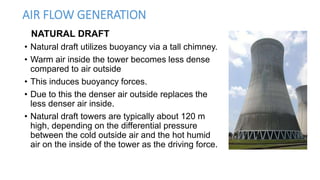
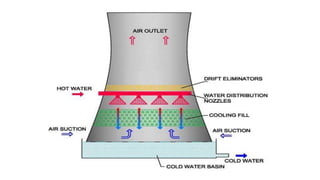
• Natural draft utilizes buoyancy via a tall chimney.
• Warm air inside the tower becomes less dense
compared to air outside
• This induces buoyancy forces.
• Due to this the denser air outside replaces the
less denser air inside.
• Natural draft towers are typically about 120 m
high, depending on the differential pressure
between the cold outside air and the hot humid
air on the inside of the tower as the driving force.
Mechanical draft tower
Uses power driven fans to draw air through the
tower.
They are of 2 types
1. Induced Draft : A mechanical draft tower with a
fan at the discharge (at the top) which pulls air up
through the tower.
2. Forced Draft : A mechanical draft tower with a
blower type fan at the intake. The fan forces air
into the tower
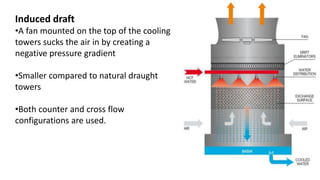
Induced draft
•A fan mounted on the top of the cooling
towers sucks the air in by creating a
negative pressure gradient
•Smaller compared to natural draught
towers
•Both counter and cross flow
configurations are used.
Forced draft
•Uses a blower fan to force air into the
tower
•Requires lesser power compared to
induced , bcoz cool air is being pumped
Air to Water Flow
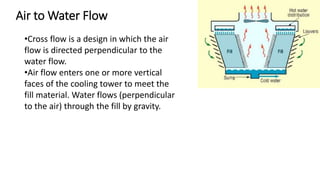
•Cross flow is a design in which the air
flow is directed perpendicular to the
water flow.
•Air flow enters one or more vertical
faces of the cooling tower to meet the
fill material. Water flows (perpendicular
to the air) through the fill by gravity.
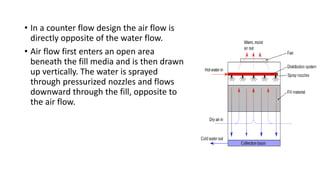
• In a counter flow design the air flow is
directly opposite of the water flow.
• Air flow first enters an open area
beneath the fill media and is then drawn
up vertically. The water is sprayed
through pressurized nozzles and flows
downward through the fill, opposite to
the air flow.
Performance parameters
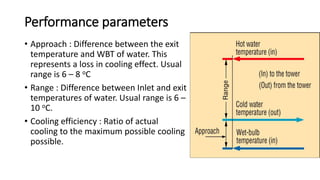
• Approach : Difference between the exit
temperature and WBT of water. This
represents a loss in cooling effect. Usual
range is 6 – 8 oC
• Range : Difference between Inlet and exit
temperatures of water. Usual range is 6 –
10 oC.
• Cooling efficiency : Ratio of actual
cooling to the maximum possible cooling
possible.
Water Losses
• Evaporation : water that evaporates and leaves along with air. Usually
around 1 -1.5% of water.
• Drift : Fine water droplets entrained and carried away by air. Drift
eliminators are installed to eliminate that.
• Blow down : To maintain a certain solid concentration, some amount
of water is removed from cold water basin. Around 1- 1.5 % of the
amount.
• Makeup water is supplied to makeup for these losses.
Parts of Cooling tower
• Frame : Most towers have structural frames that support the exterior
enclosures (casings), motors, fans, and other components.
• Fill : Most towers employ fills (made of plastic or wood) to facilitate
heat transfer by maximizing water and air contact.
• Drift eliminators: They capture water droplets entrapped in the air
stream by causing an abrupt change in flow direction of outlet air.

Cooling Towers - Classifications and Working

  • 1.
  • 2.
    • A coolingtower is a heat rejection device that rejects waste heat to the atmosphere through the cooling of a water stream to a lower temperature. • Applications include a. HVAC systems b. Thermal power plants c. Oil refineries d. Chemical plants e. Electric power generation INTRODUCTION
  • 3.
    CLASSIFICATIONS • Based onHeat Transfer method • Base on Air flow generation • Based on Air to Water flow
  • 4.
    HEAT TRANSFER METHOD Basedon heat transfer mechanism cooling towers are classified as • Dry cooling towers:Uses convection to transfer heat . Heat is transferred through a surface that separates the water from ambient air. Used when cooling water is less
  • 5.
    • Wet coolingtower: Uses evaporation to transfer heat. Water can be cooled to a temperature lower than the ambient air “dry-bulb” temperature. Most commonly used type.
  • 6.
    AIR FLOW GENERATION NATURALDRAFT • Natural draft utilizes buoyancy via a tall chimney. • Warm air inside the tower becomes less dense compared to air outside • This induces buoyancy forces. • Due to this the denser air outside replaces the less denser air inside. • Natural draft towers are typically about 120 m high, depending on the differential pressure between the cold outside air and the hot humid air on the inside of the tower as the driving force.
  • 8.
    Mechanical draft tower Usespower driven fans to draw air through the tower. They are of 2 types 1. Induced Draft : A mechanical draft tower with a fan at the discharge (at the top) which pulls air up through the tower. 2. Forced Draft : A mechanical draft tower with a blower type fan at the intake. The fan forces air into the tower
  • 9.
    Induced draft •A fanmounted on the top of the cooling towers sucks the air in by creating a negative pressure gradient •Smaller compared to natural draught towers •Both counter and cross flow configurations are used.
  • 10.
    Forced draft •Uses ablower fan to force air into the tower •Requires lesser power compared to induced , bcoz cool air is being pumped
  • 11.
    Air to WaterFlow •Cross flow is a design in which the air flow is directed perpendicular to the water flow. •Air flow enters one or more vertical faces of the cooling tower to meet the fill material. Water flows (perpendicular to the air) through the fill by gravity.
  • 12.
    • In acounter flow design the air flow is directly opposite of the water flow. • Air flow first enters an open area beneath the fill media and is then drawn up vertically. The water is sprayed through pressurized nozzles and flows downward through the fill, opposite to the air flow.
  • 13.
    Performance parameters • Approach: Difference between the exit temperature and WBT of water. This represents a loss in cooling effect. Usual range is 6 – 8 oC • Range : Difference between Inlet and exit temperatures of water. Usual range is 6 – 10 oC. • Cooling efficiency : Ratio of actual cooling to the maximum possible cooling possible.
  • 14.
    Water Losses • Evaporation: water that evaporates and leaves along with air. Usually around 1 -1.5% of water. • Drift : Fine water droplets entrained and carried away by air. Drift eliminators are installed to eliminate that. • Blow down : To maintain a certain solid concentration, some amount of water is removed from cold water basin. Around 1- 1.5 % of the amount. • Makeup water is supplied to makeup for these losses.
  • 15.
    Parts of Coolingtower • Frame : Most towers have structural frames that support the exterior enclosures (casings), motors, fans, and other components. • Fill : Most towers employ fills (made of plastic or wood) to facilitate heat transfer by maximizing water and air contact. • Drift eliminators: They capture water droplets entrapped in the air stream by causing an abrupt change in flow direction of outlet air.