
EAB 2603
POWER SYSTEM
COOLING FAN SYSTEM
NAME MATRIC NO.
MUHAMMAD ARIFF BIN ISA S16945
MOHD FAIZOL HAFFIZ BIN ABD RAZAK S17061
NORHIDAYAH BINTI MALAHUBBAN S17730
NUR SURAYA FITRI BINTI PIRDAUS S17921
MACLESTER ANAK ENTALAI S18167
Diploma in Agricultural Engineering Semester 4
2nd Semester Session 2013/2014
Lecturer: MR. LING JEN UNG
INTRODUCTION
• Recently a hydraulically driven engine cooling fan is
becoming a mainstream technology as one of the
means to bring down the level of noises generated by
construction equipment
• However, the currently available system is no better
than a small combination of various general purpose-
devices such as a hydraulic pump and motor and
valves
Function of cooling fan
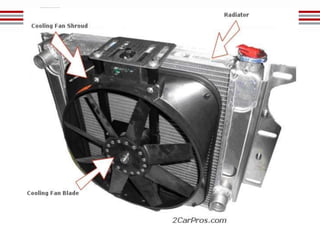
• The cooling fan circulates air through the radiator
so it can release engine heat into the surrounding
air.
• With the introduction of fan clutches and electric
cooling fans, fans have become more efficient by
operating only when they need to.
• Electric cooling fans also improve the operation of
the air conditioning system.
Types of Fan
1. Mechanical fan
• Mechanical fan is also called belt drive
• Mechanical fans are still used on some cars and light
trucks
• These fans now use a temperature-sensitive fan
clutch that allows the fan to disengage and engage
according to different operating conditions
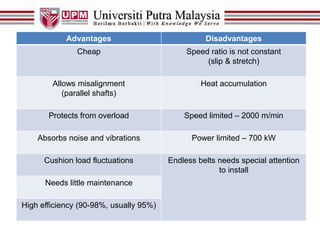
Advantages Disadvantages
Cheap Speed ratio is not constant
(slip & stretch)
Allows misalignment
(parallel shafts)
Heat accumulation
Protects from overload Speed limited – 2000 m/min
Absorbs noise and vibrations Power limited – 700 kW
Cushion load fluctuations Endless belts needs special attention
to install
Needs little maintenance
High efficiency (90-98%, usually 95%)
2. Electrical fan
• Electrical fans are powered by
vehicle’s electrical system
• More efficient alternative to
mechanical fans
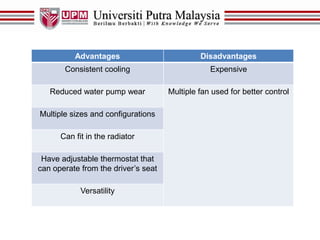
Advantages Disadvantages
Consistent cooling Expensive
Reduced water pump wear Multiple fan used for better control
Multiple sizes and configurations
Can fit in the radiator
Have adjustable thermostat that
can operate from the driver’s seat
Versatility
FACTORS CONSIDERATION
FOR FAN SELECTION
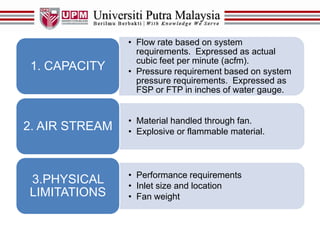
• Flow rate based on system
requirements. Expressed as actual
cubic feet per minute (acfm).
• Pressure requirement based on system
pressure requirements. Expressed as
FSP or FTP in inches of water gauge.
1. CAPACITY
• Material handled through fan.
• Explosive or flammable material.2. AIR STREAM
• Performance requirements
• Inlet size and location
• Fan weight
3.PHYSICAL
LIMITATIONS
• Generated by turbulence within he fan housing.
• “White” noise which is a mixture of all
frequencies is mostly produced.
• Radial blade fans produce a pure tone at a
frequency BPF
• BPF = rpm * n * CF.
4.NOISE
• Safety guards are required at inlet, outlet,
shaft, drive and cleanout doors.
• Accessories help in future maintenance
requirements.
• Flow control can be done using dampers.
5.
SAFETY
AND
ACCESSO
RIES
How Cooling Fan Work?
• A thermal clutch fan operates using silicon fluid
as a viscous coupling medium.
• When the clutch is cool and disengaged, most of
the silicon fluid is stored in the reservoir allowing
your fan clutch to slip relative to your water
pump shaft thereby spinning at a lower RPM
than the water pump.
Continue…
• This saves your money because the horsepower from
your engine is not wasted driving a clutch fan when it's
not needed.
• As your engine heats up, the thermal spring on the front
of the clutch expands, which opens a valve allowing the
silicon fluid to drive your clutch at an increased RPM.
• This provides more air flow through your radiator,
preventing your car from overheating.
INNOVATION FOR COOLING
FAN SYSTEM
 Structure of in-fan mounted motor
 Built in control valve
 High working efficiency
 Wide variation in combination of pump and
motor components
 Reversing fan rotating
CONCLUSION
• A hydraulically driven engine cooling fan system is
becoming more essential for lowering noises
generated by construction equipment
• It seems the fan system will remain as effective as
ever in the future since people will further intensify
attention to the issue of protecting the global
environment

Cooling fan system (presentation)

  • 1.
    EAB 2603 POWER SYSTEM COOLINGFAN SYSTEM NAME MATRIC NO. MUHAMMAD ARIFF BIN ISA S16945 MOHD FAIZOL HAFFIZ BIN ABD RAZAK S17061 NORHIDAYAH BINTI MALAHUBBAN S17730 NUR SURAYA FITRI BINTI PIRDAUS S17921 MACLESTER ANAK ENTALAI S18167 Diploma in Agricultural Engineering Semester 4 2nd Semester Session 2013/2014 Lecturer: MR. LING JEN UNG
  • 2.
    INTRODUCTION • Recently ahydraulically driven engine cooling fan is becoming a mainstream technology as one of the means to bring down the level of noises generated by construction equipment • However, the currently available system is no better than a small combination of various general purpose- devices such as a hydraulic pump and motor and valves
  • 3.
    Function of coolingfan • The cooling fan circulates air through the radiator so it can release engine heat into the surrounding air. • With the introduction of fan clutches and electric cooling fans, fans have become more efficient by operating only when they need to. • Electric cooling fans also improve the operation of the air conditioning system.
  • 4.
    Types of Fan 1.Mechanical fan • Mechanical fan is also called belt drive • Mechanical fans are still used on some cars and light trucks • These fans now use a temperature-sensitive fan clutch that allows the fan to disengage and engage according to different operating conditions
  • 5.
    Advantages Disadvantages Cheap Speedratio is not constant (slip & stretch) Allows misalignment (parallel shafts) Heat accumulation Protects from overload Speed limited – 2000 m/min Absorbs noise and vibrations Power limited – 700 kW Cushion load fluctuations Endless belts needs special attention to install Needs little maintenance High efficiency (90-98%, usually 95%)
  • 6.
    2. Electrical fan •Electrical fans are powered by vehicle’s electrical system • More efficient alternative to mechanical fans
  • 7.
    Advantages Disadvantages Consistent coolingExpensive Reduced water pump wear Multiple fan used for better control Multiple sizes and configurations Can fit in the radiator Have adjustable thermostat that can operate from the driver’s seat Versatility
  • 8.
  • 9.
    • Flow ratebased on system requirements. Expressed as actual cubic feet per minute (acfm). • Pressure requirement based on system pressure requirements. Expressed as FSP or FTP in inches of water gauge. 1. CAPACITY • Material handled through fan. • Explosive or flammable material.2. AIR STREAM • Performance requirements • Inlet size and location • Fan weight 3.PHYSICAL LIMITATIONS
  • 10.
    • Generated byturbulence within he fan housing. • “White” noise which is a mixture of all frequencies is mostly produced. • Radial blade fans produce a pure tone at a frequency BPF • BPF = rpm * n * CF. 4.NOISE • Safety guards are required at inlet, outlet, shaft, drive and cleanout doors. • Accessories help in future maintenance requirements. • Flow control can be done using dampers. 5. SAFETY AND ACCESSO RIES
  • 11.
    How Cooling FanWork? • A thermal clutch fan operates using silicon fluid as a viscous coupling medium. • When the clutch is cool and disengaged, most of the silicon fluid is stored in the reservoir allowing your fan clutch to slip relative to your water pump shaft thereby spinning at a lower RPM than the water pump.
  • 12.
    Continue… • This savesyour money because the horsepower from your engine is not wasted driving a clutch fan when it's not needed. • As your engine heats up, the thermal spring on the front of the clutch expands, which opens a valve allowing the silicon fluid to drive your clutch at an increased RPM. • This provides more air flow through your radiator, preventing your car from overheating.
  • 14.
    INNOVATION FOR COOLING FANSYSTEM  Structure of in-fan mounted motor  Built in control valve  High working efficiency  Wide variation in combination of pump and motor components  Reversing fan rotating
  • 15.
    CONCLUSION • A hydraulicallydriven engine cooling fan system is becoming more essential for lowering noises generated by construction equipment • It seems the fan system will remain as effective as ever in the future since people will further intensify attention to the issue of protecting the global environment