© Goodheart-Willcox Co., Inc. Permission granted to reproduce for educational use only
Publisher
The Goodheart-Willcox Co., Inc.
Tinley Park, Illinois
by
Russell Krick
© Goodheart-Willcox Co., Inc. Permission granted to reproduce for educational use only
 Cooling system functions
 Cooling system operation
 Cooling system types
 Basic cooling system
 Closed and open cooling systems
 Cooling system instrumentation
 Antifreeze
 Block heater
© Goodheart-Willcox Co., Inc. Permission granted to reproduce for educational use only
Remove Engine Heat
 Combustion can reach 4500ºF (2500ºC)
 This is hot enough to melt metal parts
 The cooling system removes excess heat
© Goodheart-Willcox Co., Inc. Permission granted to reproduce for educational use only
Maintain Operating
Temperature
 180ºF to 210ºF (80ºC to 100ºC)
 Ensures that clearances are correct
when an engine warms to operating
temperature, parts expand
 Ensures proper combustion, minimum
emissions, and maximum performance
© Goodheart-Willcox Co., Inc. Permission granted to reproduce for educational use only
Reach Operating
Temperature Quickly
 This minimizes several conditions:
poor combustion (poor fuel vaporization)
part wear
oil contamination
reduced fuel economy
increased emissions
© Goodheart-Willcox Co., Inc. Permission granted to reproduce for educational use only
Heater Operation
 The cooling system circulates coolant to
the vehicle’s heater
 Engine heat is used to warm the
passenger compartment
© Goodheart-Willcox Co., Inc. Permission granted to reproduce for educational use only
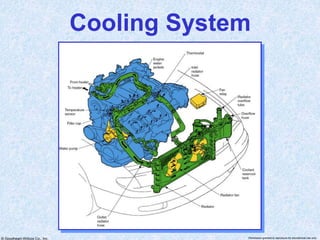
Cooling System
© Goodheart-Willcox Co., Inc. Permission granted to reproduce for educational use only
 The water pump forces coolant through
the engine water jackets
 The pump is belt or gear driven off the
crankshaft
© Goodheart-Willcox Co., Inc. Permission granted to reproduce for educational use only
Cold Engine Operation
 The thermostat is closed
 The coolant circulates inside the engine
 The engine warms quickly
© Goodheart-Willcox Co., Inc. Permission granted to reproduce for educational use only
Hot Engine Operation
 At operating temperature, the
thermostat opens
 Heated coolant then flows through the
radiator
 Excess heat is transferred from the
coolant to the air flowing through the
radiator
© Goodheart-Willcox Co., Inc. Permission granted to reproduce for educational use only
 Two common types:
air cooling
liquid cooling
© Goodheart-Willcox Co., Inc. Permission granted to reproduce for educational use only
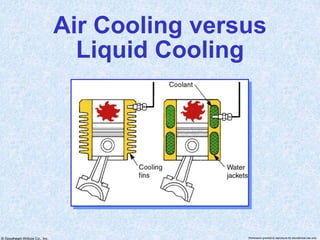
Air Cooling Systems
 Large cylinder cooling fins and outside
air remove excess heat
 The cooling fins increase the surface
area of the metal around the cylinder
 This allows enough heat to transfer to
the outside air
 Plastic or metal shrouds direct air over
the cylinder fins
© Goodheart-Willcox Co., Inc. Permission granted to reproduce for educational use only
Liquid Cooling
Systems
 Circulate coolant through the water
jackets
 Combustion heat is transferred to the
coolant
 The cooling system carries it out of the
engine
© Goodheart-Willcox Co., Inc. Permission granted to reproduce for educational use only
Liquid Cooling
Advantages
 Precise temperature control
 Less temperature variation
 Reduced emissions
 Improved heater operation
© Goodheart-Willcox Co., Inc. Permission granted to reproduce for educational use only
Air Cooling versus
Liquid Cooling
© Goodheart-Willcox Co., Inc. Permission granted to reproduce for educational use only
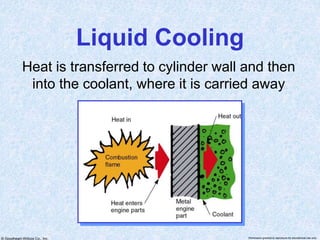
Liquid Cooling
Heat is transferred to cylinder wall and then
into the coolant, where it is carried away
© Goodheart-Willcox Co., Inc. Permission granted to reproduce for educational use only
Conventional Coolant
Flow
 Hot coolant flows from the cylinder head
to the radiator
 After being cooled in the radiator, the
coolant flows back into the engine block
© Goodheart-Willcox Co., Inc. Permission granted to reproduce for educational use only
Reverse Flow Cooling
 Cool coolant enters the head and hot
coolant exits the block to return to the
radiator
 Helps keep a more uniform temperature
throughout the engine
 Found on high-performance engines
© Goodheart-Willcox Co., Inc. Permission granted to reproduce for educational use only
 Components:
water pump
radiator hoses
radiator
fan
thermostat
© Goodheart-Willcox Co., Inc. Permission granted to reproduce for educational use only
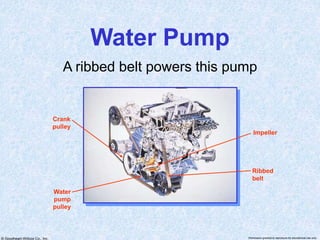
Water Pump
A ribbed belt powers this pump
Crank
pulley
Water
pump
pulley
Impeller
Ribbed
belt
© Goodheart-Willcox Co., Inc. Permission granted to reproduce for educational use only
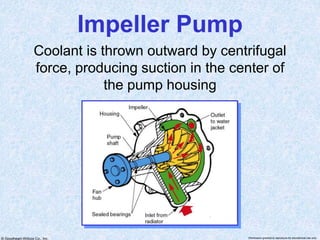
Impeller Pump
Coolant is thrown outward by centrifugal
force, producing suction in the center of
the pump housing
© Goodheart-Willcox Co., Inc. Permission granted to reproduce for educational use only
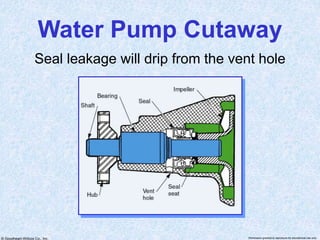
Water Pump Cutaway
Seal leakage will drip from the vent hole
© Goodheart-Willcox Co., Inc. Permission granted to reproduce for educational use only
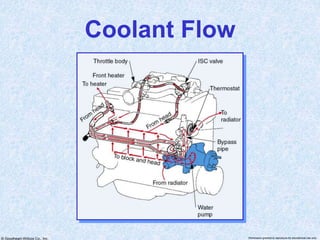
Coolant Flow
© Goodheart-Willcox Co., Inc. Permission granted to reproduce for educational use only
Coolant Flow
(Conventional)
 Coolant flows out of the radiator,
through the lower hose, into the pump
 It then flows through the pump, around
the cylinders, through the heads, up
through the thermostat, and back into
the radiator
© Goodheart-Willcox Co., Inc. Permission granted to reproduce for educational use only
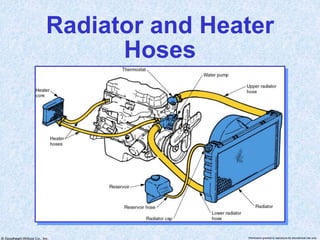
Hoses
 Radiator hoses
carry coolant between the engine water
jackets and the radiator
the lower hose is exposed to water pump
suction, so a spring may needed to prevent
collapse
 Heater hoses
carry hot coolant to the heater core
smaller diameter than radiator hoses
© Goodheart-Willcox Co., Inc. Permission granted to reproduce for educational use only
Radiator and Heater
Hoses
© Goodheart-Willcox Co., Inc. Permission granted to reproduce for educational use only
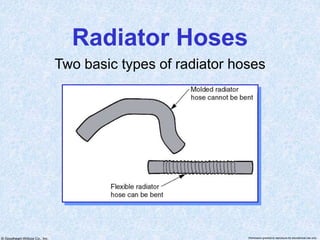
Radiator Hoses
Two basic types of radiator hoses
© Goodheart-Willcox Co., Inc. Permission granted to reproduce for educational use only
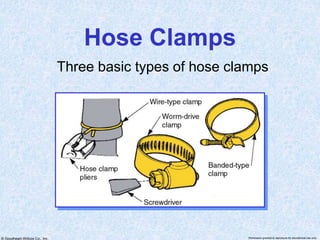
Hose Clamps
Three basic types of hose clamps
© Goodheart-Willcox Co., Inc. Permission granted to reproduce for educational use only
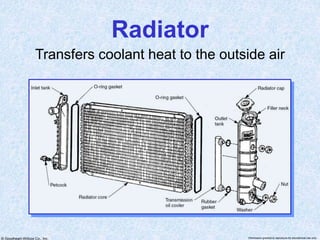
Radiator
Transfers coolant heat to the outside air
© Goodheart-Willcox Co., Inc. Permission granted to reproduce for educational use only
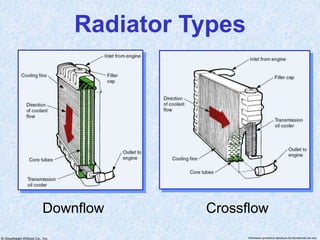
Radiator Types
Downflow Crossflow
© Goodheart-Willcox Co., Inc. Permission granted to reproduce for educational use only
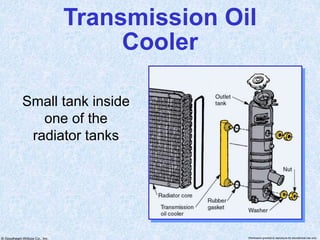
Transmission Oil
Cooler
 Often placed in the radiator on cars with
automatic transmissions
 Prevents the transmission fluid from
overheating
© Goodheart-Willcox Co., Inc. Permission granted to reproduce for educational use only
Transmission Oil
Cooler
Small tank inside
one of the
radiator tanks
© Goodheart-Willcox Co., Inc. Permission granted to reproduce for educational use only
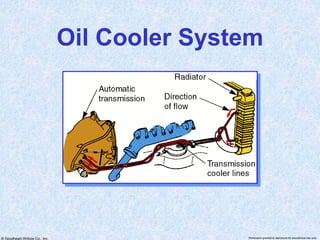
Oil Cooler System
© Goodheart-Willcox Co., Inc. Permission granted to reproduce for educational use only
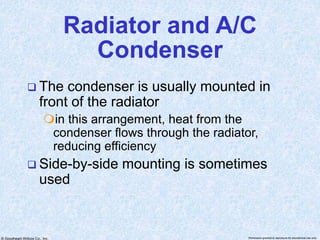
Radiator and A/C
Condenser
 The condenser is usually mounted in
front of the radiator
in this arrangement, heat from the
condenser flows through the radiator,
reducing efficiency
 Side-by-side mounting is sometimes
used
© Goodheart-Willcox Co., Inc. Permission granted to reproduce for educational use only
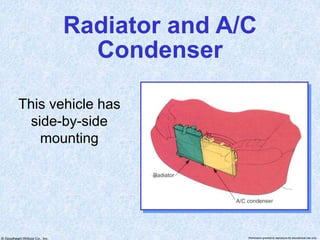
Radiator and A/C
Condenser
This vehicle has
side-by-side
mounting
© Goodheart-Willcox Co., Inc. Permission granted to reproduce for educational use only
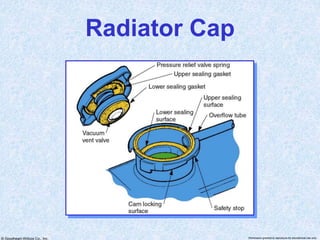
Radiator Cap
 Seals the radiator
 Pressurizes the system
 Relieves excess pressure
 Allows coolant flow between the radiator
and the coolant reservoir
© Goodheart-Willcox Co., Inc. Permission granted to reproduce for educational use only
Radiator Cap
© Goodheart-Willcox Co., Inc. Permission granted to reproduce for educational use only
Radiator Cap Pressure
Valve
 Spring-loaded disk
 Normally, water boils at 212ºF (100ºC)
 For each pound of pressure increase,
the boiling point goes up about 3ºF
(1.7ºC)
 Typical pressure:
12–16 psi (83–110 kPa)
raises the boiling point to
250–260ºF (121–127ºC)
© Goodheart-Willcox Co., Inc. Permission granted to reproduce for educational use only
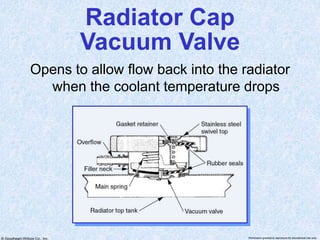
Radiator Cap
Vacuum Valve
Opens to allow flow back into the radiator
when the coolant temperature drops
© Goodheart-Willcox Co., Inc. Permission granted to reproduce for educational use only
 Closed cooling system
uses an expansion tank
overflow tube is routed into reservoir tank
 Open cooling system
allows excess coolant to leak onto the
ground
© Goodheart-Willcox Co., Inc. Permission granted to reproduce for educational use only
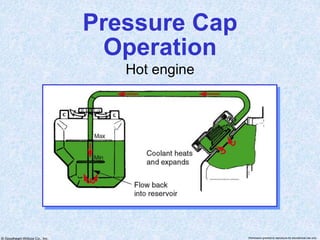
Pressure Cap
Operation
Hot engine
© Goodheart-Willcox Co., Inc. Permission granted to reproduce for educational use only
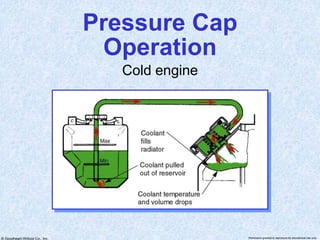
Pressure Cap
Operation
Cold engine
© Goodheart-Willcox Co., Inc. Permission granted to reproduce for educational use only
Cooling System Fans
 Pull air through the core of the radiator
 Increase the volume of air flowing
through the radiator
 Driven by fan belt or electric motor
© Goodheart-Willcox Co., Inc. Permission granted to reproduce for educational use only
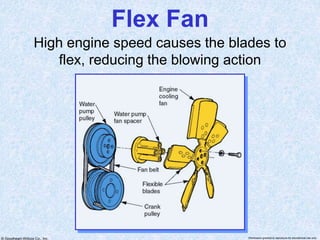
Flex Fan
High engine speed causes the blades to
flex, reducing the blowing action
© Goodheart-Willcox Co., Inc. Permission granted to reproduce for educational use only
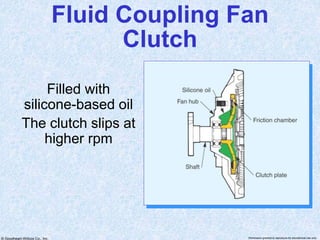
Fluid Coupling Fan
Clutch
Filled with
silicone-based oil
The clutch slips at
higher rpm
© Goodheart-Willcox Co., Inc. Permission granted to reproduce for educational use only
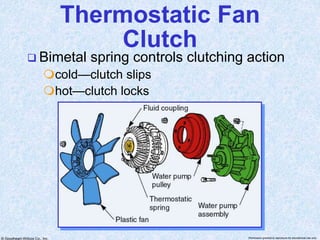
Thermostatic Fan
Clutch
 Bimetal spring controls clutching action
cold—clutch slips
hot—clutch locks
© Goodheart-Willcox Co., Inc. Permission granted to reproduce for educational use only
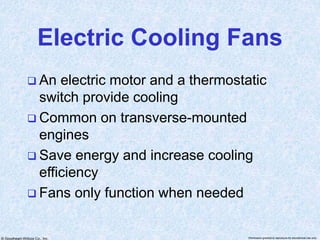
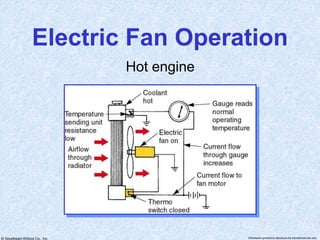
Electric Cooling Fans
 An electric motor and a thermostatic
switch provide cooling
 Common on transverse-mounted
engines
 Save energy and increase cooling
efficiency
 Fans only function when needed
© Goodheart-Willcox Co., Inc. Permission granted to reproduce for educational use only
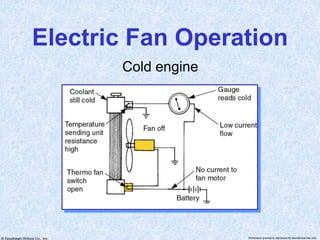
Electric Fan Operation
Cold engine
© Goodheart-Willcox Co., Inc. Permission granted to reproduce for educational use only
Electric Fan Operation
Hot engine
© Goodheart-Willcox Co., Inc. Permission granted to reproduce for educational use only
PCM-Controlled Fans
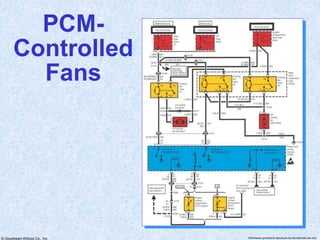
 When cold, the ECM does not energize
the fan relays
 After warm-up, the ECM feeds current
to the fan relay coils, closing the relay
contacts
 High current flows to fans
© Goodheart-Willcox Co., Inc. Permission granted to reproduce for educational use only
PCM-
Controlled
Fans
© Goodheart-Willcox Co., Inc. Permission granted to reproduce for educational use only
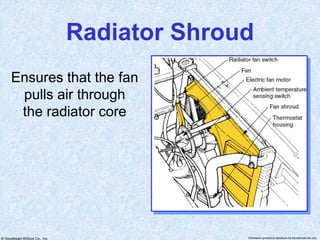
Radiator Shroud
Ensures that the fan
pulls air through
the radiator core
© Goodheart-Willcox Co., Inc. Permission granted to reproduce for educational use only
Thermostat
 Senses the coolant temperature and
controls coolant flow through the
radiator
 Reduces coolant flow in a cold
engine
 Increases coolant flow in a hot
engine
© Goodheart-Willcox Co., Inc. Permission granted to reproduce for educational use only
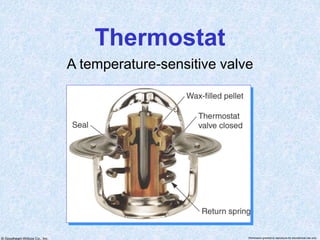
Thermostat
A temperature-sensitive valve
© Goodheart-Willcox Co., Inc. Permission granted to reproduce for educational use only
Thermostat Operation
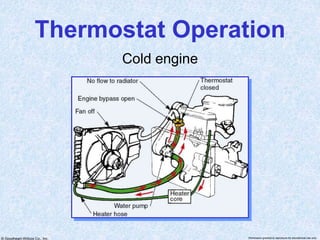
 Cold engine
wax-filled pellet has contracted
spring holds valve closed
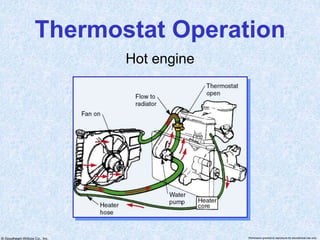
 Hot engine
when heated, pellet expands
spring tension is overcome
valve opens
© Goodheart-Willcox Co., Inc. Permission granted to reproduce for educational use only
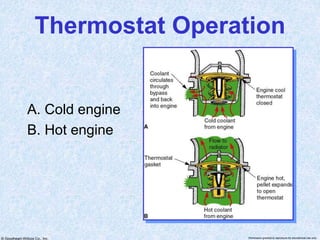
Thermostat Operation
A. Cold engine
B. Hot engine
© Goodheart-Willcox Co., Inc. Permission granted to reproduce for educational use only
Thermostat Operation
Cold engine
© Goodheart-Willcox Co., Inc. Permission granted to reproduce for educational use only
Thermostat Operation
Hot engine
© Goodheart-Willcox Co., Inc. Permission granted to reproduce for educational use only
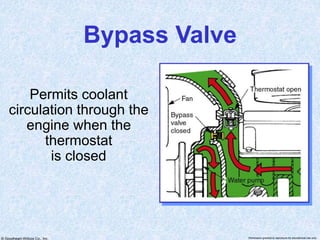
Bypass Valve
Permits coolant
circulation through the
engine when the
thermostat
is closed
© Goodheart-Willcox Co., Inc. Permission granted to reproduce for educational use only
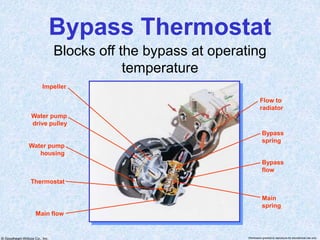
Bypass Thermostat
Blocks off the bypass at operating
temperature
Impeller
Water pump
drive pulley
Water pump
housing
Thermostat
Main flow
Flow to
radiator
Bypass
spring
Bypass
flow
Main
spring
© Goodheart-Willcox Co., Inc. Permission granted to reproduce for educational use only
 Two common types:
temperature warning light
engine temperature gauge
© Goodheart-Willcox Co., Inc. Permission granted to reproduce for educational use only
Temperature Warning
Light
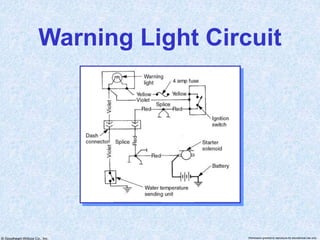
 When the coolant becomes too hot, a
temperature sending unit (switch) in the
block closes, completing a light circuit
 The warning light glows
© Goodheart-Willcox Co., Inc. Permission granted to reproduce for educational use only
Warning Light Circuit
© Goodheart-Willcox Co., Inc. Permission granted to reproduce for educational use only
Engine Temperature
Gauge
 Shows the exact operating temperature
 Components:
gauge
variable resistance sending unit
© Goodheart-Willcox Co., Inc. Permission granted to reproduce for educational use only
Engine Temperature
Gauge Operation
 When cold, the sending unit has a high
resistance
 Current flow through the gauge is low
 The gauge reads cold
 When hot, the sending unit resistance
lowers
 Current flow through the gauge
increases, the needle deflects to the
right
© Goodheart-Willcox Co., Inc. Permission granted to reproduce for educational use only
 Composed of ethylene glycol mixed with
water
 Prevents winter freeze-up
 Prevents rust and corrosion
 Lubricates the water pump
 Cools the engine
© Goodheart-Willcox Co., Inc. Permission granted to reproduce for educational use only
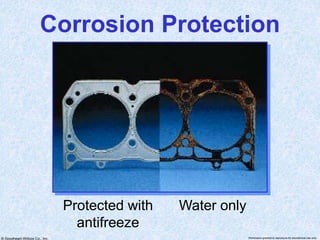
Corrosion Protection
Protected with
antifreeze
Water only
© Goodheart-Willcox Co., Inc. Permission granted to reproduce for educational use only
Antifreeze/Water
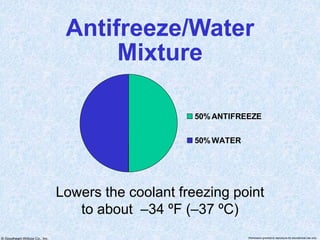
Mixture
Lowers the coolant freezing point
to about –34 ºF (–37 ºC)
50%ANTIFREEZE
50%WATER
© Goodheart-Willcox Co., Inc. Permission granted to reproduce for educational use only
 Aids engine starting in cold weather
 120-volt heating element mounted in the
block water jacket
 Common on diesel engines
© Goodheart-Willcox Co., Inc. Permission granted to reproduce for educational use only
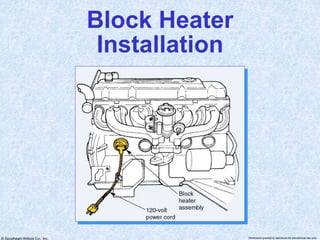
Block Heater
Installation
© Goodheart-Willcox Co., Inc. Permission granted to reproduce for educational use only
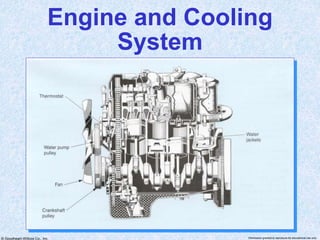
Engine and Cooling
System
© Goodheart-Willcox Co., Inc. Permission granted to reproduce for educational use only
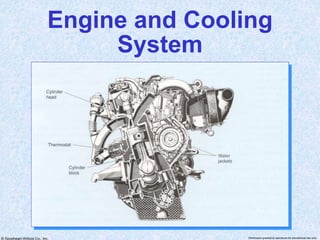
Engine and Cooling
System

CHAPTER 39_cooling7.PPT

  • 1.
    © Goodheart-Willcox Co.,Inc. Permission granted to reproduce for educational use only Publisher The Goodheart-Willcox Co., Inc. Tinley Park, Illinois by Russell Krick
  • 2.
    © Goodheart-Willcox Co.,Inc. Permission granted to reproduce for educational use only
  • 3.
    © Goodheart-Willcox Co.,Inc. Permission granted to reproduce for educational use only  Cooling system functions  Cooling system operation  Cooling system types  Basic cooling system  Closed and open cooling systems  Cooling system instrumentation  Antifreeze  Block heater
  • 4.
    © Goodheart-Willcox Co.,Inc. Permission granted to reproduce for educational use only
  • 5.
    © Goodheart-Willcox Co.,Inc. Permission granted to reproduce for educational use only Remove Engine Heat  Combustion can reach 4500ºF (2500ºC)  This is hot enough to melt metal parts  The cooling system removes excess heat
  • 6.
    © Goodheart-Willcox Co.,Inc. Permission granted to reproduce for educational use only Maintain Operating Temperature  180ºF to 210ºF (80ºC to 100ºC)  Ensures that clearances are correct when an engine warms to operating temperature, parts expand  Ensures proper combustion, minimum emissions, and maximum performance
  • 7.
    © Goodheart-Willcox Co.,Inc. Permission granted to reproduce for educational use only Reach Operating Temperature Quickly  This minimizes several conditions: poor combustion (poor fuel vaporization) part wear oil contamination reduced fuel economy increased emissions
  • 8.
    © Goodheart-Willcox Co.,Inc. Permission granted to reproduce for educational use only Heater Operation  The cooling system circulates coolant to the vehicle’s heater  Engine heat is used to warm the passenger compartment
  • 9.
    © Goodheart-Willcox Co.,Inc. Permission granted to reproduce for educational use only Cooling System
  • 10.
    © Goodheart-Willcox Co.,Inc. Permission granted to reproduce for educational use only  The water pump forces coolant through the engine water jackets  The pump is belt or gear driven off the crankshaft
  • 11.
    © Goodheart-Willcox Co.,Inc. Permission granted to reproduce for educational use only Cold Engine Operation  The thermostat is closed  The coolant circulates inside the engine  The engine warms quickly
  • 12.
    © Goodheart-Willcox Co.,Inc. Permission granted to reproduce for educational use only Hot Engine Operation  At operating temperature, the thermostat opens  Heated coolant then flows through the radiator  Excess heat is transferred from the coolant to the air flowing through the radiator
  • 13.
    © Goodheart-Willcox Co.,Inc. Permission granted to reproduce for educational use only  Two common types: air cooling liquid cooling
  • 14.
    © Goodheart-Willcox Co.,Inc. Permission granted to reproduce for educational use only Air Cooling Systems  Large cylinder cooling fins and outside air remove excess heat  The cooling fins increase the surface area of the metal around the cylinder  This allows enough heat to transfer to the outside air  Plastic or metal shrouds direct air over the cylinder fins
  • 15.
    © Goodheart-Willcox Co.,Inc. Permission granted to reproduce for educational use only Liquid Cooling Systems  Circulate coolant through the water jackets  Combustion heat is transferred to the coolant  The cooling system carries it out of the engine
  • 16.
    © Goodheart-Willcox Co.,Inc. Permission granted to reproduce for educational use only Liquid Cooling Advantages  Precise temperature control  Less temperature variation  Reduced emissions  Improved heater operation
  • 17.
    © Goodheart-Willcox Co.,Inc. Permission granted to reproduce for educational use only Air Cooling versus Liquid Cooling
  • 18.
    © Goodheart-Willcox Co.,Inc. Permission granted to reproduce for educational use only Liquid Cooling Heat is transferred to cylinder wall and then into the coolant, where it is carried away
  • 19.
    © Goodheart-Willcox Co.,Inc. Permission granted to reproduce for educational use only Conventional Coolant Flow  Hot coolant flows from the cylinder head to the radiator  After being cooled in the radiator, the coolant flows back into the engine block
  • 20.
    © Goodheart-Willcox Co.,Inc. Permission granted to reproduce for educational use only Reverse Flow Cooling  Cool coolant enters the head and hot coolant exits the block to return to the radiator  Helps keep a more uniform temperature throughout the engine  Found on high-performance engines
  • 21.
    © Goodheart-Willcox Co.,Inc. Permission granted to reproduce for educational use only  Components: water pump radiator hoses radiator fan thermostat
  • 22.
    © Goodheart-Willcox Co.,Inc. Permission granted to reproduce for educational use only Water Pump A ribbed belt powers this pump Crank pulley Water pump pulley Impeller Ribbed belt
  • 23.
    © Goodheart-Willcox Co.,Inc. Permission granted to reproduce for educational use only Impeller Pump Coolant is thrown outward by centrifugal force, producing suction in the center of the pump housing
  • 24.
    © Goodheart-Willcox Co.,Inc. Permission granted to reproduce for educational use only Water Pump Cutaway Seal leakage will drip from the vent hole
  • 25.
    © Goodheart-Willcox Co.,Inc. Permission granted to reproduce for educational use only Coolant Flow
  • 26.
    © Goodheart-Willcox Co.,Inc. Permission granted to reproduce for educational use only Coolant Flow (Conventional)  Coolant flows out of the radiator, through the lower hose, into the pump  It then flows through the pump, around the cylinders, through the heads, up through the thermostat, and back into the radiator
  • 27.
    © Goodheart-Willcox Co.,Inc. Permission granted to reproduce for educational use only Hoses  Radiator hoses carry coolant between the engine water jackets and the radiator the lower hose is exposed to water pump suction, so a spring may needed to prevent collapse  Heater hoses carry hot coolant to the heater core smaller diameter than radiator hoses
  • 28.
    © Goodheart-Willcox Co.,Inc. Permission granted to reproduce for educational use only Radiator and Heater Hoses
  • 29.
    © Goodheart-Willcox Co.,Inc. Permission granted to reproduce for educational use only Radiator Hoses Two basic types of radiator hoses
  • 30.
    © Goodheart-Willcox Co.,Inc. Permission granted to reproduce for educational use only Hose Clamps Three basic types of hose clamps
  • 31.
    © Goodheart-Willcox Co.,Inc. Permission granted to reproduce for educational use only Radiator Transfers coolant heat to the outside air
  • 32.
    © Goodheart-Willcox Co.,Inc. Permission granted to reproduce for educational use only Radiator Types Downflow Crossflow
  • 33.
    © Goodheart-Willcox Co.,Inc. Permission granted to reproduce for educational use only Transmission Oil Cooler  Often placed in the radiator on cars with automatic transmissions  Prevents the transmission fluid from overheating
  • 34.
    © Goodheart-Willcox Co.,Inc. Permission granted to reproduce for educational use only Transmission Oil Cooler Small tank inside one of the radiator tanks
  • 35.
    © Goodheart-Willcox Co.,Inc. Permission granted to reproduce for educational use only Oil Cooler System
  • 36.
    © Goodheart-Willcox Co.,Inc. Permission granted to reproduce for educational use only Radiator and A/C Condenser  The condenser is usually mounted in front of the radiator in this arrangement, heat from the condenser flows through the radiator, reducing efficiency  Side-by-side mounting is sometimes used
  • 37.
    © Goodheart-Willcox Co.,Inc. Permission granted to reproduce for educational use only Radiator and A/C Condenser This vehicle has side-by-side mounting
  • 38.
    © Goodheart-Willcox Co.,Inc. Permission granted to reproduce for educational use only Radiator Cap  Seals the radiator  Pressurizes the system  Relieves excess pressure  Allows coolant flow between the radiator and the coolant reservoir
  • 39.
    © Goodheart-Willcox Co.,Inc. Permission granted to reproduce for educational use only Radiator Cap
  • 40.
    © Goodheart-Willcox Co.,Inc. Permission granted to reproduce for educational use only Radiator Cap Pressure Valve  Spring-loaded disk  Normally, water boils at 212ºF (100ºC)  For each pound of pressure increase, the boiling point goes up about 3ºF (1.7ºC)  Typical pressure: 12–16 psi (83–110 kPa) raises the boiling point to 250–260ºF (121–127ºC)
  • 41.
    © Goodheart-Willcox Co.,Inc. Permission granted to reproduce for educational use only Radiator Cap Vacuum Valve Opens to allow flow back into the radiator when the coolant temperature drops
  • 42.
    © Goodheart-Willcox Co.,Inc. Permission granted to reproduce for educational use only  Closed cooling system uses an expansion tank overflow tube is routed into reservoir tank  Open cooling system allows excess coolant to leak onto the ground
  • 43.
    © Goodheart-Willcox Co.,Inc. Permission granted to reproduce for educational use only Pressure Cap Operation Hot engine
  • 44.
    © Goodheart-Willcox Co.,Inc. Permission granted to reproduce for educational use only Pressure Cap Operation Cold engine
  • 45.
    © Goodheart-Willcox Co.,Inc. Permission granted to reproduce for educational use only Cooling System Fans  Pull air through the core of the radiator  Increase the volume of air flowing through the radiator  Driven by fan belt or electric motor
  • 46.
    © Goodheart-Willcox Co.,Inc. Permission granted to reproduce for educational use only Flex Fan High engine speed causes the blades to flex, reducing the blowing action
  • 47.
    © Goodheart-Willcox Co.,Inc. Permission granted to reproduce for educational use only Fluid Coupling Fan Clutch Filled with silicone-based oil The clutch slips at higher rpm
  • 48.
    © Goodheart-Willcox Co.,Inc. Permission granted to reproduce for educational use only Thermostatic Fan Clutch  Bimetal spring controls clutching action cold—clutch slips hot—clutch locks
  • 49.
    © Goodheart-Willcox Co.,Inc. Permission granted to reproduce for educational use only Electric Cooling Fans  An electric motor and a thermostatic switch provide cooling  Common on transverse-mounted engines  Save energy and increase cooling efficiency  Fans only function when needed
  • 50.
    © Goodheart-Willcox Co.,Inc. Permission granted to reproduce for educational use only Electric Fan Operation Cold engine
  • 51.
    © Goodheart-Willcox Co.,Inc. Permission granted to reproduce for educational use only Electric Fan Operation Hot engine
  • 52.
    © Goodheart-Willcox Co.,Inc. Permission granted to reproduce for educational use only PCM-Controlled Fans  When cold, the ECM does not energize the fan relays  After warm-up, the ECM feeds current to the fan relay coils, closing the relay contacts  High current flows to fans
  • 53.
    © Goodheart-Willcox Co.,Inc. Permission granted to reproduce for educational use only PCM- Controlled Fans
  • 54.
    © Goodheart-Willcox Co.,Inc. Permission granted to reproduce for educational use only Radiator Shroud Ensures that the fan pulls air through the radiator core
  • 55.
    © Goodheart-Willcox Co.,Inc. Permission granted to reproduce for educational use only Thermostat  Senses the coolant temperature and controls coolant flow through the radiator  Reduces coolant flow in a cold engine  Increases coolant flow in a hot engine
  • 56.
    © Goodheart-Willcox Co.,Inc. Permission granted to reproduce for educational use only Thermostat A temperature-sensitive valve
  • 57.
    © Goodheart-Willcox Co.,Inc. Permission granted to reproduce for educational use only Thermostat Operation  Cold engine wax-filled pellet has contracted spring holds valve closed  Hot engine when heated, pellet expands spring tension is overcome valve opens
  • 58.
    © Goodheart-Willcox Co.,Inc. Permission granted to reproduce for educational use only Thermostat Operation A. Cold engine B. Hot engine
  • 59.
    © Goodheart-Willcox Co.,Inc. Permission granted to reproduce for educational use only Thermostat Operation Cold engine
  • 60.
    © Goodheart-Willcox Co.,Inc. Permission granted to reproduce for educational use only Thermostat Operation Hot engine
  • 61.
    © Goodheart-Willcox Co.,Inc. Permission granted to reproduce for educational use only Bypass Valve Permits coolant circulation through the engine when the thermostat is closed
  • 62.
    © Goodheart-Willcox Co.,Inc. Permission granted to reproduce for educational use only Bypass Thermostat Blocks off the bypass at operating temperature Impeller Water pump drive pulley Water pump housing Thermostat Main flow Flow to radiator Bypass spring Bypass flow Main spring
  • 63.
    © Goodheart-Willcox Co.,Inc. Permission granted to reproduce for educational use only  Two common types: temperature warning light engine temperature gauge
  • 64.
    © Goodheart-Willcox Co.,Inc. Permission granted to reproduce for educational use only Temperature Warning Light  When the coolant becomes too hot, a temperature sending unit (switch) in the block closes, completing a light circuit  The warning light glows
  • 65.
    © Goodheart-Willcox Co.,Inc. Permission granted to reproduce for educational use only Warning Light Circuit
  • 66.
    © Goodheart-Willcox Co.,Inc. Permission granted to reproduce for educational use only Engine Temperature Gauge  Shows the exact operating temperature  Components: gauge variable resistance sending unit
  • 67.
    © Goodheart-Willcox Co.,Inc. Permission granted to reproduce for educational use only Engine Temperature Gauge Operation  When cold, the sending unit has a high resistance  Current flow through the gauge is low  The gauge reads cold  When hot, the sending unit resistance lowers  Current flow through the gauge increases, the needle deflects to the right
  • 68.
    © Goodheart-Willcox Co.,Inc. Permission granted to reproduce for educational use only  Composed of ethylene glycol mixed with water  Prevents winter freeze-up  Prevents rust and corrosion  Lubricates the water pump  Cools the engine
  • 69.
    © Goodheart-Willcox Co.,Inc. Permission granted to reproduce for educational use only Corrosion Protection Protected with antifreeze Water only
  • 70.
    © Goodheart-Willcox Co.,Inc. Permission granted to reproduce for educational use only Antifreeze/Water Mixture Lowers the coolant freezing point to about –34 ºF (–37 ºC) 50%ANTIFREEZE 50%WATER
  • 71.
    © Goodheart-Willcox Co.,Inc. Permission granted to reproduce for educational use only  Aids engine starting in cold weather  120-volt heating element mounted in the block water jacket  Common on diesel engines
  • 72.
    © Goodheart-Willcox Co.,Inc. Permission granted to reproduce for educational use only Block Heater Installation
  • 73.
    © Goodheart-Willcox Co.,Inc. Permission granted to reproduce for educational use only Engine and Cooling System
  • 74.
    © Goodheart-Willcox Co.,Inc. Permission granted to reproduce for educational use only Engine and Cooling System