SEMINAR ON
“INTELLIGENT COOLING
SYSTEM”
Submitted By:-
Bhupender SinghUnder The Guidance of:
Er. Amit Jain 1
…………CONTENTS……………
Introduction
Necessity of Cooling System
Basic components of cooling system
Types of cooling system
 Variation in gas temperature
 Drawbacks of conventional cooling system
 Fuzzy in cooling system
Advantages of Intelligent Cooling System
Conclusion
 References
2
…………….INTRODUCTION……………...
The name “INTELLIGENT COOLING SYSTEM” represents the
improved function of a cooling system. The name is so given
because in this system a sensor senses the cylinder temperature &
controls the opening & closing of water passage in piston-cylinder
arrangement.The basic principle behind this is to control flow rate
of coolant by regulating the valve by implementing FUZZY
LOGIC.
3
….....NECESSITY OF COOLING SYSTEM.…….
 The even expansion of the piston in the cylinder may result in the
seizure of the piston.
 High temperature reduces the strength of piston.
 Overheated cylinder may lead to pre-ignition of fuel.
 Physical and chemical change may occur in the lubricating oil
which may cause sticking of piston ring and excessive wear of
cylinder.
 If cylinder head temperature is high then power output of engine
is reduced.
4
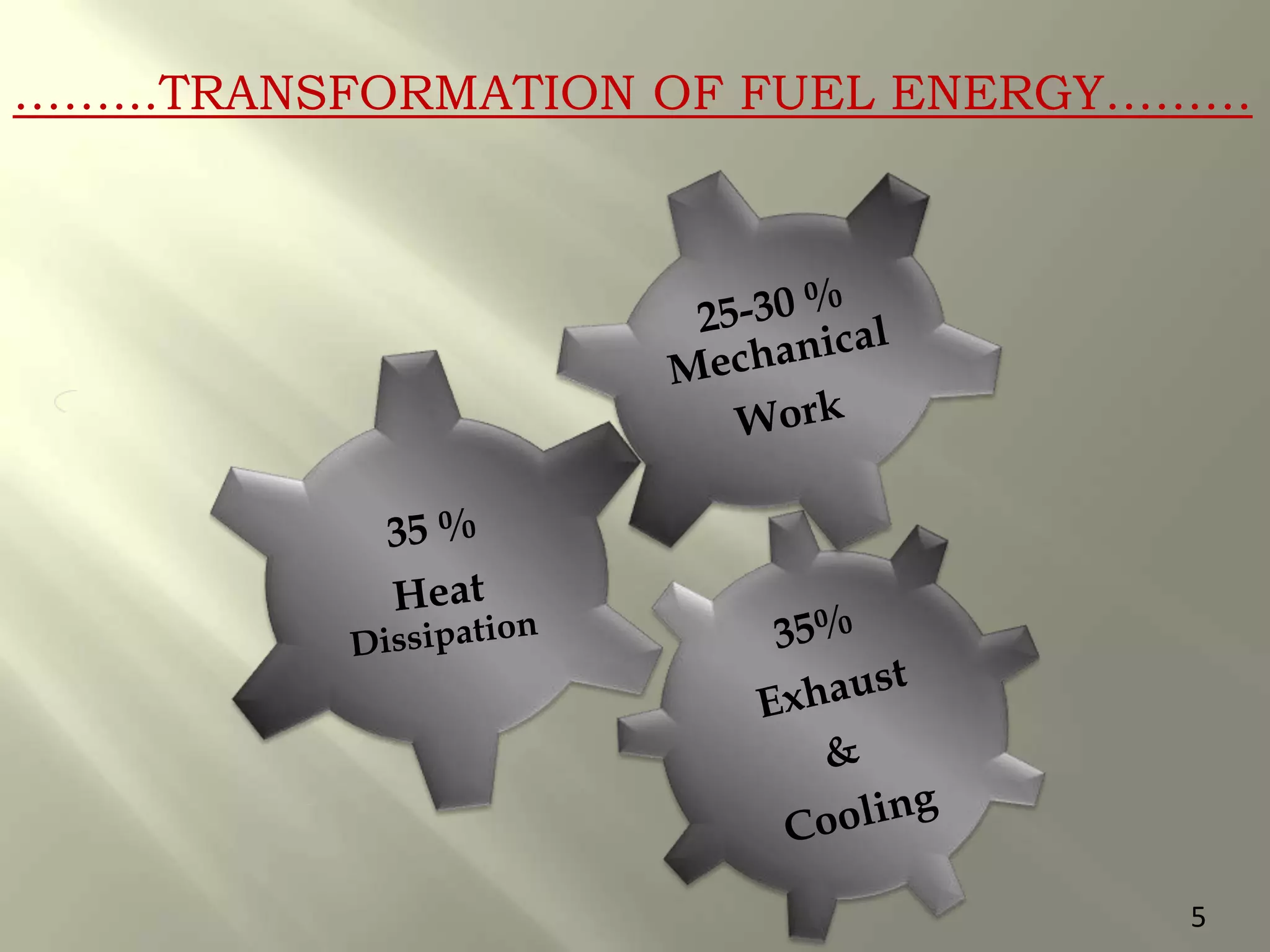
……...TRANSFORMATION OF FUEL ENERGY………
5
….BASIC COMPONENTS OF COOLING SYSTEM….
 Radiator
 Thermostat Valve
 Water Pump
 Cooling Fan
 Water Jackets
 Coolant
 Antifreeze Mixture
6
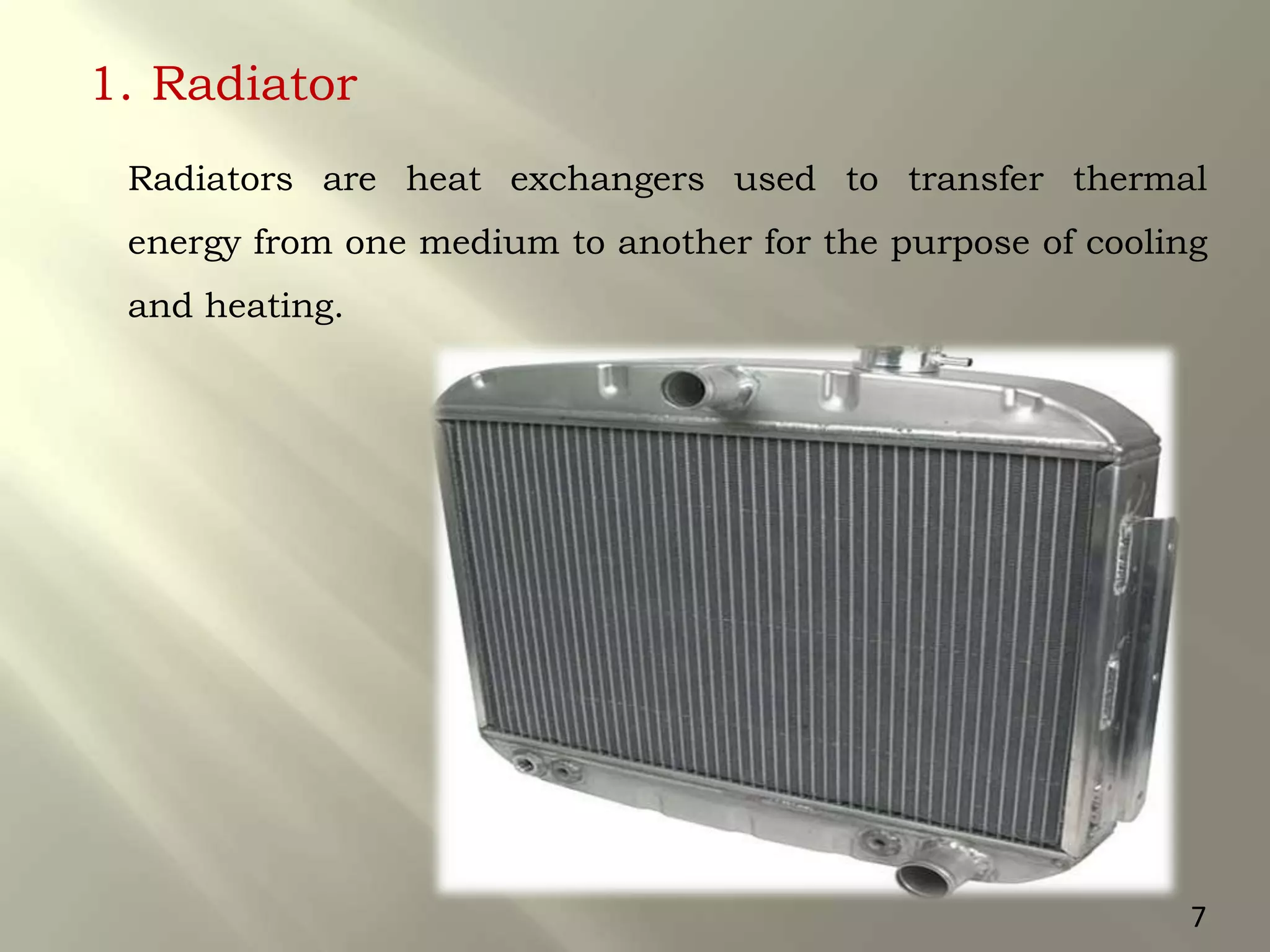
1. Radiator
Radiators are heat exchangers used to transfer thermal
energy from one medium to another for the purpose of cooling
and heating.
7
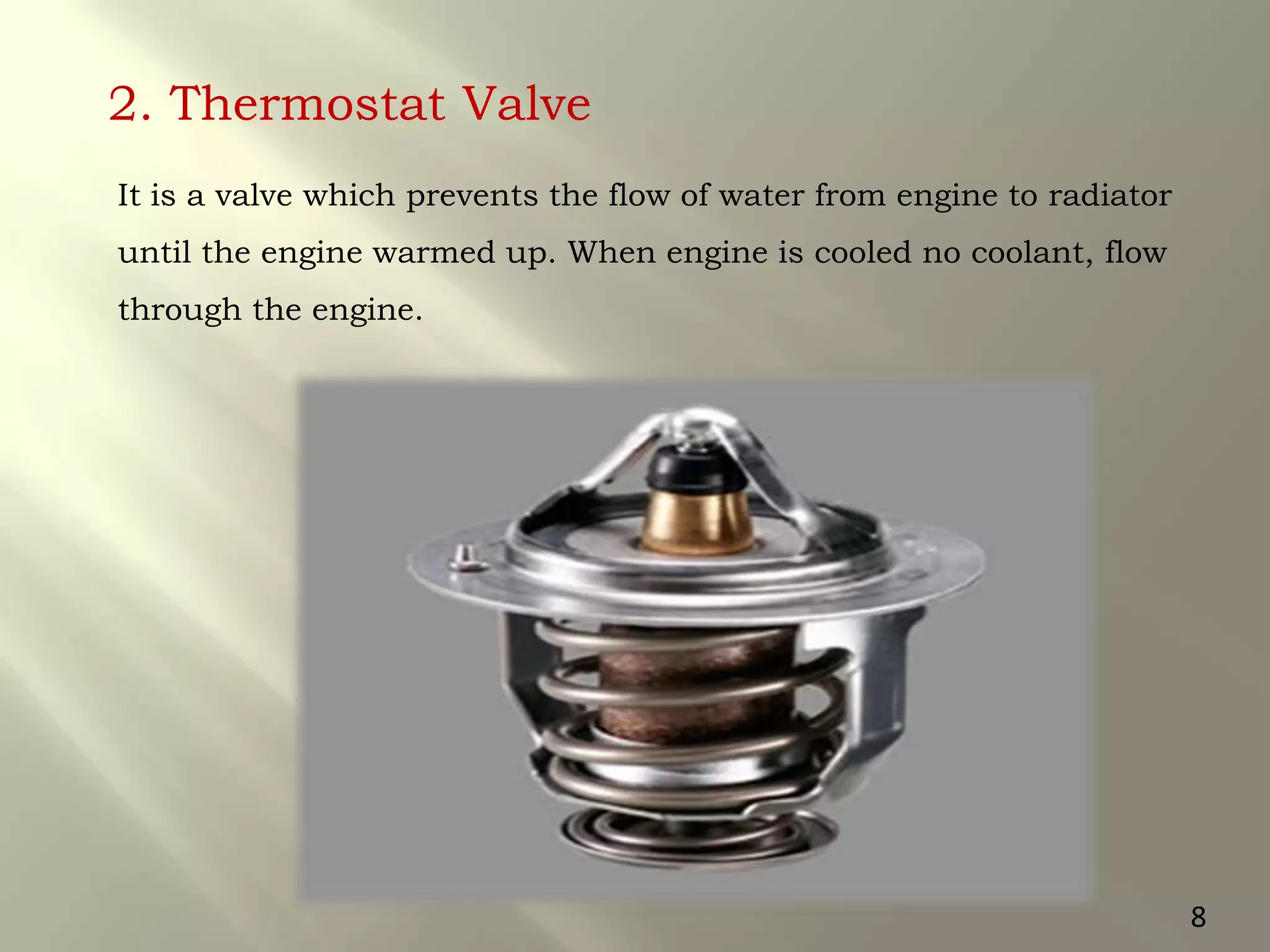
2. Thermostat Valve
It is a valve which prevents the flow of water from engine to radiator
until the engine warmed up. When engine is cooled no coolant, flow
through the engine.
8
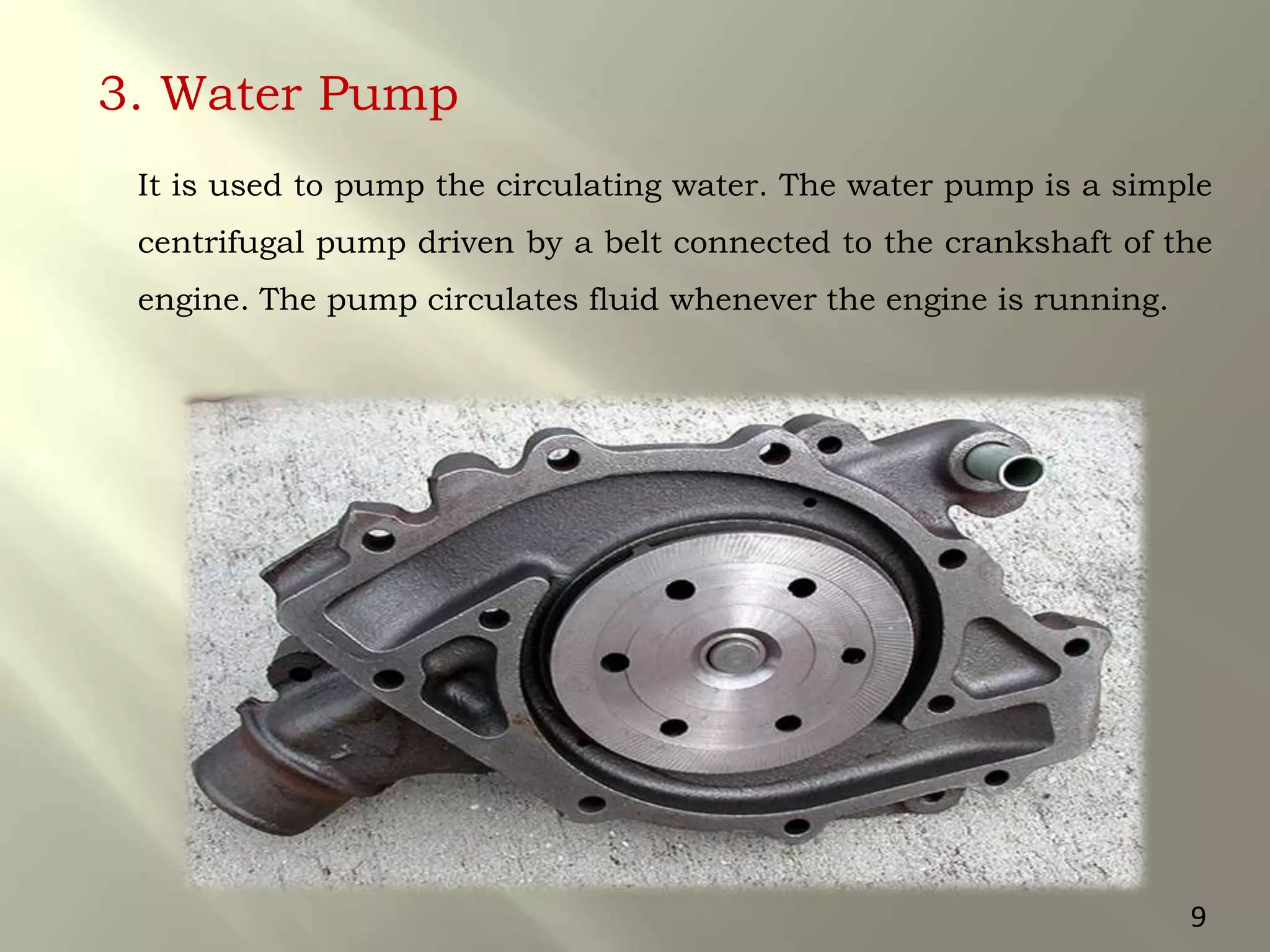
3. Water Pump
It is used to pump the circulating water. The water pump is a simple
centrifugal pump driven by a belt connected to the crankshaft of the
engine. The pump circulates fluid whenever the engine is running.
9
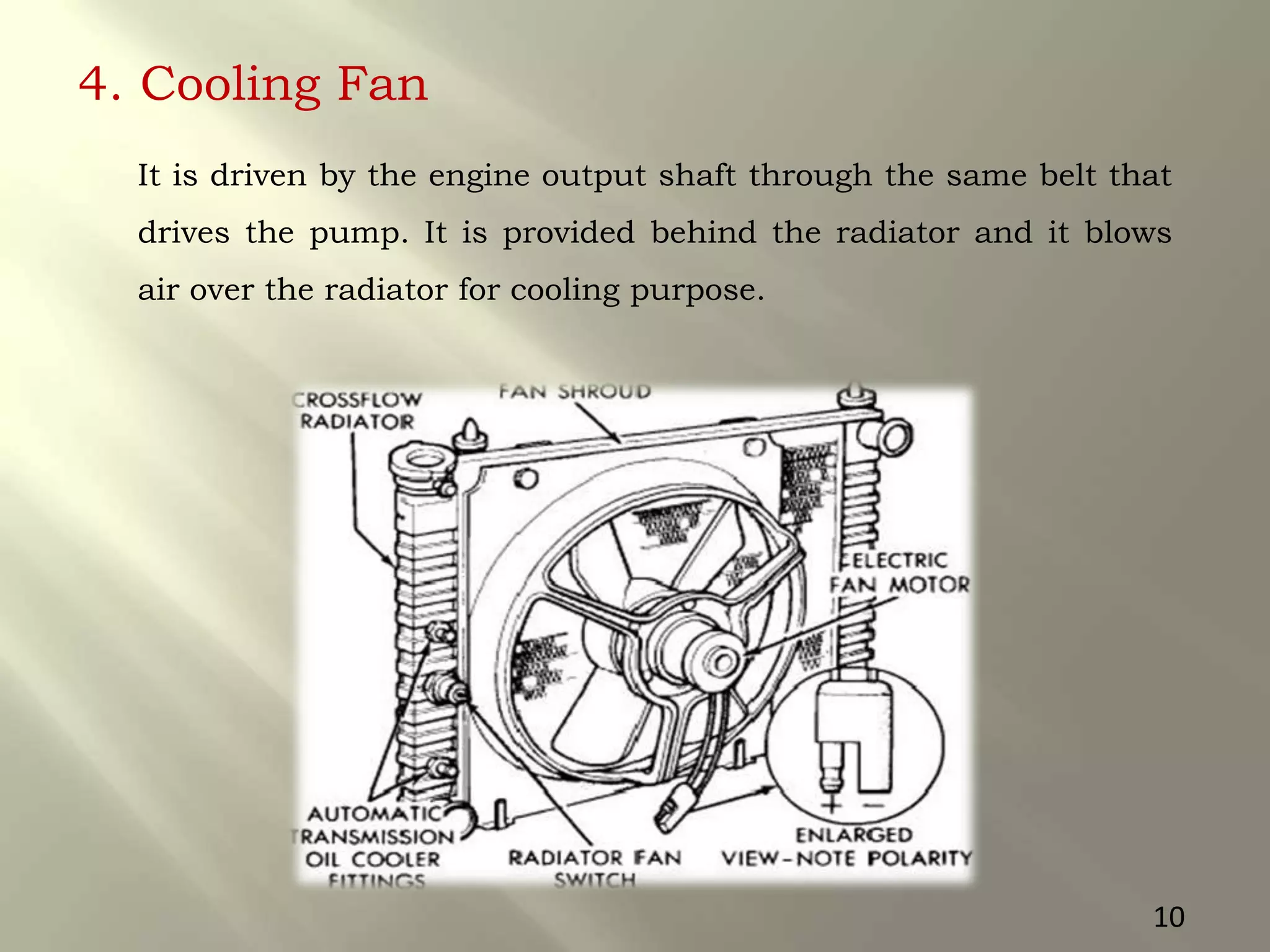
4. Cooling Fan
It is driven by the engine output shaft through the same belt that
drives the pump. It is provided behind the radiator and it blows
air over the radiator for cooling purpose.
10
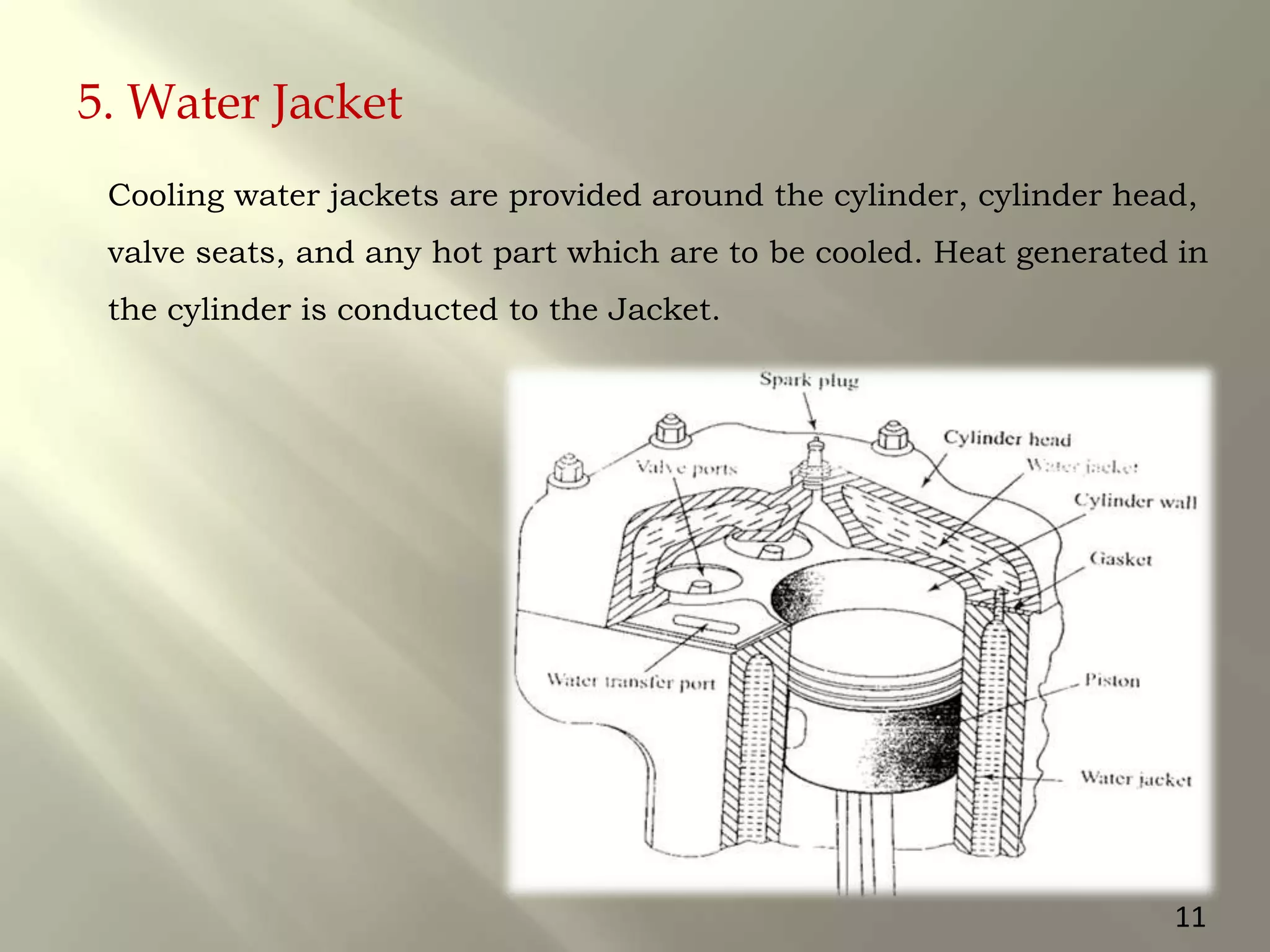
5. Water Jacket
Cooling water jackets are provided around the cylinder, cylinder head,
valve seats, and any hot part which are to be cooled. Heat generated in
the cylinder is conducted to the Jacket.
11
6. Antifreeze Mixture
 Methyl, ethyl & isopropyl alcohols
 A solution of alcohol and water
 Ethylene Glycol
 Glycerin along with water, etc.
To prevent the freezing of cooling water in western countries
antifreeze mixture are added to the cooling water.
There are the following type of antifreeze mixtures :-
12
…………...TYPES OF COOLING SYSTEM..…………..
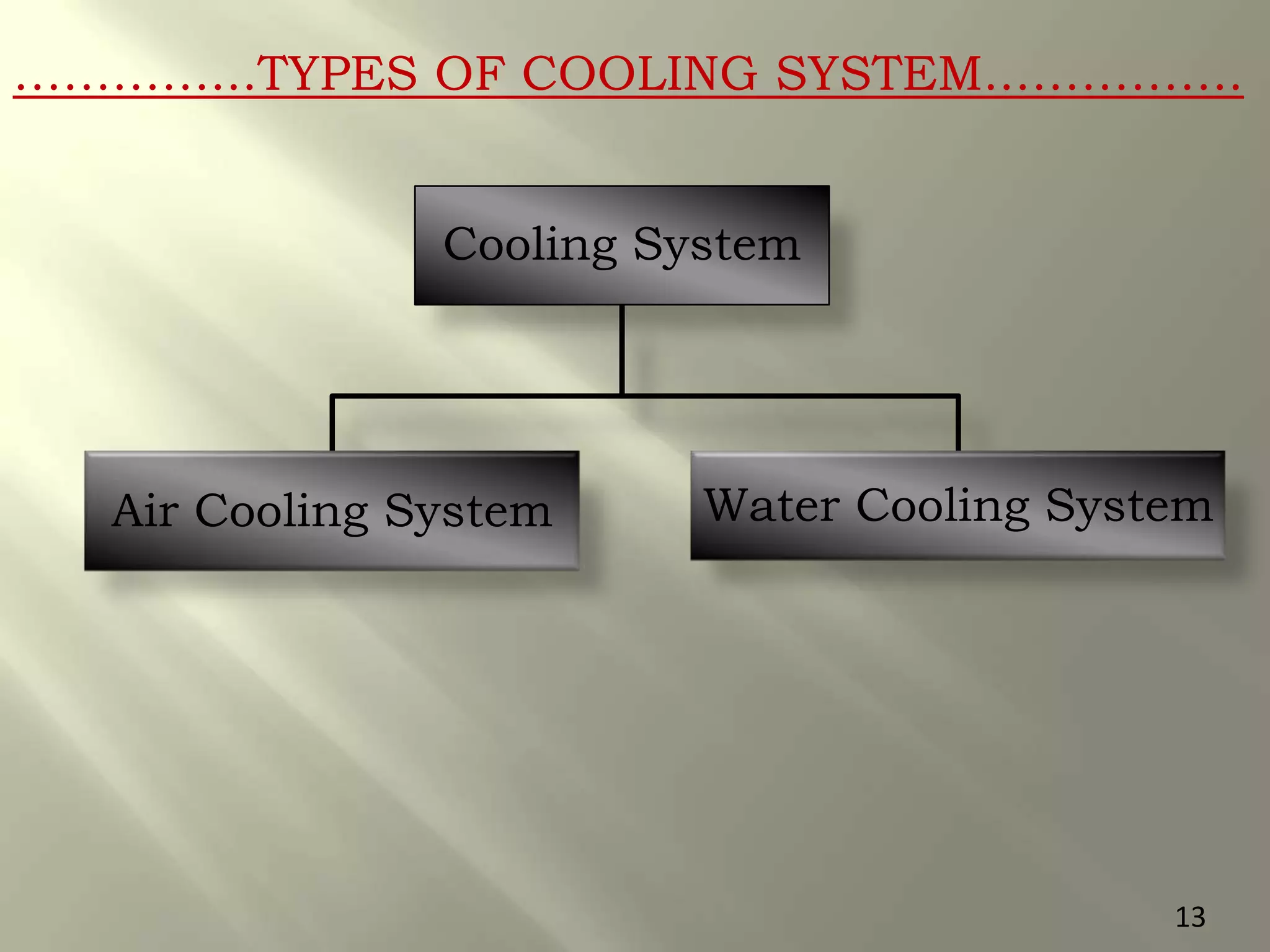
Cooling System
Air Cooling System Water Cooling System
13
…………..…AIR COOLED SYSTEM………………..
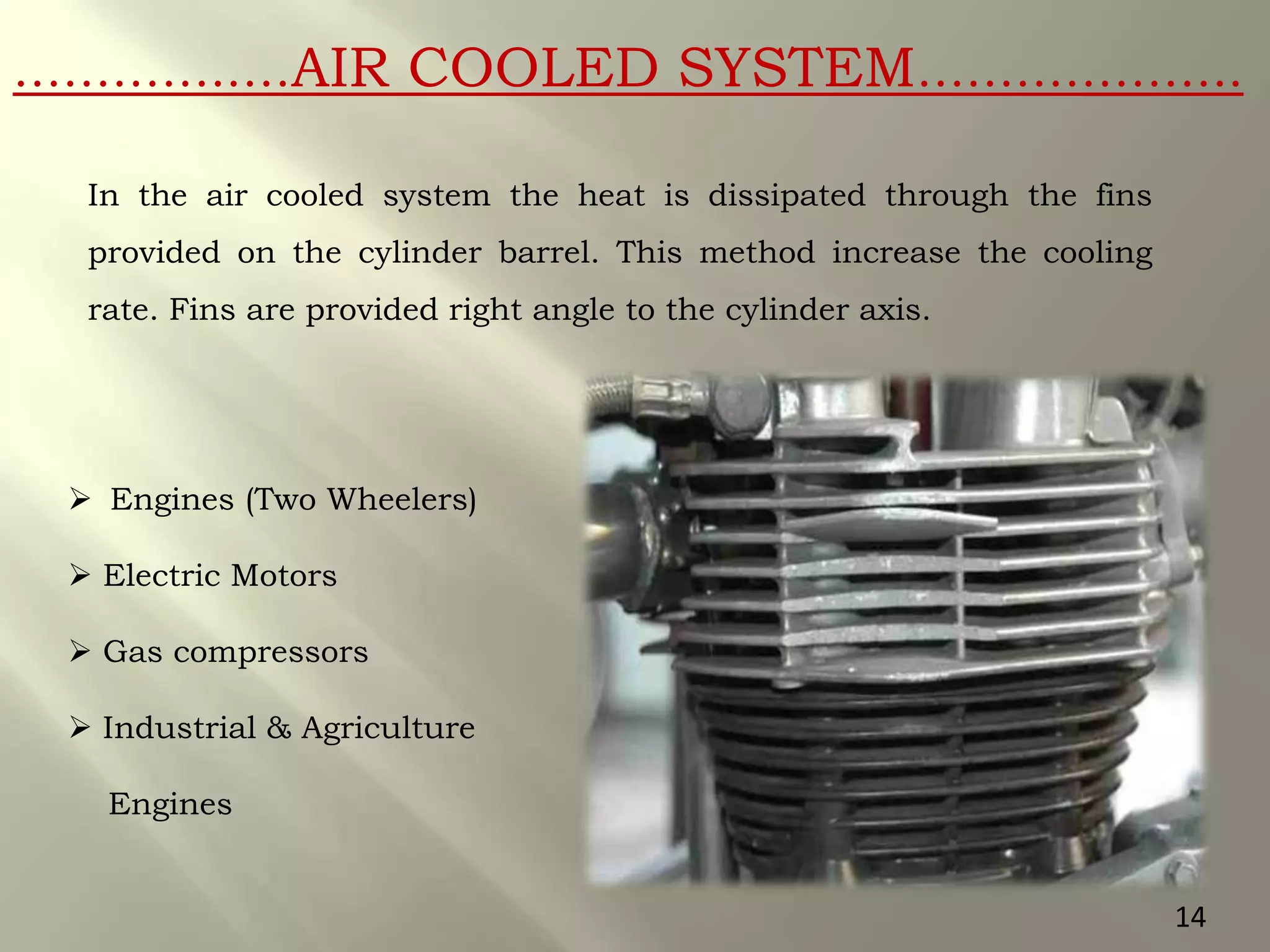
In the air cooled system the heat is dissipated through the fins
provided on the cylinder barrel. This method increase the cooling
rate. Fins are provided right angle to the cylinder axis.
 Engines (Two Wheelers)
 Electric Motors
 Gas compressors
 Industrial & Agriculture
Engines
14
…………..WATER COOLED SYSTEM………….
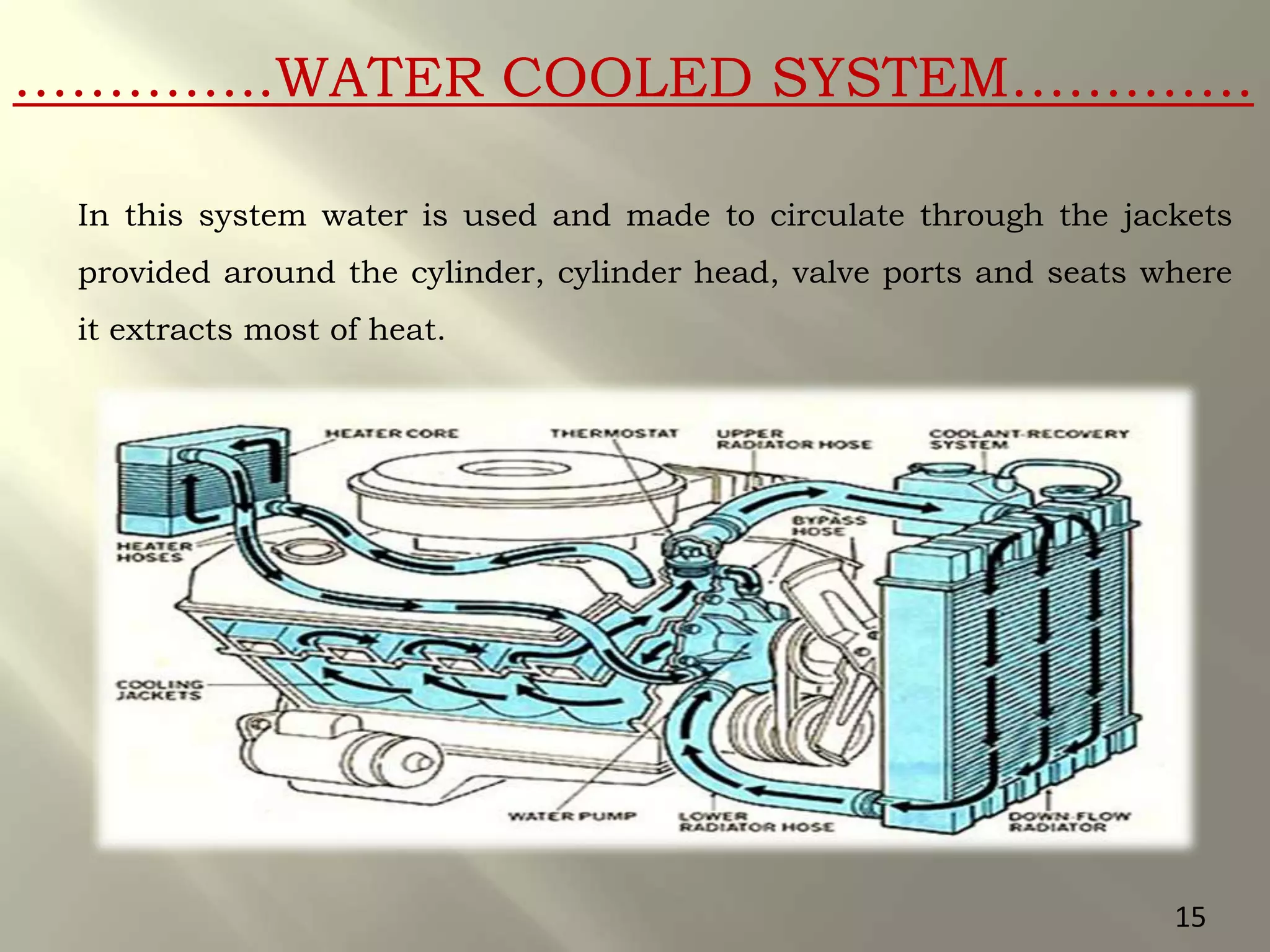
In this system water is used and made to circulate through the jackets
provided around the cylinder, cylinder head, valve ports and seats where
it extracts most of heat.
15
……TYPES OF WATER COOLED SYSTEM……
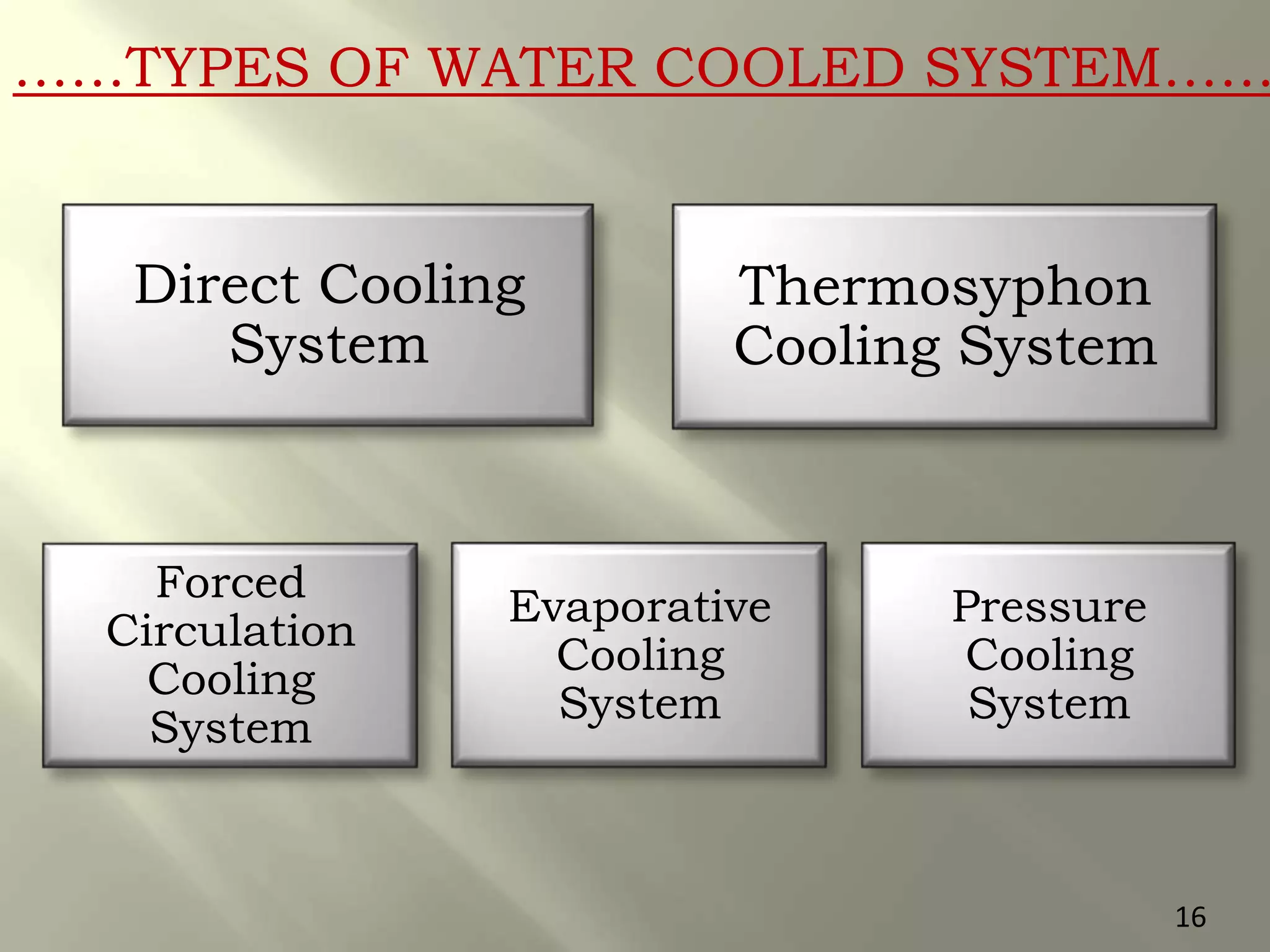
Direct Cooling
System
Thermosyphon
Cooling System
Forced
Circulation
Cooling
System
Evaporative
Cooling
System
Pressure
Cooling
System
16
1. Direct Cooling System
This system is used where plenty of water is available. The water is
supplied from large tank or river through the inlet valve of cooling
water jacket.
 The main specification of this system is that Hot
water is not cooled but simply discharged.
NOTE
17
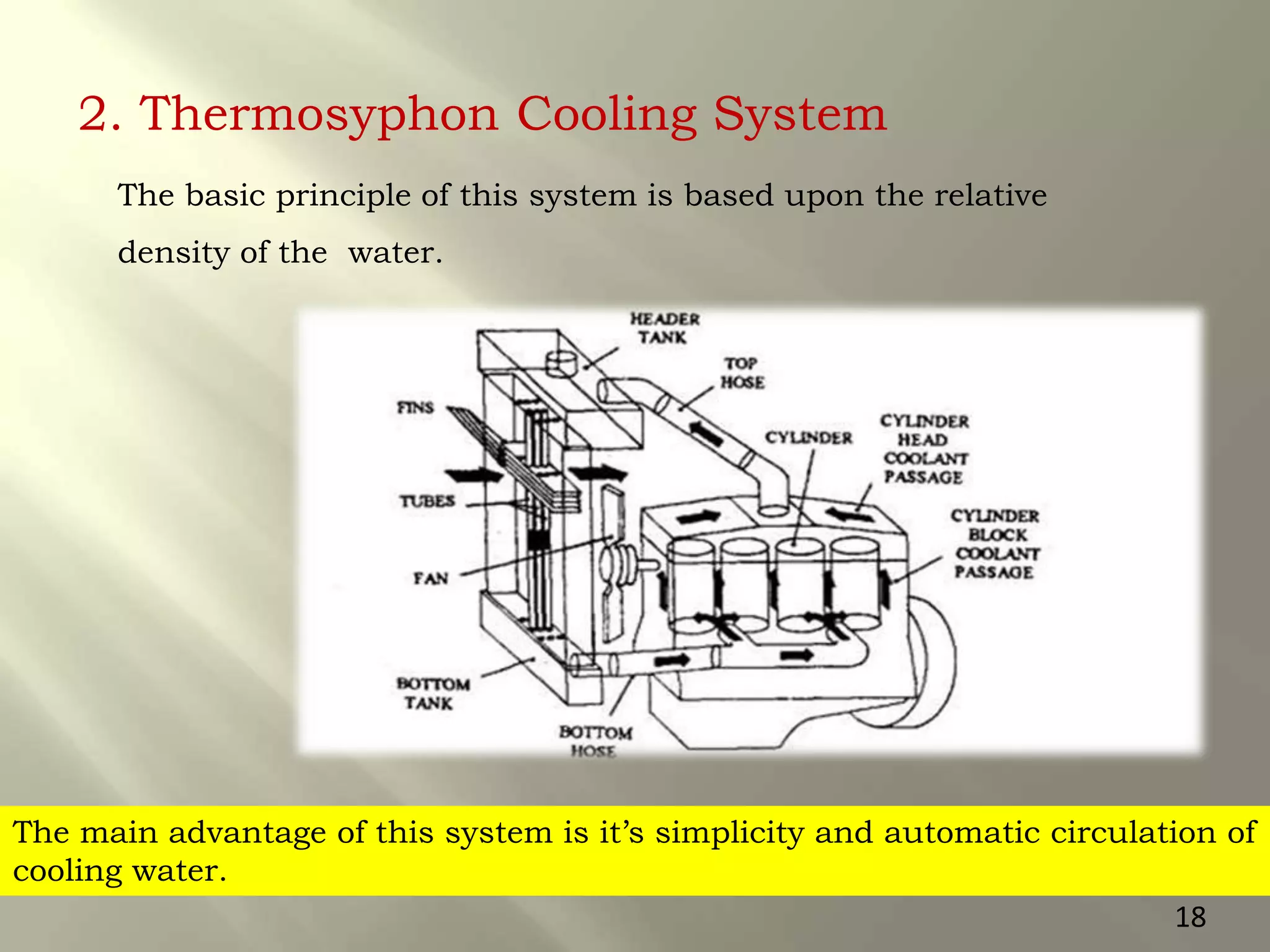
2. Thermosyphon Cooling System
The basic principle of this system is based upon the relative
density of the water.
The main advantage of this system is it’s simplicity and automatic circulation of
cooling water.
18
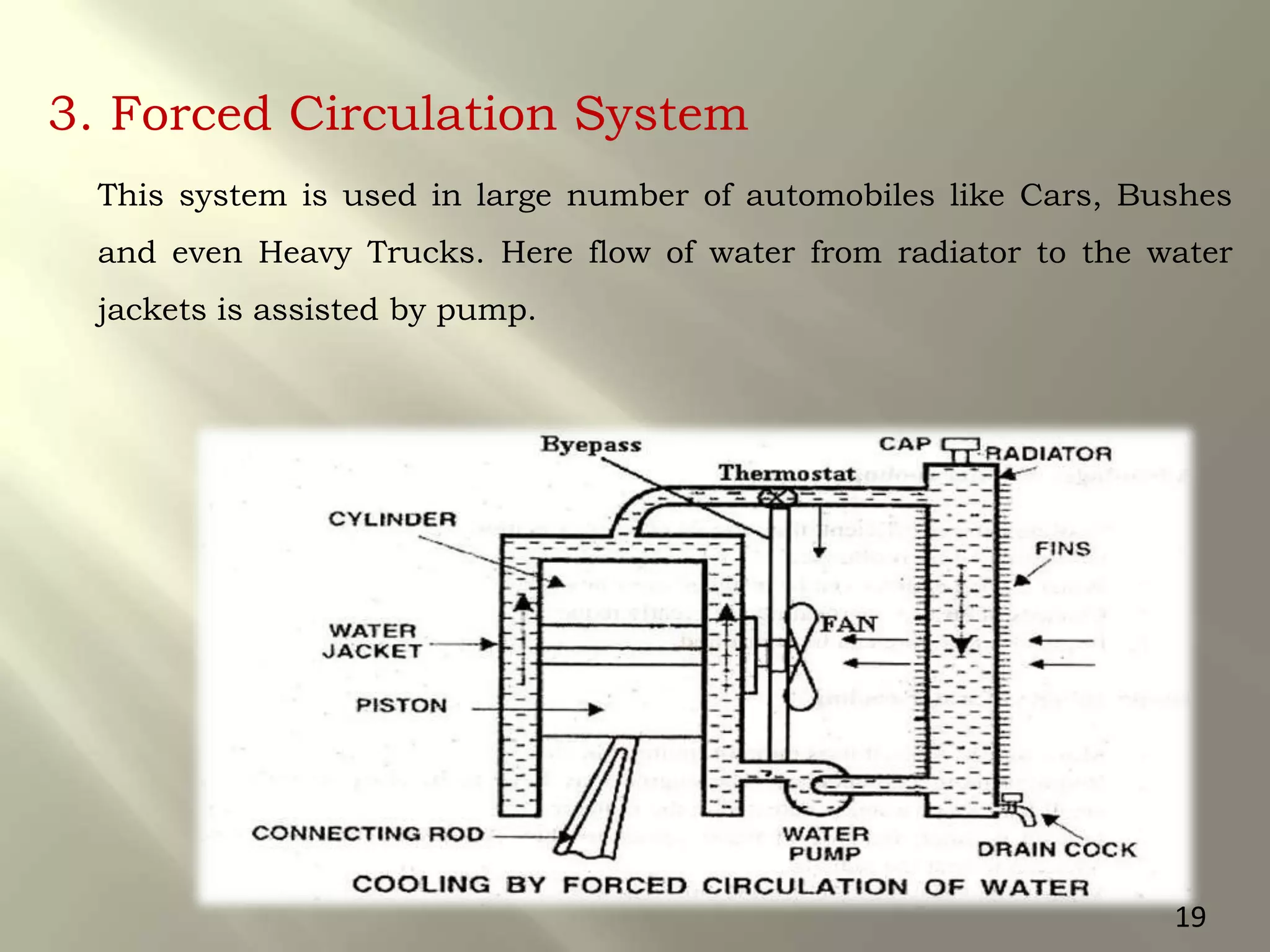
3. Forced Circulation System
This system is used in large number of automobiles like Cars, Bushes
and even Heavy Trucks. Here flow of water from radiator to the water
jackets is assisted by pump.
19
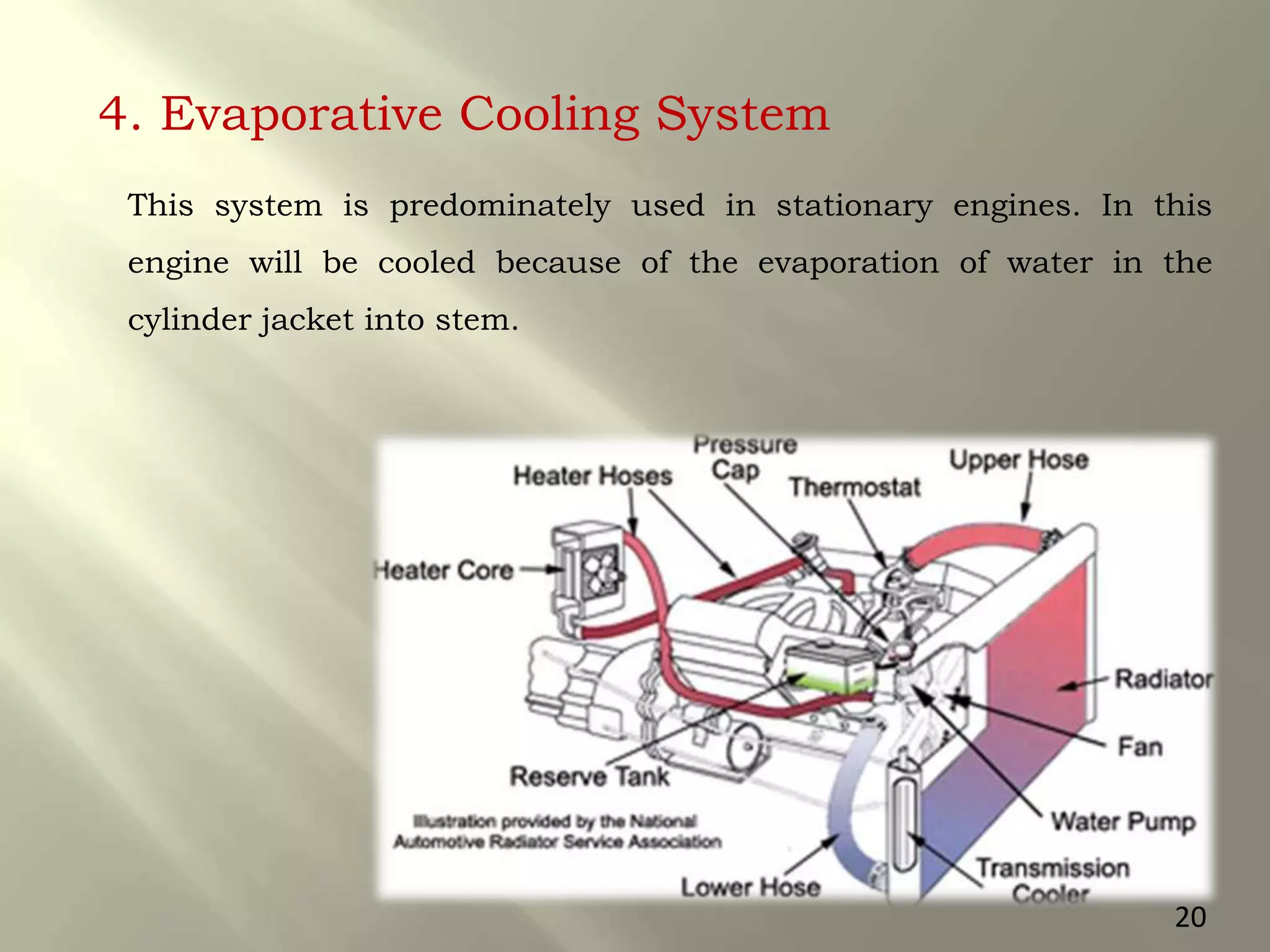
4. Evaporative Cooling System
This system is predominately used in stationary engines. In this
engine will be cooled because of the evaporation of water in the
cylinder jacket into stem.
20
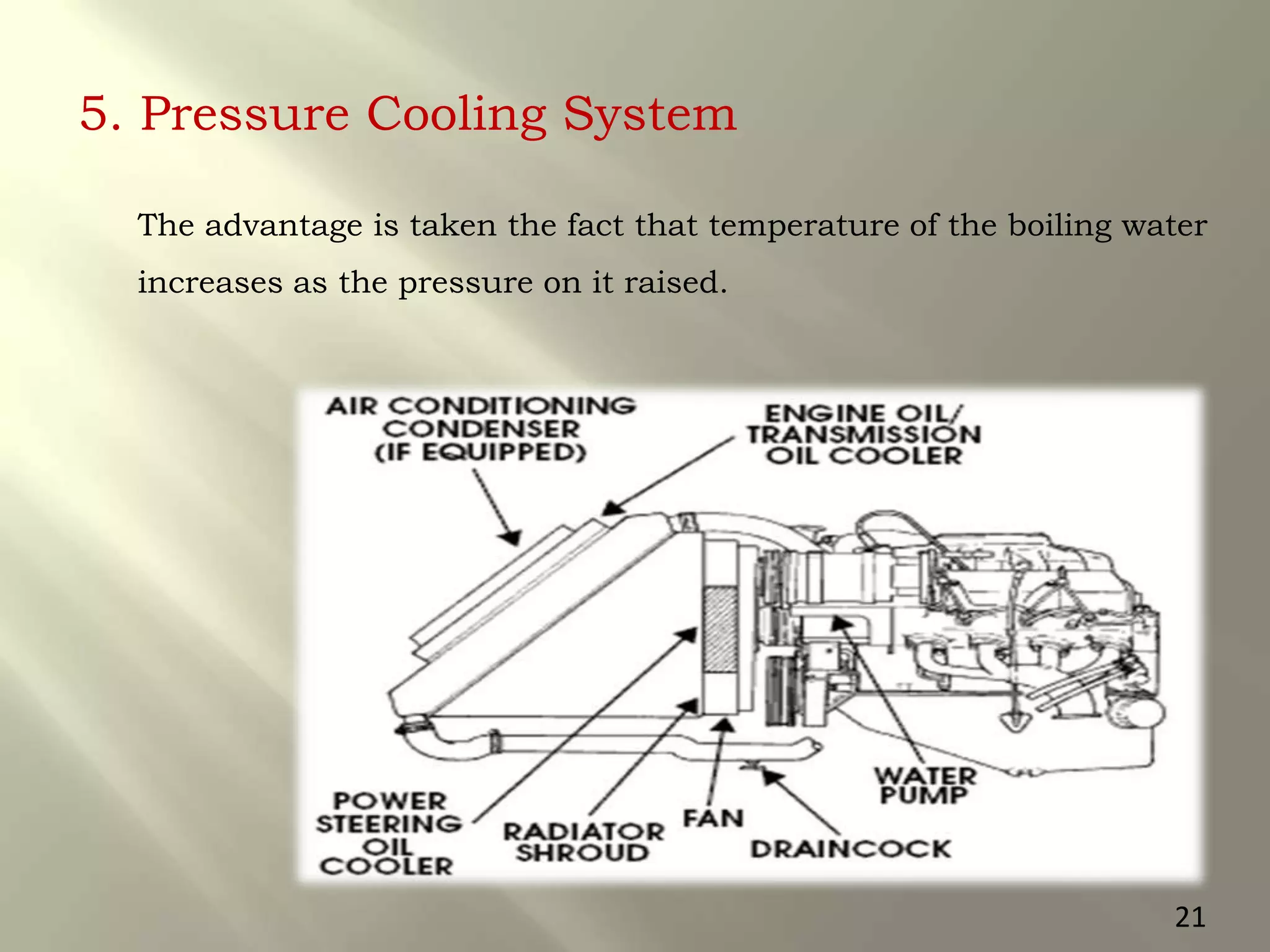
5. Pressure Cooling System
The advantage is taken the fact that temperature of the boiling water
increases as the pressure on it raised.
21
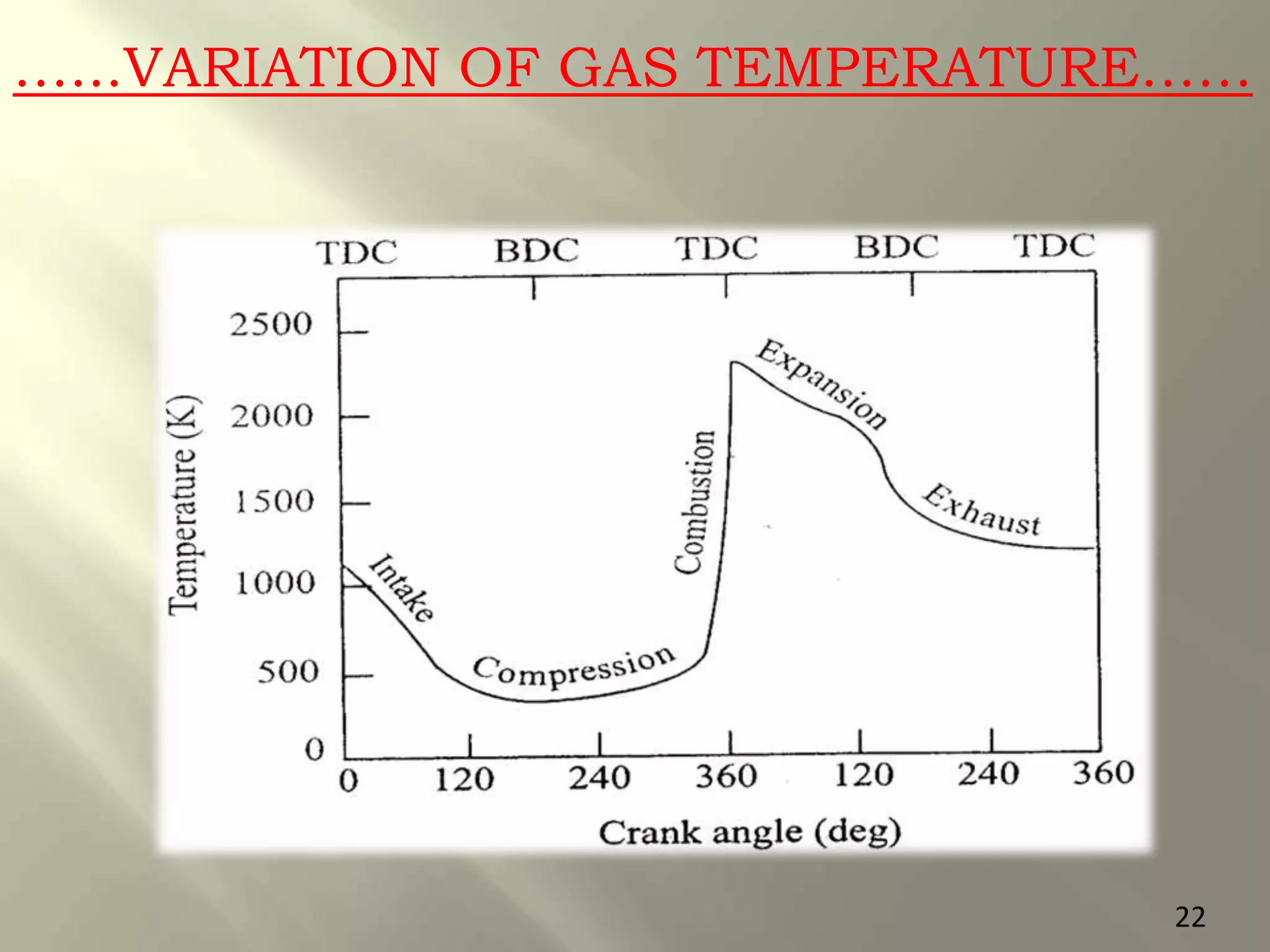
…...VARIATION OF GAS TEMPERATURE……
22
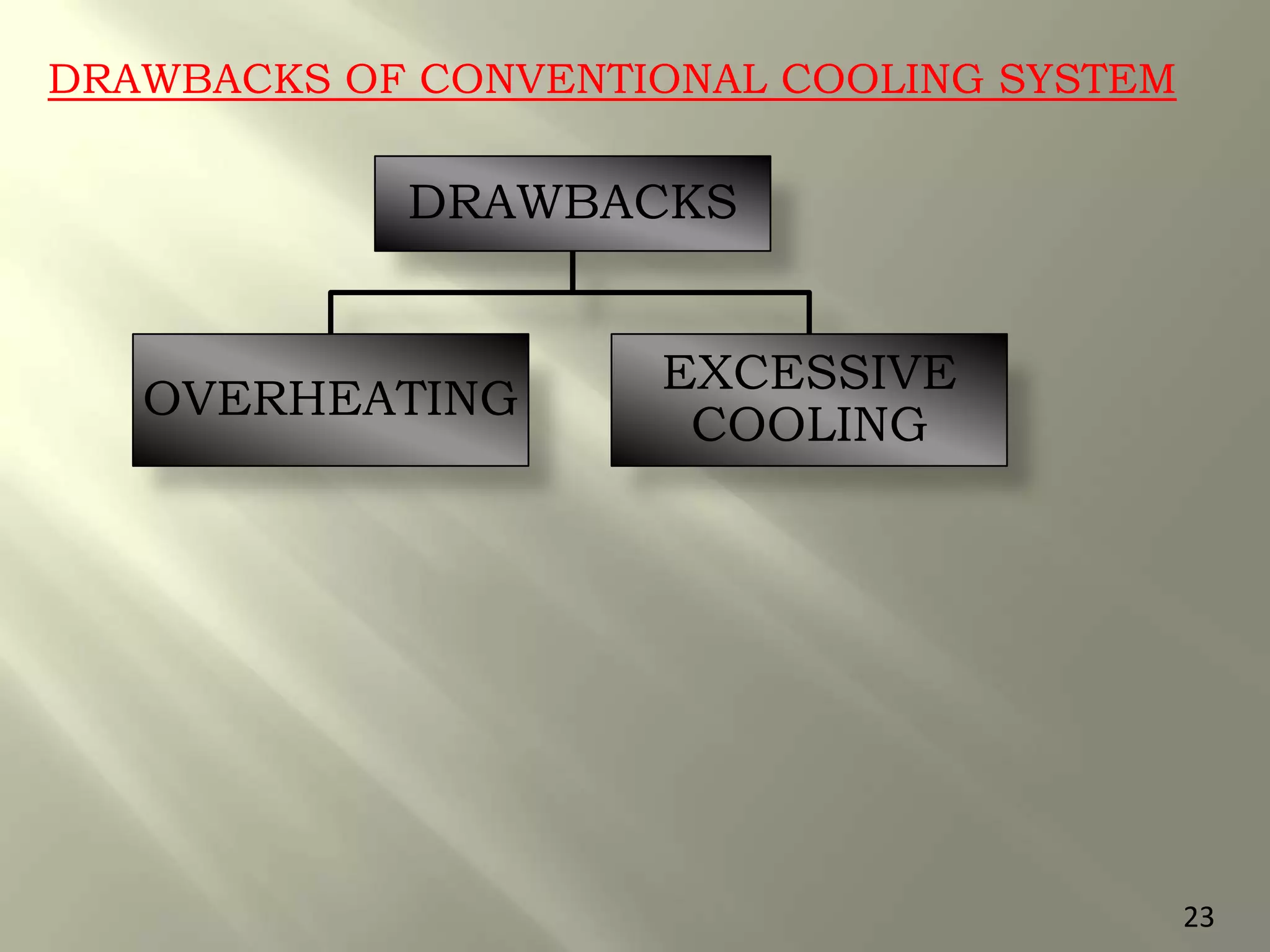
DRAWBACKS OF CONVENTIONAL COOLING SYSTEM
DRAWBACKS
OVERHEATING
EXCESSIVE
COOLING
23
24
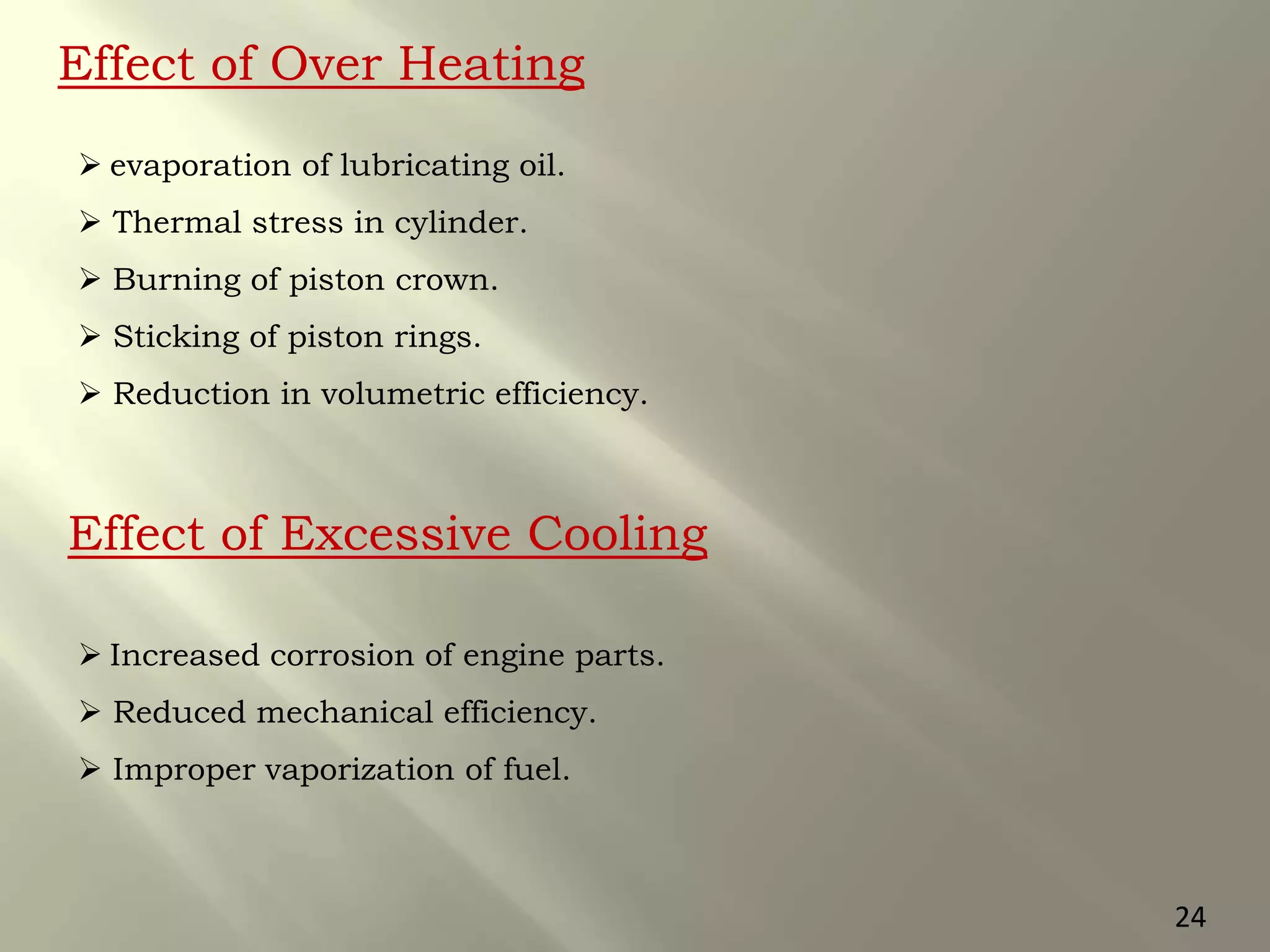
Effect of Over Heating
 evaporation of lubricating oil.
 Thermal stress in cylinder.
 Burning of piston crown.
 Sticking of piston rings.
 Reduction in volumetric efficiency.
Effect of Excessive Cooling
 Increased corrosion of engine parts.
 Reduced mechanical efficiency.
 Improper vaporization of fuel.
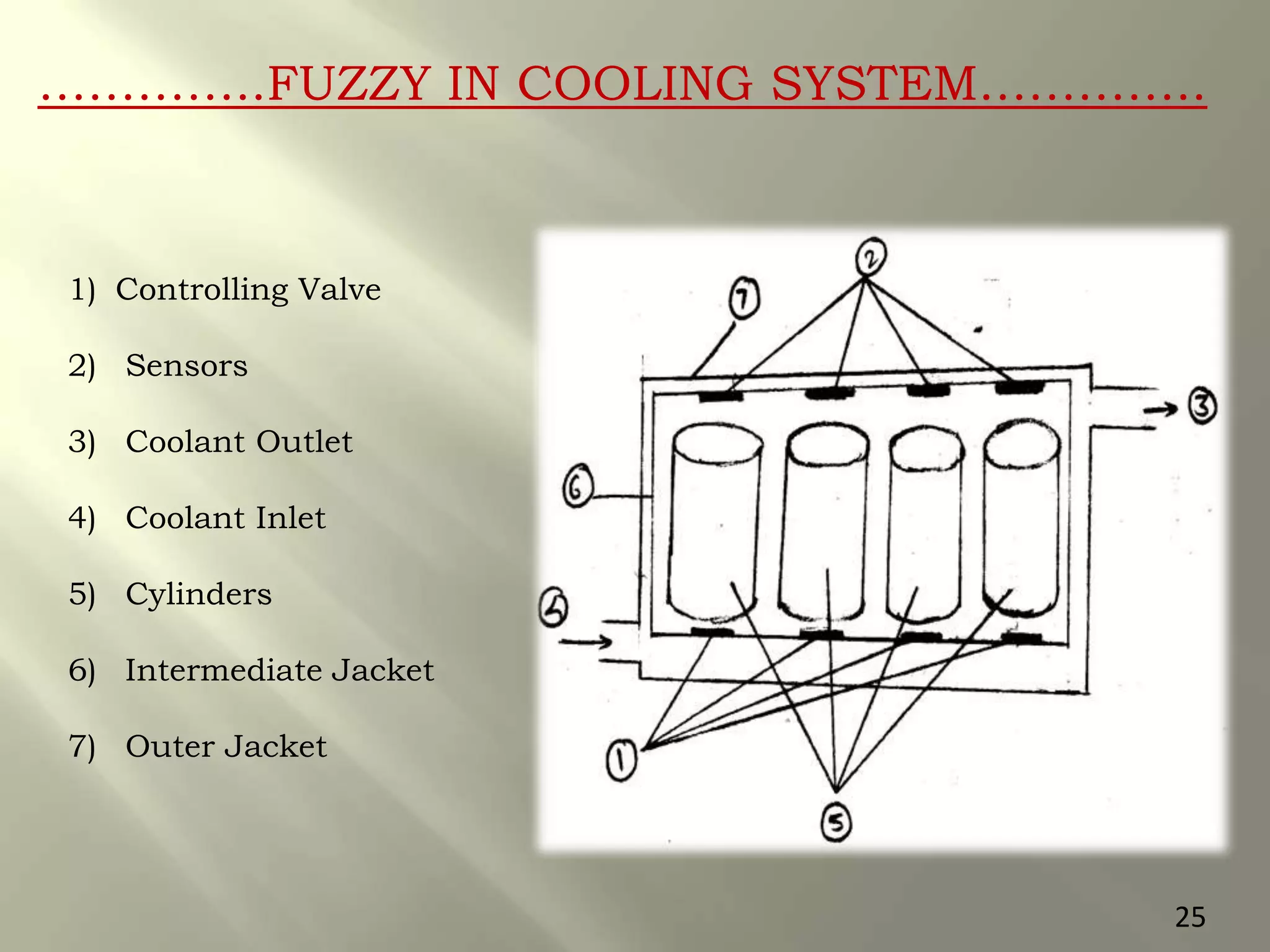
…………..FUZZY IN COOLING SYSTEM…………..
1) Controlling Valve
2) Sensors
3) Coolant Outlet
4) Coolant Inlet
5) Cylinders
6) Intermediate Jacket
7) Outer Jacket
25
ADVANTAGES OF INTELLIGENT COOLING SYSTEM
 Lubricating oil not evaporate and prevent metal to metal contact.
 Reduces Thermal stress, hence cracking of piston.
 Thermal efficiency will improve.
 Prevent Corrosion of Engine parts.
 Less maintenance will require.
 Proper vaporization of fuel take place.
 Less maintenance will require.
26
CONCLUSION
We have proposed an approach to implement fuzzy logic in an
“INTELLIGENT COOLING SYSTEM” possible implication of the system
and approach discussed with it’s possible advantages.
Future scope is concentrated on the type of sensor’s valve opening
mechanism and different coolants.
27
REFRENCES
1) R.K. RAJPUT, Internal Combustion Engines, Second Edition,
Published by: Laxmi Publication, Page No. 482, 484, 501.
2) Gnesan V. I., Internal Combustion Engines, Second Edition,
Published by: Tata McGraw – Hill, Page No. 469, 479.
3) Stamatios V. Kartalopoulos, Understanding Fuzzy Logic, Second Edition,
Published by: Asoke K. Ghosh, Prentice-Hall, Page No. 121, 124, 131.
4) http://www.howstuffworks.com/cooling-system10.htm
28
29
30

Intelligent Cooling system

  • 1.
    SEMINAR ON “INTELLIGENT COOLING SYSTEM” SubmittedBy:- Bhupender SinghUnder The Guidance of: Er. Amit Jain 1
  • 2.
    …………CONTENTS…………… Introduction Necessity of CoolingSystem Basic components of cooling system Types of cooling system  Variation in gas temperature  Drawbacks of conventional cooling system  Fuzzy in cooling system Advantages of Intelligent Cooling System Conclusion  References 2
  • 3.
    …………….INTRODUCTION……………... The name “INTELLIGENTCOOLING SYSTEM” represents the improved function of a cooling system. The name is so given because in this system a sensor senses the cylinder temperature & controls the opening & closing of water passage in piston-cylinder arrangement.The basic principle behind this is to control flow rate of coolant by regulating the valve by implementing FUZZY LOGIC. 3
  • 4.
    ….....NECESSITY OF COOLINGSYSTEM.…….  The even expansion of the piston in the cylinder may result in the seizure of the piston.  High temperature reduces the strength of piston.  Overheated cylinder may lead to pre-ignition of fuel.  Physical and chemical change may occur in the lubricating oil which may cause sticking of piston ring and excessive wear of cylinder.  If cylinder head temperature is high then power output of engine is reduced. 4
  • 5.
  • 6.
    ….BASIC COMPONENTS OFCOOLING SYSTEM….  Radiator  Thermostat Valve  Water Pump  Cooling Fan  Water Jackets  Coolant  Antifreeze Mixture 6
  • 7.
    1. Radiator Radiators areheat exchangers used to transfer thermal energy from one medium to another for the purpose of cooling and heating. 7
  • 8.
    2. Thermostat Valve Itis a valve which prevents the flow of water from engine to radiator until the engine warmed up. When engine is cooled no coolant, flow through the engine. 8
  • 9.
    3. Water Pump Itis used to pump the circulating water. The water pump is a simple centrifugal pump driven by a belt connected to the crankshaft of the engine. The pump circulates fluid whenever the engine is running. 9
  • 10.
    4. Cooling Fan Itis driven by the engine output shaft through the same belt that drives the pump. It is provided behind the radiator and it blows air over the radiator for cooling purpose. 10
  • 11.
    5. Water Jacket Coolingwater jackets are provided around the cylinder, cylinder head, valve seats, and any hot part which are to be cooled. Heat generated in the cylinder is conducted to the Jacket. 11
  • 12.
    6. Antifreeze Mixture Methyl, ethyl & isopropyl alcohols  A solution of alcohol and water  Ethylene Glycol  Glycerin along with water, etc. To prevent the freezing of cooling water in western countries antifreeze mixture are added to the cooling water. There are the following type of antifreeze mixtures :- 12
  • 13.
    …………...TYPES OF COOLINGSYSTEM..………….. Cooling System Air Cooling System Water Cooling System 13
  • 14.
    …………..…AIR COOLED SYSTEM……………….. Inthe air cooled system the heat is dissipated through the fins provided on the cylinder barrel. This method increase the cooling rate. Fins are provided right angle to the cylinder axis.  Engines (Two Wheelers)  Electric Motors  Gas compressors  Industrial & Agriculture Engines 14
  • 15.
    …………..WATER COOLED SYSTEM…………. Inthis system water is used and made to circulate through the jackets provided around the cylinder, cylinder head, valve ports and seats where it extracts most of heat. 15
  • 16.
    ……TYPES OF WATERCOOLED SYSTEM…… Direct Cooling System Thermosyphon Cooling System Forced Circulation Cooling System Evaporative Cooling System Pressure Cooling System 16
  • 17.
    1. Direct CoolingSystem This system is used where plenty of water is available. The water is supplied from large tank or river through the inlet valve of cooling water jacket.  The main specification of this system is that Hot water is not cooled but simply discharged. NOTE 17
  • 18.
    2. Thermosyphon CoolingSystem The basic principle of this system is based upon the relative density of the water. The main advantage of this system is it’s simplicity and automatic circulation of cooling water. 18
  • 19.
    3. Forced CirculationSystem This system is used in large number of automobiles like Cars, Bushes and even Heavy Trucks. Here flow of water from radiator to the water jackets is assisted by pump. 19
  • 20.
    4. Evaporative CoolingSystem This system is predominately used in stationary engines. In this engine will be cooled because of the evaporation of water in the cylinder jacket into stem. 20
  • 21.
    5. Pressure CoolingSystem The advantage is taken the fact that temperature of the boiling water increases as the pressure on it raised. 21
  • 22.
    …...VARIATION OF GASTEMPERATURE…… 22
  • 23.
    DRAWBACKS OF CONVENTIONALCOOLING SYSTEM DRAWBACKS OVERHEATING EXCESSIVE COOLING 23
  • 24.
    24 Effect of OverHeating  evaporation of lubricating oil.  Thermal stress in cylinder.  Burning of piston crown.  Sticking of piston rings.  Reduction in volumetric efficiency. Effect of Excessive Cooling  Increased corrosion of engine parts.  Reduced mechanical efficiency.  Improper vaporization of fuel.
  • 25.
    …………..FUZZY IN COOLINGSYSTEM………….. 1) Controlling Valve 2) Sensors 3) Coolant Outlet 4) Coolant Inlet 5) Cylinders 6) Intermediate Jacket 7) Outer Jacket 25
  • 26.
    ADVANTAGES OF INTELLIGENTCOOLING SYSTEM  Lubricating oil not evaporate and prevent metal to metal contact.  Reduces Thermal stress, hence cracking of piston.  Thermal efficiency will improve.  Prevent Corrosion of Engine parts.  Less maintenance will require.  Proper vaporization of fuel take place.  Less maintenance will require. 26
  • 27.
    CONCLUSION We have proposedan approach to implement fuzzy logic in an “INTELLIGENT COOLING SYSTEM” possible implication of the system and approach discussed with it’s possible advantages. Future scope is concentrated on the type of sensor’s valve opening mechanism and different coolants. 27
  • 28.
    REFRENCES 1) R.K. RAJPUT,Internal Combustion Engines, Second Edition, Published by: Laxmi Publication, Page No. 482, 484, 501. 2) Gnesan V. I., Internal Combustion Engines, Second Edition, Published by: Tata McGraw – Hill, Page No. 469, 479. 3) Stamatios V. Kartalopoulos, Understanding Fuzzy Logic, Second Edition, Published by: Asoke K. Ghosh, Prentice-Hall, Page No. 121, 124, 131. 4) http://www.howstuffworks.com/cooling-system10.htm 28
  • 29.
  • 30.