University of pune
PROJECT REPORT
ON
“EDDY CURRENT Braking System ”
SUBMITTED BY
MUTEKAR ANIKET B80260854
JAGTAP DEEPAK N. B80260856
JAGDALE GIRISHKUMAR N. B80260825
KAKADE AKASH S. B80260865
GUIDED BY
PROF. B.K SURYATAL
DEPARTMENT OF MECHANICAL ENGINEERING
P.D.E.A’S
COLLEGE OF ENGINEERING
MANJARI(BK), PUNE-412307
Pune District Education Association’s
COLLEGE OF ENGINEERING
Manjari (Bk), Pune-412307
CERTIFICATE
This is to certify that following students have successfully and satisfactorily completed
and submitted their project “EDDY CURRENT BRAKES” in fulfillment of final year of
degree course in Mechanical Engineering prescribed by University of Pune for academic
year 2013-2014.
Project Team
MUTEKAR ANIKET B80260854
JAGTAP DEEPAK N. B80260856
JAGDALE GIRISHKUMAR N. B80260825
KAKADE AKASH S. B80260865
Prof . B. K. SURYATAL Prof. D. A. KAMBLE
(Project Guide) (H.O.D)
External Examiner Dr. K.R. HARNE
(Principal)
ACKNOWLEDGEMENT
We owe a sincere gratitude towards all those who helped and supported us during this
project.
Our deepest thanks to Prof. B.K. Suryatal our project guide for guiding and correcting
various of our project, with attention and care. He has guided us to go through our project and
make required corrections, and it is because of him our project is completed and successful.
We are also thankful to our Principal Dr. K.R. Harne and H.O.D.Prof. D.A. Kamble
for their valuable guidance for this project.
MUTEKAR ANIKET B80260854
JAGTAP DEEPAK N. B80260856
JAGDALE GIRISHKUMAR N. B80260825
KAKADE AKASH S. B80260865
INDEX
TITLE PAGE NO.
CHAPTER 1:
INTRODUCTION
1.1 INTRODUCTION…………………………………………………
CHAPTER 2:
WORKING
2.1 OPERATION PRINCIPLE………………………………………...
2.2 WORKING…………………………………………………………
CHAPTER 3:
APPARATUS LIST
3.1 LIST OF APPARATUS……………………………………………
CHAPTER 4:
SELECTION OF MOTOR
4.1 POWER REQUIREMENT………………………………………
4.2 SCALE CALCULATION……………………………………….
4.3 MOTOR SPECIFICATION……………………………………...
CHAPTER 5:
ROTOR DESIGN:
5.1 ROTOR MATERIAL……………………………………………
5.2 ROTOR SPECIFICATION………………………………………
5.3 ISOMETRIC VIEW OF ROTOR………………………………..
5.4 DETAILING OF ROTOR………………………………………..
CHAPTER 6:
SHAFT DESIGN
6.1 SHAFT REQUIREMENT……………………………………………………………
6.2 SHAFT SPECIFICATION…………………………………………………………..
6.3 MACHINING OPERATIONS PERFORMED ON SHAFT………………………..
6.4 ISOMETRIC VIEW OF SHAFT……………………………………………………
6.5 DETAILING OF SHAFT……………………………………………………………
6.6 STRUCTURAL ANALYSIS ON ANSYS…………………………………………..
CHAPTER 7:
STATOR DESIGN
7.1 STATOR MATERIAL……………………………………………
7.2 STATOR SPECIFICATION……………………………………...
7.3 ISOMETRIC VIEW OF STATOR……………………………….
7.4 DETAILING OF STATOR………………………………………
CHAPTER 8:
BASE DESIGN
8.1 BASE MATERIAL………………………………………………...
8.2 BASE SPECIFICATION…………………………………………..
8.3 ISOMETRIC VIEW OF BASE PLATE……………………………
8.4 DETAILING OF BASE PLATE…………………………………...
CHAPTER 9:
ASSEMBLED MODEL
9.1 ASSEMBLY………………………………………………………..
CHAPTER 10:
COST ESTIMATION
10.1 COST ESTIMATION LIST……………………………………….
CHAPTER 11:
CONCLUSION
11.1 CONCLUSION……………………………………………………
REFRENCES
PHOTO GALLERY
ABSTRACT
This Project is directed at creating an integrated electric motor and eddy current brake. This
combination is designed to be used in the automotive industry as an electric all-wheel drive system
that can be managed by available traction and stability control technology.
This project does not address the control aspect of the system; it addresses the physical
concept of using an induced electromagnetic field to slow down the proposed vehicle. The goal is
reducing the lifetime maintenance of a vehicle and eliminating several high maintenance parts.
This system is designed as a “frictionless” system and although it is not completely
frictionless it eliminates the need for standard hydraulic brake pads and rotors which wear and fail
due to friction and material loss. This could save the consumer time and money in maintenance.
Many of the ordinary brakes, which are being used these days stop the vehicle by means
of mechanical blocking. This causes skidding and wear and tear of the vehicle. If the speed of the
vehicle is very high, the brake cannot provide that much high braking force and it will cause
problems. These drawbacks of ordinary brakes can be overcome by a simple and effective
mechanism of magnetic braking system aka 'The eddy current brake'. It is an abrasion-free method
for braking of vehicles including trains. It makes use of the opposing tendency of eddy current.
Eddy current is the swirling current produced in a conductor, which is subjected to a change
in magnetic field. Because of the tendency of eddy currents to oppose, eddy currents cause energy
to be lost. More accurately, eddy currents transform more useful forms of energy such as kinetic
energy into heat, which is much less useful. In many applications, the loss of useful energy is not
particularly desirable. But there are some practical applications. Such application is the eddy
current brake.
INTRODUCTION
Many of the ordinary brakes, which are being used these days stop the vehicle by means
of mechanical blocking. This causes skidding and wear and tear of the parts of the vehicle. If the
speed of the vehicle is very high, the brake cannot provide that much high braking force and it
could cause the problems.
These drawbacks of ordinary brakes can be overcome by a simple and effective mechanism
of braking system named as 'The eddy current brake'. It is an abrasion-free method for braking of
vehicles including trains. It makes use of the opposing tendency of eddy current.
Eddy current is the swirling current produced in a conductor, which is subjected to a change
in magnetic field. Because of the tendency of eddy currents to oppose, eddy currents cause energy
to be lost. More accurately, eddy currents transform more useful forms of energy such as kinetic
energy into heat, which is much less useful. In many applications, the loss of useful energy is not
particularly desirable. But there are some practical applications. Such an application is the eddy
current brake.
PRINCIPLE OF OPERATION
Eddy current brake works according to Faraday's law of electromagnetic induction.
According to this law, whenever a conductor cuts magnetic lines of forces, an electromagnetic
field (emf) is induced in the conductor, the magnitude of which is proportional to the strength of
magnetic field and the speed of the conductor. If the conductor is a disc, there will be circulatory
currents i.e. eddy currents in the disc. According to Lenz's law, the direction of the current is in
such a way as to oppose the cause, i.e. movement of the disc.
Essentially the eddy current brake consists of two parts, a stationary magnetic field system
and a solid rotating part, which is a copper metal disc. During braking, the metal disc is exposed
to a magnetic field from an electromagnet, generating eddy currents in the disc. The magnetic
interaction between the applied field and the eddy currents slow down the rotating disc. Thus the
wheels of the vehicle also slow down since the wheels are directly coupled to the disc of the eddy
current brake, thus producing smooth stopping motion.
This can be summarized as:
1. Eddy current brakes develop torque by the direct magnetic linking of the rotor to the stator.
2. This linking generates eddy currents in the driving rotor.
3. Eddy current brakes must have a slip between the rotor and the stator to generate torque.
4. An eddy current brake having an electromagnetic pole and the rotor is positioned in close
proximity to the stator with an air gap between them.
5. The stator comprises steel pole pieces with hollow cores that establish a magnetic circuit
for a magnetic flux field.
6. The pole pieces have machine-wound electrical windings.
7. The windings are fastened with pole caps.
8. The hollow core reduces the weight and material of the stator without significantly
adversely affecting the braking capacity.
9. The pole caps reduce the magnetic saturation and increases the overall brake torque output.
WORKING:
Essentially an eddy current brake consists of two members, a stationary magnetic field
system and a solid rotary member, generally of mild steel, which is sometimes referred to as the
secondary because the eddy currents are induced in it. Two members are separated by a short air
gap, they're being no contact between the two for the purpose of torque transmission. Consequently
there is no wear as in friction brake.
Stator consists of pole core, pole shoe, and field winding. The field winding is wounded
on the pole core. Pole core and pole shoes are made of east steel laminations and fixed to the state
of frames by means of screw or bolts. Copper and aluminum is used for winding material the
arrangement is shown in fig. 1. This system consists of two parts.
1. Stator
2. Rotor
When the vehicle is moving, the rotor disc of eddy current brake which is coupled to the
wheels of the vehicle rotates, in close proximity to stationary magnetic poles. When we want to
brake the vehicle, a control switch is put on which is placed on the steering column in a position
for easy operation.
When the control switch is operated, current flows from a battery to the field winding, thus
energizing the magnet. Then the rotating disc will cut the magnetic field. When the disc cuts the
magnetic field, flux changes occur in the disc which is proportional to the strength of the magnetic
field. The current will flow back to the zero field areas of the metal plate and thus create a closed
current loop like a whirl or eddy.
A flow of current always means there is a magnetic field as well. Due to Lenz's law, the
magnetic field produced by the eddy currents works against the movement direction. Thus instead
of mechanical friction, a magnetic friction is created. In consequence, the disc will experience a
"drag" or the braking effect, and thus the disc stops rotation. The wheels of the vehicle, which is
directly coupled to the disc, also stop rotation. Faster the wheels are spinning, stronger the effect,
meaning that as the vehicle slows, the braking force is reduced producing a smooth stopping action.
SELECTION OF MOTOR
4.1 POWER REQUIREMENT
A normal average light weight truck power: 200HP
4.2 SCALE CALCULATIONS: SCALE USED
(1:200)
OBJECT BEING SCALED*SCALE FACTOR
200HP*1/200
1HP
Thus our requirement is of a 1HP motor.
4.3 MOTOR SPECIFICATION
Given below is the motor specification we have used.
NAME OF MANUFACTURER
POWER 1HP
POWER SUPPLY NEEDED 3 PHASE
WEIGHT 15KG
SPEED 2800
COST 2000RS
ROTOR DESIGN
REQUIREMENTS OF ROTOR:
1. Rotor should be a good conducting material.
2. It should be non magnetic in nature.
ROTOR SPECIFICATIONS:
ROTOR MATERIAL COPPER
ROTOR DIAMETER 130MM
ROTOR THICKNESS 10MM
ROTOR WEIGHT 1KG
A Copper disc of 120mm was difficult to get even after days of search we
could not find it.
So we decided to cut a square copper plate to the required diameter.
MACHINE OPERATIONS:
NAME OF OPERATION MACHINE USED
CUTTING CNC-GAS CUTTING
DRILLING DRILL MACHINE
FINISHING GRINDER
ROTOR ISO-METIRC VIEW
SHAFT DESIGN
6.1 SHAFT REQUIREMENT:
1. Shaft would be rotated by a 1HP motor at 2800 RPM.
2. A copper plate (rotor) would be mounted on the shaft.
6.2 SHAFT SPECIFICATION:
Following are the shaft specifications
SHAFT MATERIAL MS
SHAFT DIAMETER 18MM
SHAFT LENGTH 330MM
SHAFT WEIGHT 0.8 KG
One end of the shaft is linked to the motor through universal coupling, and the
other end to a bearing.
Thus the 2 ends are machined according to the required diameters of the
coupling and bearing.
6.3 OPERATIONS PERFORMED ON SHAFT
OPERATION PERFORMED MACHINE USED
FACING LATHE MACHINE
TURNING LATHE MACHINE
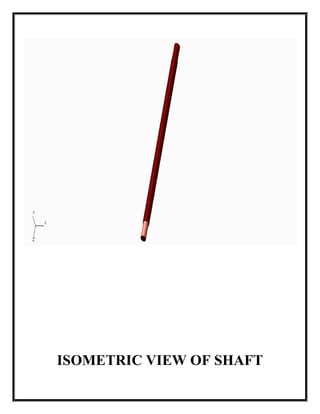
ISOMETRIC VIEW OF SHAFT
STRESS ANALYSIS ON ANSYS
TOTAL DEFORMATION IN SHAFT
ISOMETRIC VIEW OF STATOR
ISOMETRIC VIEW OF BEARING
DESIGN OF BASE PLATE
8.1 BASE MATERIAL
The base plate would be holding the whole assembly unit which weights
approximately around 40kgs.
We had many options for base plate, like steel, mild steel, wood, iron etc.
But we decided to use WOODEN BASE, because of following reasons:
1. Easily available.
2. Cheap as compared to other materials.
3. Provides good insulation.
8.2 SPECIFICATION OF WOODEN BASE PLATE:
LENGTH 1200MM
BREADTH 400MM
THICKNESS 20MM
COST 400RS
ISOMETRIC VIEW OF BASE
PLATE
Friday, April 18, 2014
8:28 PM
ASSEMBLY OF PROJECT ON PRO-E
COST ESTIMATION
According to the design of magnetic brakes, following material were
required for it. The cost estimation for is given in the below table.
TOTAL : Rs.15100
SR NO OBJECT NAME OBJECT
SPECIFICATION
COST(RS)
1 3 PHASE MOTOR IHP-2800RPM 2500
2 SHAFT 18MM DIAMETER
300MM LENGTH
200
3 BEARING SIZE 202 350
4 UNIVERSAL COUPLING M.S 350
5 BASE PLATE WOODEN 300
6 STATOR 130MM
DIAMETER-
STAINLESS STEEL
3000
7 STATOR MACHINING 2500
8 COPPER ROTOR 130MM
DIAMETER, 10MM
THICK
1600
9 COPPER WINDINGS 1800
10 CAPACITOR 300
11 WORK SHOP CHARGES 1000
12 OTHER 1500
Advantages
An eddy current brake is strongest when the speed is highest as you are generating a
stronger field which provides more braking. This diminishes with speed so at low speeds it is very
weak. For positive braking you need another type of brake such as friction. You could use an eddy
current brake to provide initial braking at high speeds and supplement that with a friction brake to
provide the final braking function.
An eddy current brake could also just be used as a governor to resist over speed. The main
advantage of an eddy-current brake is that it uses electromagnetic force and not mechanical
friction. Mechanical friction means that the two contacting surfaces wear out over time. Wearing
out also means releasing very small particles of the materials into the environment.
Advantages can be summarized as:
1.It uses electromagnetic force and not mechanical friction
2.Non-mechanical (no moving parts, no friction)
3.Fully resettable
4.Can be activated at will via electrical signal
5.Low maintenance
6.Operates at any rotational speed
7.Light weight
Disadvantages
Disadvantages include braking force diminishing as speed diminishes with no ability to hold the
load in position at standstill. That could be considered to be a safety issue, but it really means
that friction braking may need to be used as well.
In short disadvantages can written as:
1.Braking force diminishes as speed diminishes with no ability to hold the load in
position at standstill.
2.That could be considered to be a safety issue, but it really means that friction braking
may need to be used as well.
3.Eddy-current brakes can only be used where the infrastructure has been modified to
accept them.
APPLICATIONS:
1. It is used as a stopping mechanism in trains.
2. It is also used in the smooth breaking and functioning of roller coasters and such fast moving
machines.
CONCLUSION:
The design of eddy current brakes is presented in the paper. Eddy current brakes provide
non-contact means to produce braking forces required to decelerate the motion of a moving
object. In this study, four systematic engineering design scenarios to design a braking system are
presented: a constant magnetic field, an optimal magnetic field distribution, piecewise-constant
magnetic fields and a section-wise guide rail with a constant magnetic field.
Further, the sudden increase in current could cause wire overload.
The piecewise constant magnetic field has the advantages of a preset terminal speed and
predictable wire current but it produces a higher speed. Alternatively, it is much easier to keep the
magnetic field constant and select the proper conductor materials. The advantages of these last two
designs using different materials along the guide rail are tolerable deceleration; and easy
manufacturing. A nearly maintenance-free system can be achieved if permanent magnet is utilized
to establish the magnetic field.
It should be noted that the simulation results show in the paper are based on the assumption
of using infinite conducting plate. For finite dimensional conducting plate, the required magnetic
field has to be increased so that the same design results (velocity and deceleration) can be
maintained. The amount of increase on the magnetic field depends on the physical dimension
So conclusion can be summarized as:
1. The ordinary brakes which are being used now days, stop the vehicle by means of
mechanical blocking. This causes skidding and wear and tear of the vehicle. If the speed of the
vehicle is very high, it cannot provide that much high braking force and it will cause problems.
2. These drawbacks of ordinary brakes can be overcome by a simple and effective
mechanism of braking system 'The eddy current brake'.
3. It is an abrasion-free method for braking of vehicles including trains. It makes use of the
opposing tendency of eddy current
REFERENCES:
1. Gagarin, G., Kroger, U. and Saunweber, E., ‘‘Eddy-current magnetic track brakes for
highspeed
trains,’’ Joint ASME/IEEE/AAR Railroad Conference, pp. 95–99, 1987.
2. Ohyma, T., ‘‘Adhesion at higher speeds, its basic characteristic, its improvement and some
related problem,’’ Japanese Railway Engineering, Vol. 108, 1988.
3. Mcconnell, H.M., ‘‘Eddy-current phenomena in ferromagnetic material,’’ AIEE Transactions,
Vol. 73, part I, pp. 226–234, July, 1954.
4. Kesavamurthy, N., ‘‘Eddy-current in solid iron due to alternating magnetic flux,’’ The
Institution of Engineers Monograph, No. 339U, pp. 207–213, June, 1959,
5. Biro, O. and Preis, K., ‘‘Finite element analysis of 3-D eddy current,’’ IEEE Transactions on
Magnetics, Vol. 26, No. 2, pp. 418–423, Mar, 1990.
6. Heald, M.A., ‘‘Magnetic braking: improved theory,’’ American Journal of Physics, Vol. 56,
No. 6, pp. 521–522, 1988.
Transactions of the Canadian Society for Mechanical Engineering, Vol. 35, No. 1, 2011 35
7. Jaw-Kuen Shiau, Der-Ming Ma, and Min Jou, ‘‘Analysis and experiments of eddy current
brakes with moving magnets,’’ Materials Science Forum, Vols. 575–578, pp. 1299–1304, 2008.
8. Ross Robert, B, Metallic Materials Specification Handbook, 4th edition, Springer, 1991.
9. Donald E. Kirk, Optimal Control Theory: An Introduction, Prentice-Hall, 1970.
10. Frank L. Lewis and Vassilis L. Syrmos, Optimal Control, 2nd edition, John Wiely & Sons,
1995.
11. Josef Stoer and Roland Bulirsch, Introduction to Numerical Analysis, Springer-Verlag, 1980.
12. James F. Parker and Vita R. West, Bioastronautics Data Book, 2nd edition, NASA SP-3006,
1973.

Eddy Current Braking System

  • 1.
    University of pune PROJECTREPORT ON “EDDY CURRENT Braking System ” SUBMITTED BY MUTEKAR ANIKET B80260854 JAGTAP DEEPAK N. B80260856 JAGDALE GIRISHKUMAR N. B80260825 KAKADE AKASH S. B80260865 GUIDED BY PROF. B.K SURYATAL DEPARTMENT OF MECHANICAL ENGINEERING P.D.E.A’S COLLEGE OF ENGINEERING MANJARI(BK), PUNE-412307
  • 2.
    Pune District EducationAssociation’s COLLEGE OF ENGINEERING Manjari (Bk), Pune-412307 CERTIFICATE This is to certify that following students have successfully and satisfactorily completed and submitted their project “EDDY CURRENT BRAKES” in fulfillment of final year of degree course in Mechanical Engineering prescribed by University of Pune for academic year 2013-2014. Project Team MUTEKAR ANIKET B80260854 JAGTAP DEEPAK N. B80260856 JAGDALE GIRISHKUMAR N. B80260825 KAKADE AKASH S. B80260865 Prof . B. K. SURYATAL Prof. D. A. KAMBLE (Project Guide) (H.O.D) External Examiner Dr. K.R. HARNE (Principal)
  • 3.
    ACKNOWLEDGEMENT We owe asincere gratitude towards all those who helped and supported us during this project. Our deepest thanks to Prof. B.K. Suryatal our project guide for guiding and correcting various of our project, with attention and care. He has guided us to go through our project and make required corrections, and it is because of him our project is completed and successful. We are also thankful to our Principal Dr. K.R. Harne and H.O.D.Prof. D.A. Kamble for their valuable guidance for this project. MUTEKAR ANIKET B80260854 JAGTAP DEEPAK N. B80260856 JAGDALE GIRISHKUMAR N. B80260825 KAKADE AKASH S. B80260865
  • 4.
    INDEX TITLE PAGE NO. CHAPTER1: INTRODUCTION 1.1 INTRODUCTION………………………………………………… CHAPTER 2: WORKING 2.1 OPERATION PRINCIPLE………………………………………... 2.2 WORKING………………………………………………………… CHAPTER 3: APPARATUS LIST 3.1 LIST OF APPARATUS…………………………………………… CHAPTER 4: SELECTION OF MOTOR 4.1 POWER REQUIREMENT……………………………………… 4.2 SCALE CALCULATION………………………………………. 4.3 MOTOR SPECIFICATION……………………………………...
  • 5.
    CHAPTER 5: ROTOR DESIGN: 5.1ROTOR MATERIAL…………………………………………… 5.2 ROTOR SPECIFICATION……………………………………… 5.3 ISOMETRIC VIEW OF ROTOR……………………………….. 5.4 DETAILING OF ROTOR……………………………………….. CHAPTER 6: SHAFT DESIGN 6.1 SHAFT REQUIREMENT…………………………………………………………… 6.2 SHAFT SPECIFICATION………………………………………………………….. 6.3 MACHINING OPERATIONS PERFORMED ON SHAFT……………………….. 6.4 ISOMETRIC VIEW OF SHAFT…………………………………………………… 6.5 DETAILING OF SHAFT…………………………………………………………… 6.6 STRUCTURAL ANALYSIS ON ANSYS………………………………………….. CHAPTER 7: STATOR DESIGN 7.1 STATOR MATERIAL…………………………………………… 7.2 STATOR SPECIFICATION……………………………………... 7.3 ISOMETRIC VIEW OF STATOR………………………………. 7.4 DETAILING OF STATOR………………………………………
  • 6.
    CHAPTER 8: BASE DESIGN 8.1BASE MATERIAL………………………………………………... 8.2 BASE SPECIFICATION………………………………………….. 8.3 ISOMETRIC VIEW OF BASE PLATE…………………………… 8.4 DETAILING OF BASE PLATE…………………………………... CHAPTER 9: ASSEMBLED MODEL 9.1 ASSEMBLY……………………………………………………….. CHAPTER 10: COST ESTIMATION 10.1 COST ESTIMATION LIST………………………………………. CHAPTER 11: CONCLUSION 11.1 CONCLUSION…………………………………………………… REFRENCES PHOTO GALLERY
  • 7.
    ABSTRACT This Project isdirected at creating an integrated electric motor and eddy current brake. This combination is designed to be used in the automotive industry as an electric all-wheel drive system that can be managed by available traction and stability control technology. This project does not address the control aspect of the system; it addresses the physical concept of using an induced electromagnetic field to slow down the proposed vehicle. The goal is reducing the lifetime maintenance of a vehicle and eliminating several high maintenance parts. This system is designed as a “frictionless” system and although it is not completely frictionless it eliminates the need for standard hydraulic brake pads and rotors which wear and fail due to friction and material loss. This could save the consumer time and money in maintenance. Many of the ordinary brakes, which are being used these days stop the vehicle by means of mechanical blocking. This causes skidding and wear and tear of the vehicle. If the speed of the vehicle is very high, the brake cannot provide that much high braking force and it will cause problems. These drawbacks of ordinary brakes can be overcome by a simple and effective mechanism of magnetic braking system aka 'The eddy current brake'. It is an abrasion-free method for braking of vehicles including trains. It makes use of the opposing tendency of eddy current. Eddy current is the swirling current produced in a conductor, which is subjected to a change in magnetic field. Because of the tendency of eddy currents to oppose, eddy currents cause energy to be lost. More accurately, eddy currents transform more useful forms of energy such as kinetic energy into heat, which is much less useful. In many applications, the loss of useful energy is not particularly desirable. But there are some practical applications. Such application is the eddy current brake.
  • 8.
    INTRODUCTION Many of theordinary brakes, which are being used these days stop the vehicle by means of mechanical blocking. This causes skidding and wear and tear of the parts of the vehicle. If the speed of the vehicle is very high, the brake cannot provide that much high braking force and it could cause the problems. These drawbacks of ordinary brakes can be overcome by a simple and effective mechanism of braking system named as 'The eddy current brake'. It is an abrasion-free method for braking of vehicles including trains. It makes use of the opposing tendency of eddy current. Eddy current is the swirling current produced in a conductor, which is subjected to a change in magnetic field. Because of the tendency of eddy currents to oppose, eddy currents cause energy to be lost. More accurately, eddy currents transform more useful forms of energy such as kinetic energy into heat, which is much less useful. In many applications, the loss of useful energy is not particularly desirable. But there are some practical applications. Such an application is the eddy current brake.
  • 9.
    PRINCIPLE OF OPERATION Eddycurrent brake works according to Faraday's law of electromagnetic induction. According to this law, whenever a conductor cuts magnetic lines of forces, an electromagnetic field (emf) is induced in the conductor, the magnitude of which is proportional to the strength of magnetic field and the speed of the conductor. If the conductor is a disc, there will be circulatory currents i.e. eddy currents in the disc. According to Lenz's law, the direction of the current is in such a way as to oppose the cause, i.e. movement of the disc. Essentially the eddy current brake consists of two parts, a stationary magnetic field system and a solid rotating part, which is a copper metal disc. During braking, the metal disc is exposed to a magnetic field from an electromagnet, generating eddy currents in the disc. The magnetic interaction between the applied field and the eddy currents slow down the rotating disc. Thus the wheels of the vehicle also slow down since the wheels are directly coupled to the disc of the eddy current brake, thus producing smooth stopping motion. This can be summarized as: 1. Eddy current brakes develop torque by the direct magnetic linking of the rotor to the stator. 2. This linking generates eddy currents in the driving rotor. 3. Eddy current brakes must have a slip between the rotor and the stator to generate torque. 4. An eddy current brake having an electromagnetic pole and the rotor is positioned in close proximity to the stator with an air gap between them. 5. The stator comprises steel pole pieces with hollow cores that establish a magnetic circuit for a magnetic flux field. 6. The pole pieces have machine-wound electrical windings. 7. The windings are fastened with pole caps. 8. The hollow core reduces the weight and material of the stator without significantly adversely affecting the braking capacity. 9. The pole caps reduce the magnetic saturation and increases the overall brake torque output. WORKING:
  • 10.
    Essentially an eddycurrent brake consists of two members, a stationary magnetic field system and a solid rotary member, generally of mild steel, which is sometimes referred to as the secondary because the eddy currents are induced in it. Two members are separated by a short air gap, they're being no contact between the two for the purpose of torque transmission. Consequently there is no wear as in friction brake. Stator consists of pole core, pole shoe, and field winding. The field winding is wounded on the pole core. Pole core and pole shoes are made of east steel laminations and fixed to the state of frames by means of screw or bolts. Copper and aluminum is used for winding material the arrangement is shown in fig. 1. This system consists of two parts. 1. Stator 2. Rotor When the vehicle is moving, the rotor disc of eddy current brake which is coupled to the wheels of the vehicle rotates, in close proximity to stationary magnetic poles. When we want to brake the vehicle, a control switch is put on which is placed on the steering column in a position for easy operation. When the control switch is operated, current flows from a battery to the field winding, thus energizing the magnet. Then the rotating disc will cut the magnetic field. When the disc cuts the magnetic field, flux changes occur in the disc which is proportional to the strength of the magnetic field. The current will flow back to the zero field areas of the metal plate and thus create a closed current loop like a whirl or eddy. A flow of current always means there is a magnetic field as well. Due to Lenz's law, the magnetic field produced by the eddy currents works against the movement direction. Thus instead of mechanical friction, a magnetic friction is created. In consequence, the disc will experience a "drag" or the braking effect, and thus the disc stops rotation. The wheels of the vehicle, which is directly coupled to the disc, also stop rotation. Faster the wheels are spinning, stronger the effect, meaning that as the vehicle slows, the braking force is reduced producing a smooth stopping action.
  • 11.
    SELECTION OF MOTOR 4.1POWER REQUIREMENT A normal average light weight truck power: 200HP 4.2 SCALE CALCULATIONS: SCALE USED (1:200) OBJECT BEING SCALED*SCALE FACTOR 200HP*1/200 1HP Thus our requirement is of a 1HP motor. 4.3 MOTOR SPECIFICATION Given below is the motor specification we have used. NAME OF MANUFACTURER POWER 1HP POWER SUPPLY NEEDED 3 PHASE WEIGHT 15KG SPEED 2800 COST 2000RS
  • 12.
    ROTOR DESIGN REQUIREMENTS OFROTOR: 1. Rotor should be a good conducting material. 2. It should be non magnetic in nature. ROTOR SPECIFICATIONS: ROTOR MATERIAL COPPER ROTOR DIAMETER 130MM ROTOR THICKNESS 10MM ROTOR WEIGHT 1KG A Copper disc of 120mm was difficult to get even after days of search we could not find it. So we decided to cut a square copper plate to the required diameter. MACHINE OPERATIONS: NAME OF OPERATION MACHINE USED CUTTING CNC-GAS CUTTING DRILLING DRILL MACHINE FINISHING GRINDER
  • 13.
  • 14.
    SHAFT DESIGN 6.1 SHAFTREQUIREMENT: 1. Shaft would be rotated by a 1HP motor at 2800 RPM. 2. A copper plate (rotor) would be mounted on the shaft. 6.2 SHAFT SPECIFICATION: Following are the shaft specifications SHAFT MATERIAL MS SHAFT DIAMETER 18MM SHAFT LENGTH 330MM SHAFT WEIGHT 0.8 KG One end of the shaft is linked to the motor through universal coupling, and the other end to a bearing. Thus the 2 ends are machined according to the required diameters of the coupling and bearing. 6.3 OPERATIONS PERFORMED ON SHAFT OPERATION PERFORMED MACHINE USED FACING LATHE MACHINE TURNING LATHE MACHINE
  • 15.
  • 16.
  • 17.
  • 18.
  • 19.
  • 20.
    DESIGN OF BASEPLATE 8.1 BASE MATERIAL The base plate would be holding the whole assembly unit which weights approximately around 40kgs. We had many options for base plate, like steel, mild steel, wood, iron etc. But we decided to use WOODEN BASE, because of following reasons: 1. Easily available. 2. Cheap as compared to other materials. 3. Provides good insulation. 8.2 SPECIFICATION OF WOODEN BASE PLATE: LENGTH 1200MM BREADTH 400MM THICKNESS 20MM COST 400RS
  • 21.
  • 22.
    Friday, April 18,2014 8:28 PM ASSEMBLY OF PROJECT ON PRO-E
  • 23.
    COST ESTIMATION According tothe design of magnetic brakes, following material were required for it. The cost estimation for is given in the below table. TOTAL : Rs.15100 SR NO OBJECT NAME OBJECT SPECIFICATION COST(RS) 1 3 PHASE MOTOR IHP-2800RPM 2500 2 SHAFT 18MM DIAMETER 300MM LENGTH 200 3 BEARING SIZE 202 350 4 UNIVERSAL COUPLING M.S 350 5 BASE PLATE WOODEN 300 6 STATOR 130MM DIAMETER- STAINLESS STEEL 3000 7 STATOR MACHINING 2500 8 COPPER ROTOR 130MM DIAMETER, 10MM THICK 1600 9 COPPER WINDINGS 1800 10 CAPACITOR 300 11 WORK SHOP CHARGES 1000 12 OTHER 1500
  • 24.
    Advantages An eddy currentbrake is strongest when the speed is highest as you are generating a stronger field which provides more braking. This diminishes with speed so at low speeds it is very weak. For positive braking you need another type of brake such as friction. You could use an eddy current brake to provide initial braking at high speeds and supplement that with a friction brake to provide the final braking function. An eddy current brake could also just be used as a governor to resist over speed. The main advantage of an eddy-current brake is that it uses electromagnetic force and not mechanical friction. Mechanical friction means that the two contacting surfaces wear out over time. Wearing out also means releasing very small particles of the materials into the environment. Advantages can be summarized as: 1.It uses electromagnetic force and not mechanical friction 2.Non-mechanical (no moving parts, no friction) 3.Fully resettable 4.Can be activated at will via electrical signal 5.Low maintenance 6.Operates at any rotational speed 7.Light weight
  • 25.
    Disadvantages Disadvantages include brakingforce diminishing as speed diminishes with no ability to hold the load in position at standstill. That could be considered to be a safety issue, but it really means that friction braking may need to be used as well. In short disadvantages can written as: 1.Braking force diminishes as speed diminishes with no ability to hold the load in position at standstill. 2.That could be considered to be a safety issue, but it really means that friction braking may need to be used as well. 3.Eddy-current brakes can only be used where the infrastructure has been modified to accept them. APPLICATIONS: 1. It is used as a stopping mechanism in trains. 2. It is also used in the smooth breaking and functioning of roller coasters and such fast moving machines.
  • 26.
    CONCLUSION: The design ofeddy current brakes is presented in the paper. Eddy current brakes provide non-contact means to produce braking forces required to decelerate the motion of a moving object. In this study, four systematic engineering design scenarios to design a braking system are presented: a constant magnetic field, an optimal magnetic field distribution, piecewise-constant magnetic fields and a section-wise guide rail with a constant magnetic field. Further, the sudden increase in current could cause wire overload. The piecewise constant magnetic field has the advantages of a preset terminal speed and predictable wire current but it produces a higher speed. Alternatively, it is much easier to keep the magnetic field constant and select the proper conductor materials. The advantages of these last two designs using different materials along the guide rail are tolerable deceleration; and easy manufacturing. A nearly maintenance-free system can be achieved if permanent magnet is utilized to establish the magnetic field. It should be noted that the simulation results show in the paper are based on the assumption of using infinite conducting plate. For finite dimensional conducting plate, the required magnetic field has to be increased so that the same design results (velocity and deceleration) can be maintained. The amount of increase on the magnetic field depends on the physical dimension So conclusion can be summarized as: 1. The ordinary brakes which are being used now days, stop the vehicle by means of mechanical blocking. This causes skidding and wear and tear of the vehicle. If the speed of the vehicle is very high, it cannot provide that much high braking force and it will cause problems. 2. These drawbacks of ordinary brakes can be overcome by a simple and effective mechanism of braking system 'The eddy current brake'. 3. It is an abrasion-free method for braking of vehicles including trains. It makes use of the opposing tendency of eddy current
  • 27.
    REFERENCES: 1. Gagarin, G.,Kroger, U. and Saunweber, E., ‘‘Eddy-current magnetic track brakes for highspeed trains,’’ Joint ASME/IEEE/AAR Railroad Conference, pp. 95–99, 1987. 2. Ohyma, T., ‘‘Adhesion at higher speeds, its basic characteristic, its improvement and some related problem,’’ Japanese Railway Engineering, Vol. 108, 1988. 3. Mcconnell, H.M., ‘‘Eddy-current phenomena in ferromagnetic material,’’ AIEE Transactions, Vol. 73, part I, pp. 226–234, July, 1954. 4. Kesavamurthy, N., ‘‘Eddy-current in solid iron due to alternating magnetic flux,’’ The Institution of Engineers Monograph, No. 339U, pp. 207–213, June, 1959, 5. Biro, O. and Preis, K., ‘‘Finite element analysis of 3-D eddy current,’’ IEEE Transactions on Magnetics, Vol. 26, No. 2, pp. 418–423, Mar, 1990. 6. Heald, M.A., ‘‘Magnetic braking: improved theory,’’ American Journal of Physics, Vol. 56, No. 6, pp. 521–522, 1988. Transactions of the Canadian Society for Mechanical Engineering, Vol. 35, No. 1, 2011 35 7. Jaw-Kuen Shiau, Der-Ming Ma, and Min Jou, ‘‘Analysis and experiments of eddy current brakes with moving magnets,’’ Materials Science Forum, Vols. 575–578, pp. 1299–1304, 2008. 8. Ross Robert, B, Metallic Materials Specification Handbook, 4th edition, Springer, 1991. 9. Donald E. Kirk, Optimal Control Theory: An Introduction, Prentice-Hall, 1970. 10. Frank L. Lewis and Vassilis L. Syrmos, Optimal Control, 2nd edition, John Wiely & Sons, 1995. 11. Josef Stoer and Roland Bulirsch, Introduction to Numerical Analysis, Springer-Verlag, 1980. 12. James F. Parker and Vita R. West, Bioastronautics Data Book, 2nd edition, NASA SP-3006, 1973.