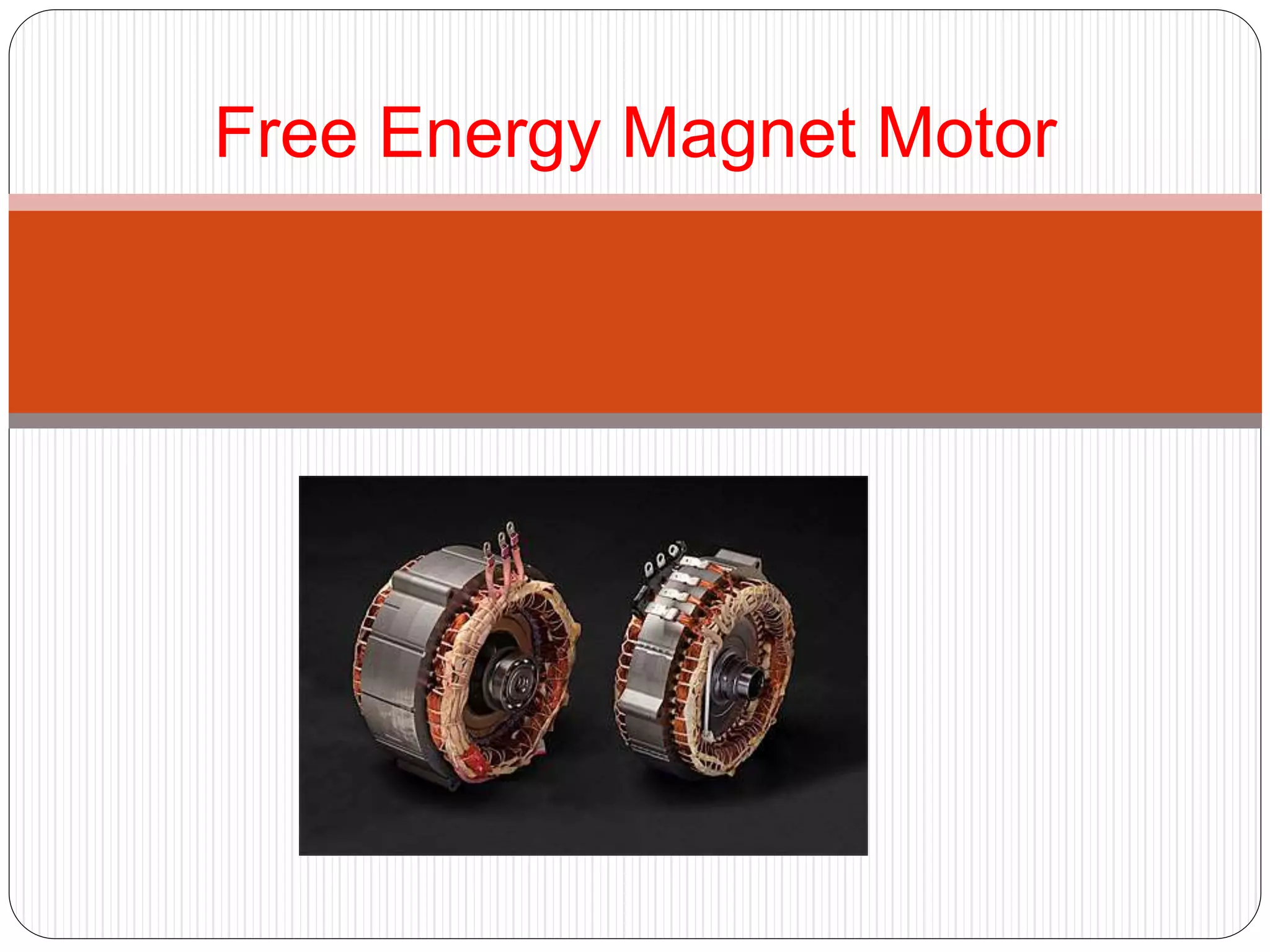
Free Energy Magnet Motor
About
 Magnetic motor rotates in Perpetual motion.
 Perpetual motion is motion that continues indefinitely
without any external source of energy.
 A perpetual motion machine (i.e magnet motor)
produces work without any source external energy,
thus it breaks the law of energy conversation.
 This motor runs on with help of a single magnet.
General characteristics
 Compact
 High efficiency (no excitation current)
 Smooth torque
 Low acoustic noise
 Fast dynamic response (both torque and
speed)
 Expensive
Mechanism
 This motor works on the principal of magnetic
induction.
 The motion of rotor is occurring due to by
changing flux of magnet.
 If we hold the magnet near the rotor it’ll rotate fast
and holding far than it’ll rotate slower.
 Thus happen due to change of magnetic flux.
Mechanism
 Revolution of the rotor due to magnet gives us
some mechanical work.
 If we connect the rotor with generator, it’ll give us
some electricity.
 Thus the mechanical energy is converted into
electric energy.
Applications
 industrial drives, e.g., pumps, fans, blowers, mills, hoists,
handling systems.
 elevators and escalators, people movers, light railways and
streetcars (trams), electric road vehicles, aircraft flight control
surface actuation.
Advantages
 no electrical energy is absorbed by the field excitation system and
thus there are no excitation losses which means substantial
increase in the efficiency.
 higher torque and/or output power per volume than when using
electromagnetic excitation.
 better dynamic performance than motors with electromagnetic
excitation (higher magnetic flux density in the air gap).
 simplification of construction and maintenance.
 reduction of prices for some types of machines.
Disadvantages
 Low speed range at high constant power but hybrid
design with reluctance torque allows phase advance to
extend speed range With high energy permanent
magnet can give 3:1 speed range and do not need any
change of ratio.
 High cost of permanent magnets.
 Magnet corrosion and possible demagnetization.
-BY
Brijesh Daraniya
(FW-1)
(Roll no.-31)

Free energy magnet motor

  • 1.
  • 2.
    About  Magnetic motorrotates in Perpetual motion.  Perpetual motion is motion that continues indefinitely without any external source of energy.  A perpetual motion machine (i.e magnet motor) produces work without any source external energy, thus it breaks the law of energy conversation.  This motor runs on with help of a single magnet.
  • 3.
    General characteristics  Compact High efficiency (no excitation current)  Smooth torque  Low acoustic noise  Fast dynamic response (both torque and speed)  Expensive
  • 4.
    Mechanism  This motorworks on the principal of magnetic induction.  The motion of rotor is occurring due to by changing flux of magnet.  If we hold the magnet near the rotor it’ll rotate fast and holding far than it’ll rotate slower.  Thus happen due to change of magnetic flux.
  • 5.
    Mechanism  Revolution ofthe rotor due to magnet gives us some mechanical work.  If we connect the rotor with generator, it’ll give us some electricity.  Thus the mechanical energy is converted into electric energy.
  • 6.
    Applications  industrial drives,e.g., pumps, fans, blowers, mills, hoists, handling systems.  elevators and escalators, people movers, light railways and streetcars (trams), electric road vehicles, aircraft flight control surface actuation.
  • 8.
    Advantages  no electricalenergy is absorbed by the field excitation system and thus there are no excitation losses which means substantial increase in the efficiency.  higher torque and/or output power per volume than when using electromagnetic excitation.  better dynamic performance than motors with electromagnetic excitation (higher magnetic flux density in the air gap).  simplification of construction and maintenance.  reduction of prices for some types of machines.
  • 9.
    Disadvantages  Low speedrange at high constant power but hybrid design with reluctance torque allows phase advance to extend speed range With high energy permanent magnet can give 3:1 speed range and do not need any change of ratio.  High cost of permanent magnets.  Magnet corrosion and possible demagnetization.
  • 10.