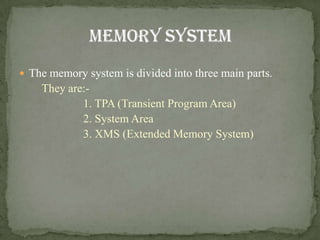
 The memory system is divided into three main parts.
    They are:-
            1. TPA (Transient Program Area)
            2. System Area
            3. XMS (Extended Memory System)
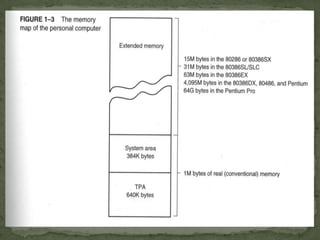
The first 1 M byte of memory is called the
real memory or conventional memory. It is called so
because each microprocessor is designed to function in
this area by using the real mode of operation.
 The conventional memory of 1 M byte is comprised of
 two portions.
 They are:-
            TPA           – 640k
            System Area – 384k
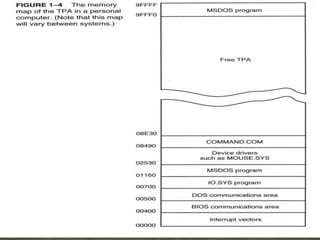
 The Transient program area holds the dos operating
  system and other programs that control the computer
  system.
 The TPA also stores any currently active or inactive
  DOS application programs.
 The size of TPA is 640KB.
 DOS requires a portion of TPA to function.
 Both PCDOS and MSDOS are compatible with TPA.
 Windows and OS/2 are other two operating systems that
 are compatible with DOS programs and executes it.
 Interrupt vectors access various features of the
  DOS, BIOS and applications. System BIOS is a collection
  of programs stored in ROM or Flash Memory.
 Contains the transient data used by the program to access
  I/O devices and internal features of the computer system.
  These are stored in the TPA so they can be changed as the
  system operates.
 It is a program that loads into TPA whenever the MSDOS
 or PCDOS system is started. This program allow DOS to
 use keyboard, printer, video display and other I/O devices
 often found in computer system.
 The size of driver area and number of drivers changes
 from one system to another. Drivers are programs that
 control installable I/O devices. Drivers are files normally
 they have extension .SYS and sometimes it will be .EXE.
 REGEDIT is a program that contains information about
 system and the drivers.
 Controls the operation of the computer when keyboard is
  operated in DOS mode.
 Incase if it is erased the computer cannot be used with
  keyboard in DOS mode.
 This area holds DOS application programs as they are
 executed. This application includes word processor and
 spreadsheets. Also it holds TSR (terminate and stay
 resident) programs that remain in memory in an inactive
 state until activated by interrupt.
 It occupies 2 area of memory. One area of 16 bytes of
 memory at the top and another large area of memory located
 near the bottom of TPA. Size depends on version of DOS
 installed. If DOS is installed in High Memory, most of the
 TPA is free to hold Application program.
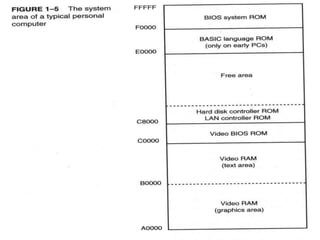
 It is smaller than TPA and it is of 384 kb in size. It
 contains program on either a read only memory or flash
 memory and RAM for data storage.
 It is the first part in system area, it contains video control
  programs on ROM or flash memory. The size and amount
  of memory used depends on the type of video display
  adapter.
    The Video Display Ram is Classified into 3 parts:-
       Video RAM (Graphics)
       Video RAM (Text)
       Video BIOS ROM
 Video RAM (Graphics ) used to store graphical or bit-
  mapped data.
 Video RAM (Text area) stores Text.
 Video BIOS ROM contains program that control the DOS
  Video display.
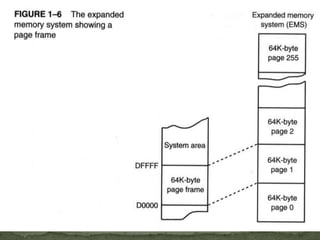
 C8000H – DFFFFH is free. This area is used for expanded
 memory systems. It allows a 64-k byte page frame of
 memory to be used by application programs.
 The memory region between E0000H – EFFFFH contains
 the BASIC language on ROM found in early IBM
 personal computer systems. In newer systems this area is
 free and referred as upper memory, which is used as extra
 RAM for the use of DOS programs.
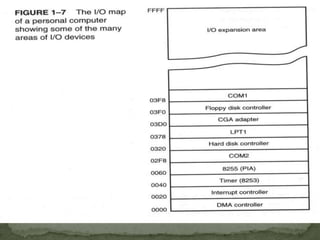
 It controls the operation of Basic I/O devices connected to
  the computer. The Video system is not controlled by this.
  I/O space in a computer system extends from 0000H to
  FFFFH which allows the microprocessor to communicate
  between itself and the outside world.
 This memory from 0000H to FFFFH is divided into
 two regions. 0000H to 03FFH is reserved for system
 devices and other for expansion on newer system that
 extends from I/O port 0400H through FFFFH.
Conventional memory

Conventional memory

  • 2.
     The memorysystem is divided into three main parts. They are:- 1. TPA (Transient Program Area) 2. System Area 3. XMS (Extended Memory System)
  • 4.
    The first 1M byte of memory is called the real memory or conventional memory. It is called so because each microprocessor is designed to function in this area by using the real mode of operation.
  • 5.
     The conventionalmemory of 1 M byte is comprised of two portions. They are:- TPA – 640k System Area – 384k
  • 6.
     The Transientprogram area holds the dos operating system and other programs that control the computer system.  The TPA also stores any currently active or inactive DOS application programs.  The size of TPA is 640KB.  DOS requires a portion of TPA to function.
  • 7.
     Both PCDOSand MSDOS are compatible with TPA. Windows and OS/2 are other two operating systems that are compatible with DOS programs and executes it.
  • 9.
     Interrupt vectorsaccess various features of the DOS, BIOS and applications. System BIOS is a collection of programs stored in ROM or Flash Memory.
  • 10.
     Contains thetransient data used by the program to access I/O devices and internal features of the computer system. These are stored in the TPA so they can be changed as the system operates.
  • 11.
     It isa program that loads into TPA whenever the MSDOS or PCDOS system is started. This program allow DOS to use keyboard, printer, video display and other I/O devices often found in computer system.
  • 12.
     The sizeof driver area and number of drivers changes from one system to another. Drivers are programs that control installable I/O devices. Drivers are files normally they have extension .SYS and sometimes it will be .EXE. REGEDIT is a program that contains information about system and the drivers.
  • 13.
     Controls theoperation of the computer when keyboard is operated in DOS mode.  Incase if it is erased the computer cannot be used with keyboard in DOS mode.
  • 14.
     This areaholds DOS application programs as they are executed. This application includes word processor and spreadsheets. Also it holds TSR (terminate and stay resident) programs that remain in memory in an inactive state until activated by interrupt.
  • 15.
     It occupies2 area of memory. One area of 16 bytes of memory at the top and another large area of memory located near the bottom of TPA. Size depends on version of DOS installed. If DOS is installed in High Memory, most of the TPA is free to hold Application program.
  • 16.
     It issmaller than TPA and it is of 384 kb in size. It contains program on either a read only memory or flash memory and RAM for data storage.
  • 18.
     It isthe first part in system area, it contains video control programs on ROM or flash memory. The size and amount of memory used depends on the type of video display adapter.  The Video Display Ram is Classified into 3 parts:-  Video RAM (Graphics)  Video RAM (Text)  Video BIOS ROM
  • 19.
     Video RAM(Graphics ) used to store graphical or bit- mapped data.  Video RAM (Text area) stores Text.  Video BIOS ROM contains program that control the DOS Video display.
  • 20.
     C8000H –DFFFFH is free. This area is used for expanded memory systems. It allows a 64-k byte page frame of memory to be used by application programs.
  • 22.
     The memoryregion between E0000H – EFFFFH contains the BASIC language on ROM found in early IBM personal computer systems. In newer systems this area is free and referred as upper memory, which is used as extra RAM for the use of DOS programs.
  • 23.
     It controlsthe operation of Basic I/O devices connected to the computer. The Video system is not controlled by this. I/O space in a computer system extends from 0000H to FFFFH which allows the microprocessor to communicate between itself and the outside world.
  • 25.
     This memoryfrom 0000H to FFFFH is divided into two regions. 0000H to 03FFH is reserved for system devices and other for expansion on newer system that extends from I/O port 0400H through FFFFH.