11/13/01 CS-550 Presentation - Overview of
Microsoft disk operating system.
1
An Overview of Microsoft Disk
Operating System
11/13/01 CS-550 Presentation - Overview of
Microsoft disk operating system.
2
Introduction to MS-DOS
• An operating system is a set of interrelated programs that manage and control computer
processing.The Microsoft Disk Operating System, MS-DOS, is a traditional
microcomputer operating system that consists of four major components.
• The Operating-system loader
- It brings the operating system from the startup into RAM.
- Bootstrapping
• The MS-DOS BIOS
- BIOS stands for Basic Input/Output systems
- Loaded from the file IO.SYS during initialization.
- Layer that sits between operating system kernel and hardware.
• The User Interface (shell)
- Conventional program that allows the user to interact with the operating system.
- Default MS – DOS user interface is a shell program called Command.com.
• The MS-DOS Kernel
- Heart of the operating system
- it is a proprietary program supplied by Microsoft corporation.
11/13/01 CS-550 Presentation - Overview of
Microsoft disk operating system.
3
MS-DOS Kernel
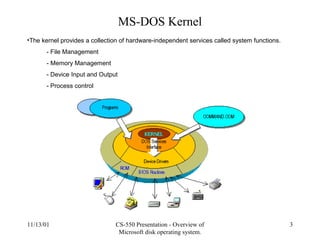
•The kernel provides a collection of hardware-independent services called system functions.
- File Management
- Memory Management
- Device Input and Output
- Process control
11/13/01 CS-550 Presentation - Overview of
Microsoft disk operating system.
4
File Management
• Block Devices are accessed on a sector basis. The MS- DOS kernel through the device driver sees a
block as a logical fixed size array of sectors. the device driver in turn translates the logical sector
requests from the MS – DOS into physical locations on the block device.
• MS – DOS file system is divided into four parts
- Boot Sector
- Always at the beginning of a partition.
- Contains OEM identification, a loader routine , and a BIOS parameter block.
- File Allocation Tables (FAT)
- Provides a map to the storage locations of files on the disk by indicating which
clusters are allocated to each file.
- Second copy of FAT as back up.
- Free cluster is found by scanning the FAT for a zero value.
- Root directory
- Root directory entries are 32 bytes long.
- Each entry includes a filename and extension, size, starting FAT entry, the time and date the
file was created and the files attributes.
- Files Area
- Contains subdirectories, file data and unallocated clusters.
- The area is divided into fixed size clusters and the use for a particular cluster is
specified by the corresponding FAT entry
11/13/01 CS-550 Presentation - Overview of
Microsoft disk operating system.
5
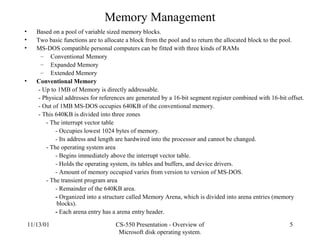
Memory Management
• Based on a pool of variable sized memory blocks.
• Two basic functions are to allocate a block from the pool and to return the allocated block to the pool.
• MS-DOS compatible personal computers can be fitted with three kinds of RAMs
– Conventional Memory
– Expanded Memory
– Extended Memory
• Conventional Memory
- Up to 1MB of Memory is directly addressable.
- Physical addresses for references are generated by a 16-bit segment register combined with 16-bit offset.
- Out of 1MB MS-DOS occupies 640KB of the conventional memory.
- This 640KB is divided into three zones
- The interrupt vector table
- Occupies lowest 1024 bytes of memory.
- Its address and length are hardwired into the processor and cannot be changed.
- The operating system area
- Begins immediately above the interrupt vector table.
- Holds the operating system, its tables and buffers, and device drivers.
- Amount of memory occupied varies from version to version of MS-DOS.
- The transient program area
- Remainder of the 640KB area.
- Organized into a structure called Memory Arena, which is divided into arena entries (memory
blocks).
- Each arena entry has a arena entry header.
11/13/01 CS-550 Presentation - Overview of
Microsoft disk operating system.
6
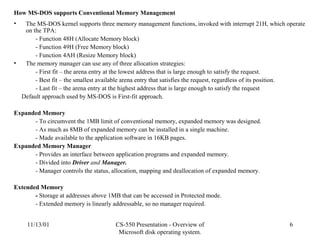
How MS-DOS supports Conventional Memory Management
• The MS-DOS kernel supports three memory management functions, invoked with interrupt 21H, which operate
on the TPA:
- Function 48H (Allocate Memory block)
- Function 49H (Free Memory block)
- Function 4AH (Resize Memory block)
• The memory manager can use any of three allocation strategies:
- First fit – the arena entry at the lowest address that is large enough to satisfy the request.
- Best fit – the smallest available arena entry that satisfies the request, regardless of its position.
- Last fit – the arena entry at the highest address that is large enough to satisfy the request
Default approach used by MS-DOS is First-fit approach.
Expanded Memory
- To circumvent the 1MB limit of conventional memory, expanded memory was designed.
- As much as 8MB of expanded memory can be installed in a single machine.
- Made available to the application software in 16KB pages.
Expanded Memory Manager
- Provides an interface between application programs and expanded memory.
- Divided into Driver and Manager.
- Manager controls the status, allocation, mapping and deallocation of expanded memory.
Extended Memory
- Storage at addresses above 1MB that can be accessed in Protected mode.
- Extended memory is linearly addressable, so no manager required.
11/13/01 CS-550 Presentation - Overview of
Microsoft disk operating system.
7
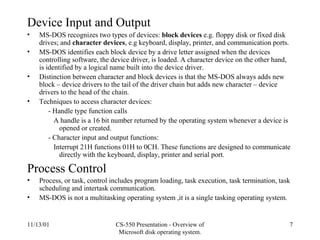
Device Input and Output
• MS-DOS recognizes two types of devices: block devices e.g. floppy disk or fixed disk
drives; and character devices, e.g keyboard, display, printer, and communication ports.
• MS-DOS identifies each block device by a drive letter assigned when the devices
controlling software, the device driver, is loaded. A character device on the other hand,
is identified by a logical name built into the device driver.
• Distinction between character and block devices is that the MS-DOS always adds new
block – device drivers to the tail of the driver chain but adds new character – device
drivers to the head of the chain.
• Techniques to access character devices:
- Handle type function calls
A handle is a 16 bit number returned by the operating system whenever a device is
opened or created.
- Character input and output functions:
Interrupt 21H functions 01H to 0CH. These functions are designed to communicate
directly with the keyboard, display, printer and serial port.
Process Control
• Process, or task, control includes program loading, task execution, task termination, task
scheduling and intertask communication.
• MS-DOS is not a multitasking operating system ,it is a single tasking operating system.

Dheeraj chugh -_presentation_on_ms-dos

  • 1.
    11/13/01 CS-550 Presentation- Overview of Microsoft disk operating system. 1 An Overview of Microsoft Disk Operating System
  • 2.
    11/13/01 CS-550 Presentation- Overview of Microsoft disk operating system. 2 Introduction to MS-DOS • An operating system is a set of interrelated programs that manage and control computer processing.The Microsoft Disk Operating System, MS-DOS, is a traditional microcomputer operating system that consists of four major components. • The Operating-system loader - It brings the operating system from the startup into RAM. - Bootstrapping • The MS-DOS BIOS - BIOS stands for Basic Input/Output systems - Loaded from the file IO.SYS during initialization. - Layer that sits between operating system kernel and hardware. • The User Interface (shell) - Conventional program that allows the user to interact with the operating system. - Default MS – DOS user interface is a shell program called Command.com. • The MS-DOS Kernel - Heart of the operating system - it is a proprietary program supplied by Microsoft corporation.
  • 3.
    11/13/01 CS-550 Presentation- Overview of Microsoft disk operating system. 3 MS-DOS Kernel •The kernel provides a collection of hardware-independent services called system functions. - File Management - Memory Management - Device Input and Output - Process control
  • 4.
    11/13/01 CS-550 Presentation- Overview of Microsoft disk operating system. 4 File Management • Block Devices are accessed on a sector basis. The MS- DOS kernel through the device driver sees a block as a logical fixed size array of sectors. the device driver in turn translates the logical sector requests from the MS – DOS into physical locations on the block device. • MS – DOS file system is divided into four parts - Boot Sector - Always at the beginning of a partition. - Contains OEM identification, a loader routine , and a BIOS parameter block. - File Allocation Tables (FAT) - Provides a map to the storage locations of files on the disk by indicating which clusters are allocated to each file. - Second copy of FAT as back up. - Free cluster is found by scanning the FAT for a zero value. - Root directory - Root directory entries are 32 bytes long. - Each entry includes a filename and extension, size, starting FAT entry, the time and date the file was created and the files attributes. - Files Area - Contains subdirectories, file data and unallocated clusters. - The area is divided into fixed size clusters and the use for a particular cluster is specified by the corresponding FAT entry
  • 5.
    11/13/01 CS-550 Presentation- Overview of Microsoft disk operating system. 5 Memory Management • Based on a pool of variable sized memory blocks. • Two basic functions are to allocate a block from the pool and to return the allocated block to the pool. • MS-DOS compatible personal computers can be fitted with three kinds of RAMs – Conventional Memory – Expanded Memory – Extended Memory • Conventional Memory - Up to 1MB of Memory is directly addressable. - Physical addresses for references are generated by a 16-bit segment register combined with 16-bit offset. - Out of 1MB MS-DOS occupies 640KB of the conventional memory. - This 640KB is divided into three zones - The interrupt vector table - Occupies lowest 1024 bytes of memory. - Its address and length are hardwired into the processor and cannot be changed. - The operating system area - Begins immediately above the interrupt vector table. - Holds the operating system, its tables and buffers, and device drivers. - Amount of memory occupied varies from version to version of MS-DOS. - The transient program area - Remainder of the 640KB area. - Organized into a structure called Memory Arena, which is divided into arena entries (memory blocks). - Each arena entry has a arena entry header.
  • 6.
    11/13/01 CS-550 Presentation- Overview of Microsoft disk operating system. 6 How MS-DOS supports Conventional Memory Management • The MS-DOS kernel supports three memory management functions, invoked with interrupt 21H, which operate on the TPA: - Function 48H (Allocate Memory block) - Function 49H (Free Memory block) - Function 4AH (Resize Memory block) • The memory manager can use any of three allocation strategies: - First fit – the arena entry at the lowest address that is large enough to satisfy the request. - Best fit – the smallest available arena entry that satisfies the request, regardless of its position. - Last fit – the arena entry at the highest address that is large enough to satisfy the request Default approach used by MS-DOS is First-fit approach. Expanded Memory - To circumvent the 1MB limit of conventional memory, expanded memory was designed. - As much as 8MB of expanded memory can be installed in a single machine. - Made available to the application software in 16KB pages. Expanded Memory Manager - Provides an interface between application programs and expanded memory. - Divided into Driver and Manager. - Manager controls the status, allocation, mapping and deallocation of expanded memory. Extended Memory - Storage at addresses above 1MB that can be accessed in Protected mode. - Extended memory is linearly addressable, so no manager required.
  • 7.
    11/13/01 CS-550 Presentation- Overview of Microsoft disk operating system. 7 Device Input and Output • MS-DOS recognizes two types of devices: block devices e.g. floppy disk or fixed disk drives; and character devices, e.g keyboard, display, printer, and communication ports. • MS-DOS identifies each block device by a drive letter assigned when the devices controlling software, the device driver, is loaded. A character device on the other hand, is identified by a logical name built into the device driver. • Distinction between character and block devices is that the MS-DOS always adds new block – device drivers to the tail of the driver chain but adds new character – device drivers to the head of the chain. • Techniques to access character devices: - Handle type function calls A handle is a 16 bit number returned by the operating system whenever a device is opened or created. - Character input and output functions: Interrupt 21H functions 01H to 0CH. These functions are designed to communicate directly with the keyboard, display, printer and serial port. Process Control • Process, or task, control includes program loading, task execution, task termination, task scheduling and intertask communication. • MS-DOS is not a multitasking operating system ,it is a single tasking operating system.