UNDERSTANDING
CONTROL UNITS
and its types
By
Muhammad Shafiullah
Ahmed Akhtar
Ahsan Raza
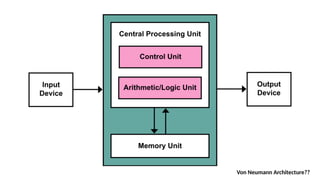
Von Neumann Architecture??
What is a Control Unit?
• The Control Unit:
1. Directs the flow of data and instructions within the central
processing unit,
2. Managing the execution of operations to perform tasks
specified by a program.
3. It oversees the fetching, decoding, and execution of instructions,
ensuring proper coordination of the CPU's components.
•It manages and directs how instructions are executed.
Simply:
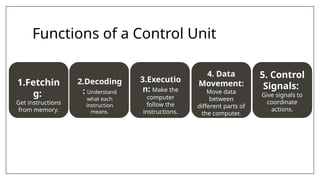
Functions of a Control Unit
1.Fetchin
g:
Get instructions
from memory.
2.Decoding
: Understand
what each
instruction
means.
3.Executio
n: Make the
computer
follow the
instructions.
4. Data
Movement:
Move data
between
different parts of
the computer.
5. Control
Signals:
Give signals to
coordinate
actions.
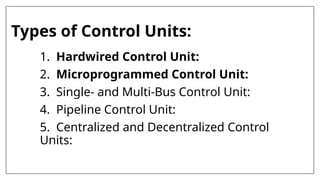
Types of Control Units:
1. Hardwired Control Unit:
2. Microprogrammed Control Unit:
3. Single- and Multi-Bus Control Unit:
4. Pipeline Control Unit:
5. Centralized and Decentralized Control
Units:
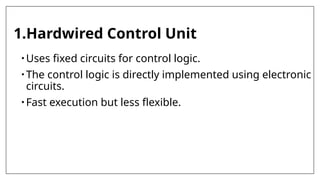
1.Hardwired Control Unit
• Uses fixed circuits for control logic.
• The control logic is directly implemented using electronic
circuits.
• Fast execution but less flexible.
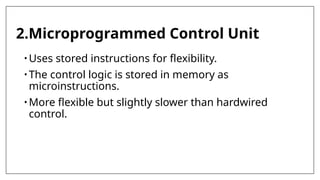
2.Microprogrammed Control Unit
• Uses stored instructions for flexibility.
• The control logic is stored in memory as
microinstructions.
• More flexible but slightly slower than hardwired
control.
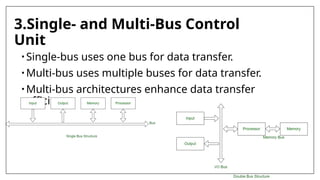
3.Single- and Multi-Bus Control
Unit
• Single-bus uses one bus for data transfer.
• Multi-bus uses multiple buses for data transfer.
• Multi-bus architectures enhance data transfer
efficiency.
4.Pipeline Control Unit
• Divides instruction execution into stages for speed.
• Different stages of instructions are executed
simultaneously.
• Improves overall processing speed.
5.Centralized and Decentralized
Control Units
• Centralized has a single control unit managing all instructions.
• Decentralized may have multiple control units, each handling
specific tasks.
• Provides flexibility in task management.
Thankyou.

What are Control Units in Computer Architecture

  • 1.
    UNDERSTANDING CONTROL UNITS and itstypes By Muhammad Shafiullah Ahmed Akhtar Ahsan Raza
  • 2.
  • 3.
    What is aControl Unit? • The Control Unit: 1. Directs the flow of data and instructions within the central processing unit, 2. Managing the execution of operations to perform tasks specified by a program. 3. It oversees the fetching, decoding, and execution of instructions, ensuring proper coordination of the CPU's components. •It manages and directs how instructions are executed. Simply:
  • 4.
    Functions of aControl Unit 1.Fetchin g: Get instructions from memory. 2.Decoding : Understand what each instruction means. 3.Executio n: Make the computer follow the instructions. 4. Data Movement: Move data between different parts of the computer. 5. Control Signals: Give signals to coordinate actions.
  • 5.
    Types of ControlUnits: 1. Hardwired Control Unit: 2. Microprogrammed Control Unit: 3. Single- and Multi-Bus Control Unit: 4. Pipeline Control Unit: 5. Centralized and Decentralized Control Units:
  • 6.
    1.Hardwired Control Unit •Uses fixed circuits for control logic. • The control logic is directly implemented using electronic circuits. • Fast execution but less flexible.
  • 7.
    2.Microprogrammed Control Unit •Uses stored instructions for flexibility. • The control logic is stored in memory as microinstructions. • More flexible but slightly slower than hardwired control.
  • 8.
    3.Single- and Multi-BusControl Unit • Single-bus uses one bus for data transfer. • Multi-bus uses multiple buses for data transfer. • Multi-bus architectures enhance data transfer efficiency.
  • 9.
    4.Pipeline Control Unit •Divides instruction execution into stages for speed. • Different stages of instructions are executed simultaneously. • Improves overall processing speed.
  • 10.
    5.Centralized and Decentralized ControlUnits • Centralized has a single control unit managing all instructions. • Decentralized may have multiple control units, each handling specific tasks. • Provides flexibility in task management.
  • 11.

Editor's Notes

  • #3 The control unit is a component of a computer's central processing unit (CPU) that manages and coordinates the execution of instructions. It fetches instructions from memory, decodes them to determine the necessary operations, and controls the flow of data between the CPU's different functional units to carry out those instructions. In essence, the control unit plays a crucial role in ensuring that the computer's operations are executed in the correct sequence and according to the program's instructions.
  • #5 1. Hardwired Control Unit: - Uses fixed circuits for control logic. 2. Microprogrammed Control Unit: - Uses stored instructions for flexibility. 3. Single- and Multi-Bus Control Unit: - Use one or more buses for data transfer. 4. Pipeline Control Unit: - Divides instruction execution into stages for speed. 5. Centralized and Decentralized Control Units: - Have one or multiple control units managing tasks.