
CONTROLLING

Made by:
Archi Garg 098
Shreya Saxena 099
Ripudaman 100
Renu Meena 101
Rakesh 102
CONTENTS:
 What is controlling??
 Why is control important??
 Planning and controlling: Parallel Functions…
 Controlling process…
 Tools for controlling organizational performance…
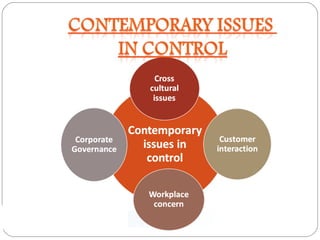
 Contemporary issues in control!!!
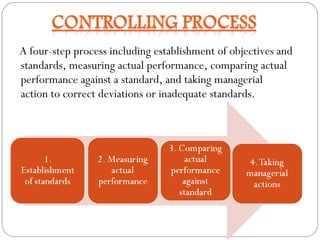
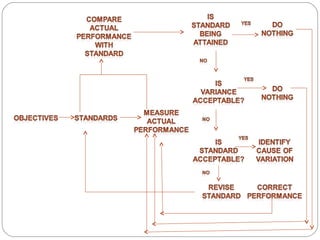
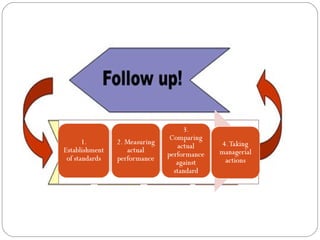
A four-step process including establishment of objectives and
standards, measuring actual performance, comparing actual
performance against a standard, and taking managerial
action to correct deviations or inadequate standards.
1.Establishment of standards:
3 questions arises:
⇒WHERE
⇒WHAT
⇒WHEN
What are STANDARDS????
TYPES OF STANDARDS:

i) Measurable/ Tangible standards:
Eg. In the form of cost, output, expenditure, time, profit etc.
ii) Non Measurable/ Intangible standards:
Eg. Performance of a manager, deviation of workers, their attitude
towards a concern
2. Measuring actual performance:
2 questions arises:
⇒ How we measure??
⇒ What we measure??

i) HOW WE MEASURE ??

It can be done through various sources:
⇒Personal observation,
⇒ statistical reports,
⇒ oral reports,
⇒ written reports etc..
ii) WHAT WE MEASURE??
What people in the organization will attempt to excel at?
⇒ Tangible Standards: measurement is easy
Eg. Budgets
 Costs
 Output
 Sales

⇒ Intangible Standards: measurement through subjective measures
Eg. Employees
 Performance
 Satisfaction

 Measurements must be accurate enough to spot deviations or variances

between what really occurs and what is most desired.
 Without measurement, effective control is not possible.
3. Comparing actual performance
against standards:
The comparison of actual performance with desired

performance establishes the need for action.
3 things need to be find out:
⇒ Range of variation
⇒ Extent of deviation
⇒ Cause of deviation
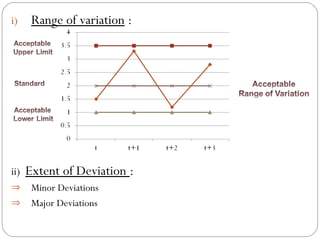
i)

Range of variation :

ii)

Extent of Deviation :

⇒
⇒

Minor Deviations
Major Deviations
iii) Cause of Deviation :
⇒ Planning
⇒ Coordination
⇒ Implementation
⇒ Supervision
⇒ Communication
4. Taking managerial actions:
 3 Courses of Action:
⇒ Doing Nothing
⇒ Correcting actual (current) performance
⇒ Revising the standard

i) Doing nothing
Only if deviation is judged to be insignificant.

ii) Correcting actual (current) performance
Immediate corrective action
Basic corrective action

iii) Revising the standard
Examining the standard to ascertain whether or not the standard is

realistic, fair, and achievable:
Upholding
Resetting
TOOLS FOR CONTROLLING
ORGANIZATIONAL
PERFORMANCE
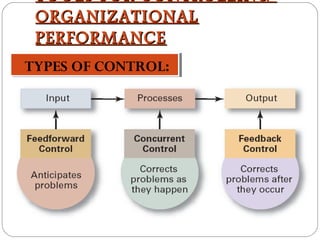
TYPES OF CONTROL:
TYPES OF CONTROL:
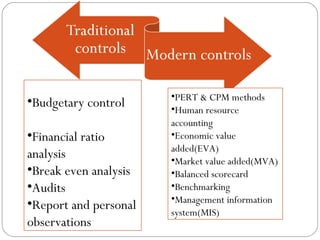
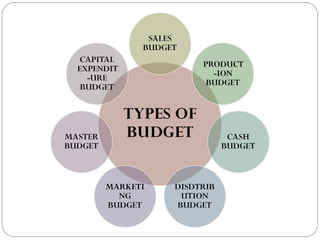
•Budgetary control
•Financial ratio
analysis
•Break even analysis
•Audits
•Report and personal
observations

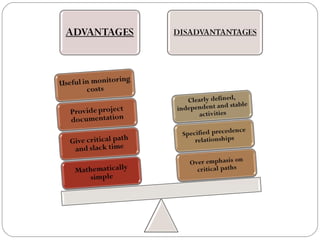
•PERT & CPM methods
•Human resource
accounting
•Economic value
added(EVA)
•Market value added(MVA)
•Balanced scorecard
•Benchmarking
•Management information
system(MIS)
BUDGETARY CONTROL
BUDGET:

A budget is a financially expressed statement of anticipated
results during a designated time period(usually 1 year).
BUDGETARY CONTROL:
It is a system of controlling costs which includes
the preparation of budgets, coordinating the
departmentsand establishing responsibility, comparing the
actual performance with budgeted and acting upon resultsto
achieve maximum profitability.
FINANCIAL RATIO ANALYSIS
It examines the relationship between specific figures on the

financial statements and helps explain the significance of those
figures:
LIQUIDITY RATIOS:It measure an organization's ability to
generate cash.
PROFITABILITY RATIOS:It measures an organization‘s
ability to generate profits.
DEBT RATIOS: It measure an organization's ability to pay its
debts.
ACTIVITY RATIOS: It measure an organization's efficiency in
operations and use of assets 
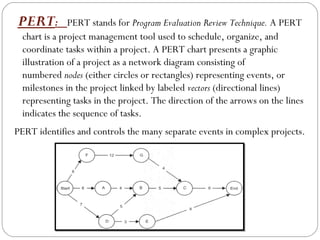
PERT:  PERT stands for Program Evaluation Review Technique. A PERT

chart is a project management tool used to schedule, organize, and
coordinate tasks within a project. A PERT chart presents a graphic
illustration of a project as a network diagram consisting of
numbered nodes (either circles or rectangles) representing events, or
milestones in the project linked by labeled vectors (directional lines)
representing tasks in the project. The direction of the arrows on the lines
indicates the sequence of tasks.

PERT identifies and controls the many separate events in complex projects.
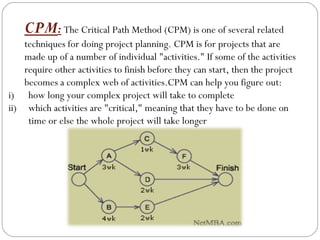
CPM: The Critical Path Method (CPM) is one of several related

techniques for doing project planning. CPM is for projects that are
made up of a number of individual "activities." If some of the activities
require other activities to finish before they can start, then the project
becomes a complex web of activities.CPM can help you figure out:
i) how long your complex project will take to complete
ii) which activities are "critical," meaning that they have to be done on
time or else the whole project will take longer
HRA: Human Resource Accounting may be defined as the
measurement and reporting of the cost and value of people as
organizational resources. It involves accounting for investment in
people and their replacement costs, as well as accounting for the
economic values of people to an organization.
Other Measures:


Economic Value Added (EVA): How much value is created by what a
company does with its assets, less any capital investments in those
assets: the rate of return earned over and above the cost of capital.



Market Value Added (MVA): The value that the stock market places
on a firm’s past and expected capital investment projects



Balanced Scorecard: A measurement tool that uses goals set by
managers in four areas to measure a company’s performance:
Financial, customer, internal processes, and
people/innovation/growth assets
Benchmarking: The search for the best practices among competitors or

non competitors that lead to their superior performance.
Information Controls: Management Information Systems (MIS) : A

system used to provide management with needed information on a
regular basis.
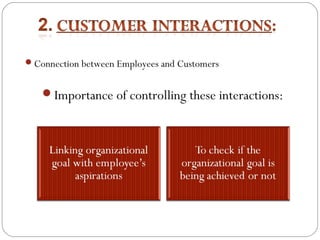
Connection between Employees and Customers

Importance of controlling these interactions:
Ques > How to control this interaction??
Answer > Service profit chain
The service sequence from employees to customers to profit:
service capability affects service value which impacts on
customer satisfaction that, in turn, leads to customer loyalty in
the form of repeat business (profit).
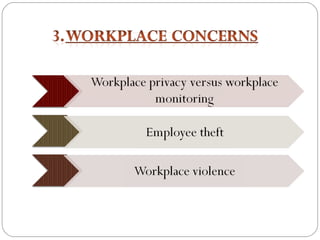
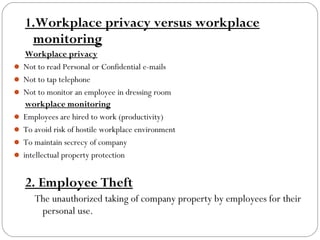
1.Workplace privacy versus workplace
monitoring
Workplace privacy
 Not to read Personal or Confidential e-mails
 Not to tap telephone
 Not to monitor an employee in dressing room
workplace monitoring
 Employees are hired to work (productivity)
 To avoid risk of hostile workplace environment
 To maintain secrecy of company
 intellectual property protection

2. Employee Theft
The unauthorized taking of company property by employees for their
personal use.
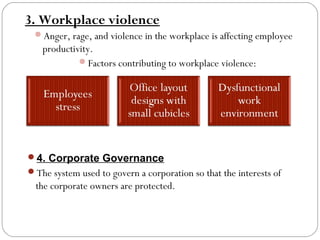
3. Workplace violence
Anger, rage, and violence in the workplace is affecting employee

productivity.
Factors contributing to workplace violence:

4. Corporate Governance
The system used to govern a corporation so that the interests of

the corporate owners are protected.
Controlling (1)

Controlling (1)

  • 1.
    CONTROLLING Made by: Archi Garg098 Shreya Saxena 099 Ripudaman 100 Renu Meena 101 Rakesh 102
  • 2.
    CONTENTS:  What iscontrolling??  Why is control important??  Planning and controlling: Parallel Functions…  Controlling process…  Tools for controlling organizational performance…  Contemporary issues in control!!!
  • 8.
    A four-step processincluding establishment of objectives and standards, measuring actual performance, comparing actual performance against a standard, and taking managerial action to correct deviations or inadequate standards.
  • 9.
    1.Establishment of standards: 3questions arises: ⇒WHERE ⇒WHAT ⇒WHEN What are STANDARDS???? TYPES OF STANDARDS: i) Measurable/ Tangible standards: Eg. In the form of cost, output, expenditure, time, profit etc. ii) Non Measurable/ Intangible standards: Eg. Performance of a manager, deviation of workers, their attitude towards a concern
  • 10.
    2. Measuring actualperformance: 2 questions arises: ⇒ How we measure?? ⇒ What we measure?? i) HOW WE MEASURE ?? It can be done through various sources: ⇒Personal observation, ⇒ statistical reports, ⇒ oral reports, ⇒ written reports etc..
  • 11.
    ii) WHAT WEMEASURE?? What people in the organization will attempt to excel at? ⇒ Tangible Standards: measurement is easy Eg. Budgets  Costs  Output  Sales ⇒ Intangible Standards: measurement through subjective measures Eg. Employees  Performance  Satisfaction  Measurements must be accurate enough to spot deviations or variances between what really occurs and what is most desired.  Without measurement, effective control is not possible.
  • 12.
    3. Comparing actualperformance against standards: The comparison of actual performance with desired performance establishes the need for action. 3 things need to be find out: ⇒ Range of variation ⇒ Extent of deviation ⇒ Cause of deviation
  • 13.
    i) Range of variation: ii) Extent of Deviation : ⇒ ⇒ Minor Deviations Major Deviations
  • 14.
    iii) Cause ofDeviation : ⇒ Planning ⇒ Coordination ⇒ Implementation ⇒ Supervision ⇒ Communication
  • 15.
    4. Taking managerialactions:  3 Courses of Action: ⇒ Doing Nothing ⇒ Correcting actual (current) performance ⇒ Revising the standard i) Doing nothing Only if deviation is judged to be insignificant. ii) Correcting actual (current) performance Immediate corrective action Basic corrective action iii) Revising the standard Examining the standard to ascertain whether or not the standard is realistic, fair, and achievable: Upholding Resetting
  • 18.
  • 19.
    •Budgetary control •Financial ratio analysis •Breakeven analysis •Audits •Report and personal observations •PERT & CPM methods •Human resource accounting •Economic value added(EVA) •Market value added(MVA) •Balanced scorecard •Benchmarking •Management information system(MIS)
  • 20.
    BUDGETARY CONTROL BUDGET: A budgetis a financially expressed statement of anticipated results during a designated time period(usually 1 year). BUDGETARY CONTROL: It is a system of controlling costs which includes the preparation of budgets, coordinating the departmentsand establishing responsibility, comparing the actual performance with budgeted and acting upon resultsto achieve maximum profitability.
  • 22.
    FINANCIAL RATIO ANALYSIS Itexamines the relationship between specific figures on the financial statements and helps explain the significance of those figures: LIQUIDITY RATIOS:It measure an organization's ability to generate cash. PROFITABILITY RATIOS:It measures an organization‘s ability to generate profits. DEBT RATIOS: It measure an organization's ability to pay its debts. ACTIVITY RATIOS: It measure an organization's efficiency in operations and use of assets 
  • 23.
    PERT:  PERT standsfor Program Evaluation Review Technique. A PERT chart is a project management tool used to schedule, organize, and coordinate tasks within a project. A PERT chart presents a graphic illustration of a project as a network diagram consisting of numbered nodes (either circles or rectangles) representing events, or milestones in the project linked by labeled vectors (directional lines) representing tasks in the project. The direction of the arrows on the lines indicates the sequence of tasks. PERT identifies and controls the many separate events in complex projects.
  • 24.
    CPM: The CriticalPath Method (CPM) is one of several related techniques for doing project planning. CPM is for projects that are made up of a number of individual "activities." If some of the activities require other activities to finish before they can start, then the project becomes a complex web of activities.CPM can help you figure out: i) how long your complex project will take to complete ii) which activities are "critical," meaning that they have to be done on time or else the whole project will take longer
  • 26.
    HRA: Human ResourceAccounting may be defined as the measurement and reporting of the cost and value of people as organizational resources. It involves accounting for investment in people and their replacement costs, as well as accounting for the economic values of people to an organization. Other Measures:  Economic Value Added (EVA): How much value is created by what a company does with its assets, less any capital investments in those assets: the rate of return earned over and above the cost of capital.  Market Value Added (MVA): The value that the stock market places on a firm’s past and expected capital investment projects  Balanced Scorecard: A measurement tool that uses goals set by managers in four areas to measure a company’s performance: Financial, customer, internal processes, and people/innovation/growth assets
  • 27.
    Benchmarking: The searchfor the best practices among competitors or non competitors that lead to their superior performance. Information Controls: Management Information Systems (MIS) : A system used to provide management with needed information on a regular basis.
  • 30.
    Connection between Employeesand Customers Importance of controlling these interactions:
  • 31.
    Ques > Howto control this interaction?? Answer > Service profit chain The service sequence from employees to customers to profit: service capability affects service value which impacts on customer satisfaction that, in turn, leads to customer loyalty in the form of repeat business (profit).
  • 33.
    1.Workplace privacy versusworkplace monitoring Workplace privacy  Not to read Personal or Confidential e-mails  Not to tap telephone  Not to monitor an employee in dressing room workplace monitoring  Employees are hired to work (productivity)  To avoid risk of hostile workplace environment  To maintain secrecy of company  intellectual property protection 2. Employee Theft The unauthorized taking of company property by employees for their personal use.
  • 34.
    3. Workplace violence Anger,rage, and violence in the workplace is affecting employee productivity. Factors contributing to workplace violence: 4. Corporate Governance The system used to govern a corporation so that the interests of the corporate owners are protected.

Editor's Notes

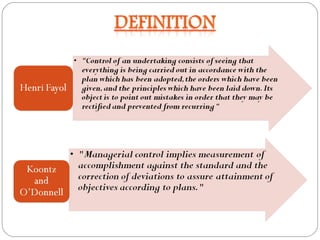
  • #5 IN THE WORDS OF HENRY FAYOL "Control consists in verifying whether everything occurs in conformity with the plan adopted, the instructions issued and the principles established. Its object is to find out the weakness and errors in order to rectify them and prevent recurrence. It operates on everything, i.e., things, people and actions". From the above definitions it is clear that the managerial function of control consists in a comparison of the actual performance with the planned performance with the object of discovering whether all is going on well according to plans and if not why. Remedial action arising from a study of deviations of the actual performance with the standard or planned performance will serve to correct the plans and make suitable changes. Controlling is the nature of follow-up to the other three fundamental functions of management. There can, in fact, be not controlling without previous planning, organizing and directing. Controlling cannot take place in a vacuum.
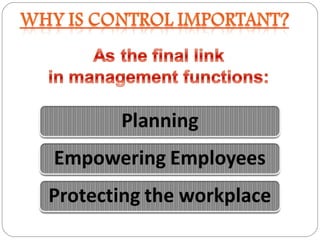
  • #6 Planning Controls let managers know whether their goals and plans are on target and what future actions to take. Empowering employees Control systems provide managers with information and feedback on employee performance. Protecting the workplace Controls enhance physical security and help minimize workplace disruptions
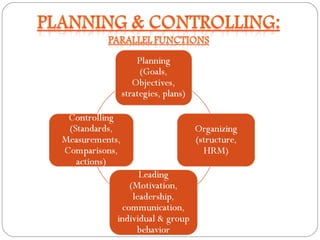
  • #7 Planning and Controlling might be thought of as a Siamese Twins because they are so closely related. Planning sets the ship’s course and controlling keeps it on course. When the ship begins to veer off the course, the navigator notices it and recommends a new heading designed to return the ship to its proper course. Essentially, management control works the same way. Management set goals and seek information on whether they are being reached as planned. If not, management make adjustments.
  • #13 Range of variation the acceptable parameters of variance between actual performance and the standard.
  • #16 Corrective Actions Change strategy, structure, compensation scheme, or training programs; redesign jobs; or fire employees Immediate corrective action to correct the problem at once. Basic corrective action to locate and to correct the source of the deviation.
  • #24 http://www.egyankosh.ac.in/bitstream/123456789/38723/1/new%20%20Unit-5.pdf To conclude, we can say that human resource accounting aims at: (1) increased managerial awareness of the values of human resources, (2) better decisions about. people, based on improved information systems, (3) greater accountability on the part of management for its human resources,. (4) developing new measures of effective manpower utilisation, (5) enabling a longer time horizon for planning and budgeting, and (6) better human resource planning.
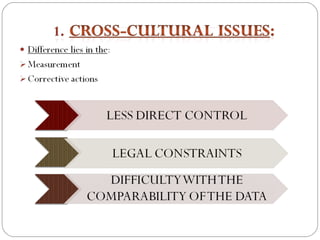
  • #30 i) Less direct control by the home office: The use of technology to increase direct corporate control of local operations ii) Legal constraints on corrective actions in foreign countries iii) Difficulty with the comparability of data collected from operations in different countries