Instructor
Mr. Shyamasundar Tripathy
Management Faculty(HR)
What is Performance Management
 “Performance management is the process of creating a
work environment or setting in which people are
enabled to perform to the best of their abilities.”
 “Performance management is a continuous process of
identifying, measuring and developing the
performance of individuals and teams and aligning
performance with the strategic goals of the
organisation”
 In the words of Hetcher,
“ Perf Mgt is an approach to creating a shared vision of
the purpose and aims of the organisation, helping each
individual employee understanding and recognise
his/her perf of both the individual and the
organisation”
“P.M is an ongoing communication process undertaken in
partnership, between an employee and his/her immediate
supervisor that involves establishing clear expectations and
understanding about:
1. The essential job functions the employee is expected to
do.
2. How the employee’s job contributes to the goals of the
organisation.
3. What doing the work will mean in concrete terms.
4. How employee and supervisor will work together to
sustain, improve or build on existing employees perf.
5. How performance mgt will be measured
6. Identifying barriers to performance and removing them.”
 It is integrated, because it effects four types of
integration
 Vertical
 Functional
 Human Resource
 Goals
What is Performance Management?
Nature of performance
Management
 Concern with output,outcomes,process and input.
 Concern with planning.
 Concern with measurement and review.
 Concern with continuous development and
improvement.
 Concern for communication.
 Concern for stakeholder.
 Ethical concerns.
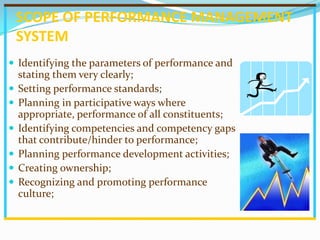
SCOPE OF PERFORMANCE MANAGEMENT
SYSTEM
 Identifying the parameters of performance and
stating them very clearly;
 Setting performance standards;
 Planning in participative ways where
appropriate, performance of all constituents;
 Identifying competencies and competency gaps
that contribute/hinder to performance;
 Planning performance development activities;
 Creating ownership;
 Recognizing and promoting performance
culture;
To enable the employees towards achievement of
superior standards of work performance.
To help the employees in identifying the
knowledge and skills required for performing the
job efficiently as this would drive their focus
towards performing the right task in the right way.
Boosting the performance of the employees by
encouraging employee empowerment, motivation
and implementation of an effective reward
mechanism.
OBJECTIVES OF PERFORMANCE MANAGEMENT
Promoting a two way system of communication
between the supervisors and the employees for
providing a regular and a transparent feedback for
improving employee performance and continuous
coaching.
Identifying the barriers to effective performance
and resolving those barriers through constant
monitoring, coaching and development
interventions.
Creating a basis for several administrative decisions
strategic planning, succession planning, promotions
and performance based payment.
Importance of PM
 Improve employee performance
 Develop people for promotional opportunities
 Meet employee need for feedback
 Ensure that employees are working toward
organizational goals
 Provide the data needed to make and defend
important human resources decisions.
 Obtain better results from the organization, teams
and individuals by understanding and managing
performance within an agreed framework of
planned goals, standards and competency
requirements
 Establish shared understanding on what is to be
achieved, and manage and develop people in a way
which ensures that it will be achieved
 Align individual objectives to organizational
objectives and ensure that individuals uphold
corporate core values
 Act as a lever for change
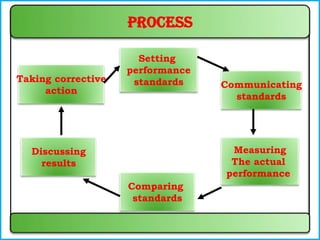
Setting
performance
standardsTaking corrective
action
Discussing
results
Comparing
standards
Measuring
The actual
performance
Communicating
standards
Process
Process of Performance Management
Setting Performance Standard / Establish Performance
Standards
Performance standards serve as benchmarks against
which performance is measured.
Standards should relate to the desired results of each job
Communicate the Standards
 Performance appraisal involves at least two
parties, the appraiser who does the appraisal and
the appraisee whose performance is being
evaluated.
Communicate the Standards
The appraiser should prepare job descriptions clearly;
help appraisee set his goals and targets; analyse results
objectively; offer coaching and guidance to appraisee
whenever required and reward good results
The appraisee should be very clear about what he is
doing and why
Measure Actual Performance
Performance measures, to be helpful must be easy
to use, reliable and must report on the critical
behaviors that determine performance.
 Performance measures may be objective or subjective.
 Objective performance measures are indications of job
performance that can be verified by others and are usually
quantitative.
Measure Actual Performance
 Subjective performance measures are ratings that
are based on the personal standards or opinions of
those doing the evaluation and are not verifiable by
others
Compare Actual performance with Standards and
Discuss the Appraisal
Actual performance may be better than
expected and sometimes it may go off the track
Whatever be the consequences, there is a way
to communicate and discuss the final outcome
Taking Corrective Action
Corrective action is of two types.
One puts out the fires immediately.
Other strikes at the root of the problem
permanently.

Performance management

  • 1.
  • 2.
    What is PerformanceManagement  “Performance management is the process of creating a work environment or setting in which people are enabled to perform to the best of their abilities.”  “Performance management is a continuous process of identifying, measuring and developing the performance of individuals and teams and aligning performance with the strategic goals of the organisation”
  • 3.
     In thewords of Hetcher, “ Perf Mgt is an approach to creating a shared vision of the purpose and aims of the organisation, helping each individual employee understanding and recognise his/her perf of both the individual and the organisation”
  • 4.
    “P.M is anongoing communication process undertaken in partnership, between an employee and his/her immediate supervisor that involves establishing clear expectations and understanding about: 1. The essential job functions the employee is expected to do. 2. How the employee’s job contributes to the goals of the organisation. 3. What doing the work will mean in concrete terms. 4. How employee and supervisor will work together to sustain, improve or build on existing employees perf. 5. How performance mgt will be measured 6. Identifying barriers to performance and removing them.”
  • 5.
     It isintegrated, because it effects four types of integration  Vertical  Functional  Human Resource  Goals What is Performance Management?
  • 6.
    Nature of performance Management Concern with output,outcomes,process and input.  Concern with planning.  Concern with measurement and review.  Concern with continuous development and improvement.  Concern for communication.  Concern for stakeholder.  Ethical concerns.
  • 7.
    SCOPE OF PERFORMANCEMANAGEMENT SYSTEM  Identifying the parameters of performance and stating them very clearly;  Setting performance standards;  Planning in participative ways where appropriate, performance of all constituents;  Identifying competencies and competency gaps that contribute/hinder to performance;  Planning performance development activities;  Creating ownership;  Recognizing and promoting performance culture;
  • 8.
    To enable theemployees towards achievement of superior standards of work performance. To help the employees in identifying the knowledge and skills required for performing the job efficiently as this would drive their focus towards performing the right task in the right way. Boosting the performance of the employees by encouraging employee empowerment, motivation and implementation of an effective reward mechanism. OBJECTIVES OF PERFORMANCE MANAGEMENT
  • 9.
    Promoting a twoway system of communication between the supervisors and the employees for providing a regular and a transparent feedback for improving employee performance and continuous coaching. Identifying the barriers to effective performance and resolving those barriers through constant monitoring, coaching and development interventions. Creating a basis for several administrative decisions strategic planning, succession planning, promotions and performance based payment.
  • 10.
    Importance of PM Improve employee performance  Develop people for promotional opportunities  Meet employee need for feedback  Ensure that employees are working toward organizational goals  Provide the data needed to make and defend important human resources decisions.
  • 11.
     Obtain betterresults from the organization, teams and individuals by understanding and managing performance within an agreed framework of planned goals, standards and competency requirements  Establish shared understanding on what is to be achieved, and manage and develop people in a way which ensures that it will be achieved  Align individual objectives to organizational objectives and ensure that individuals uphold corporate core values  Act as a lever for change
  • 12.
  • 13.
    Process of PerformanceManagement Setting Performance Standard / Establish Performance Standards Performance standards serve as benchmarks against which performance is measured. Standards should relate to the desired results of each job
  • 14.
    Communicate the Standards Performance appraisal involves at least two parties, the appraiser who does the appraisal and the appraisee whose performance is being evaluated.
  • 15.
    Communicate the Standards Theappraiser should prepare job descriptions clearly; help appraisee set his goals and targets; analyse results objectively; offer coaching and guidance to appraisee whenever required and reward good results The appraisee should be very clear about what he is doing and why
  • 16.
    Measure Actual Performance Performancemeasures, to be helpful must be easy to use, reliable and must report on the critical behaviors that determine performance.  Performance measures may be objective or subjective.  Objective performance measures are indications of job performance that can be verified by others and are usually quantitative.
  • 17.
    Measure Actual Performance Subjective performance measures are ratings that are based on the personal standards or opinions of those doing the evaluation and are not verifiable by others
  • 18.
    Compare Actual performancewith Standards and Discuss the Appraisal Actual performance may be better than expected and sometimes it may go off the track Whatever be the consequences, there is a way to communicate and discuss the final outcome
  • 19.
    Taking Corrective Action Correctiveaction is of two types. One puts out the fires immediately. Other strikes at the root of the problem permanently.