Operational and Financial
Control Techniques
Presented by:
Susmi Harsha C S
Control
• According to Harold Koontz and Heinz Weihrich , “ The
managerial function of controlling is the measurement and
correction of performance in order to make sure that organisation
objectives and plans devised to attain them are being
accomplished.”
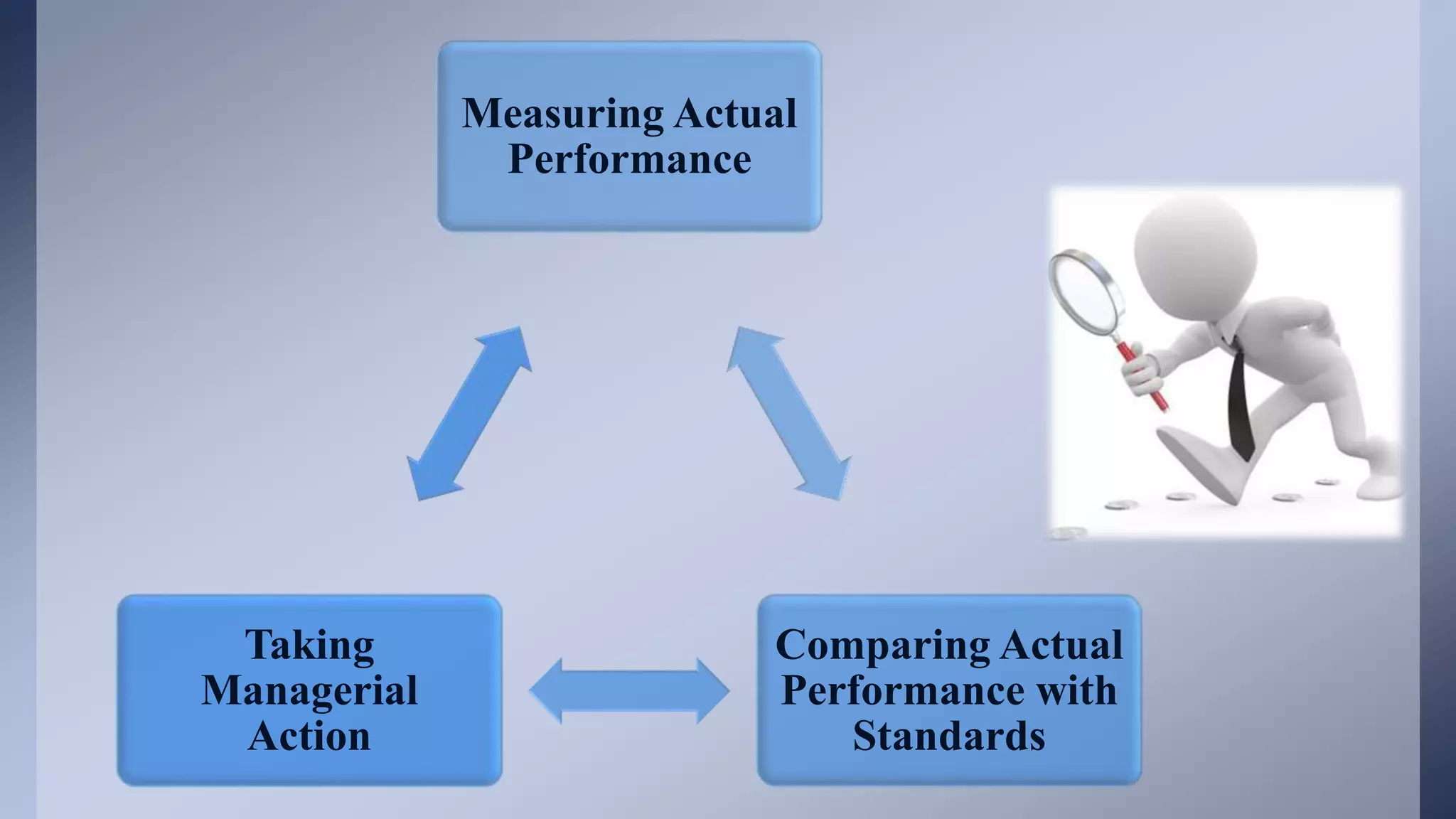
• The process of monitoring , comparing , and correcting the work
performance
Measuring Actual
Performance
Comparing Actual
Performance with
Standards
Taking
Managerial
Action
Control Techniques
• Financial control techniques
• Operational control techniques
Financial Control Techniques
• Budgeting
• Cost Accounting
• Financial Ratio Analysis
• Break Even Analysis
• Internal Audit
• Economic Values Added Technique
• Market Value Added Technique
Budgeting
Budgetary control is a system of controlling costs which includes
the preparation of budgets, coordinating the departments and
establishing responsibility, comparing actual performance with
budgeted and acting upon results to achieve profitability
-- Brown and Howard --
• Helps to learn from past experience
• Coordinate the work of entire organisation
Zero Based Budgeting
• A method of budgeting whereby all activities are re-evaluated each time a budget is set.
• The budget for the period covered starts from ‘Zero base’, instead of figures from
previous budgets
Programme Budgeting
Systematic identification and analysis of alternative programmes which are compared with
each other in terms of cost and resultant benefit.
Performance Budgeting
It is an input – output budget which emphasises organisational activity and the cost of each
activity , thus helps in knowing whether the organisation is getting adequate results for the
money spent.
Cost Accounting
• Control through costing involves the control over costs in the light
of certain pre-determined costs usually known as standard costs.
• Standard costing is a method of cost accounting in which standard
costs are used in recording certain transactions and the actual costs
are compared with the standard costs to find out the amount and
reasons of variations from the standard
Financial Ratio Analysis
A process of evaluating relationship between component parts of financial statements to
obtain a better understanding of a firm’s position and performance
-- Metcalf and Titard –
Liquidity ratios (ability to repay short term debts)
 Current ratio (relationship between current assets and current liabilities)
 Quick ratio (relationship between liquid assets and current liabilities)
Activity ratio (how funds of the organization are being used)
 Inventory turnover ratio (number of times inventory is replaced during the
year and with what effectiveness)
 Receivable turnover ratio (how promptly the organization is able to collect
due from the debtors)
 Asset turnover ratio (how effectively assets have been used to generate sales)
Leverage ratio (relative amount of funds in the business supplied by creditors/financiers
and shareholders/owners)
 Debt-equity ratio (proportion of debts in relation to equity and indicates the
financial strength of the organization)
 Debt-total capital ratio (the proportion of debts to total capital employed)
 Interest coverage ratio (the interest burden being borne by the organization in
relation to its profit)
Profitability ratios (the ability of an organization to earn profit in relation to its sales
and/or investment)
 Profit margin (expressed in the form of relationship between profit and sales and
indicates the degree of profitability)
 Return on investment (relating profit to investment. Most comprehensive technique
for controlling overall performance)also known as Du Pont system of financial
analysis
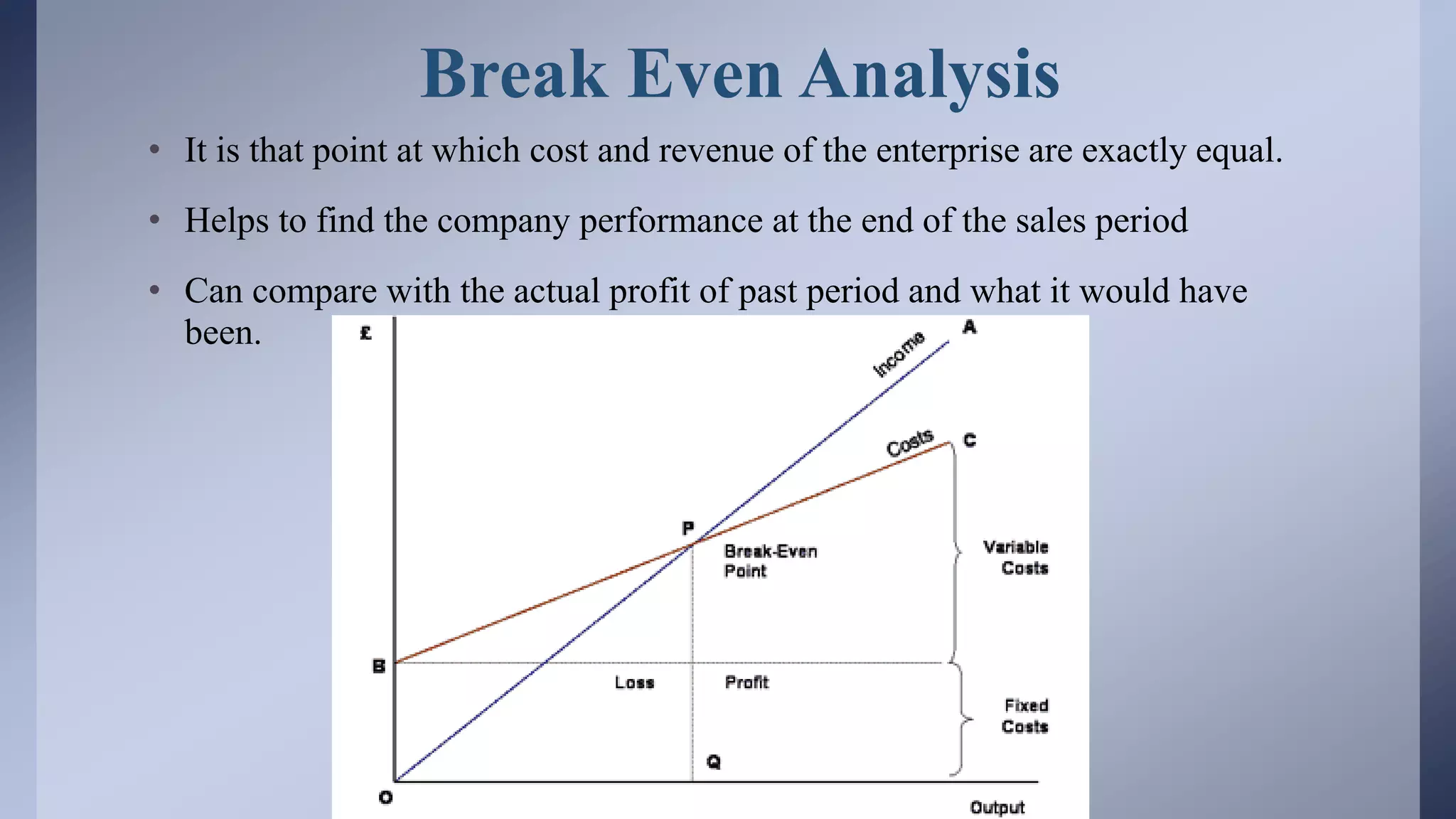
Break Even Analysis
• It is that point at which cost and revenue of the enterprise are exactly equal.
• Helps to find the company performance at the end of the sales period
• Can compare with the actual profit of past period and what it would have
been.
Internal Audit
• Carried out by internal auditor who is an employee of organization.
• Appraises policies, procedures, use of authority, quality of
management, effectiveness of methods, special problems
External Audit
• An independent appraisal of organization’s financial accounts and
statements.
• To ensure the interest of stakeholders are safeguarded against the
malpractices of management
Economic Value Added Technique
 Economic Value Added is excess profit of a firm after charging
cost of capital
 It is a comprehensive measure of performance
Market Value Added Technique
Market Value Added measures the stock market’s estimate
of net present value of a company’s past and expected
capital investment projects.
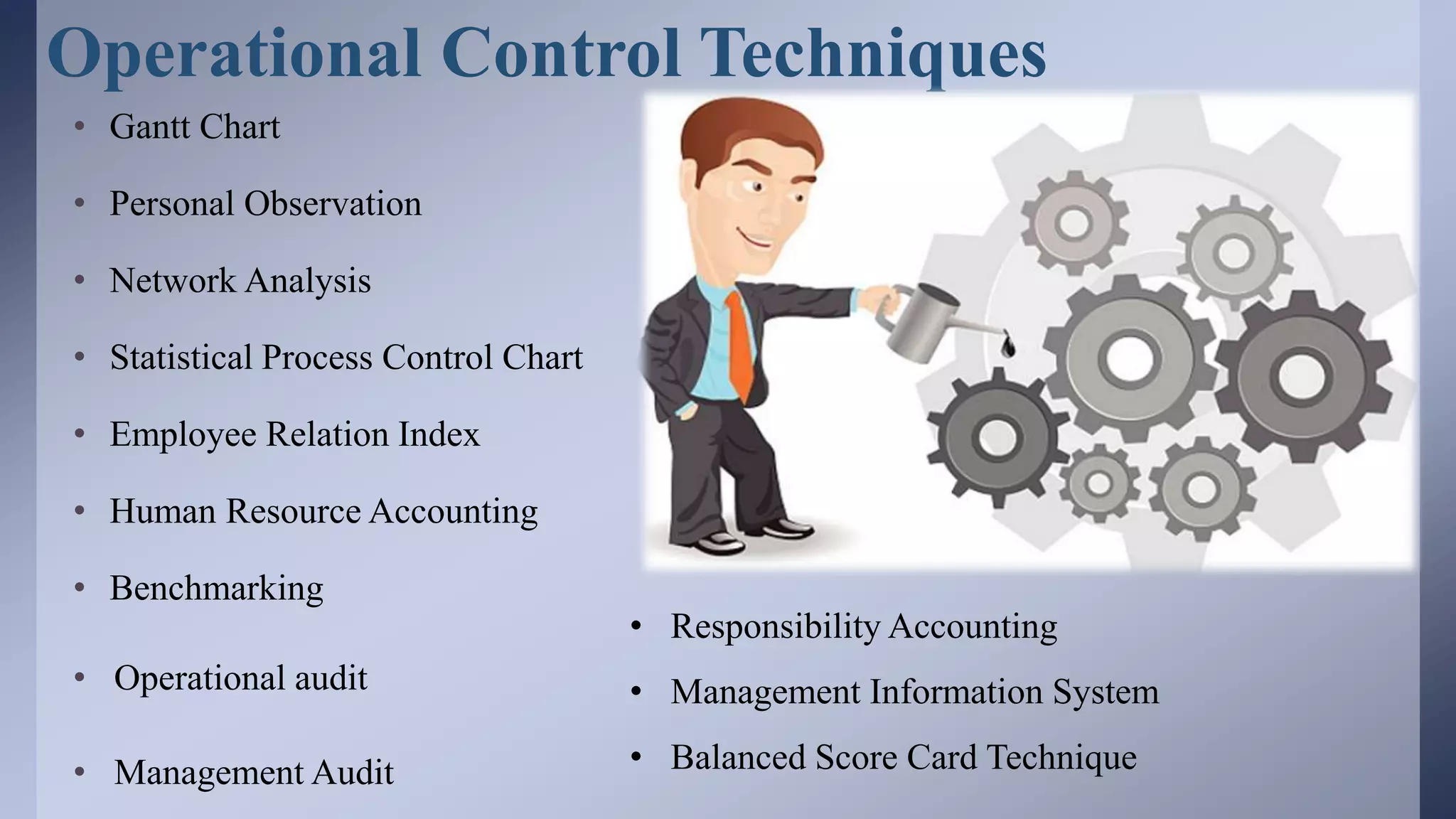
Operational Control Techniques
• Gantt Chart
• Personal Observation
• Network Analysis
• Statistical Process Control Chart
• Employee Relation Index
• Human Resource Accounting
• Benchmarking
• Operational audit
• Management Audit
• Responsibility Accounting
• Management Information System
• Balanced Score Card Technique
Personal Observation
• Helps the manager to know the worker’s attitude towards the work
and correct their work and methods, if necessary.
• Makes the workers alert and not wastes time.
Gantt Chart
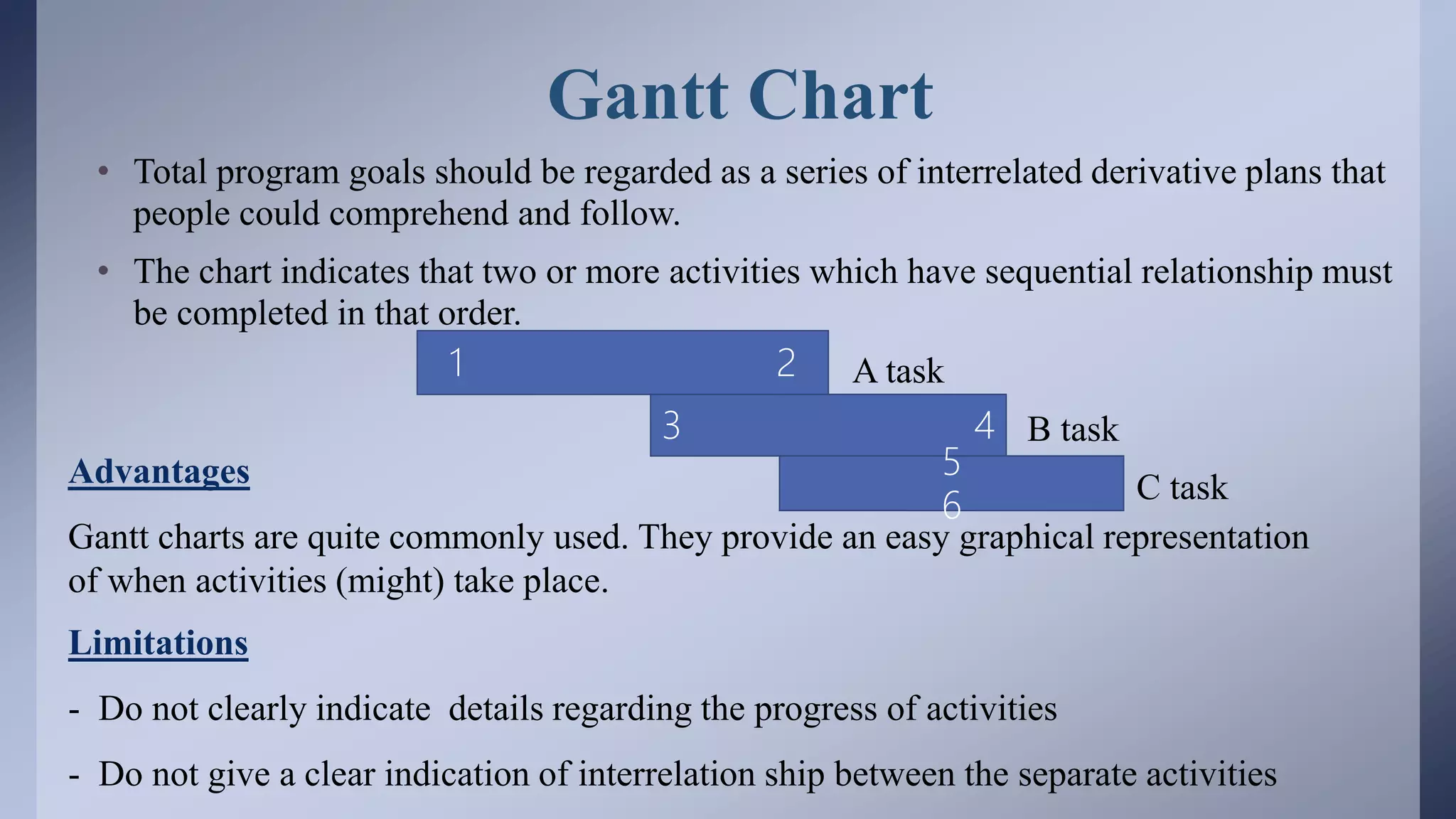
• Total program goals should be regarded as a series of interrelated derivative plans that
people could comprehend and follow.
• The chart indicates that two or more activities which have sequential relationship must
be completed in that order.
A task
B task
C task
1 2
3 4
5
6
Advantages
Gantt charts are quite commonly used. They provide an easy graphical representation
of when activities (might) take place.
Limitations
- Do not clearly indicate details regarding the progress of activities
- Do not give a clear indication of interrelation ship between the separate activities
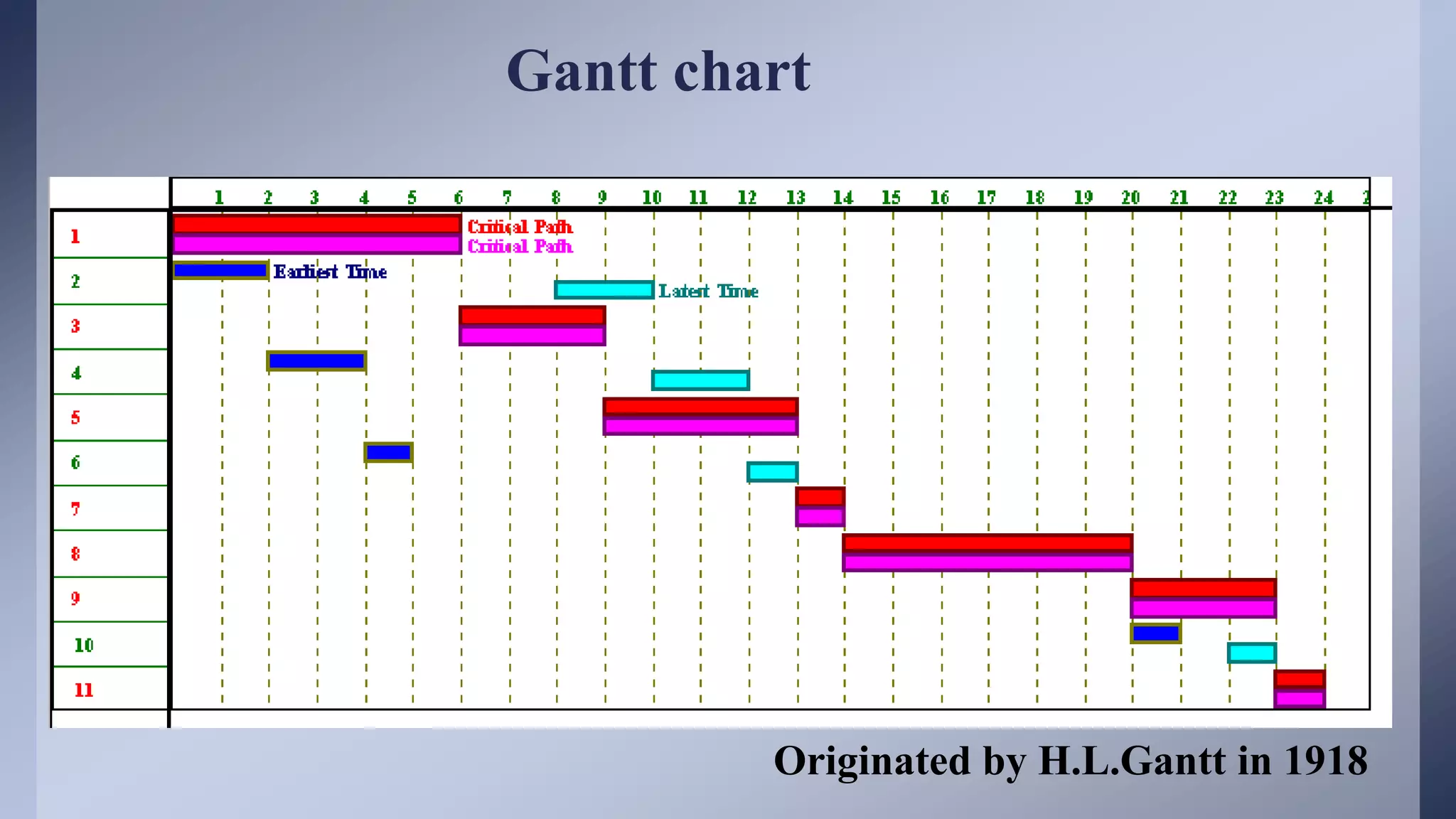
Originated by H.L.Gantt in 1918
Gantt chart
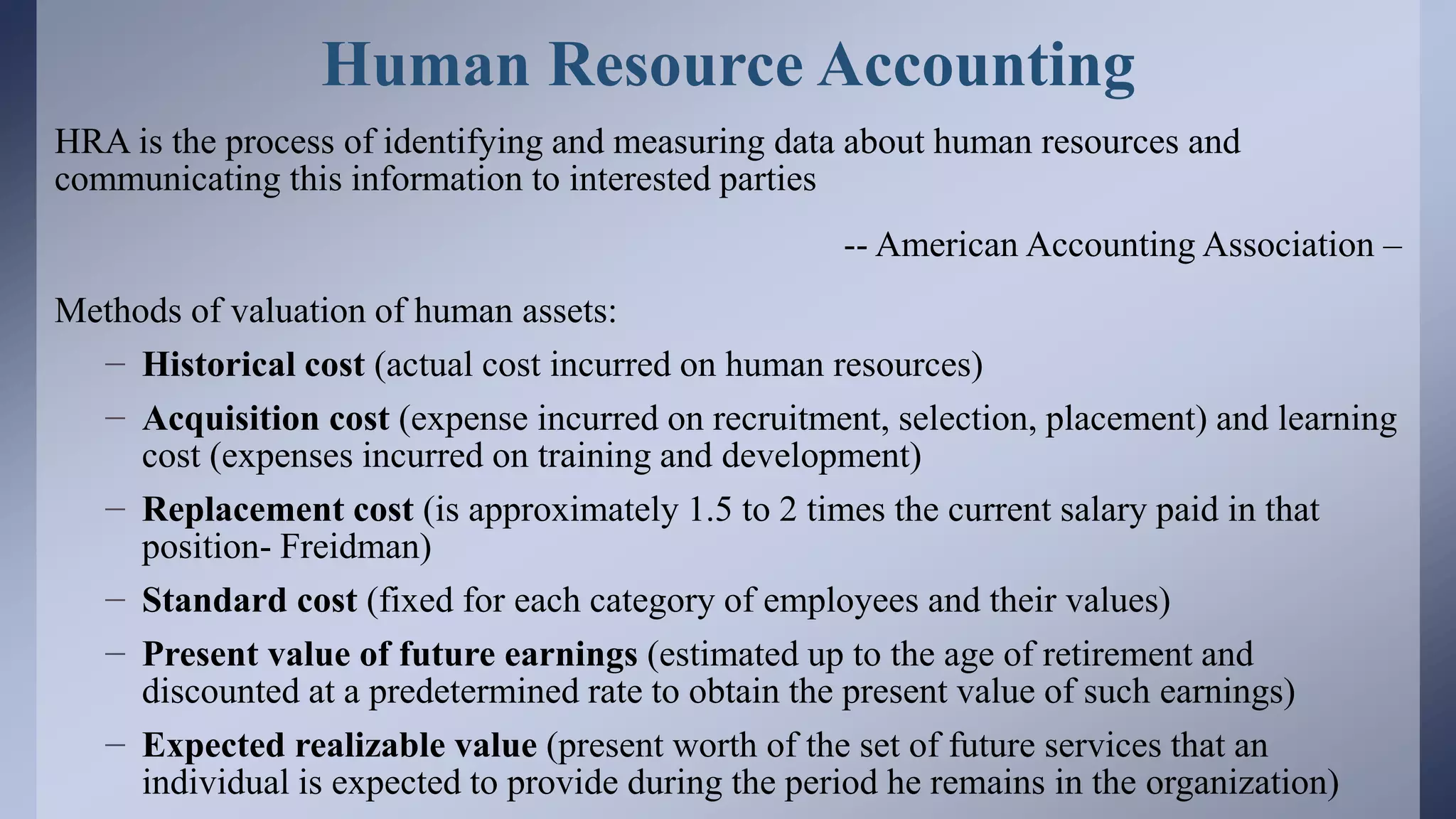
Human Resource Accounting
HRA is the process of identifying and measuring data about human resources and
communicating this information to interested parties
-- American Accounting Association –
Methods of valuation of human assets:
– Historical cost (actual cost incurred on human resources)
– Acquisition cost (expense incurred on recruitment, selection, placement) and learning
cost (expenses incurred on training and development)
– Replacement cost (is approximately 1.5 to 2 times the current salary paid in that
position- Freidman)
– Standard cost (fixed for each category of employees and their values)
– Present value of future earnings (estimated up to the age of retirement and
discounted at a predetermined rate to obtain the present value of such earnings)
– Expected realizable value (present worth of the set of future services that an
individual is expected to provide during the period he remains in the organization)
Management Audit
• Independent and critical examination of the entire management
process.
• It examines the total managerial process of planning, organizing,
staffing, directing and controlling besides examining the
company’s plans, objectives, policies, procedures, organization,
systems of control, personnel relations.
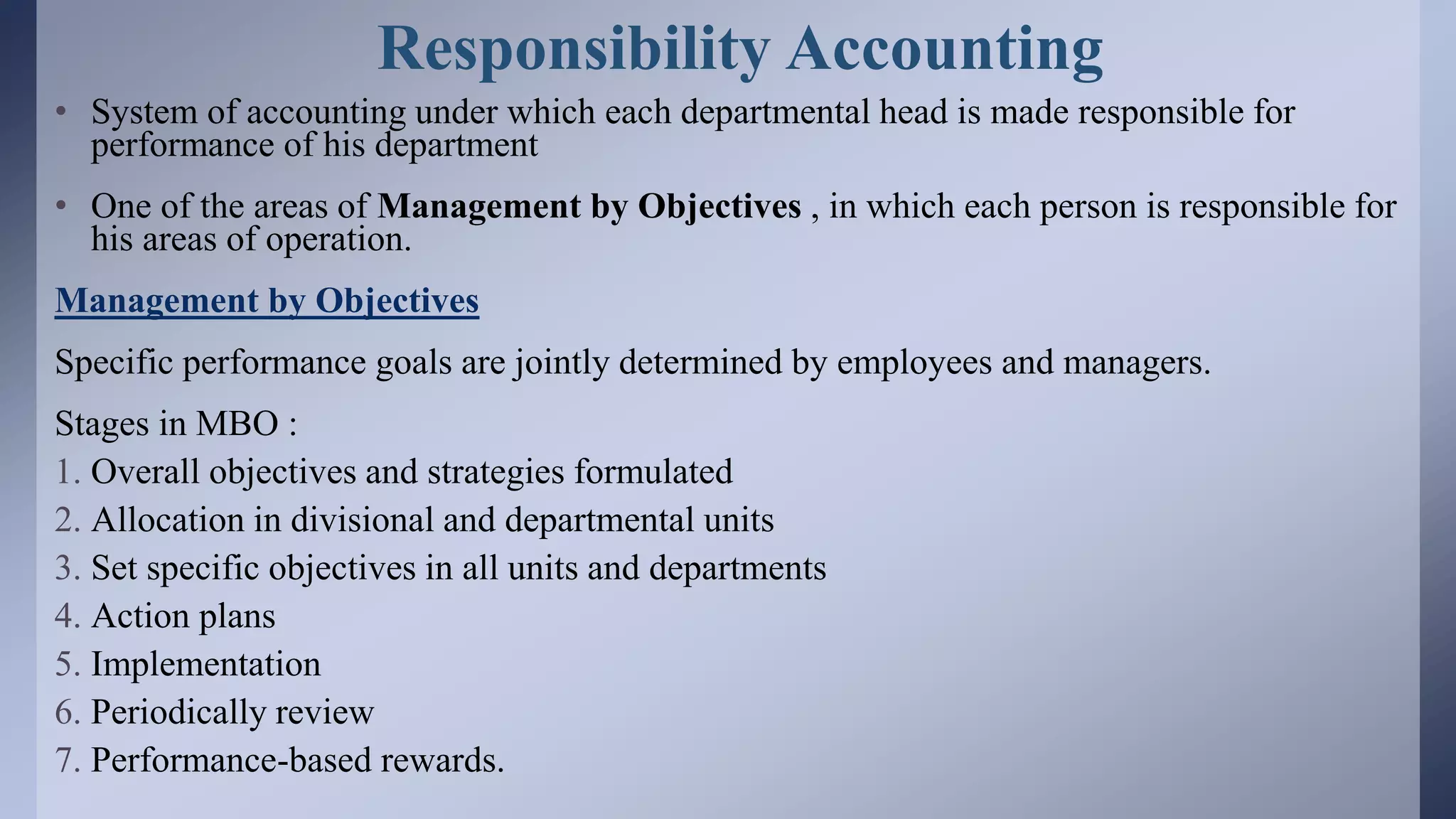
Responsibility Accounting
• System of accounting under which each departmental head is made responsible for
performance of his department
• One of the areas of Management by Objectives , in which each person is responsible for
his areas of operation.
Management by Objectives
Specific performance goals are jointly determined by employees and managers.
Stages in MBO :
1. Overall objectives and strategies formulated
2. Allocation in divisional and departmental units
3. Set specific objectives in all units and departments
4. Action plans
5. Implementation
6. Periodically review
7. Performance-based rewards.
References
• Principles of Management – P C Tripathi , P N Reddy
• Essentials of Management – Harold Koontz , Heinz Weihrich
• Management – Stephen P Robbins , Mary Coulter , Neharika Vohra
• Management ,Principles and Practices – Pradeep Kumar , K S Thakur
Operational and financial control techniques

Operational and financial control techniques

  • 1.
    Operational and Financial ControlTechniques Presented by: Susmi Harsha C S
  • 2.
    Control • According toHarold Koontz and Heinz Weihrich , “ The managerial function of controlling is the measurement and correction of performance in order to make sure that organisation objectives and plans devised to attain them are being accomplished.” • The process of monitoring , comparing , and correcting the work performance
  • 3.
    Measuring Actual Performance Comparing Actual Performancewith Standards Taking Managerial Action
  • 4.
    Control Techniques • Financialcontrol techniques • Operational control techniques
  • 5.
    Financial Control Techniques •Budgeting • Cost Accounting • Financial Ratio Analysis • Break Even Analysis • Internal Audit • Economic Values Added Technique • Market Value Added Technique
  • 6.
    Budgeting Budgetary control isa system of controlling costs which includes the preparation of budgets, coordinating the departments and establishing responsibility, comparing actual performance with budgeted and acting upon results to achieve profitability -- Brown and Howard -- • Helps to learn from past experience • Coordinate the work of entire organisation
  • 7.
    Zero Based Budgeting •A method of budgeting whereby all activities are re-evaluated each time a budget is set. • The budget for the period covered starts from ‘Zero base’, instead of figures from previous budgets Programme Budgeting Systematic identification and analysis of alternative programmes which are compared with each other in terms of cost and resultant benefit. Performance Budgeting It is an input – output budget which emphasises organisational activity and the cost of each activity , thus helps in knowing whether the organisation is getting adequate results for the money spent.
  • 8.
    Cost Accounting • Controlthrough costing involves the control over costs in the light of certain pre-determined costs usually known as standard costs. • Standard costing is a method of cost accounting in which standard costs are used in recording certain transactions and the actual costs are compared with the standard costs to find out the amount and reasons of variations from the standard
  • 9.
    Financial Ratio Analysis Aprocess of evaluating relationship between component parts of financial statements to obtain a better understanding of a firm’s position and performance -- Metcalf and Titard – Liquidity ratios (ability to repay short term debts)  Current ratio (relationship between current assets and current liabilities)  Quick ratio (relationship between liquid assets and current liabilities) Activity ratio (how funds of the organization are being used)  Inventory turnover ratio (number of times inventory is replaced during the year and with what effectiveness)  Receivable turnover ratio (how promptly the organization is able to collect due from the debtors)  Asset turnover ratio (how effectively assets have been used to generate sales)
  • 10.
    Leverage ratio (relativeamount of funds in the business supplied by creditors/financiers and shareholders/owners)  Debt-equity ratio (proportion of debts in relation to equity and indicates the financial strength of the organization)  Debt-total capital ratio (the proportion of debts to total capital employed)  Interest coverage ratio (the interest burden being borne by the organization in relation to its profit) Profitability ratios (the ability of an organization to earn profit in relation to its sales and/or investment)  Profit margin (expressed in the form of relationship between profit and sales and indicates the degree of profitability)  Return on investment (relating profit to investment. Most comprehensive technique for controlling overall performance)also known as Du Pont system of financial analysis
  • 11.
    Break Even Analysis •It is that point at which cost and revenue of the enterprise are exactly equal. • Helps to find the company performance at the end of the sales period • Can compare with the actual profit of past period and what it would have been.
  • 12.
    Internal Audit • Carriedout by internal auditor who is an employee of organization. • Appraises policies, procedures, use of authority, quality of management, effectiveness of methods, special problems External Audit • An independent appraisal of organization’s financial accounts and statements. • To ensure the interest of stakeholders are safeguarded against the malpractices of management
  • 13.
    Economic Value AddedTechnique  Economic Value Added is excess profit of a firm after charging cost of capital  It is a comprehensive measure of performance
  • 14.
    Market Value AddedTechnique Market Value Added measures the stock market’s estimate of net present value of a company’s past and expected capital investment projects.
  • 15.
    Operational Control Techniques •Gantt Chart • Personal Observation • Network Analysis • Statistical Process Control Chart • Employee Relation Index • Human Resource Accounting • Benchmarking • Operational audit • Management Audit • Responsibility Accounting • Management Information System • Balanced Score Card Technique
  • 16.
    Personal Observation • Helpsthe manager to know the worker’s attitude towards the work and correct their work and methods, if necessary. • Makes the workers alert and not wastes time.
  • 17.
    Gantt Chart • Totalprogram goals should be regarded as a series of interrelated derivative plans that people could comprehend and follow. • The chart indicates that two or more activities which have sequential relationship must be completed in that order. A task B task C task 1 2 3 4 5 6 Advantages Gantt charts are quite commonly used. They provide an easy graphical representation of when activities (might) take place. Limitations - Do not clearly indicate details regarding the progress of activities - Do not give a clear indication of interrelation ship between the separate activities
  • 18.
    Originated by H.L.Ganttin 1918 Gantt chart
  • 19.
    Human Resource Accounting HRAis the process of identifying and measuring data about human resources and communicating this information to interested parties -- American Accounting Association – Methods of valuation of human assets: – Historical cost (actual cost incurred on human resources) – Acquisition cost (expense incurred on recruitment, selection, placement) and learning cost (expenses incurred on training and development) – Replacement cost (is approximately 1.5 to 2 times the current salary paid in that position- Freidman) – Standard cost (fixed for each category of employees and their values) – Present value of future earnings (estimated up to the age of retirement and discounted at a predetermined rate to obtain the present value of such earnings) – Expected realizable value (present worth of the set of future services that an individual is expected to provide during the period he remains in the organization)
  • 20.
    Management Audit • Independentand critical examination of the entire management process. • It examines the total managerial process of planning, organizing, staffing, directing and controlling besides examining the company’s plans, objectives, policies, procedures, organization, systems of control, personnel relations.
  • 21.
    Responsibility Accounting • Systemof accounting under which each departmental head is made responsible for performance of his department • One of the areas of Management by Objectives , in which each person is responsible for his areas of operation. Management by Objectives Specific performance goals are jointly determined by employees and managers. Stages in MBO : 1. Overall objectives and strategies formulated 2. Allocation in divisional and departmental units 3. Set specific objectives in all units and departments 4. Action plans 5. Implementation 6. Periodically review 7. Performance-based rewards.
  • 22.
    References • Principles ofManagement – P C Tripathi , P N Reddy • Essentials of Management – Harold Koontz , Heinz Weihrich • Management – Stephen P Robbins , Mary Coulter , Neharika Vohra • Management ,Principles and Practices – Pradeep Kumar , K S Thakur