CONTROLLED DRUG
DELIVERY SYSTEM
Presented by
P.Sushmitha
I year M.Tech Biotechnology
Sri Venkateswara College of Engineering.
Introduction
• Sustained release:- Pharmaceutical dosage form formulated to
retard the release of therapeutic agent, prolonged presence in
plasma.
• Controlled release:- Therapeutic agents may be released at a
pre-determined rate over a long period of time. Predictability
and Reproducibility in drug release kinetics.
Advantages
• Total dose is low.
• Reduced GI side effects.
• Better patient acceptance and compliance.
• Less fluctuation at plasma drug level.
• Improved efficacy/safety ratio.
• Uniform drug effect.
Classification
1. Rate Pre-programmed Drug Delivery System.
2. Activation Modulated Drug Delivery System.
3. Feedback Regulated Drug Delivery System.
4. Site Targeting Drug Delivery System.
1. Rate Pre-programmed Drug Delivery
System
• Release of drug molecules from the delivery system has been
programmed at specific rate profiles.
• Controls diffusion of drug molecule into medium.
Types
a) Polymer membrane permeation controlled DDS.
b) Polymer matrix diffusion controlled DDS.
c) Microreservoir partition controlled DDS
a) Polymer membrane permeation controlled
DDS
• Drug formulation is totally or partially encapsulated within drug
reservoir.
• Drug release surface is covered by rate controlling polymer
membrane having specific permeability.
• Drug reservoir – Solid, suspension or solution.
• Polymer membrane – Non-porous polymeric material,
microporous membrane.
• Methods of encapsulation – Injection moulding, spray coating or
microencapsulation.
• Release of drug material controlled by – Partition coefficient,
diffusivity, thickness of membrane.
Example:- Progestasert IUD
• Reservoir
Suspension of crystallized
Progesterone and barium
sulphate in silicone medical
fluid.
• Polymer
Non-porous membrane of
ethylene-vinyl acetate co-
polymer.
• Daily dosage of 65µg/day
to aid in contraception for
1 year.
b) Polymer matrix diffusion controlled DDS
• Homogeneous dispersion of drug in polymer matrix.
Accomplished by one of the following methods.
i. Finely grounded therapeutic drug blended with liquid polymer or
high viscous base polymer followed by cross linking of polymer
chains.
ii. Drug solids mixed with rubbery polymer at elevated temperatures.
iii. Drug and polymer dissolved in common solvent followed by
solvent evaporation at elevated temperature.
iv. Release of drug controlled by:- Loading dose, polymer solubility
of drug, Drug diffusivity in polymer matrix.
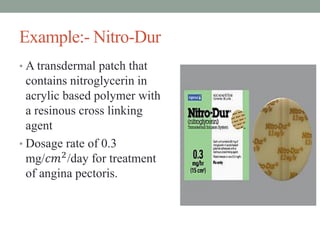
Example:- Nitro-Dur
• A transdermal patch that
contains nitroglycerin in
acrylic based polymer with
a resinous cross linking
agent
• Dosage rate of 0.3
mg/𝑐𝑚2
/day for treatment
of angina pectoris.
c) Microreservoir partition controlled DDS
• Drug reservoir – Micro-dispersion of aqueous suspension of drug
molecule in a biocompatible polymer to form homogeneous
dispersion.
• According to the physicochemical properties of drug and its
release rate it can be further coated with biocompatible polymer to
modify the rate of release of drug.
• Drug dispersion moulded to form a solid medicated disc on an
impermeable metallic plastic laminate by injection moulding under
instantaneous heating.
• Drug release controlled by:- Partition coefficient, diffusivity of
drug, solubility of drug.
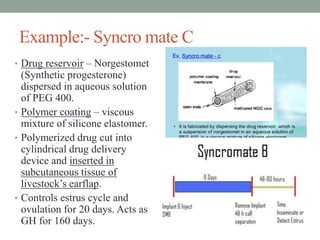
Example:- Syncro mate C
• Drug reservoir – Norgestomet
(Synthetic progesterone)
dispersed in aqueous solution
of PEG 400.
• Polymer coating – viscous
mixture of silicone elastomer.
• Polymerized drug cut into
cylindrical drug delivery
device and inserted in
subcutaneous tissue of
livestock’s earflap.
• Controls estrus cycle and
ovulation for 20 days. Acts as
GH for 160 days.
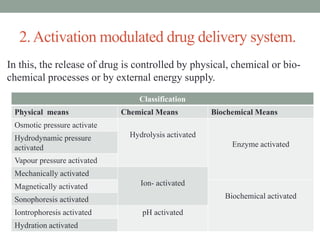
2.Activation modulated drug delivery system.
In this, the release of drug is controlled by physical, chemical or bio-
chemical processes or by external energy supply.
Classification
Physical means Chemical Means Biochemical Means
Osmotic pressure activate
Hydrolysis activated
Enzyme activated
Hydrodynamic pressure
activated
Vapour pressure activated
Mechanically activated
Ion- activatedMagnetically activated
Biochemical activatedSonophoresis activated
Iontrophoresis activated pH activated
Hydration activated
Physical
meas
Description Example
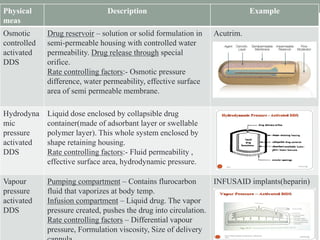
Osmotic
controlled
activated
DDS
Drug reservoir – solution or solid formulation in
semi-permeable housing with controlled water
permeability. Drug release through special
orifice.
Rate controlling factors:- Osmotic pressure
difference, water permeability, effective surface
area of semi permeable membrane.
Acutrim.
Hydrodyna
mic
pressure
activated
DDS
Liquid dose enclosed by collapsible drug
container(made of adsorbant layer or swellable
polymer layer). This whole system enclosed by
shape retaining housing.
Rate controlling factors:- Fluid permeability ,
effective surface area, hydrodynamic pressure.
Vapour
pressure
activated
DDS
Pumping compartment – Contains flurocarbon
fluid that vaporizes at body temp.
Infusion compartment – Liquid drug. The vapor
pressure created, pushes the drug into circulation.
Rate controlling factors – Differential vapour
pressure, Formulation viscosity, Size of delivery
INFUSAID implants(heparin)
Physical means Description Example
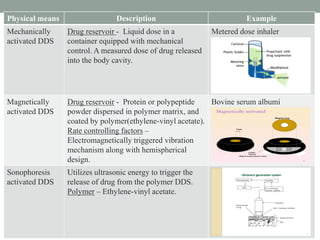
Mechanically
activated DDS
Drug reservoir - Liquid dose in a
container equipped with mechanical
control. A measured dose of drug released
into the body cavity.
Metered dose inhaler
Magnetically
activated DDS
Drug reservoir - Protein or polypeptide
powder dispersed in polymer matrix, and
coated by polymer(ethylene-vinyl acetate).
Rate controlling factors –
Electromagnetically triggered vibration
mechanism along with hemispherical
design.
Bovine serum albumi
Sonophoresis
activated DDS
Utilizes ultrasonic energy to trigger the
release of drug from the polymer DDS.
Polymer – Ethylene-vinyl acetate.
Physical means Description Example
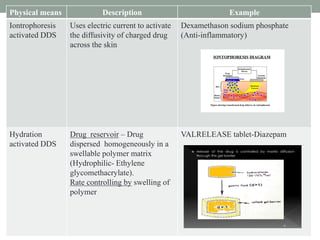
Iontrophoresis
activated DDS
Uses electric current to activate
the diffusivity of charged drug
across the skin
Dexamethason sodium phosphate
(Anti-inflammatory)
Hydration
activated DDS
Drug reservoir – Drug
dispersed homogeneously in a
swellable polymer matrix
(Hydrophilic- Ethylene
glycomethacrylate).
Rate controlling by swelling of
polymer
VALRELEASE tablet-Diazepam
Chemical
means
Description Example
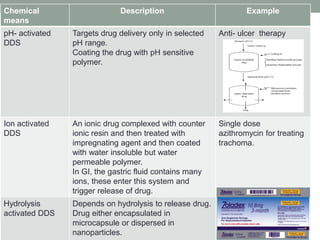
pH- activated
DDS
Targets drug delivery only in selected
pH range.
Coating the drug with pH sensitive
polymer.
Anti- ulcer therapy
Ion activated
DDS
An ionic drug complexed with counter
ionic resin and then treated with
impregnating agent and then coated
with water insoluble but water
permeable polymer.
In GI, the gastric fluid contains many
ions, these enter this system and
trigger release of drug.
Single dose
azithromycin for treating
trachoma.
Hydrolysis
activated DDS
Depends on hydrolysis to release drug.
Drug either encapsulated in
microcapsule or dispersed in
nanoparticles.
Biochemical means Description Example
Enzyme activated DDS Depend on enzymatic
process to activate release of
drug.
Drug reservoir – drug
physically entrapped in
microspheres or chemically
bound to polymer
chain(albumins or
polypeptides).
Enzymatic hydrolysis of
biopolymers by specific
enzyme in target tissue.
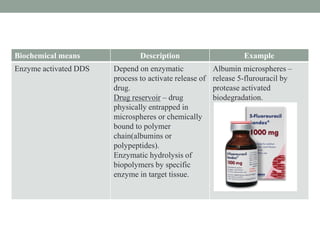
Albumin microspheres –
release 5-flurouracil by
protease activated
biodegradation.
3. Feedback Regulated Drug Delivery System
• Drug release activated by a triggering system (biochemical
substances) and its concentration.
• They are further classified as
a) Bioerosion-regulated DDS.
b) Bioresponsive DDS.
c) Self regulated DDS.
a) Bioerosion regulated DDS
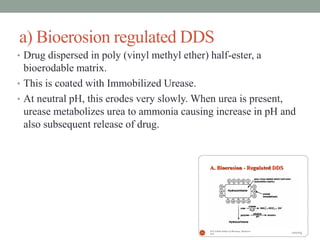
• Drug dispersed in poly (vinyl methyl ether) half-ester, a
bioerodable matrix.
• This is coated with Immobilized Urease.
• At neutral pH, this erodes very slowly. When urea is present,
urease metabolizes urea to ammonia causing increase in pH and
also subsequent release of drug.
b) Bioresponsive DDS
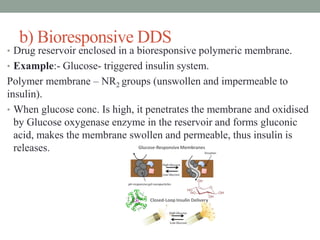
• Drug reservoir enclosed in a bioresponsive polymeric membrane.
• Example:- Glucose- triggered insulin system.
Polymer membrane – NR2 groups (unswollen and impermeable to
insulin).
• When glucose conc. Is high, it penetrates the membrane and oxidised
by Glucose oxygenase enzyme in the reservoir and forms gluconic
acid, makes the membrane swollen and permeable, thus insulin is
releases.
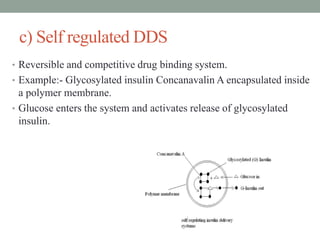
c) Self regulated DDS
• Reversible and competitive drug binding system.
• Example:- Glycosylated insulin Concanavalin A encapsulated inside
a polymer membrane.
• Glucose enters the system and activates release of glycosylated
insulin.
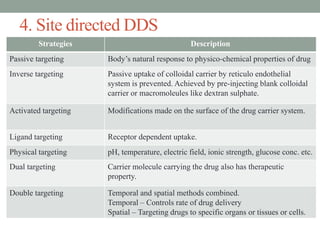
4. Site directed DDS
Strategies Description
Passive targeting Body’s natural response to physico-chemical properties of drug
Inverse targeting Passive uptake of colloidal carrier by reticulo endothelial
system is prevented. Achieved by pre-injecting blank colloidal
carrier or macromoleules like dextran sulphate.
Activated targeting Modifications made on the surface of the drug carrier system.
Ligand targeting Receptor dependent uptake.
Physical targeting pH, temperature, electric field, ionic strength, glucose conc. etc.
Dual targeting Carrier molecule carrying the drug also has therapeutic
property.
Double targeting Temporal and spatial methods combined.
Temporal – Controls rate of drug delivery
Spatial – Targeting drugs to specific organs or tissues or cells.
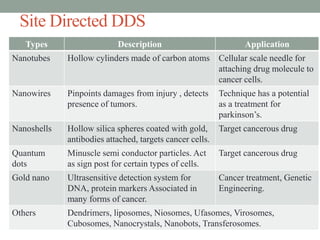
Site Directed DDS
Types Description Application
Nanotubes Hollow cylinders made of carbon atoms Cellular scale needle for
attaching drug molecule to
cancer cells.
Nanowires Pinpoints damages from injury , detects
presence of tumors.
Technique has a potential
as a treatment for
parkinson’s.
Nanoshells Hollow silica spheres coated with gold,
antibodies attached, targets cancer cells.
Target cancerous drug
Quantum
dots
Minuscle semi conductor particles. Act
as sign post for certain types of cells.
Target cancerous drug
Gold nano Ultrasensitive detection system for
DNA, protein markers Associated in
many forms of cancer.
Cancer treatment, Genetic
Engineering.
Others Dendrimers, liposomes, Niosomes, Ufasomes, Virosomes,
Cubosomes, Nanocrystals, Nanobots, Transferosomes.
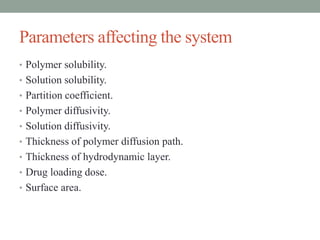
Parameters affecting the system
• Polymer solubility.
• Solution solubility.
• Partition coefficient.
• Polymer diffusivity.
• Solution diffusivity.
• Thickness of polymer diffusion path.
• Thickness of hydrodynamic layer.
• Drug loading dose.
• Surface area.
Disadvantages
• Poor In-vivo, In-vitro correlation.
• Possibility of dose dumping.
• Higher cost formulation.
Controlled drug delivery system

Controlled drug delivery system

  • 1.
    CONTROLLED DRUG DELIVERY SYSTEM Presentedby P.Sushmitha I year M.Tech Biotechnology Sri Venkateswara College of Engineering.
  • 2.
    Introduction • Sustained release:-Pharmaceutical dosage form formulated to retard the release of therapeutic agent, prolonged presence in plasma. • Controlled release:- Therapeutic agents may be released at a pre-determined rate over a long period of time. Predictability and Reproducibility in drug release kinetics.
  • 3.
    Advantages • Total doseis low. • Reduced GI side effects. • Better patient acceptance and compliance. • Less fluctuation at plasma drug level. • Improved efficacy/safety ratio. • Uniform drug effect.
  • 4.
    Classification 1. Rate Pre-programmedDrug Delivery System. 2. Activation Modulated Drug Delivery System. 3. Feedback Regulated Drug Delivery System. 4. Site Targeting Drug Delivery System.
  • 5.
    1. Rate Pre-programmedDrug Delivery System • Release of drug molecules from the delivery system has been programmed at specific rate profiles. • Controls diffusion of drug molecule into medium. Types a) Polymer membrane permeation controlled DDS. b) Polymer matrix diffusion controlled DDS. c) Microreservoir partition controlled DDS
  • 6.
    a) Polymer membranepermeation controlled DDS • Drug formulation is totally or partially encapsulated within drug reservoir. • Drug release surface is covered by rate controlling polymer membrane having specific permeability. • Drug reservoir – Solid, suspension or solution. • Polymer membrane – Non-porous polymeric material, microporous membrane. • Methods of encapsulation – Injection moulding, spray coating or microencapsulation. • Release of drug material controlled by – Partition coefficient, diffusivity, thickness of membrane.
  • 7.
    Example:- Progestasert IUD •Reservoir Suspension of crystallized Progesterone and barium sulphate in silicone medical fluid. • Polymer Non-porous membrane of ethylene-vinyl acetate co- polymer. • Daily dosage of 65µg/day to aid in contraception for 1 year.
  • 8.
    b) Polymer matrixdiffusion controlled DDS • Homogeneous dispersion of drug in polymer matrix. Accomplished by one of the following methods. i. Finely grounded therapeutic drug blended with liquid polymer or high viscous base polymer followed by cross linking of polymer chains. ii. Drug solids mixed with rubbery polymer at elevated temperatures. iii. Drug and polymer dissolved in common solvent followed by solvent evaporation at elevated temperature. iv. Release of drug controlled by:- Loading dose, polymer solubility of drug, Drug diffusivity in polymer matrix.
  • 9.
    Example:- Nitro-Dur • Atransdermal patch that contains nitroglycerin in acrylic based polymer with a resinous cross linking agent • Dosage rate of 0.3 mg/𝑐𝑚2 /day for treatment of angina pectoris.
  • 10.
    c) Microreservoir partitioncontrolled DDS • Drug reservoir – Micro-dispersion of aqueous suspension of drug molecule in a biocompatible polymer to form homogeneous dispersion. • According to the physicochemical properties of drug and its release rate it can be further coated with biocompatible polymer to modify the rate of release of drug. • Drug dispersion moulded to form a solid medicated disc on an impermeable metallic plastic laminate by injection moulding under instantaneous heating. • Drug release controlled by:- Partition coefficient, diffusivity of drug, solubility of drug.
  • 11.
    Example:- Syncro mateC • Drug reservoir – Norgestomet (Synthetic progesterone) dispersed in aqueous solution of PEG 400. • Polymer coating – viscous mixture of silicone elastomer. • Polymerized drug cut into cylindrical drug delivery device and inserted in subcutaneous tissue of livestock’s earflap. • Controls estrus cycle and ovulation for 20 days. Acts as GH for 160 days.
  • 12.
    2.Activation modulated drugdelivery system. In this, the release of drug is controlled by physical, chemical or bio- chemical processes or by external energy supply. Classification Physical means Chemical Means Biochemical Means Osmotic pressure activate Hydrolysis activated Enzyme activated Hydrodynamic pressure activated Vapour pressure activated Mechanically activated Ion- activatedMagnetically activated Biochemical activatedSonophoresis activated Iontrophoresis activated pH activated Hydration activated
  • 13.
    Physical meas Description Example Osmotic controlled activated DDS Drug reservoir– solution or solid formulation in semi-permeable housing with controlled water permeability. Drug release through special orifice. Rate controlling factors:- Osmotic pressure difference, water permeability, effective surface area of semi permeable membrane. Acutrim. Hydrodyna mic pressure activated DDS Liquid dose enclosed by collapsible drug container(made of adsorbant layer or swellable polymer layer). This whole system enclosed by shape retaining housing. Rate controlling factors:- Fluid permeability , effective surface area, hydrodynamic pressure. Vapour pressure activated DDS Pumping compartment – Contains flurocarbon fluid that vaporizes at body temp. Infusion compartment – Liquid drug. The vapor pressure created, pushes the drug into circulation. Rate controlling factors – Differential vapour pressure, Formulation viscosity, Size of delivery INFUSAID implants(heparin)
  • 14.
    Physical means DescriptionExample Mechanically activated DDS Drug reservoir - Liquid dose in a container equipped with mechanical control. A measured dose of drug released into the body cavity. Metered dose inhaler Magnetically activated DDS Drug reservoir - Protein or polypeptide powder dispersed in polymer matrix, and coated by polymer(ethylene-vinyl acetate). Rate controlling factors – Electromagnetically triggered vibration mechanism along with hemispherical design. Bovine serum albumi Sonophoresis activated DDS Utilizes ultrasonic energy to trigger the release of drug from the polymer DDS. Polymer – Ethylene-vinyl acetate.
  • 15.
    Physical means DescriptionExample Iontrophoresis activated DDS Uses electric current to activate the diffusivity of charged drug across the skin Dexamethason sodium phosphate (Anti-inflammatory) Hydration activated DDS Drug reservoir – Drug dispersed homogeneously in a swellable polymer matrix (Hydrophilic- Ethylene glycomethacrylate). Rate controlling by swelling of polymer VALRELEASE tablet-Diazepam
  • 16.
    Chemical means Description Example pH- activated DDS Targetsdrug delivery only in selected pH range. Coating the drug with pH sensitive polymer. Anti- ulcer therapy Ion activated DDS An ionic drug complexed with counter ionic resin and then treated with impregnating agent and then coated with water insoluble but water permeable polymer. In GI, the gastric fluid contains many ions, these enter this system and trigger release of drug. Single dose azithromycin for treating trachoma. Hydrolysis activated DDS Depends on hydrolysis to release drug. Drug either encapsulated in microcapsule or dispersed in nanoparticles.
  • 17.
    Biochemical means DescriptionExample Enzyme activated DDS Depend on enzymatic process to activate release of drug. Drug reservoir – drug physically entrapped in microspheres or chemically bound to polymer chain(albumins or polypeptides). Enzymatic hydrolysis of biopolymers by specific enzyme in target tissue. Albumin microspheres – release 5-flurouracil by protease activated biodegradation.
  • 18.
    3. Feedback RegulatedDrug Delivery System • Drug release activated by a triggering system (biochemical substances) and its concentration. • They are further classified as a) Bioerosion-regulated DDS. b) Bioresponsive DDS. c) Self regulated DDS.
  • 19.
    a) Bioerosion regulatedDDS • Drug dispersed in poly (vinyl methyl ether) half-ester, a bioerodable matrix. • This is coated with Immobilized Urease. • At neutral pH, this erodes very slowly. When urea is present, urease metabolizes urea to ammonia causing increase in pH and also subsequent release of drug.
  • 20.
    b) Bioresponsive DDS •Drug reservoir enclosed in a bioresponsive polymeric membrane. • Example:- Glucose- triggered insulin system. Polymer membrane – NR2 groups (unswollen and impermeable to insulin). • When glucose conc. Is high, it penetrates the membrane and oxidised by Glucose oxygenase enzyme in the reservoir and forms gluconic acid, makes the membrane swollen and permeable, thus insulin is releases.
  • 21.
    c) Self regulatedDDS • Reversible and competitive drug binding system. • Example:- Glycosylated insulin Concanavalin A encapsulated inside a polymer membrane. • Glucose enters the system and activates release of glycosylated insulin.
  • 22.
    4. Site directedDDS Strategies Description Passive targeting Body’s natural response to physico-chemical properties of drug Inverse targeting Passive uptake of colloidal carrier by reticulo endothelial system is prevented. Achieved by pre-injecting blank colloidal carrier or macromoleules like dextran sulphate. Activated targeting Modifications made on the surface of the drug carrier system. Ligand targeting Receptor dependent uptake. Physical targeting pH, temperature, electric field, ionic strength, glucose conc. etc. Dual targeting Carrier molecule carrying the drug also has therapeutic property. Double targeting Temporal and spatial methods combined. Temporal – Controls rate of drug delivery Spatial – Targeting drugs to specific organs or tissues or cells.
  • 23.
    Site Directed DDS TypesDescription Application Nanotubes Hollow cylinders made of carbon atoms Cellular scale needle for attaching drug molecule to cancer cells. Nanowires Pinpoints damages from injury , detects presence of tumors. Technique has a potential as a treatment for parkinson’s. Nanoshells Hollow silica spheres coated with gold, antibodies attached, targets cancer cells. Target cancerous drug Quantum dots Minuscle semi conductor particles. Act as sign post for certain types of cells. Target cancerous drug Gold nano Ultrasensitive detection system for DNA, protein markers Associated in many forms of cancer. Cancer treatment, Genetic Engineering. Others Dendrimers, liposomes, Niosomes, Ufasomes, Virosomes, Cubosomes, Nanocrystals, Nanobots, Transferosomes.
  • 24.
    Parameters affecting thesystem • Polymer solubility. • Solution solubility. • Partition coefficient. • Polymer diffusivity. • Solution diffusivity. • Thickness of polymer diffusion path. • Thickness of hydrodynamic layer. • Drug loading dose. • Surface area.
  • 25.
    Disadvantages • Poor In-vivo,In-vitro correlation. • Possibility of dose dumping. • Higher cost formulation.