Sustained release
  formulations


Hardi Sdiq muhemmed
   Collage of Pharmacy
  University of Suleiman


                           1
DEFINITION:-

 SRF’s describes the s l o w release of a drug
  substance from a dosage form to maintain
  therapeutic response for extended period (8-12hrs)of
  time.

 Time depends on the dosage form. In oral form it is
  in hours, and in parenteral’s it is in days and months.
  Ex: Aspirin SR, Dextrim SR.


                                                     2
The             of SRDF’s is to obtain Zero order
 release from the dosage form.
Zero order release is a release which is
 independent of the amount of drug present in the
 dosage form.
Usually SRDF’s do not follow zero order release
 but they try to mimic zero order release by
 releasing the drug in a slow first order fashion.
Pharmacological action is seen as long as the drug
 is in therapeutic range, problems occur when drug
 concentration is above/below therapeutic range.
                                               3
The period between 1950 to 1970 is considered as
period of Sustained drug release.
The main AIM of preparing sustained release
formulation’s was intended to modify and improve the
drug performance by :
      the duration of drug action.
      the frequency of dosing.
      the required dose employed.
   Providing uniform drug delivery.
                                                       4
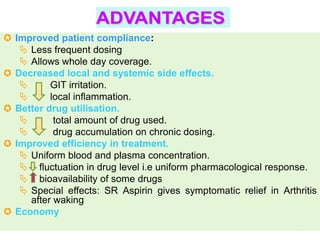
 Improved patient compliance:
    Less frequent dosing
    Allows whole day coverage.
 Decreased local and systemic side effects.
         GIT irritation.
         local inflammation.
 Better drug utilisation.
          total amount of drug used.
          drug accumulation on chronic dosing.
 Improved efficiency in treatment.
    Uniform blood and plasma concentration.
    fluctuation in drug level i.e uniform pharmacological response.
    bioavailability of some drugs
    Special effects: SR Aspirin gives symptomatic relief in Arthritis
     after waking
 Economy
                                                                 5
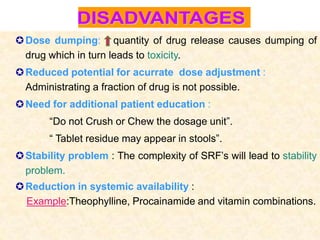
 Dose dumping: quantity of drug release causes dumping of
  drug which in turn leads to toxicity.
 Reduced potential for acurrate dose adjustment :
  Administrating a fraction of drug is not possible.
 Need for additional patient education :
       “Do not Crush or Chew the dosage unit”.
       “ Tablet residue may appear in stools”.
 Stability problem : The complexity of SRF’s will lead to stability
  problem.
 Reduction in systemic availability :
  Example:Theophylline, Procainamide and vitamin combinations.

                                                               6
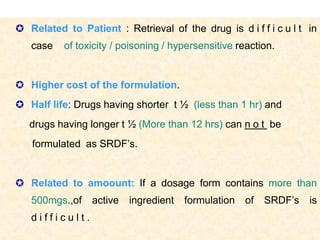
 Related to Patient : Retrieval of the drug is d i f f i c u l t in
   case    of toxicity / poisoning / hypersensitive reaction.


 Higher cost of the formulation.
 Half life: Drugs having shorter t ½ (less than 1 hr) and
   drugs having longer t ½ (More than 12 hrs) can n o t be
   formulated as SRDF’s.


 Related to amoount: If a dosage form contains more than
   500mgs.,of    active   ingredient   formulation   of   SRDF’s    is
   difficult.
                                                                7
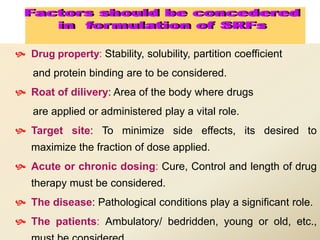
 Drug property: Stability, solubility, partition coefficient
    and protein binding are to be considered.
 Roat of dilivery: Area of the body where drugs
    are applied or administered play a vital role.
 Target site: To minimize side effects, its desired to
   maximize the fraction of dose applied.
 Acute or chronic dosing: Cure, Control and length of drug
   therapy must be considered.
 The disease: Pathological conditions play a significant role.
 The patients: Ambulatory/ bedridden, young or old, etc.,
                                                                8
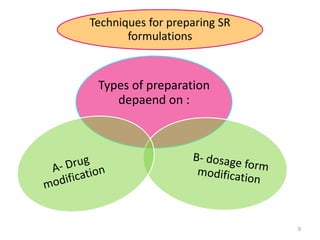
Techniques for preparing SR
       formulations


 Types of preparation
    depaend on :


                              9
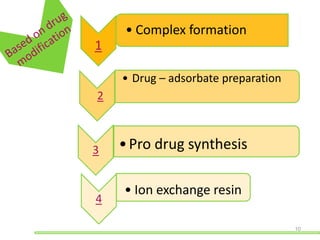
• Complex formation
1

     • Drug – adsorbate preparation
22


3    • Pro drug synthesis

     • Ion exchange resin
4

                                      10
 1- Complex formation:
      The rate of dissolution of solid complex in biological fluids
and rate of dissociation of complex in the solution are considered
and they depend upon pH and composition of gastric and
intestinal fluids.

 2- Drug-adsorbate preparation:
       In this product is insoluble. Drug availability is determined
by rate of disabsorption.

3- Pro drug synthesis:
      They are inactive and need enzymatic hydrolysis for
regeneration. Solubility, absorption rate of prodrug must be lower
than parent drug.
                                                               11
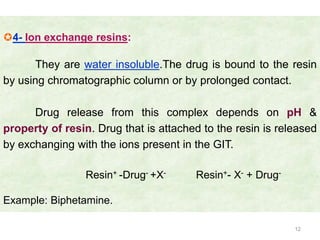
4- Ion exchange resins:

      They are water insoluble.The drug is bound to the resin
by using chromatographic column or by prolonged contact.

      Drug release from this complex depends on pH &
property of resin. Drug that is attached to the resin is released
by exchanging with the ions present in the GIT.

                 Resin+ -Drug- +X-     Resin+- X- + Drug-

Example: Biphetamine.

                                                            12
• Microencapsulation
1


    • Barrier coating
2


                        13
 1-Microencapsulation:
      It’s a process in which tiny particles are surrounded by
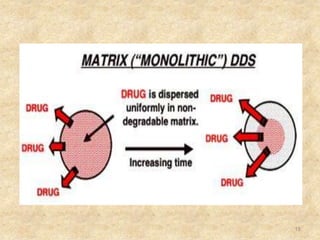
uniform coating (microcapsule) or held in a matrix of polymer
(microsphere.) Spray drying is used which involves rapid
evaporation of the solvent from the drug surface.

 2-Barrier coating:
       In this one quarter(1/4) of the granules are in non
sustained form for sudden drug release,
   remaining part are coated for sustained release.
   Both these granules are filled in hard gelatin capsule or
compressed in a tablet, and the release mechanism is by
diffusion. Coating material used are fats, waxes.
                                                         14
15

Sustained release formulation 2012

  • 1.
    Sustained release formulations Hardi Sdiq muhemmed Collage of Pharmacy University of Suleiman 1
  • 2.
    DEFINITION:-  SRF’s describesthe s l o w release of a drug substance from a dosage form to maintain therapeutic response for extended period (8-12hrs)of time.  Time depends on the dosage form. In oral form it is in hours, and in parenteral’s it is in days and months. Ex: Aspirin SR, Dextrim SR. 2
  • 3.
    The of SRDF’s is to obtain Zero order release from the dosage form. Zero order release is a release which is independent of the amount of drug present in the dosage form. Usually SRDF’s do not follow zero order release but they try to mimic zero order release by releasing the drug in a slow first order fashion. Pharmacological action is seen as long as the drug is in therapeutic range, problems occur when drug concentration is above/below therapeutic range. 3
  • 4.
    The period between1950 to 1970 is considered as period of Sustained drug release. The main AIM of preparing sustained release formulation’s was intended to modify and improve the drug performance by :  the duration of drug action.  the frequency of dosing.  the required dose employed.  Providing uniform drug delivery. 4
  • 5.
     Improved patientcompliance:  Less frequent dosing  Allows whole day coverage.  Decreased local and systemic side effects.  GIT irritation.  local inflammation.  Better drug utilisation.  total amount of drug used.  drug accumulation on chronic dosing.  Improved efficiency in treatment.  Uniform blood and plasma concentration.  fluctuation in drug level i.e uniform pharmacological response.  bioavailability of some drugs  Special effects: SR Aspirin gives symptomatic relief in Arthritis after waking  Economy 5
  • 6.
     Dose dumping:quantity of drug release causes dumping of drug which in turn leads to toxicity.  Reduced potential for acurrate dose adjustment : Administrating a fraction of drug is not possible.  Need for additional patient education : “Do not Crush or Chew the dosage unit”. “ Tablet residue may appear in stools”.  Stability problem : The complexity of SRF’s will lead to stability problem.  Reduction in systemic availability : Example:Theophylline, Procainamide and vitamin combinations. 6
  • 7.
     Related toPatient : Retrieval of the drug is d i f f i c u l t in case of toxicity / poisoning / hypersensitive reaction.  Higher cost of the formulation.  Half life: Drugs having shorter t ½ (less than 1 hr) and drugs having longer t ½ (More than 12 hrs) can n o t be formulated as SRDF’s.  Related to amoount: If a dosage form contains more than 500mgs.,of active ingredient formulation of SRDF’s is difficult. 7
  • 8.
     Drug property:Stability, solubility, partition coefficient and protein binding are to be considered.  Roat of dilivery: Area of the body where drugs are applied or administered play a vital role.  Target site: To minimize side effects, its desired to maximize the fraction of dose applied.  Acute or chronic dosing: Cure, Control and length of drug therapy must be considered.  The disease: Pathological conditions play a significant role.  The patients: Ambulatory/ bedridden, young or old, etc., 8
  • 9.
    Techniques for preparingSR formulations Types of preparation depaend on : 9
  • 10.
    • Complex formation 1 • Drug – adsorbate preparation 22 3 • Pro drug synthesis • Ion exchange resin 4 10
  • 11.
     1- Complexformation: The rate of dissolution of solid complex in biological fluids and rate of dissociation of complex in the solution are considered and they depend upon pH and composition of gastric and intestinal fluids.  2- Drug-adsorbate preparation: In this product is insoluble. Drug availability is determined by rate of disabsorption. 3- Pro drug synthesis: They are inactive and need enzymatic hydrolysis for regeneration. Solubility, absorption rate of prodrug must be lower than parent drug. 11
  • 12.
    4- Ion exchangeresins: They are water insoluble.The drug is bound to the resin by using chromatographic column or by prolonged contact. Drug release from this complex depends on pH & property of resin. Drug that is attached to the resin is released by exchanging with the ions present in the GIT. Resin+ -Drug- +X- Resin+- X- + Drug- Example: Biphetamine. 12
  • 13.
    • Microencapsulation 1 • Barrier coating 2 13
  • 14.
     1-Microencapsulation: It’s a process in which tiny particles are surrounded by uniform coating (microcapsule) or held in a matrix of polymer (microsphere.) Spray drying is used which involves rapid evaporation of the solvent from the drug surface.  2-Barrier coating: In this one quarter(1/4) of the granules are in non sustained form for sudden drug release, remaining part are coated for sustained release. Both these granules are filled in hard gelatin capsule or compressed in a tablet, and the release mechanism is by diffusion. Coating material used are fats, waxes. 14
  • 15.