발표 영상 : https://goo.gl/jrKrvf
데모 영상 : https://youtu.be/exXD6wJLJ6s
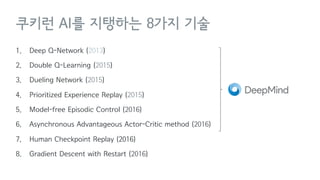
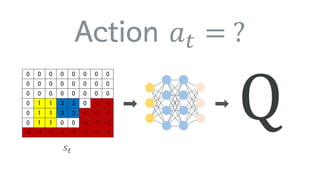
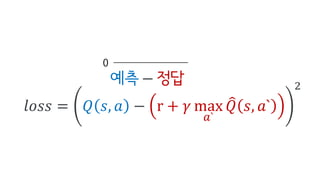
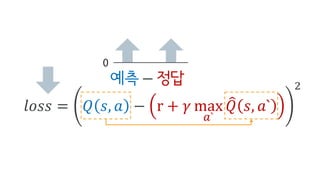
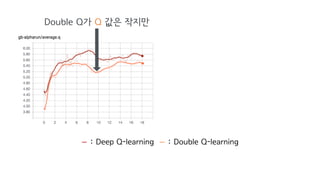
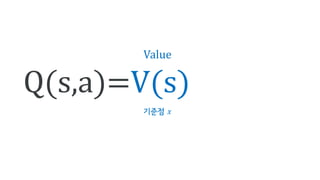
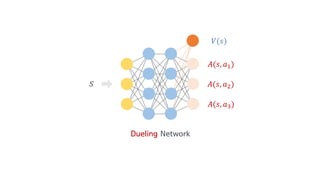
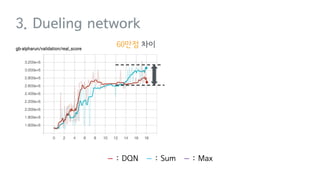
Deep Q-Network, Double Q-learning, Dueling Network 등의 기술을 소개하며, hyperparameter, debugging, ensemble 등의 엔지니어링으로 성능을 끌어 올린 과정을 공유합니다.
1. activation_fn :activation function (relu, tanh, elu, leaky)
2. initializer : weight initializer (xavier)
3. regularizer : weight regularizer (None, l1, l2)
4. apply_reg : layers where regularizer is applied
5. regularizer_scale : scale of regularizer
6. hidden_dims : dimension of network
7. kernel_size : kernel size of CNN network
8. stride_size : stride size of CNN network
9. dueling : whether to use dueling network
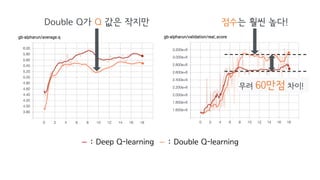
10.double_q : whether to use double Q-learning
11.use_batch_norm : whether to use batch normalization
1. optimizer : type of optimizer (adam, adagrad, rmsprop)
2. batch_norm : whether to use batch normalization
3. max_step : maximum step to train
4. target_q_update_step : # of step to update target network
5. learn_start_step : # of step to begin a training
6. learning_rate_start : the maximum value of learning rate
7. learning_rate_end : the minimum value of learning rate
8. clip_grad : value for a max gradient
9. clip_delta : value for a max delta
10. clip_reward : value for a max reward
11. learning_rate_restart : whether to use learning rate restart
1. history_length : the length of history
2. memory_size : size of experience memory
3. priority : whether to use prioritized experience memory
4. preload_memory : whether to preload a saved memory
5. preload_batch_size : batch size of preloaded memory
6. preload_prob : probability of sampling from pre-mem
7. alpha : alpha of prioritized experience memory
8. beta_start: beta of prioritized experience memory
9. beta_end_t: beta of prioritized experience memory
1. screen_height : # of rows for a grid state
2. screen_height_to_use : actual # of rows for a state
3. screen_width : # of columns for a grid state
4. screen_width_to_us : actual # of columns for a state
5. screen_expr : actual # of row for a state
• c : cookie
• p : platform
• s : score of cells
• p : plain jelly
ex) (c+2*p)-s,i+h+m,[rj,sp], ((c+2*p)-s)/2.,i+h+m,[rj,sp,hi]
6. action_repeat : # of reapt of an action (frame skip)
• i : plain item
• h : heal
• m : magic
• hi : height
• sp : speed
• rj : remained
jump
도움이 된 순간
•모든 action에 대해서 Q 값이 0
• State 값을 조금 바꿔서 출력해도 여전히 0
• Tensorflow의 fully_connected 함수에 activation function의
default값이 nn.relu로 설정되어 있음
• Activation function을 None으로 지정하니 해결!























































![1. activation_fn : activation function (relu, tanh, elu, leaky)
2. initializer : weight initializer (xavier)
3. regularizer : weight regularizer (None, l1, l2)
4. apply_reg : layers where regularizer is applied
5. regularizer_scale : scale of regularizer
6. hidden_dims : dimension of network
7. kernel_size : kernel size of CNN network
8. stride_size : stride size of CNN network
9. dueling : whether to use dueling network
10.double_q : whether to use double Q-learning
11.use_batch_norm : whether to use batch normalization
1. optimizer : type of optimizer (adam, adagrad, rmsprop)
2. batch_norm : whether to use batch normalization
3. max_step : maximum step to train
4. target_q_update_step : # of step to update target network
5. learn_start_step : # of step to begin a training
6. learning_rate_start : the maximum value of learning rate
7. learning_rate_end : the minimum value of learning rate
8. clip_grad : value for a max gradient
9. clip_delta : value for a max delta
10. clip_reward : value for a max reward
11. learning_rate_restart : whether to use learning rate restart
1. history_length : the length of history
2. memory_size : size of experience memory
3. priority : whether to use prioritized experience memory
4. preload_memory : whether to preload a saved memory
5. preload_batch_size : batch size of preloaded memory
6. preload_prob : probability of sampling from pre-mem
7. alpha : alpha of prioritized experience memory
8. beta_start: beta of prioritized experience memory
9. beta_end_t: beta of prioritized experience memory
1. screen_height : # of rows for a grid state
2. screen_height_to_use : actual # of rows for a state
3. screen_width : # of columns for a grid state
4. screen_width_to_us : actual # of columns for a state
5. screen_expr : actual # of row for a state
• c : cookie
• p : platform
• s : score of cells
• p : plain jelly
ex) (c+2*p)-s,i+h+m,[rj,sp], ((c+2*p)-s)/2.,i+h+m,[rj,sp,hi]
6. action_repeat : # of reapt of an action (frame skip)
• i : plain item
• h : heal
• m : magic
• hi : height
• sp : speed
• rj : remained
jump](https://image.slidesharecdn.com/deviewalpharun-161025082950/85/AI-DEVIEW-2016-125-320.jpg)



![for land in range(3, 7):
for cookie in cookies:
options = []
option = {
'hidden_dims': ["[800, 400, 200]", "[1000, 800, 200]"],
'double_q': [True, False],
'start_land': land,
'cookie': cookie,
}
options.append(option.copy())
array_run(options, ’double_q_test')](https://image.slidesharecdn.com/deviewalpharun-161025082950/85/AI-DEVIEW-2016-129-320.jpg)




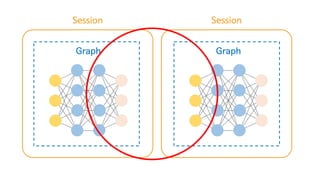


![sessions = []
g = tf.Graph()
with g.as_default():
network = Network()
sess = tf.Session(graph=g)
sessions.append(sess)
sessions[0].run(network.output)
이렇게 Session을 살려서 선언하시면 됩니다](https://image.slidesharecdn.com/deviewalpharun-161025082950/85/AI-DEVIEW-2016-164-320.jpg)



![[GomGuard] 뉴런부터 YOLO 까지 - 딥러닝 전반에 대한 이야기](https://cdn.slidesharecdn.com/ss_thumbnails/part1mlp2cnn-slidesharev-180308015531-thumbnail.jpg?width=640&height=640&fit=bounds)


![오딘: 발할라 라이징 MMORPG의 성능 최적화 사례 공유 [카카오게임즈 - 레벨 300] - 발표자: 김문권, 팀장, 라이온하트 스튜디오...](https://cdn.slidesharecdn.com/ss_thumbnails/t3s1-221108101729-c6b32f4f-thumbnail.jpg?width=640&height=640&fit=bounds)


![[IGC 2016] 넷게임즈 김복식 - 중국 모바일 게임과 캐주얼 게임 디자인](https://cdn.slidesharecdn.com/ss_thumbnails/2-161009034159-thumbnail.jpg?width=640&height=640&fit=bounds)


![[2A4]DeepLearningAtNAVER](https://cdn.slidesharecdn.com/ss_thumbnails/2a4deeplearningatnaver-140929210707-phpapp01-thumbnail.jpg?width=640&height=640&fit=bounds)


![[데이터야놀자2107] 강남 출근길에 판교/정자역에 내릴 사람 예측하기](https://cdn.slidesharecdn.com/ss_thumbnails/predict-get-off-station-171012210042-thumbnail.jpg?width=640&height=640&fit=bounds)


![[RLkorea] 각잡고 로봇팔 발표](https://cdn.slidesharecdn.com/ss_thumbnails/rlkorea-robotarm-190303021332-thumbnail.jpg?width=640&height=640&fit=bounds)


![Random Thoughts on Paper Implementations [KAIST 2018]](https://cdn.slidesharecdn.com/ss_thumbnails/kaist2018-180426031539-thumbnail.jpg?width=640&height=640&fit=bounds)


