1
Maximum Entropy Reinforcement Learning
Stochastic Control
T. Haarnoja, et al., “Reinforcement Learning with Deep Energy-Based Policies”, ICML
2017
T. Haarnoja, et, al., “Soft Actor-Critic: Off-Policy Maximum Entropy Deep Reinforcement
Learning with a Stochastic Actor”, ICML 2018
T. Haarnoja, et, al., “Soft Actor-Critic Algorithms and Applications”, arXiv preprint 2018
Dongmin Lee
August, 2019
T. Haarnoja, et al., “Reinforcement Learning with Deep Energy-Based
Policies”, ICML 2017
T. Haarnoja, et, al., “Soft Actor-Critic: Off-Policy Maximum Entropy
Deep Reinforcement Learning with a Stochastic Actor”, ICML 2018
T. Haarnoja, et, al., “Soft Actor-Critic Algorithms and Applications”,
arXiv preprint 2018
Presented by Dongmin Lee
August, 2019
2
Outline
1. Introduction
2. Reinforcement Learning
• Markov Decision Processes (MDPs)
• Bellman Equation
3. Exploration methods
4. Maximum Entropy Reinforcement Learning
• Soft MDPs
• Soft Bellman Equation
5. From Soft Policy Iteration to Soft Actor-Critic
• Soft Policy Iteration
• Soft Actor-Critic
6. Results
3
Introduction
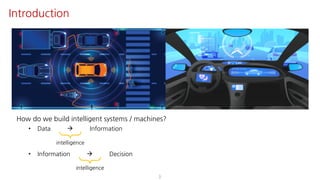
How do we build intelligent systems / machines?
• Data à Information
• Information à Decision
intelligence
intelligence
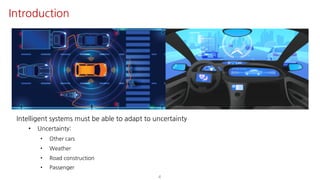
Intelligent systems must be able to adapt to uncertainty
• Uncertainty:
• Other cars
• Weather
• Road construction
• Passenger
4
Introduction
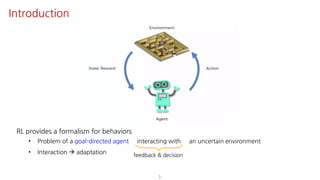
RL provides a formalism for behaviors
• Problem of a goal-directed agent interacting with an uncertain environment
• Interaction à adaptation
5
feedback & decision
Introduction
6
Introduction
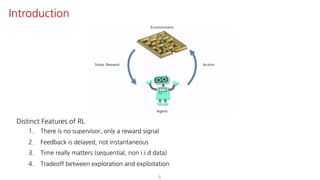
Distinct Features of RL
1. There is no supervisor, only a reward signal
2. Feedback is delayed, not instantaneous
3. Time really matters (sequential, non i.i.d data)
4. Tradeoff between exploration and exploitation
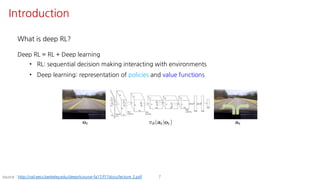
What is deep RL?
Deep RL = RL + Deep learning
• RL: sequential decision making interacting with environments
• Deep learning: representation of policies and value functions
7source : http://rail.eecs.berkeley.edu/deeprlcourse-fa17/f17docs/lecture_2.pdf
Introduction
What are the challenges of deep RL?
• Huge # of samples: millions
• Fast, stable learning
• Hyperparameter tuning
• Exploration
• Sparse reward signals
• Safety / reliability
• Simulator
8
Introduction
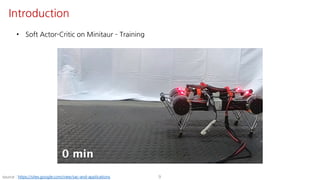
• Soft Actor-Critic on Minitaur ­ Training
9
Introduction
source : https://sites.google.com/view/sac-and-applications
• Soft Actor-Critic on Minitaur ­ Testing
10
Introduction
source : https://sites.google.com/view/sac-and-applications
• Interfered rollouts from Soft Actor-Critic policy trained for Dynamixel Claw task from vision
11
Introduction
source : https://sites.google.com/view/sac-and-applications
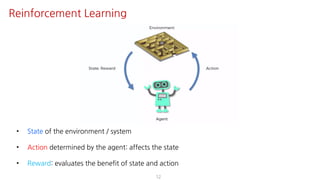
• State of the environment / system
• Action determined by the agent: affects the state
• Reward: evaluates the benefit of state and action
12
Reinforcement Learning
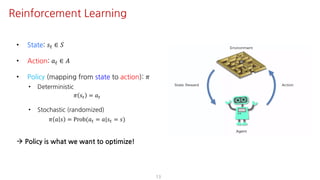
• State: 𝑠" ∈ 𝑆
• Action: 𝑎" ∈ 𝐴
• Policy (mapping from state to action): 𝜋
• Deterministic
𝜋 𝑠" = 𝑎"
• Stochastic (randomized)
𝜋 𝑎 𝑠 = Prob(𝑎" = 𝑎|𝑠" = 𝑠)
à Policy is what we want to optimize!
13
Reinforcement Learning
A Markov decision process (MDP) is a tuple < 𝑆, 𝐴, 𝑝, 𝑟, 𝛾 >, consisting of
• 𝑆: set of states (state space)
e.g., 𝑆 = 1, … , 𝑛 (discrete), 𝑆 = ℝ:
(continuous)
• 𝐴: set of actions (action space)
e.g., 𝐴 = 1, … , 𝑚 (discrete), 𝐴 = ℝ<
(continuous)
• 𝑝: state transition probability
𝑝 𝑠= 𝑠, 𝑎 ≜ Prob 𝑠"?@ = 𝑠= 𝑠" = 𝑠, 𝑎" = 𝑎 d
• 𝑟: reward function
𝑟 𝑠", 𝑎" = 𝑟"d
• 𝛾 ∈ (0,1]: discount factor
14
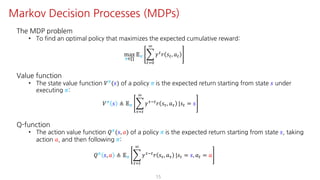
Markov Decision Processes (MDPs)
The MDP problem
• To find an optimal policy that maximizes the expected cumulative reward:
max
F∈∏
𝔼F I
"JK
L
𝛾" 𝑟 𝑠", 𝑎"
Value function
• The state value function 𝑉F
(𝑠) of a policy 𝜋 is the expected return starting from state 𝑠 under
executing 𝜋:
𝑉F
𝑠 ≜ 𝔼F I
NJ"
L
𝛾NO"
𝑟 𝑠N, 𝑎N |𝑠" = 𝑠
Q-function
• The action value function 𝑄F(𝑠, 𝑎) of a policy 𝜋 is the expected return starting from state 𝑠, taking
action 𝑎, and then following 𝜋:
𝑄F
𝑠, 𝑎 ≜ 𝔼F I
NJ"
L
𝛾NO"
𝑟 𝑠N, 𝑎N |𝑠" = 𝑠, 𝑎" = 𝑎
15
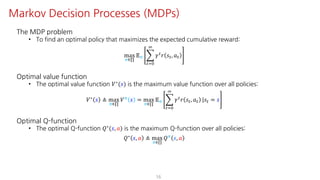
Markov Decision Processes (MDPs)
The MDP problem
• To find an optimal policy that maximizes the expected cumulative reward:
max
F∈∏
𝔼F I
"JK
L
𝛾"
𝑟 𝑠", 𝑎"
Optimal value function
• The optimal value function 𝑉∗(𝑠) is the maximum value function over all policies:
𝑉∗ 𝑠 ≜ max
F∈∏
𝑉F 𝑠 = max
F∈∏
𝔼F I
"JK
L
𝛾" 𝑟 𝑠", 𝑎" |𝑠" = 𝑠
Optimal Q-function
• The optimal Q-function 𝑄∗(𝑠, 𝑎) is the maximum Q-function over all policies:
𝑄∗ 𝑠, 𝑎 ≜ max
F∈∏
𝑄F 𝑠, 𝑎
16
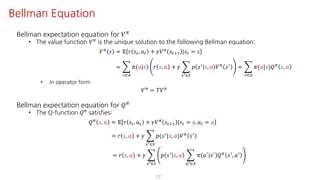
Markov Decision Processes (MDPs)
Bellman expectation equation for 𝑉F
• The value function 𝑉F is the unique solution to the following Bellman equation:
𝑉F 𝑠 = 𝔼 𝑟 𝑠", 𝑎" + 𝛾𝑉F 𝑠"?@ |𝑠" = 𝑠
= I
S∈T
𝜋(𝑎|𝑠) 𝑟 𝑠, 𝑎 + 𝛾 I
UV∈W
𝑝 𝑠=
𝑠, 𝑎 𝑉F
𝑠=
= I
S∈T
𝜋(𝑎|𝑠)𝑄F
𝑠, 𝑎
• In operator form
𝑉F = 𝑇𝑉F
Bellman expectation equation for 𝑄F
• The Q-function 𝑄F satisfies:
𝑄F 𝑠, 𝑎 = 𝔼 𝑟 𝑠", 𝑎" + 𝛾𝑉F 𝑠"?@ |𝑠" = 𝑠, 𝑎" = 𝑎
= 𝑟 𝑠, 𝑎 + 𝛾 I
UV∈W
𝑝(𝑠=|𝑠, 𝑎)𝑉F 𝑠=
= 𝑟 𝑠, 𝑎 + 𝛾 I
UV∈W
𝑝 𝑠=
𝑠, 𝑎 I
SV∈T
𝜋 𝑎=
𝑠=
𝑄F
𝑠=
, 𝑎=
17
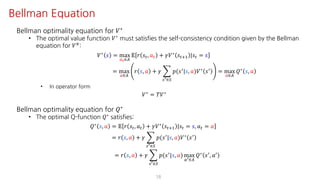
Bellman Equation
Bellman optimality equation for 𝑉∗
• The optimal value function 𝑉∗
must satisfies the self-consistency condition given by the Bellman
equation for 𝑉F:
𝑉∗ 𝑠 = max
SY∈T
𝔼 𝑟 𝑠", 𝑎" + 𝛾𝑉∗ 𝑠"?@ |𝑠" = 𝑠
= max
S∈T
𝑟 𝑠, 𝑎 + 𝛾 I
UV∈W
𝑝(𝑠=|𝑠, 𝑎)𝑉∗ 𝑠= = max
S∈T
𝑄∗ 𝑠, 𝑎
• In operator form
𝑉∗
= 𝑇𝑉∗
Bellman optimality equation for 𝑄∗
• The optimal Q-function 𝑄∗ satisfies:
𝑄∗
𝑠, 𝑎 = 𝔼 𝑟 𝑠", 𝑎" + 𝛾𝑉∗
𝑠"?@ |𝑠" = 𝑠, 𝑎" = 𝑎
= 𝑟 𝑠, 𝑎 + 𝛾 I
UV∈W
𝑝(𝑠=|𝑠, 𝑎)𝑉∗ 𝑠=
= 𝑟 𝑠, 𝑎 + 𝛾 I
UV∈W
𝑝(𝑠=|𝑠, 𝑎) max
SV∈T
𝑄∗ 𝑠=, 𝑎=
18
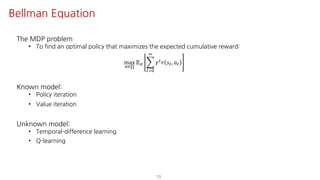
Bellman Equation
The MDP problem
• To find an optimal policy that maximizes the expected cumulative reward:
max
F∈∏
𝔼F I
"JK
L
𝛾" 𝑟 𝑠", 𝑎"
Known model:
• Policy iteration
• Value iteration
Unknown model:
• Temporal-difference learning
• Q-learning
19
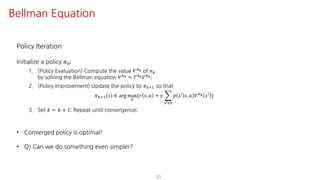
Bellman Equation
Policy Iteration
Initialize a policy 𝜋K;
1. (Policy Evaluation) Compute the value 𝑉F[ of 𝜋
by solving the Bellman equation 𝑉F[ = 𝑇F[ 𝑉F[;
2. (Policy Improvement) Update the policy to 𝜋?@ so that
𝜋?@(𝑠) ∈ arg max
S
{𝑟 𝑠, 𝑎 + 𝛾 I
UV∈W
𝑝 𝑠= 𝑠, 𝑎 𝑉F[ 𝑠= }
3. Set 𝑘 ← 𝑘 + 1; Repeat until convergence;
• Converged policy is optimal!
• Q) Can we do something even simpler?
20
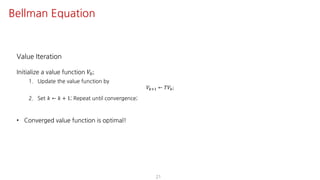
Bellman Equation
Value Iteration
Initialize a value function 𝑉K;
1. Update the value function by
𝑉?@ ← 𝑇𝑉;
2. Set 𝑘 ← 𝑘 + 1; Repeat until convergence;
• Converged value function is optimal!
21
Bellman Equation
Common issue: exploration
• Is there a value of exploring unknown regions of the environment?
• Which action should we try to explore unknown regions of the environment?
22
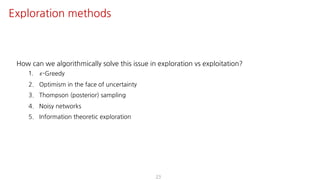
Exploration methods
How can we algorithmically solve this issue in exploration vs exploitation?
1. 𝜖-Greedy
2. Optimism in the face of uncertainty
3. Thompson (posterior) sampling
4. Noisy networks
5. Information theoretic exploration
23
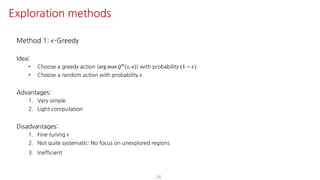
Exploration methods
Method 1: 𝜖-Greedy
Idea:
• Choose a greedy action (arg max 𝑄F(𝑠, 𝑎)) with probability (1 − 𝜖)
• Choose a random action with probability 𝜖
Advantages:
1. Very simple
2. Light computation
Disadvantages:
1. Fine tuning 𝜖
2. Not quite systematic: No focus on unexplored regions
3. Inefficient
24
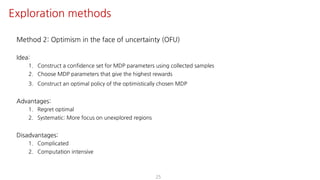
Exploration methods
Method 2: Optimism in the face of uncertainty (OFU)
Idea:
1. Construct a confidence set for MDP parameters using collected samples
2. Choose MDP parameters that give the highest rewards
3. Construct an optimal policy of the optimistically chosen MDP
Advantages:
1. Regret optimal
2. Systematic: More focus on unexplored regions
Disadvantages:
1. Complicated
2. Computation intensive
25
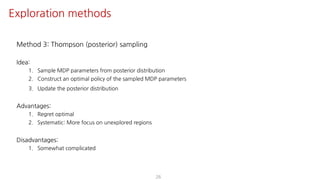
Exploration methods
Method 3: Thompson (posterior) sampling
Idea:
1. Sample MDP parameters from posterior distribution
2. Construct an optimal policy of the sampled MDP parameters
3. Update the posterior distribution
Advantages:
1. Regret optimal
2. Systematic: More focus on unexplored regions
Disadvantages:
1. Somewhat complicated
26
Exploration methods
Method 4: Noisy networks
Idea:
• Inject noise to the weights of Neural Network
Advantages:
1. Simple
2. Good empirical performance
Disadvantages:
1. Not systematic: No focus on unexplored regions
27
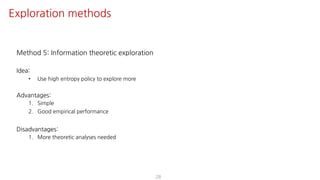
Exploration methods
Method 5: Information theoretic exploration
Idea:
• Use high entropy policy to explore more
Advantages:
1. Simple
2. Good empirical performance
Disadvantages:
1. More theoretic analyses needed
28
Exploration methods
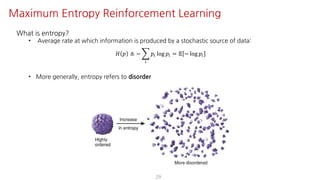
What is entropy?
• Average rate at which information is produced by a stochastic source of data:
𝐻 𝑝 ≜ − I
e
𝑝e log 𝑝e = 𝔼 − log 𝑝e
• More generally, entropy refers to disorder
29
Maximum Entropy Reinforcement Learning
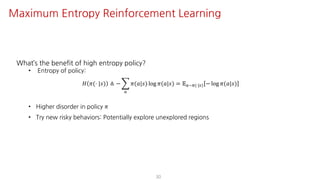
What’s the benefit of high entropy policy?
• Entropy of policy:
𝐻 𝜋(⋅ |𝑠) ≜ − I
S
𝜋(𝑎|𝑠) log 𝜋(𝑎|𝑠) = 𝔼S~F(⋅|U) − log 𝜋(𝑎|𝑠)
• Higher disorder in policy 𝜋
• Try new risky behaviors: Potentially explore unexplored regions
30
Maximum Entropy Reinforcement Learning
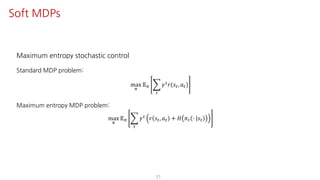
Maximum entropy stochastic control
Standard MDP problem:
max
F
𝔼F I
"
𝛾" 𝑟(𝑠", 𝑎")
Maximum entropy MDP problem:
max
F
𝔼F I
"
𝛾" 𝑟 𝑠", 𝑎" + 𝐻 𝜋" ⋅ 𝑠"
31
Soft MDPs
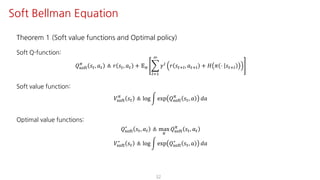
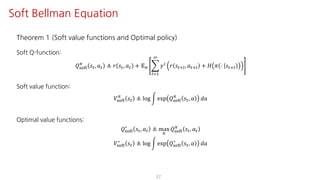
Theorem 1 (Soft value functions and Optimal policy)
Soft Q-function:
𝑄ijkl
F
𝑠", 𝑎" ≜ 𝑟 𝑠", 𝑎" + 𝔼F I
mJ@
L
𝛾m 𝑟 𝑠"?m, 𝑎"?m + 𝐻 𝜋 ⋅ 𝑠"?m
Soft value function:
𝑉ijkl
F
𝑠" ≜ log n exp 𝑄ijkl
F
𝑠", 𝑎 𝑑𝑎
Optimal value functions:
𝑄ijkl
∗
𝑠", 𝑎" ≜ max
F
𝑄ijkl
F
𝑠", 𝑎"
𝑉ijkl
∗
𝑠" ≜ log n exp 𝑄ijkl
∗
𝑠", 𝑎 𝑑𝑎
32
Soft Bellman Equation
Proof.
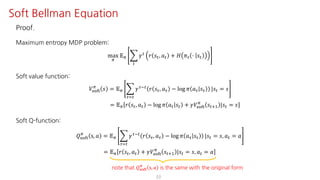
Maximum entropy MDP problem:
max
F
𝔼F I
"
𝛾"
𝑟 𝑠", 𝑎" + 𝐻 𝜋" ⋅ 𝑠"
Soft value function:
𝑉ijkl
F
𝑠 = 𝔼F I
NJ"
𝛾NO" 𝑟 𝑠N, 𝑎N − log 𝜋 𝑎N 𝑠N |𝑠" = 𝑠
= 𝔼F 𝑟 𝑠", 𝑎" − log 𝜋 𝑎" 𝑠" + 𝛾𝑉ijkl
F
𝑠"?@ |𝑠" = 𝑠
Soft Q-function:
𝑄ijkl
F
s, 𝑎 = 𝔼F I
NJ"
𝛾NO"
𝑟 𝑠N, 𝑎N − log 𝜋 𝑎N 𝑠N |𝑠" = 𝑠, 𝑎" = 𝑎
= 𝔼F 𝑟 𝑠", 𝑎" + 𝛾𝑉ijkl
F
𝑠"?@ |𝑠" = 𝑠, 𝑎" = 𝑎
33
Soft Bellman Equation
note that 𝑄ijkl
F
s, 𝑎 is the same with the original form
Proof.
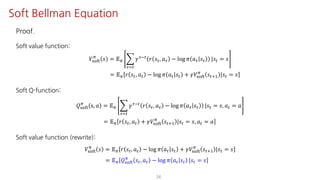
Soft value function:
𝑉ijkl
F
𝑠 = 𝔼F I
NJ"
𝛾NO" 𝑟 𝑠N, 𝑎N − log 𝜋 𝑎N 𝑠N |𝑠" = 𝑠
= 𝔼F 𝑟 𝑠", 𝑎" − log 𝜋 𝑎" 𝑠" + 𝛾𝑉ijkl
F
𝑠"?@ |𝑠" = 𝑠
Soft Q-function:
𝑄ijkl
F
s, 𝑎 = 𝔼F I
NJ"
𝛾NO"
𝑟 𝑠N, 𝑎N − log 𝜋 𝑎N 𝑠N |𝑠" = 𝑠, 𝑎" = 𝑎
= 𝔼F 𝑟 𝑠", 𝑎" + 𝛾𝑉ijkl
F
𝑠"?@ |𝑠" = 𝑠, 𝑎" = 𝑎
Soft value function (rewrite):
𝑉ijkl
F
𝑠 = 𝔼F 𝑟 𝑠", 𝑎" − log 𝜋 𝑎" 𝑠" + 𝛾𝑉ijkl
F
𝑠"?@ |𝑠" = 𝑠
= 𝔼F 𝑄ijkl
F
𝑠", 𝑎" − log 𝜋 𝑎" 𝑠" |𝑠" = 𝑠
34
Soft Bellman Equation
Proof.
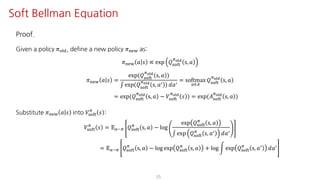
Given a policy 𝜋jst, define a new policy 𝜋uvw as:
𝜋uvw 𝑎 𝑠 ∝ exp 𝑄ijkl
Fyz{
s, 𝑎
𝜋uvw 𝑎 𝑠 =
exp(𝑄ijkl
Fyz{
s, 𝑎 )
∫ exp(𝑄ijkl
Fyz{
s, 𝑎= ) 𝑑𝑎=
= softmax
S∈T
𝑄ijkl
Fyz{
s, 𝑎
= exp(𝑄ijkl
Fyz{
s, 𝑎 − 𝑉ijkl
Fyz{
𝑠 ) = exp(𝐴ijkl
Fyz{
s, 𝑎 )
Substitute 𝜋uvw 𝑎 𝑠 into 𝑉ijkl
F
𝑠 :
𝑉ijkl
F
𝑠 = 𝔼S~F 𝑄ijkl
F
s, 𝑎 − log
exp 𝑄ijkl
F
s, 𝑎
∫ exp 𝑄ijkl
F
s, 𝑎= 𝑑𝑎=
= 𝔼S~F 𝑄ijkl
F
s, 𝑎 − log exp 𝑄ijkl
F
s, 𝑎 + log n exp 𝑄ijkl
F
s, 𝑎=
𝑑𝑎=
35
Soft Bellman Equation
Proof.
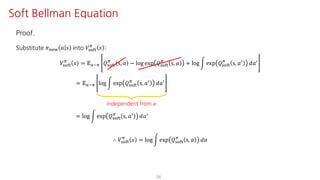
Substitute 𝜋uvw 𝑎 𝑠 into 𝑉ijkl
F
𝑠 :
𝑉ijkl
F
𝑠 = 𝔼S~F 𝑄ijkl
F
s, 𝑎 − log exp 𝑄ijkl
F
s, 𝑎 + log n exp 𝑄ijkl
F
s, 𝑎=
𝑑𝑎=
= 𝔼S~F log n exp 𝑄ijkl
F
s, 𝑎=
𝑑𝑎=
= log n exp 𝑄ijkl
F
s, 𝑎= 𝑑𝑎=
∴ 𝑉ijkl
F
𝑠 = log n exp 𝑄ijkl
F
s, 𝑎 𝑑𝑎
36
Soft Bellman Equation
independent from 𝑎
Theorem 1 (Soft value functions and Optimal policy)
Soft Q-function:
𝑄ijkl
F
𝑠", 𝑎" ≜ 𝑟 𝑠", 𝑎" + 𝔼F I
mJ@
L
𝛾m 𝑟 𝑠"?m, 𝑎"?m + 𝐻 𝜋 ⋅ 𝑠"?m
Soft value function:
𝑉ijkl
F
𝑠" ≜ log n exp 𝑄ijkl
F
𝑠", 𝑎 𝑑𝑎
Optimal value functions:
𝑄ijkl
∗
𝑠", 𝑎" ≜ max
F
𝑄ijkl
F
𝑠", 𝑎"
𝑉ijkl
∗
𝑠" ≜ log n exp 𝑄ijkl
∗
𝑠", 𝑎 𝑑𝑎
37
Soft Bellman Equation
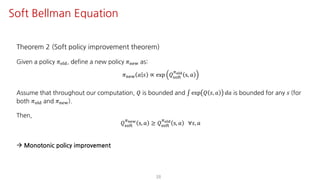
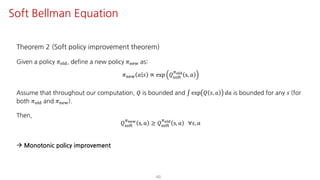
Theorem 2 (Soft policy improvement theorem)
Given a policy 𝜋jst, define a new policy 𝜋uvw as:
𝜋uvw 𝑎 𝑠 ∝ exp 𝑄ijkl
Fyz{
s, 𝑎
Assume that throughout our computation, 𝑄 is bounded and ∫ exp 𝑄 𝑠, 𝑎 𝑑𝑎 is bounded for any 𝑠 (for
both 𝜋jst and 𝜋uvw).
Then,
𝑄ijkl
F€•‚
s, 𝑎 ≥ 𝑄ijkl
Fyz{
s, 𝑎 ∀𝑠, 𝑎
à Monotonic policy improvement
38
Soft Bellman Equation
39
Soft Bellman Equation
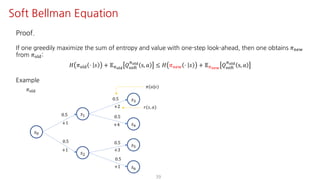
Proof.
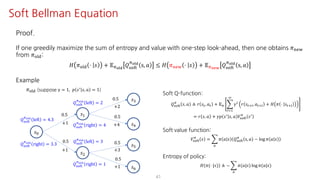
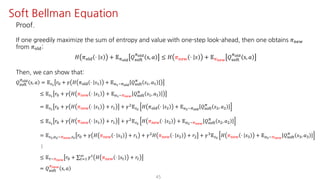
If one greedily maximize the sum of entropy and value with one-step look-ahead, then one obtains 𝜋uvw
from 𝜋jst:
𝐻 𝜋jst ⋅ 𝑠 + 𝔼Fyz{
𝑄ijkl
Fyz{
s, 𝑎 ≤ 𝐻 𝜋uvw ⋅ 𝑠 + 𝔼F€•‚
𝑄ijkl
Fyz{
s, 𝑎
Example
𝜋(𝑎|𝑠)
𝑟(𝑠, 𝑎)
𝑠K
𝑠@
𝑠†
𝑠‡
𝑠ˆ
𝜋jst
0.5
0.5
0.5
0.5
+2
+4+1
+1
𝑠•
𝑠Ž
0.5
+3
0.5
+1
40
Soft Bellman Equation
Proof.
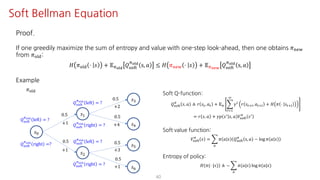
If one greedily maximize the sum of entropy and value with one-step look-ahead, then one obtains 𝜋uvw
from 𝜋jst:
𝐻 𝜋jst ⋅ 𝑠 + 𝔼Fyz{
𝑄ijkl
Fyz{
s, 𝑎 ≤ 𝐻 𝜋uvw ⋅ 𝑠 + 𝔼F€•‚
𝑄ijkl
Fyz{
s, 𝑎
Example
𝑠K
𝑠@
𝑠†
𝑠‡
𝑠ˆ
𝜋jst
0.5
0.5
0.5
0.5
+2
+4+1
+1
𝑠•
𝑠Ž
0.5
+3
0.5
+1
𝑄ijkl
Fyz{
left = ?
𝑄ijkl
Fyz{
right = ?
𝑄ijkl
Fyz{
left = ?
𝑄ijkl
Fyz{
right = ?
𝑄ijkl
Fyz{
left = ?
𝑄ijkl
Fyz{
right =?
Soft Q-function:
𝑄ijkl
F
𝑠, 𝑎 ≜ 𝑟 𝑠", 𝑎" + 𝔼F I
mJ@
L
𝛾m
𝑟 𝑠"?m, 𝑎"?m + 𝐻 𝜋 ⋅ 𝑠"?m
= 𝑟 𝑠, 𝑎 + 𝛾𝑝 𝑠=
𝑠, 𝑎 𝑉ijkl
F
𝑠=
Soft value function:
𝑉ijkl
F
𝑠 = I
S
𝜋 𝑎 𝑠 𝑄ijkl
F
s, 𝑎 − log 𝜋 𝑎 𝑠
Entropy of policy:
𝐻 𝜋(⋅ |𝑠) ≜ − I
S
𝜋(𝑎|𝑠) log 𝜋(𝑎|𝑠)
41
Soft Bellman Equation
Proof.
If one greedily maximize the sum of entropy and value with one-step look-ahead, then one obtains 𝜋uvw
from 𝜋jst:
𝐻 𝜋jst ⋅ 𝑠 + 𝔼Fyz{
𝑄ijkl
Fyz{
s, 𝑎 ≤ 𝐻 𝜋uvw ⋅ 𝑠 + 𝔼F€•‚
𝑄ijkl
Fyz{
s, 𝑎
Example
𝑠K
𝑠@
𝑠†
𝑠‡
𝑠ˆ
𝜋jst (suppose γ = 1, 𝑝 𝑠=
𝑠, 𝑎 = 1)
0.5
0.5
0.5
0.5
+2
+4+1
+1
𝑠•
𝑠Ž
0.5
+3
0.5
+1
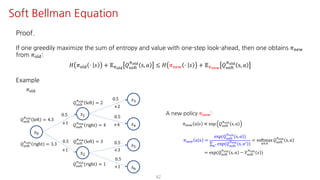
𝑄ijkl
Fyz{
left = 2
𝑄ijkl
Fyz{
right = 4
𝑄ijkl
Fyz{
left = 3
𝑄ijkl
Fyz{
right = 1
𝑄ijkl
Fyz{
left = 4.3
𝑄ijkl
Fyz{
right = 3.3
Soft Q-function:
𝑄ijkl
F
𝑠, 𝑎 ≜ 𝑟 𝑠", 𝑎" + 𝔼F I
mJ@
L
𝛾m
𝑟 𝑠"?m, 𝑎"?m + 𝐻 𝜋 ⋅ 𝑠"?m
= 𝑟 𝑠, 𝑎 + 𝛾𝑝 𝑠=
𝑠, 𝑎 𝑉ijkl
F
𝑠=
Soft value function:
𝑉ijkl
F
𝑠 = I
S
𝜋 𝑎 𝑠 𝑄ijkl
F
s, 𝑎 − log 𝜋 𝑎 𝑠
Entropy of policy:
𝐻 𝜋(⋅ |𝑠) ≜ − I
S
𝜋(𝑎|𝑠) log 𝜋(𝑎|𝑠)
42
Soft Bellman Equation
Proof.
If one greedily maximize the sum of entropy and value with one-step look-ahead, then one obtains 𝜋uvw
from 𝜋jst:
𝐻 𝜋jst ⋅ 𝑠 + 𝔼Fyz{
𝑄ijkl
Fyz{
s, 𝑎 ≤ 𝐻 𝜋uvw ⋅ 𝑠 + 𝔼F€•‚
𝑄ijkl
Fyz{
s, 𝑎
Example
𝑠K
𝑠@
𝑠†
𝑠‡
𝑠ˆ
𝜋jst
0.5
0.5
0.5
0.5
+2
+4+1
+1
𝑠•
𝑠Ž
0.5
+3
0.5
+1
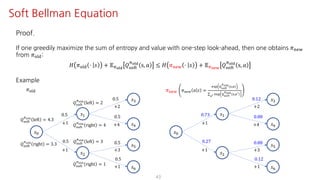
A new policy 𝜋uvw:
𝜋uvw 𝑎 𝑠 ∝ exp 𝑄ijkl
Fyz{
s, 𝑎
𝜋uvw 𝑎 𝑠 =
exp(𝑄ijkl
Fyz{
s, 𝑎 )
∑SV exp(𝑄ijkl
Fyz{
s, 𝑎= )
= softmax
S∈T
𝑄ijkl
Fyz{
s, 𝑎
= exp(𝑄ijkl
Fyz{
s, 𝑎 − 𝑉ijkl
Fyz{
𝑠 )
𝑄ijkl
Fyz{
left = 2
𝑄ijkl
Fyz{
right = 4
𝑄ijkl
Fyz{
left = 3
𝑄ijkl
Fyz{
right = 1
𝑄ijkl
Fyz{
left = 4.3
𝑄ijkl
Fyz{
right = 3.3
43
Soft Bellman Equation
Proof.
If one greedily maximize the sum of entropy and value with one-step look-ahead, then one obtains 𝜋uvw
from 𝜋jst:
𝐻 𝜋jst ⋅ 𝑠 + 𝔼Fyz{
𝑄ijkl
Fyz{
s, 𝑎 ≤ 𝐻 𝜋uvw ⋅ 𝑠 + 𝔼F€•‚
𝑄ijkl
Fyz{
s, 𝑎
Example
𝑠K
𝑠@
𝑠†
𝑠‡
𝑠ˆ
𝜋jst
0.5
0.5
0.5
0.5
+2
+4+1
+1
𝑠•
𝑠Ž
0.5
+3
0.5
+1
𝑄ijkl
Fyz{
left = 2
𝑄ijkl
Fyz{
right = 4
𝑄ijkl
Fyz{
left = 3
𝑄ijkl
Fyz{
right = 1
𝑄ijkl
Fyz{
left = 4.3
𝑄ijkl
Fyz{
right = 3.3
𝑠K
𝑠@
𝑠†
𝑠‡
𝑠ˆ
𝜋uvw 𝜋uvw 𝑎 𝑠 =
v•– —˜y™š
›yz{
i,S
∑
œV v•– —˜y™š
›yz{ i,SV
0.73
0.27
0.12
0.88
+2
+4+1
+1
𝑠•
𝑠Ž
0.88
+3
0.12
+1
44
Soft Bellman Equation
Proof.
If one greedily maximize the sum of entropy and value with one-step look-ahead, then one obtains 𝜋uvw
from 𝜋jst:
𝐻 𝜋jst ⋅ 𝑠 + 𝔼Fyz{
𝑄ijkl
Fyz{
s, 𝑎 ≤ 𝐻 𝜋uvw ⋅ 𝑠 + 𝔼F€•‚
𝑄ijkl
Fyz{
s, 𝑎
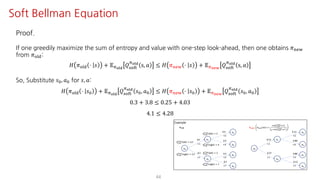
So, Substitute 𝑠K, 𝑎K for 𝑠, 𝑎:
𝐻 𝜋jst ⋅ 𝑠K + 𝔼Fyz{
𝑄ijkl
Fyz{
𝑠K, 𝑎K ≤ 𝐻 𝜋uvw ⋅ 𝑠K + 𝔼F€•‚
𝑄ijkl
Fyz{
𝑠K, 𝑎K
0.3 + 3.8 ≤ 0.25 + 4.03
4.1 ≤ 4.28
45
Soft Bellman Equation
Proof.
If one greedily maximize the sum of entropy and value with one-step look-ahead, then one obtains 𝜋uvw
from 𝜋jst:
𝐻 𝜋jst ⋅ 𝑠 + 𝔼Fyz{
𝑄ijkl
Fyz{
s, 𝑎 ≤ 𝐻 𝜋uvw ⋅ 𝑠 + 𝔼F€•‚
𝑄ijkl
Fyz{
s, 𝑎
Then, we can show that:
𝑄ijkl
Fyz{
s, 𝑎 = 𝔼UŸ
𝑟K + 𝛾 𝐻 𝜋jst ⋅ 𝑠@ + 𝔼SŸ~Fyz{
𝑄ijkl
F
𝑠@, 𝑎@
≤ 𝔼UŸ
𝑟K + 𝛾 𝐻 𝜋uvw ⋅ 𝑠@ + 𝔼SŸ~F€•‚
𝑄ijkl
F
𝑠@, 𝑎@
= 𝔼UŸ
𝑟K + 𝛾 𝐻 𝜋uvw ⋅ 𝑠@ + 𝑟@ + 𝛾† 𝔼U 𝐻 𝜋jst ⋅ 𝑠† + 𝔼S ~Fyz{
𝑄ijkl
F
𝑠†, 𝑎†
≤ 𝔼UŸ
𝑟K + 𝛾 𝐻 𝜋uvw ⋅ 𝑠@ + 𝑟@ + 𝛾† 𝔼U 𝐻 𝜋uvw ⋅ 𝑠† + 𝔼S ~F€•‚
𝑄ijkl
F
𝑠†, 𝑎†
= 𝔼UŸ,S ~F€•‚,U 𝑟K + 𝛾 𝐻 𝜋uvw ⋅ 𝑠@ + 𝑟@ + 𝛾† 𝐻 𝜋uvw ⋅ 𝑠† + 𝑟† + 𝛾‡ 𝔼U¡
𝐻 𝜋uvw ⋅ 𝑠‡ + 𝔼S¡~F€•‚
𝑄ijkl
F
𝑠‡, 𝑎‡
⋮
≤ 𝔼N~F€•‚
𝑟K + ∑"J@
L 𝛾" 𝐻 𝜋uvw ⋅ 𝑠" + 𝑟"
= 𝑄ijkl
F€•‚
s, 𝑎
Theorem 2 (Soft policy improvement theorem)
Given a policy 𝜋jst, define a new policy 𝜋uvw as:
𝜋uvw 𝑎 𝑠 ∝ exp 𝑄ijkl
Fyz{
s, 𝑎
Assume that throughout our computation, 𝑄 is bounded and ∫ exp 𝑄 𝑠, 𝑎 𝑑𝑎 is bounded for any 𝑠 (for
both 𝜋jst and 𝜋uvw).
Then,
𝑄ijkl
F€•‚
s, 𝑎 ≥ 𝑄ijkl
Fyz{
s, 𝑎 ∀𝑠, 𝑎
à Monotonic policy improvement
46
Soft Bellman Equation
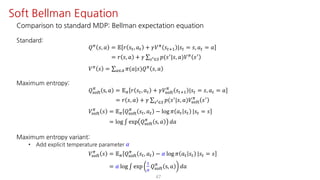
Comparison to standard MDP: Bellman expectation equation
Standard:
𝑄F
𝑠, 𝑎 = 𝔼 𝑟 𝑠", 𝑎" + 𝛾𝑉F
𝑠"?@ |𝑠" = 𝑠, 𝑎" = 𝑎
= 𝑟 𝑠, 𝑎 + 𝛾 ∑UV∈W 𝑝(𝑠=
|𝑠, 𝑎)𝑉F
𝑠=
𝑉F
𝑠 = ∑S∈T 𝜋(𝑎|𝑠)𝑄F
𝑠, 𝑎
Maximum entropy:
𝑄ijkl
F
s, 𝑎 = 𝔼F 𝑟 𝑠", 𝑎" + 𝛾𝑉ijkl
F
𝑠"?@ |𝑠" = 𝑠, 𝑎" = 𝑎
= 𝑟 𝑠, 𝑎 + 𝛾 ∑UV∈W 𝑝(𝑠=|𝑠, 𝑎)𝑉ijkl
F
𝑠=
𝑉ijkl
F
𝑠 = 𝔼F 𝑄ijkl
F
𝑠", 𝑎" − log 𝜋 𝑎" 𝑠" |𝑠" = 𝑠
= log ∫ exp 𝑄ijkl
F
s, 𝑎 𝑑𝑎
Maximum entropy variant:
• Add explicit temperature parameter 𝛼
𝑉ijkl
F
𝑠 = 𝔼F 𝑄ijkl
F
𝑠", 𝑎" − 𝛼 log 𝜋 𝑎" 𝑠" |𝑠" = 𝑠
= 𝛼 log ∫ exp
@
¤
𝑄ijkl
F
s, 𝑎 𝑑𝑎
47
Soft Bellman Equation
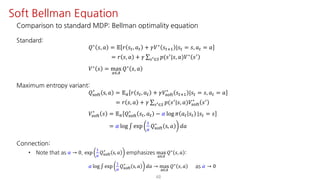
Comparison to standard MDP: Bellman optimality equation
Standard:
𝑄∗
𝑠, 𝑎 = 𝔼 𝑟 𝑠", 𝑎" + 𝛾𝑉∗
𝑠"?@ |𝑠" = 𝑠, 𝑎" = 𝑎
= 𝑟 𝑠, 𝑎 + 𝛾 ∑UV∈W 𝑝(𝑠=|𝑠, 𝑎)𝑉∗ 𝑠=
𝑉∗ 𝑠 = max
S∈T
𝑄∗ 𝑠, 𝑎
Maximum entropy variant:
𝑄ijkl
∗
s, 𝑎 = 𝔼F 𝑟 𝑠", 𝑎" + 𝛾𝑉ijkl
∗
𝑠"?@ |𝑠" = 𝑠, 𝑎" = 𝑎
= 𝑟 𝑠, 𝑎 + 𝛾 ∑UV∈W 𝑝(𝑠=|𝑠, 𝑎)𝑉ijkl
∗
𝑠=
𝑉ijkl
∗
𝑠 = 𝔼F 𝑄ijkl
∗
𝑠", 𝑎" − 𝛼 log 𝜋 𝑎" 𝑠" |𝑠" = 𝑠
= 𝛼 log ∫ exp
@
¤
𝑄ijkl
∗
s, 𝑎 𝑑𝑎
Connection:
• Note that as 𝛼 → 0, exp
@
¤
𝑄ijkl
∗
s, 𝑎 emphasizes max
S∈T
𝑄∗ 𝑠, 𝑎 :
𝛼 log ∫ exp
@
¤
𝑄ijkl
∗
s, 𝑎 𝑑𝑎 → max
S∈T
𝑄∗ 𝑠, 𝑎 as 𝛼 → 0
48
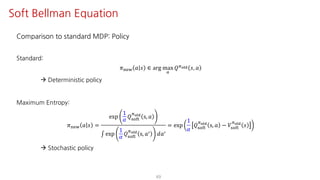
Soft Bellman Equation
Comparison to standard MDP: Policy
Standard:
𝜋uvw 𝑎 𝑠 ∈ arg max
S
𝑄Fyz{ 𝑠, 𝑎
à Deterministic policy
Maximum Entropy:
𝜋uvw 𝑎 𝑠 =
exp
1
𝛼
𝑄ijkl
Fyz{
s, 𝑎
∫ exp
1
𝛼
𝑄ijkl
Fyz{
s, 𝑎= 𝑑𝑎=
= exp
1
𝛼
𝑄ijkl
Fyz{
s, 𝑎 − 𝑉ijkl
Fyz{
𝑠
à Stochastic policy
49
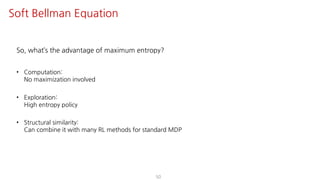
Soft Bellman Equation
So, what’s the advantage of maximum entropy?
• Computation:
No maximization involved
• Exploration:
High entropy policy
• Structural similarity:
Can combine it with many RL methods for standard MDP
50
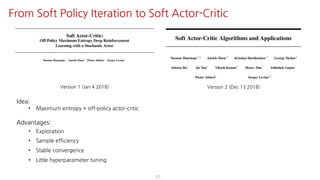
Soft Bellman Equation
Idea:
• Maximum entropy + off-policy actor-critic
Advantages:
• Exploration
• Sample efficiency
• Stable convergence
• Little hyperparameter tuning
51
From Soft Policy Iteration to Soft Actor-Critic
Version 1 (Jan 4 2018) Version 2 (Dec 13 2018)
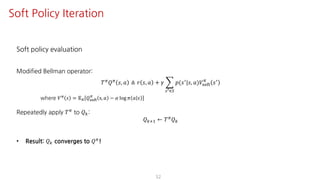
Soft policy evaluation
Modified Bellman operator:
𝑇F
𝑄F
𝑠, 𝑎 ≜ 𝑟 𝑠, 𝑎 + 𝛾 I
UV∈W
𝑝(𝑠=
|𝑠, 𝑎)𝑉ijkl
F
𝑠=
where 𝑉F 𝑠 = 𝔼F 𝑄ijkl
F
s, 𝑎 − 𝛼 log 𝜋 𝑎 𝑠
Repeatedly apply 𝑇F
to 𝑄:
𝑄?@ ← 𝑇F 𝑄
• Result: 𝑄 converges to 𝑄F!
52
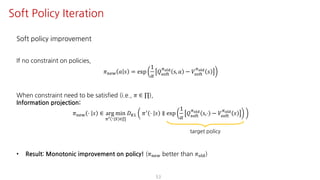
Soft Policy Iteration
Soft policy improvement
If no constraint on policies,
𝜋uvw 𝑎 𝑠 = exp
1
𝛼
𝑄ijkl
Fyz{
s, 𝑎 − 𝑉ijkl
Fyz{
𝑠
When constraint need to be satisfied (i.e., 𝜋 ∈ ∏),
Information projection:
𝜋uvw ⋅ 𝑠 ∈ arg min
FV ⋅ 𝑠 ∈∏
𝐷¨© 𝜋= ⋅ 𝑠 ∥ exp
1
𝛼
𝑄ijkl
Fyz{
s,⋅ − 𝑉ijkl
Fyz{
𝑠
• Result: Monotonic improvement on policy! (𝜋uvw better than 𝜋jst)
53
target policy
Soft Policy Iteration
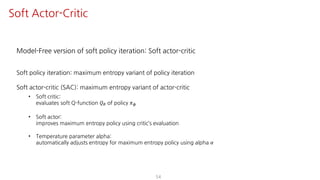
Model-Free version of soft policy iteration: Soft actor-critic
Soft policy iteration: maximum entropy variant of policy iteration
Soft actor-critic (SAC): maximum entropy variant of actor-critic
• Soft critic:
evaluates soft Q-function 𝑄« of policy 𝜋¬
• Soft actor:
improves maximum entropy policy using critic’s evaluation
• Temperature parameter alpha:
automatically adjusts entropy for maximum entropy policy using alpha 𝛼
54
Soft Actor-Critic
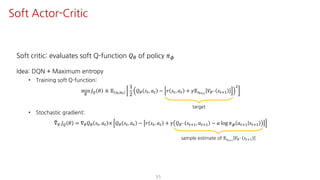
Soft critic: evaluates soft Q-function 𝑄« of policy 𝜋¬
Idea: DQN + Maximum entropy
• Training soft Q-function:
min
«
𝐽— 𝜃 ≜ 𝔼 UY,SY
1
2
𝑄« 𝑠", 𝑎" − 𝑟 𝑠", 𝑎" + 𝛾𝔼UY¯Ÿ
𝑉«° 𝑠"?@
†
• Stochastic gradient:
±∇« 𝐽— 𝜃 = ∇« 𝑄« 𝑠", 𝑎" × 𝑄« 𝑠", 𝑎" − 𝑟 𝑠", 𝑎" + 𝛾 𝑄«° 𝑠"?@, 𝑎"?@ − 𝛼 log 𝜋¬ 𝑎"?@ 𝑠"?@
55
Soft Actor-Critic
target
sample estimate of 𝔼UY¯Ÿ
𝑉«° 𝑠"?@
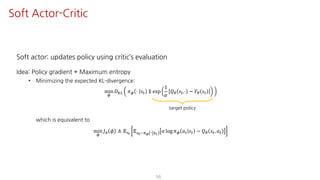
Soft actor: updates policy using critic’s evaluation
Idea: Policy gradient + Maximum entropy
• Minimizing the expected KL-divergence:
min
¬
𝐷¨© 𝜋¬ ⋅ 𝑠" ∥ exp
1
𝛼
𝑄« 𝑠",⋅ − 𝑉« 𝑠"
which is equivalent to
min
¬
𝐽F 𝜙 ≜ 𝔼UY
𝔼SY~Fµ ⋅ 𝑠"
𝛼 log 𝜋¬ 𝑎" 𝑠" − 𝑄« 𝑠", 𝑎"
56
Soft Actor-Critic
target policy
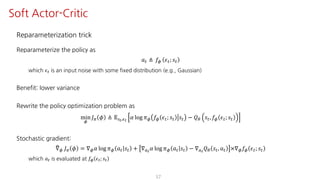
Reparameterization trick
Reparameterize the policy as
𝑎" ≜ 𝑓¬ 𝜖"; 𝑠"
which 𝜖" is an input noise with some fixed distribution (e.g., Gaussian)
Benefit: lower variance
Rewrite the policy optimization problem as
min
¬
𝐽F 𝜙 ≜ 𝔼UY,·Y
𝛼 log 𝜋¬ 𝑓¬ 𝜖"; 𝑠" 𝑠" − 𝑄« 𝑠", 𝑓¬ 𝜖"; 𝑠"
Stochastic gradient:
±∇¬ 𝐽F 𝜙 = ∇¬ 𝛼 log 𝜋¬ 𝑎" 𝑠" + ∇SY
𝛼 log 𝜋¬ 𝑎" 𝑠" − ∇SY
𝑄« 𝑠", 𝑎" ×∇¬ 𝑓¬ 𝜖"; 𝑠"
which 𝑎" is evaluated at 𝑓¬ 𝜖"; 𝑠"
57
Soft Actor-Critic
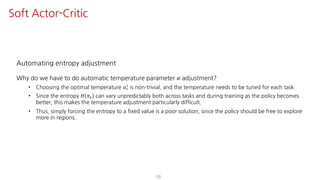
Automating entropy adjustment
Why do we have to do automatic temperature parameter 𝛼 adjustment?
• Choosing the optimal temperature 𝛼"
∗ is non-trivial, and the temperature needs to be tuned for each task.
• Since the entropy 𝐻 𝜋" can vary unpredictably both across tasks and during training as the policy becomes
better, this makes the temperature adjustment particularly difficult.
• Thus, simply forcing the entropy to a fixed value is a poor solution, since the policy should be free to explore
more in regions.
58
Soft Actor-Critic
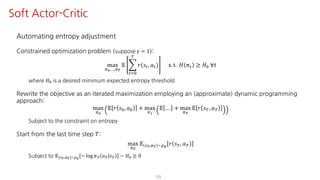
Automating entropy adjustment
Constrained optimization problem suppose 𝛾 = 1 :
max
F¸,…,F¹
𝔼 I
"JK
º
𝑟(𝑠", 𝑎") s. t. 𝐻 𝜋" ≥ 𝐻K ∀𝑡
where 𝐻K is a desired minimum expected entropy threshold
Rewrite the objective as an iterated maximization employing an (approximate) dynamic programming
approach:
max
F¸
𝔼 𝑟 𝑠K, 𝑎K + max
FŸ
𝔼 … + max
F¹
𝔼 𝑟 𝑠º, 𝑎º
Subject to the constraint on entropy
Start from the last time step 𝑇:
max
F¹
𝔼 U¹,S¹ ~¼›
𝑟 𝑠º, 𝑎º
Subject to 𝔼 U¹,S¹ ~¼›
− log 𝜋º 𝑎º 𝑠º − 𝐻K ≥ 0
59
Soft Actor-Critic
Automating entropy adjustment
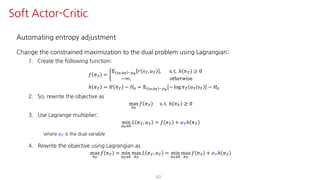
Change the constrained maximization to the dual problem using Lagrangian:
1. Create the following function:
𝑓 𝜋º = ½
𝔼 U¹,S¹ ~¼›
𝑟 𝑠º, 𝑎º , s. t. ℎ(𝜋º) ≥ 0
−∞, otherwise
ℎ 𝜋º = 𝐻 𝜋º − 𝐻K = 𝔼 U¹,S¹ ~¼›
− log 𝜋º 𝑎º 𝑠º − 𝐻K
2. So, rewrite the objective as
max
F¹
𝑓 𝜋º s. t. ℎ 𝜋º ≥ 0
3. Use Lagrange multiplier:
min
¤¹ÁK
𝐿 𝜋º, 𝛼º = 𝑓 𝜋º + 𝛼ºℎ 𝜋º
where 𝛼º is the dual variable
4. Rewrite the objective using Lagrangian as
max
F¹
𝑓 𝜋º = min
¤¹ÁK
max
F¹
𝐿 𝜋º, 𝛼º = min
¤¹ÁK
max
F¹
𝑓 𝜋º + 𝛼ºℎ 𝜋º
60
Soft Actor-Critic
Automating entropy adjustment
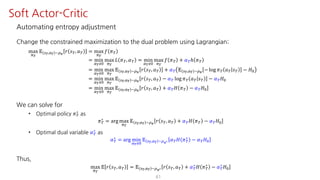
Change the constrained maximization to the dual problem using Lagrangian:
max
F¹
𝔼 U¹,S¹ ~¼›
𝑟 𝑠º, 𝑎º = max
F¹
𝑓 𝜋º
= min
¤¹ÁK
max
F¹
𝐿 𝜋º, 𝛼º = min
¤¹ÁK
max
F¹
𝑓 𝜋º + 𝛼ºℎ 𝜋º
= min
¤¹ÁK
max
F¹
𝔼 U¹,S¹ ~¼›
𝑟 𝑠º, 𝑎º + 𝛼º 𝔼 U¹,S¹ ~¼›
− log 𝜋º 𝑎º 𝑠º − 𝐻K
= min
¤¹ÁK
max
F¹
𝔼 U¹,S¹ ~¼›
𝑟 𝑠º, 𝑎º − 𝛼º log 𝜋º 𝑎º 𝑠º − 𝛼º 𝐻K
= min
¤¹ÁK
max
F¹
𝔼 U¹,S¹ ~¼›
𝑟 𝑠º, 𝑎º + 𝛼º 𝐻 𝜋º − 𝛼º 𝐻K
We can solve for
• Optimal policy 𝜋º
∗
as
𝜋º
∗ = arg max
F¹
𝔼 U¹,S¹ ~¼›
𝑟 𝑠º, 𝑎º + 𝛼º 𝐻 𝜋º − 𝛼º 𝐻K
• Optimal dual variable 𝛼º
∗
as
𝛼º
∗
= arg min
¤¹ÁK
𝔼 U¹,S¹ ~¼›∗ 𝛼º 𝐻 𝜋º
∗
− 𝛼º 𝐻K
Thus,
max
F¹
𝔼 𝑟 𝑠º, 𝑎º = 𝔼 U¹,S¹ ~¼›∗ 𝑟 𝑠º, 𝑎º + 𝛼º
∗ 𝐻 𝜋º
∗ − 𝛼º
∗ 𝐻K
61
Soft Actor-Critic
Automating entropy adjustment
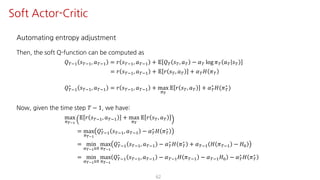
Then, the soft Q-function can be computed as
𝑄ºO@ 𝑠ºO@, 𝑎ºO@ = 𝑟 𝑠ºO@, 𝑎ºO@ + 𝔼 𝑄º 𝑠º, 𝑎º − 𝛼º log 𝜋º 𝑎º 𝑠º
= 𝑟 𝑠ºO@, 𝑎ºO@ + 𝔼 𝑟 𝑠º, 𝑎º + 𝛼º 𝐻 𝜋º
𝑄ºO@
∗
𝑠ºO@, 𝑎ºO@ = 𝑟 𝑠ºO@, 𝑎ºO@ + max
F¹
𝔼 𝑟 𝑠º, 𝑎º + 𝛼º
∗
𝐻(𝜋º
∗
)
Now, given the time step 𝑇 − 1, we have:
max
F¹°Ÿ
𝔼 𝑟 𝑠ºO@, 𝑎ºO@ + max
F¹
𝔼 𝑟 𝑠º, 𝑎º
= max
F¹°Ÿ
𝑄ºO@
∗
𝑠ºO@, 𝑎ºO@ − 𝛼º
∗
𝐻 𝜋º
∗
= min
¤¹°ŸÁK
max
F¹°Ÿ
𝑄ºO@
∗
𝑠ºO@, 𝑎ºO@ − 𝛼º
∗
𝐻 𝜋º
∗
+ 𝛼ºO@ 𝐻 𝜋ºO@ − 𝐻K
= min
¤¹°ŸÁK
max
F¹°Ÿ
𝑄ºO@
∗
𝑠ºO@, 𝑎ºO@ − 𝛼ºO@ 𝐻 𝜋ºO@ − 𝛼ºO@ 𝐻K − 𝛼º
∗
𝐻 𝜋º
∗
62
Soft Actor-Critic
Automating entropy adjustment
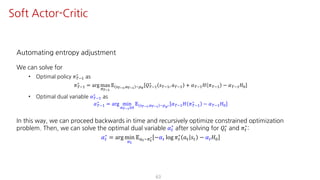
We can solve for
• Optimal policy 𝜋ºO@
∗
as
𝜋ºO@
∗
= arg max
F¹°Ÿ
𝔼 U¹°Ÿ,S¹°Ÿ ~¼›
𝑄ºO@
∗
𝑠ºO@, 𝑎ºO@ + 𝛼ºO@ 𝐻 𝜋ºO@ − 𝛼ºO@ 𝐻K
• Optimal dual variable 𝛼ºO@
∗
as
𝛼ºO@
∗ = arg min
¤¹°ŸÁK
𝔼 U¹°Ÿ,S¹°Ÿ ~¼›∗ 𝛼ºO@ 𝐻 𝜋ºO@
∗ − 𝛼ºO@ 𝐻K
In this way, we can proceed backwards in time and recursively optimize constrained optimization
problem. Then, we can solve the optimal dual variable 𝛼"
∗
after solving for 𝑄"
∗
and 𝜋"
∗
:
𝛼"
∗
= arg min
¤Y
𝔼SY~FY
∗ −𝛼" log 𝜋"
∗
𝑎" 𝑠" − 𝛼" 𝐻K
63
Soft Actor-Critic
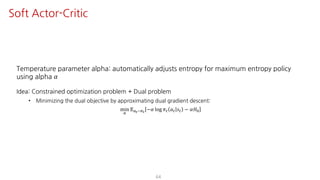
Temperature parameter alpha: automatically adjusts entropy for maximum entropy policy
using alpha 𝛼
Idea: Constrained optimization problem + Dual problem
• Minimizing the dual objective by approximating dual gradient descent:
min
¤
𝔼SY~FY
−𝛼 log 𝜋" 𝑎" 𝑠" − 𝛼𝐻K
64
Soft Actor-Critic
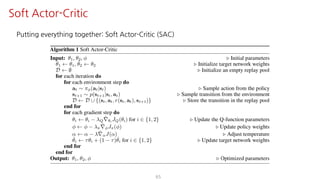
Putting everything together: Soft Actor-Critic (SAC)
65
Soft Actor-Critic
66
Results
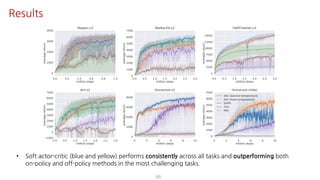
• Soft actor-critic (blue and yellow) performs consistently across all tasks and outperforming both
on-policy and off-policy methods in the most challenging tasks.
67
References
Papers
• T. Haarnoja, et al., “Reinforcement Learning with Deep Energy-Based Policies”, ICML 2017
• T. Haarnoja, et, al., “Soft Actor-Critic: Off-Policy Maximum Entropy Deep Reinforcement Learning
with a Stochastic Actor”, ICML 2018
• T. Haarnoja, et, al., “Soft Actor-Critic Algorithms and Applications”, arXiv preprint 2018
Theoretical analysis
• “Induction of Q-learning, Soft Q-learning, and Sparse Q-learning” written by Sungjoon Choi
• “Reinforcement Learning with Deep Energy-Based Policies” reviewed by Kyungjae Lee
• “Entropy Regularization in Reinforcement Learning (Stochastic Policy)” reviewed by Kyungjae Lee
• Reframing Control as an Inference Problem, CS 294-112: Deep Reinforcement Learning
• Constrained optimization problem and dual problem for SAC with automatically adjusted
temperature (in Korean)
68
Any Questions?
69
Thank You

Maximum Entropy Reinforcement Learning (Stochastic Control)

  • 1.
    1 Maximum Entropy ReinforcementLearning Stochastic Control T. Haarnoja, et al., “Reinforcement Learning with Deep Energy-Based Policies”, ICML 2017 T. Haarnoja, et, al., “Soft Actor-Critic: Off-Policy Maximum Entropy Deep Reinforcement Learning with a Stochastic Actor”, ICML 2018 T. Haarnoja, et, al., “Soft Actor-Critic Algorithms and Applications”, arXiv preprint 2018 Dongmin Lee August, 2019 T. Haarnoja, et al., “Reinforcement Learning with Deep Energy-Based Policies”, ICML 2017 T. Haarnoja, et, al., “Soft Actor-Critic: Off-Policy Maximum Entropy Deep Reinforcement Learning with a Stochastic Actor”, ICML 2018 T. Haarnoja, et, al., “Soft Actor-Critic Algorithms and Applications”, arXiv preprint 2018 Presented by Dongmin Lee August, 2019
  • 2.
    2 Outline 1. Introduction 2. ReinforcementLearning • Markov Decision Processes (MDPs) • Bellman Equation 3. Exploration methods 4. Maximum Entropy Reinforcement Learning • Soft MDPs • Soft Bellman Equation 5. From Soft Policy Iteration to Soft Actor-Critic • Soft Policy Iteration • Soft Actor-Critic 6. Results
  • 3.
    3 Introduction How do webuild intelligent systems / machines? • Data à Information • Information à Decision intelligence intelligence
  • 4.
    Intelligent systems mustbe able to adapt to uncertainty • Uncertainty: • Other cars • Weather • Road construction • Passenger 4 Introduction
  • 5.
    RL provides aformalism for behaviors • Problem of a goal-directed agent interacting with an uncertain environment • Interaction à adaptation 5 feedback & decision Introduction
  • 6.
    6 Introduction Distinct Features ofRL 1. There is no supervisor, only a reward signal 2. Feedback is delayed, not instantaneous 3. Time really matters (sequential, non i.i.d data) 4. Tradeoff between exploration and exploitation
  • 7.
    What is deepRL? Deep RL = RL + Deep learning • RL: sequential decision making interacting with environments • Deep learning: representation of policies and value functions 7source : http://rail.eecs.berkeley.edu/deeprlcourse-fa17/f17docs/lecture_2.pdf Introduction
  • 8.
    What are thechallenges of deep RL? • Huge # of samples: millions • Fast, stable learning • Hyperparameter tuning • Exploration • Sparse reward signals • Safety / reliability • Simulator 8 Introduction
  • 9.
    • Soft Actor-Criticon Minitaur ­ Training 9 Introduction source : https://sites.google.com/view/sac-and-applications
  • 10.
    • Soft Actor-Criticon Minitaur ­ Testing 10 Introduction source : https://sites.google.com/view/sac-and-applications
  • 11.
    • Interfered rolloutsfrom Soft Actor-Critic policy trained for Dynamixel Claw task from vision 11 Introduction source : https://sites.google.com/view/sac-and-applications
  • 12.
    • State ofthe environment / system • Action determined by the agent: affects the state • Reward: evaluates the benefit of state and action 12 Reinforcement Learning
  • 13.
    • State: 𝑠"∈ 𝑆 • Action: 𝑎" ∈ 𝐴 • Policy (mapping from state to action): 𝜋 • Deterministic 𝜋 𝑠" = 𝑎" • Stochastic (randomized) 𝜋 𝑎 𝑠 = Prob(𝑎" = 𝑎|𝑠" = 𝑠) à Policy is what we want to optimize! 13 Reinforcement Learning
  • 14.
    A Markov decisionprocess (MDP) is a tuple < 𝑆, 𝐴, 𝑝, 𝑟, 𝛾 >, consisting of • 𝑆: set of states (state space) e.g., 𝑆 = 1, … , 𝑛 (discrete), 𝑆 = ℝ: (continuous) • 𝐴: set of actions (action space) e.g., 𝐴 = 1, … , 𝑚 (discrete), 𝐴 = ℝ< (continuous) • 𝑝: state transition probability 𝑝 𝑠= 𝑠, 𝑎 ≜ Prob 𝑠"?@ = 𝑠= 𝑠" = 𝑠, 𝑎" = 𝑎 d • 𝑟: reward function 𝑟 𝑠", 𝑎" = 𝑟"d • 𝛾 ∈ (0,1]: discount factor 14 Markov Decision Processes (MDPs)
  • 15.
    The MDP problem •To find an optimal policy that maximizes the expected cumulative reward: max F∈∏ 𝔼F I "JK L 𝛾" 𝑟 𝑠", 𝑎" Value function • The state value function 𝑉F (𝑠) of a policy 𝜋 is the expected return starting from state 𝑠 under executing 𝜋: 𝑉F 𝑠 ≜ 𝔼F I NJ" L 𝛾NO" 𝑟 𝑠N, 𝑎N |𝑠" = 𝑠 Q-function • The action value function 𝑄F(𝑠, 𝑎) of a policy 𝜋 is the expected return starting from state 𝑠, taking action 𝑎, and then following 𝜋: 𝑄F 𝑠, 𝑎 ≜ 𝔼F I NJ" L 𝛾NO" 𝑟 𝑠N, 𝑎N |𝑠" = 𝑠, 𝑎" = 𝑎 15 Markov Decision Processes (MDPs)
  • 16.
    The MDP problem •To find an optimal policy that maximizes the expected cumulative reward: max F∈∏ 𝔼F I "JK L 𝛾" 𝑟 𝑠", 𝑎" Optimal value function • The optimal value function 𝑉∗(𝑠) is the maximum value function over all policies: 𝑉∗ 𝑠 ≜ max F∈∏ 𝑉F 𝑠 = max F∈∏ 𝔼F I "JK L 𝛾" 𝑟 𝑠", 𝑎" |𝑠" = 𝑠 Optimal Q-function • The optimal Q-function 𝑄∗(𝑠, 𝑎) is the maximum Q-function over all policies: 𝑄∗ 𝑠, 𝑎 ≜ max F∈∏ 𝑄F 𝑠, 𝑎 16 Markov Decision Processes (MDPs)
  • 17.
    Bellman expectation equationfor 𝑉F • The value function 𝑉F is the unique solution to the following Bellman equation: 𝑉F 𝑠 = 𝔼 𝑟 𝑠", 𝑎" + 𝛾𝑉F 𝑠"?@ |𝑠" = 𝑠 = I S∈T 𝜋(𝑎|𝑠) 𝑟 𝑠, 𝑎 + 𝛾 I UV∈W 𝑝 𝑠= 𝑠, 𝑎 𝑉F 𝑠= = I S∈T 𝜋(𝑎|𝑠)𝑄F 𝑠, 𝑎 • In operator form 𝑉F = 𝑇𝑉F Bellman expectation equation for 𝑄F • The Q-function 𝑄F satisfies: 𝑄F 𝑠, 𝑎 = 𝔼 𝑟 𝑠", 𝑎" + 𝛾𝑉F 𝑠"?@ |𝑠" = 𝑠, 𝑎" = 𝑎 = 𝑟 𝑠, 𝑎 + 𝛾 I UV∈W 𝑝(𝑠=|𝑠, 𝑎)𝑉F 𝑠= = 𝑟 𝑠, 𝑎 + 𝛾 I UV∈W 𝑝 𝑠= 𝑠, 𝑎 I SV∈T 𝜋 𝑎= 𝑠= 𝑄F 𝑠= , 𝑎= 17 Bellman Equation
  • 18.
    Bellman optimality equationfor 𝑉∗ • The optimal value function 𝑉∗ must satisfies the self-consistency condition given by the Bellman equation for 𝑉F: 𝑉∗ 𝑠 = max SY∈T 𝔼 𝑟 𝑠", 𝑎" + 𝛾𝑉∗ 𝑠"?@ |𝑠" = 𝑠 = max S∈T 𝑟 𝑠, 𝑎 + 𝛾 I UV∈W 𝑝(𝑠=|𝑠, 𝑎)𝑉∗ 𝑠= = max S∈T 𝑄∗ 𝑠, 𝑎 • In operator form 𝑉∗ = 𝑇𝑉∗ Bellman optimality equation for 𝑄∗ • The optimal Q-function 𝑄∗ satisfies: 𝑄∗ 𝑠, 𝑎 = 𝔼 𝑟 𝑠", 𝑎" + 𝛾𝑉∗ 𝑠"?@ |𝑠" = 𝑠, 𝑎" = 𝑎 = 𝑟 𝑠, 𝑎 + 𝛾 I UV∈W 𝑝(𝑠=|𝑠, 𝑎)𝑉∗ 𝑠= = 𝑟 𝑠, 𝑎 + 𝛾 I UV∈W 𝑝(𝑠=|𝑠, 𝑎) max SV∈T 𝑄∗ 𝑠=, 𝑎= 18 Bellman Equation
  • 19.
    The MDP problem •To find an optimal policy that maximizes the expected cumulative reward: max F∈∏ 𝔼F I "JK L 𝛾" 𝑟 𝑠", 𝑎" Known model: • Policy iteration • Value iteration Unknown model: • Temporal-difference learning • Q-learning 19 Bellman Equation
  • 20.
    Policy Iteration Initialize apolicy 𝜋K; 1. (Policy Evaluation) Compute the value 𝑉F[ of 𝜋 by solving the Bellman equation 𝑉F[ = 𝑇F[ 𝑉F[; 2. (Policy Improvement) Update the policy to 𝜋?@ so that 𝜋?@(𝑠) ∈ arg max S {𝑟 𝑠, 𝑎 + 𝛾 I UV∈W 𝑝 𝑠= 𝑠, 𝑎 𝑉F[ 𝑠= } 3. Set 𝑘 ← 𝑘 + 1; Repeat until convergence; • Converged policy is optimal! • Q) Can we do something even simpler? 20 Bellman Equation
  • 21.
    Value Iteration Initialize avalue function 𝑉K; 1. Update the value function by 𝑉?@ ← 𝑇𝑉; 2. Set 𝑘 ← 𝑘 + 1; Repeat until convergence; • Converged value function is optimal! 21 Bellman Equation
  • 22.
    Common issue: exploration •Is there a value of exploring unknown regions of the environment? • Which action should we try to explore unknown regions of the environment? 22 Exploration methods
  • 23.
    How can wealgorithmically solve this issue in exploration vs exploitation? 1. 𝜖-Greedy 2. Optimism in the face of uncertainty 3. Thompson (posterior) sampling 4. Noisy networks 5. Information theoretic exploration 23 Exploration methods
  • 24.
    Method 1: 𝜖-Greedy Idea: •Choose a greedy action (arg max 𝑄F(𝑠, 𝑎)) with probability (1 − 𝜖) • Choose a random action with probability 𝜖 Advantages: 1. Very simple 2. Light computation Disadvantages: 1. Fine tuning 𝜖 2. Not quite systematic: No focus on unexplored regions 3. Inefficient 24 Exploration methods
  • 25.
    Method 2: Optimismin the face of uncertainty (OFU) Idea: 1. Construct a confidence set for MDP parameters using collected samples 2. Choose MDP parameters that give the highest rewards 3. Construct an optimal policy of the optimistically chosen MDP Advantages: 1. Regret optimal 2. Systematic: More focus on unexplored regions Disadvantages: 1. Complicated 2. Computation intensive 25 Exploration methods
  • 26.
    Method 3: Thompson(posterior) sampling Idea: 1. Sample MDP parameters from posterior distribution 2. Construct an optimal policy of the sampled MDP parameters 3. Update the posterior distribution Advantages: 1. Regret optimal 2. Systematic: More focus on unexplored regions Disadvantages: 1. Somewhat complicated 26 Exploration methods
  • 27.
    Method 4: Noisynetworks Idea: • Inject noise to the weights of Neural Network Advantages: 1. Simple 2. Good empirical performance Disadvantages: 1. Not systematic: No focus on unexplored regions 27 Exploration methods
  • 28.
    Method 5: Informationtheoretic exploration Idea: • Use high entropy policy to explore more Advantages: 1. Simple 2. Good empirical performance Disadvantages: 1. More theoretic analyses needed 28 Exploration methods
  • 29.
    What is entropy? •Average rate at which information is produced by a stochastic source of data: 𝐻 𝑝 ≜ − I e 𝑝e log 𝑝e = 𝔼 − log 𝑝e • More generally, entropy refers to disorder 29 Maximum Entropy Reinforcement Learning
  • 30.
    What’s the benefitof high entropy policy? • Entropy of policy: 𝐻 𝜋(⋅ |𝑠) ≜ − I S 𝜋(𝑎|𝑠) log 𝜋(𝑎|𝑠) = 𝔼S~F(⋅|U) − log 𝜋(𝑎|𝑠) • Higher disorder in policy 𝜋 • Try new risky behaviors: Potentially explore unexplored regions 30 Maximum Entropy Reinforcement Learning
  • 31.
    Maximum entropy stochasticcontrol Standard MDP problem: max F 𝔼F I " 𝛾" 𝑟(𝑠", 𝑎") Maximum entropy MDP problem: max F 𝔼F I " 𝛾" 𝑟 𝑠", 𝑎" + 𝐻 𝜋" ⋅ 𝑠" 31 Soft MDPs
  • 32.
    Theorem 1 (Softvalue functions and Optimal policy) Soft Q-function: 𝑄ijkl F 𝑠", 𝑎" ≜ 𝑟 𝑠", 𝑎" + 𝔼F I mJ@ L 𝛾m 𝑟 𝑠"?m, 𝑎"?m + 𝐻 𝜋 ⋅ 𝑠"?m Soft value function: 𝑉ijkl F 𝑠" ≜ log n exp 𝑄ijkl F 𝑠", 𝑎 𝑑𝑎 Optimal value functions: 𝑄ijkl ∗ 𝑠", 𝑎" ≜ max F 𝑄ijkl F 𝑠", 𝑎" 𝑉ijkl ∗ 𝑠" ≜ log n exp 𝑄ijkl ∗ 𝑠", 𝑎 𝑑𝑎 32 Soft Bellman Equation
  • 33.
    Proof. Maximum entropy MDPproblem: max F 𝔼F I " 𝛾" 𝑟 𝑠", 𝑎" + 𝐻 𝜋" ⋅ 𝑠" Soft value function: 𝑉ijkl F 𝑠 = 𝔼F I NJ" 𝛾NO" 𝑟 𝑠N, 𝑎N − log 𝜋 𝑎N 𝑠N |𝑠" = 𝑠 = 𝔼F 𝑟 𝑠", 𝑎" − log 𝜋 𝑎" 𝑠" + 𝛾𝑉ijkl F 𝑠"?@ |𝑠" = 𝑠 Soft Q-function: 𝑄ijkl F s, 𝑎 = 𝔼F I NJ" 𝛾NO" 𝑟 𝑠N, 𝑎N − log 𝜋 𝑎N 𝑠N |𝑠" = 𝑠, 𝑎" = 𝑎 = 𝔼F 𝑟 𝑠", 𝑎" + 𝛾𝑉ijkl F 𝑠"?@ |𝑠" = 𝑠, 𝑎" = 𝑎 33 Soft Bellman Equation note that 𝑄ijkl F s, 𝑎 is the same with the original form
  • 34.
    Proof. Soft value function: 𝑉ijkl F 𝑠= 𝔼F I NJ" 𝛾NO" 𝑟 𝑠N, 𝑎N − log 𝜋 𝑎N 𝑠N |𝑠" = 𝑠 = 𝔼F 𝑟 𝑠", 𝑎" − log 𝜋 𝑎" 𝑠" + 𝛾𝑉ijkl F 𝑠"?@ |𝑠" = 𝑠 Soft Q-function: 𝑄ijkl F s, 𝑎 = 𝔼F I NJ" 𝛾NO" 𝑟 𝑠N, 𝑎N − log 𝜋 𝑎N 𝑠N |𝑠" = 𝑠, 𝑎" = 𝑎 = 𝔼F 𝑟 𝑠", 𝑎" + 𝛾𝑉ijkl F 𝑠"?@ |𝑠" = 𝑠, 𝑎" = 𝑎 Soft value function (rewrite): 𝑉ijkl F 𝑠 = 𝔼F 𝑟 𝑠", 𝑎" − log 𝜋 𝑎" 𝑠" + 𝛾𝑉ijkl F 𝑠"?@ |𝑠" = 𝑠 = 𝔼F 𝑄ijkl F 𝑠", 𝑎" − log 𝜋 𝑎" 𝑠" |𝑠" = 𝑠 34 Soft Bellman Equation
  • 35.
    Proof. Given a policy𝜋jst, define a new policy 𝜋uvw as: 𝜋uvw 𝑎 𝑠 ∝ exp 𝑄ijkl Fyz{ s, 𝑎 𝜋uvw 𝑎 𝑠 = exp(𝑄ijkl Fyz{ s, 𝑎 ) ∫ exp(𝑄ijkl Fyz{ s, 𝑎= ) 𝑑𝑎= = softmax S∈T 𝑄ijkl Fyz{ s, 𝑎 = exp(𝑄ijkl Fyz{ s, 𝑎 − 𝑉ijkl Fyz{ 𝑠 ) = exp(𝐴ijkl Fyz{ s, 𝑎 ) Substitute 𝜋uvw 𝑎 𝑠 into 𝑉ijkl F 𝑠 : 𝑉ijkl F 𝑠 = 𝔼S~F 𝑄ijkl F s, 𝑎 − log exp 𝑄ijkl F s, 𝑎 ∫ exp 𝑄ijkl F s, 𝑎= 𝑑𝑎= = 𝔼S~F 𝑄ijkl F s, 𝑎 − log exp 𝑄ijkl F s, 𝑎 + log n exp 𝑄ijkl F s, 𝑎= 𝑑𝑎= 35 Soft Bellman Equation
  • 36.
    Proof. Substitute 𝜋uvw 𝑎𝑠 into 𝑉ijkl F 𝑠 : 𝑉ijkl F 𝑠 = 𝔼S~F 𝑄ijkl F s, 𝑎 − log exp 𝑄ijkl F s, 𝑎 + log n exp 𝑄ijkl F s, 𝑎= 𝑑𝑎= = 𝔼S~F log n exp 𝑄ijkl F s, 𝑎= 𝑑𝑎= = log n exp 𝑄ijkl F s, 𝑎= 𝑑𝑎= ∴ 𝑉ijkl F 𝑠 = log n exp 𝑄ijkl F s, 𝑎 𝑑𝑎 36 Soft Bellman Equation independent from 𝑎
  • 37.
    Theorem 1 (Softvalue functions and Optimal policy) Soft Q-function: 𝑄ijkl F 𝑠", 𝑎" ≜ 𝑟 𝑠", 𝑎" + 𝔼F I mJ@ L 𝛾m 𝑟 𝑠"?m, 𝑎"?m + 𝐻 𝜋 ⋅ 𝑠"?m Soft value function: 𝑉ijkl F 𝑠" ≜ log n exp 𝑄ijkl F 𝑠", 𝑎 𝑑𝑎 Optimal value functions: 𝑄ijkl ∗ 𝑠", 𝑎" ≜ max F 𝑄ijkl F 𝑠", 𝑎" 𝑉ijkl ∗ 𝑠" ≜ log n exp 𝑄ijkl ∗ 𝑠", 𝑎 𝑑𝑎 37 Soft Bellman Equation
  • 38.
    Theorem 2 (Softpolicy improvement theorem) Given a policy 𝜋jst, define a new policy 𝜋uvw as: 𝜋uvw 𝑎 𝑠 ∝ exp 𝑄ijkl Fyz{ s, 𝑎 Assume that throughout our computation, 𝑄 is bounded and ∫ exp 𝑄 𝑠, 𝑎 𝑑𝑎 is bounded for any 𝑠 (for both 𝜋jst and 𝜋uvw). Then, 𝑄ijkl F€•‚ s, 𝑎 ≥ 𝑄ijkl Fyz{ s, 𝑎 ∀𝑠, 𝑎 à Monotonic policy improvement 38 Soft Bellman Equation
  • 39.
    39 Soft Bellman Equation Proof. Ifone greedily maximize the sum of entropy and value with one-step look-ahead, then one obtains 𝜋uvw from 𝜋jst: 𝐻 𝜋jst ⋅ 𝑠 + 𝔼Fyz{ 𝑄ijkl Fyz{ s, 𝑎 ≤ 𝐻 𝜋uvw ⋅ 𝑠 + 𝔼F€•‚ 𝑄ijkl Fyz{ s, 𝑎 Example 𝜋(𝑎|𝑠) 𝑟(𝑠, 𝑎) 𝑠K 𝑠@ 𝑠† 𝑠‡ 𝑠ˆ 𝜋jst 0.5 0.5 0.5 0.5 +2 +4+1 +1 𝑠• 𝑠Ž 0.5 +3 0.5 +1
  • 40.
    40 Soft Bellman Equation Proof. Ifone greedily maximize the sum of entropy and value with one-step look-ahead, then one obtains 𝜋uvw from 𝜋jst: 𝐻 𝜋jst ⋅ 𝑠 + 𝔼Fyz{ 𝑄ijkl Fyz{ s, 𝑎 ≤ 𝐻 𝜋uvw ⋅ 𝑠 + 𝔼F€•‚ 𝑄ijkl Fyz{ s, 𝑎 Example 𝑠K 𝑠@ 𝑠† 𝑠‡ 𝑠ˆ 𝜋jst 0.5 0.5 0.5 0.5 +2 +4+1 +1 𝑠• 𝑠Ž 0.5 +3 0.5 +1 𝑄ijkl Fyz{ left = ? 𝑄ijkl Fyz{ right = ? 𝑄ijkl Fyz{ left = ? 𝑄ijkl Fyz{ right = ? 𝑄ijkl Fyz{ left = ? 𝑄ijkl Fyz{ right =? Soft Q-function: 𝑄ijkl F 𝑠, 𝑎 ≜ 𝑟 𝑠", 𝑎" + 𝔼F I mJ@ L 𝛾m 𝑟 𝑠"?m, 𝑎"?m + 𝐻 𝜋 ⋅ 𝑠"?m = 𝑟 𝑠, 𝑎 + 𝛾𝑝 𝑠= 𝑠, 𝑎 𝑉ijkl F 𝑠= Soft value function: 𝑉ijkl F 𝑠 = I S 𝜋 𝑎 𝑠 𝑄ijkl F s, 𝑎 − log 𝜋 𝑎 𝑠 Entropy of policy: 𝐻 𝜋(⋅ |𝑠) ≜ − I S 𝜋(𝑎|𝑠) log 𝜋(𝑎|𝑠)
  • 41.
    41 Soft Bellman Equation Proof. Ifone greedily maximize the sum of entropy and value with one-step look-ahead, then one obtains 𝜋uvw from 𝜋jst: 𝐻 𝜋jst ⋅ 𝑠 + 𝔼Fyz{ 𝑄ijkl Fyz{ s, 𝑎 ≤ 𝐻 𝜋uvw ⋅ 𝑠 + 𝔼F€•‚ 𝑄ijkl Fyz{ s, 𝑎 Example 𝑠K 𝑠@ 𝑠† 𝑠‡ 𝑠ˆ 𝜋jst (suppose γ = 1, 𝑝 𝑠= 𝑠, 𝑎 = 1) 0.5 0.5 0.5 0.5 +2 +4+1 +1 𝑠• 𝑠Ž 0.5 +3 0.5 +1 𝑄ijkl Fyz{ left = 2 𝑄ijkl Fyz{ right = 4 𝑄ijkl Fyz{ left = 3 𝑄ijkl Fyz{ right = 1 𝑄ijkl Fyz{ left = 4.3 𝑄ijkl Fyz{ right = 3.3 Soft Q-function: 𝑄ijkl F 𝑠, 𝑎 ≜ 𝑟 𝑠", 𝑎" + 𝔼F I mJ@ L 𝛾m 𝑟 𝑠"?m, 𝑎"?m + 𝐻 𝜋 ⋅ 𝑠"?m = 𝑟 𝑠, 𝑎 + 𝛾𝑝 𝑠= 𝑠, 𝑎 𝑉ijkl F 𝑠= Soft value function: 𝑉ijkl F 𝑠 = I S 𝜋 𝑎 𝑠 𝑄ijkl F s, 𝑎 − log 𝜋 𝑎 𝑠 Entropy of policy: 𝐻 𝜋(⋅ |𝑠) ≜ − I S 𝜋(𝑎|𝑠) log 𝜋(𝑎|𝑠)
  • 42.
    42 Soft Bellman Equation Proof. Ifone greedily maximize the sum of entropy and value with one-step look-ahead, then one obtains 𝜋uvw from 𝜋jst: 𝐻 𝜋jst ⋅ 𝑠 + 𝔼Fyz{ 𝑄ijkl Fyz{ s, 𝑎 ≤ 𝐻 𝜋uvw ⋅ 𝑠 + 𝔼F€•‚ 𝑄ijkl Fyz{ s, 𝑎 Example 𝑠K 𝑠@ 𝑠† 𝑠‡ 𝑠ˆ 𝜋jst 0.5 0.5 0.5 0.5 +2 +4+1 +1 𝑠• 𝑠Ž 0.5 +3 0.5 +1 A new policy 𝜋uvw: 𝜋uvw 𝑎 𝑠 ∝ exp 𝑄ijkl Fyz{ s, 𝑎 𝜋uvw 𝑎 𝑠 = exp(𝑄ijkl Fyz{ s, 𝑎 ) ∑SV exp(𝑄ijkl Fyz{ s, 𝑎= ) = softmax S∈T 𝑄ijkl Fyz{ s, 𝑎 = exp(𝑄ijkl Fyz{ s, 𝑎 − 𝑉ijkl Fyz{ 𝑠 ) 𝑄ijkl Fyz{ left = 2 𝑄ijkl Fyz{ right = 4 𝑄ijkl Fyz{ left = 3 𝑄ijkl Fyz{ right = 1 𝑄ijkl Fyz{ left = 4.3 𝑄ijkl Fyz{ right = 3.3
  • 43.
    43 Soft Bellman Equation Proof. Ifone greedily maximize the sum of entropy and value with one-step look-ahead, then one obtains 𝜋uvw from 𝜋jst: 𝐻 𝜋jst ⋅ 𝑠 + 𝔼Fyz{ 𝑄ijkl Fyz{ s, 𝑎 ≤ 𝐻 𝜋uvw ⋅ 𝑠 + 𝔼F€•‚ 𝑄ijkl Fyz{ s, 𝑎 Example 𝑠K 𝑠@ 𝑠† 𝑠‡ 𝑠ˆ 𝜋jst 0.5 0.5 0.5 0.5 +2 +4+1 +1 𝑠• 𝑠Ž 0.5 +3 0.5 +1 𝑄ijkl Fyz{ left = 2 𝑄ijkl Fyz{ right = 4 𝑄ijkl Fyz{ left = 3 𝑄ijkl Fyz{ right = 1 𝑄ijkl Fyz{ left = 4.3 𝑄ijkl Fyz{ right = 3.3 𝑠K 𝑠@ 𝑠† 𝑠‡ 𝑠ˆ 𝜋uvw 𝜋uvw 𝑎 𝑠 = v•– —˜y™š ›yz{ i,S ∑ œV v•– —˜y™š ›yz{ i,SV 0.73 0.27 0.12 0.88 +2 +4+1 +1 𝑠• 𝑠Ž 0.88 +3 0.12 +1
  • 44.
    44 Soft Bellman Equation Proof. Ifone greedily maximize the sum of entropy and value with one-step look-ahead, then one obtains 𝜋uvw from 𝜋jst: 𝐻 𝜋jst ⋅ 𝑠 + 𝔼Fyz{ 𝑄ijkl Fyz{ s, 𝑎 ≤ 𝐻 𝜋uvw ⋅ 𝑠 + 𝔼F€•‚ 𝑄ijkl Fyz{ s, 𝑎 So, Substitute 𝑠K, 𝑎K for 𝑠, 𝑎: 𝐻 𝜋jst ⋅ 𝑠K + 𝔼Fyz{ 𝑄ijkl Fyz{ 𝑠K, 𝑎K ≤ 𝐻 𝜋uvw ⋅ 𝑠K + 𝔼F€•‚ 𝑄ijkl Fyz{ 𝑠K, 𝑎K 0.3 + 3.8 ≤ 0.25 + 4.03 4.1 ≤ 4.28
  • 45.
    45 Soft Bellman Equation Proof. Ifone greedily maximize the sum of entropy and value with one-step look-ahead, then one obtains 𝜋uvw from 𝜋jst: 𝐻 𝜋jst ⋅ 𝑠 + 𝔼Fyz{ 𝑄ijkl Fyz{ s, 𝑎 ≤ 𝐻 𝜋uvw ⋅ 𝑠 + 𝔼F€•‚ 𝑄ijkl Fyz{ s, 𝑎 Then, we can show that: 𝑄ijkl Fyz{ s, 𝑎 = 𝔼UŸ 𝑟K + 𝛾 𝐻 𝜋jst ⋅ 𝑠@ + 𝔼SŸ~Fyz{ 𝑄ijkl F 𝑠@, 𝑎@ ≤ 𝔼UŸ 𝑟K + 𝛾 𝐻 𝜋uvw ⋅ 𝑠@ + 𝔼SŸ~F€•‚ 𝑄ijkl F 𝑠@, 𝑎@ = 𝔼UŸ 𝑟K + 𝛾 𝐻 𝜋uvw ⋅ 𝑠@ + 𝑟@ + 𝛾† 𝔼U 𝐻 𝜋jst ⋅ 𝑠† + 𝔼S ~Fyz{ 𝑄ijkl F 𝑠†, 𝑎† ≤ 𝔼UŸ 𝑟K + 𝛾 𝐻 𝜋uvw ⋅ 𝑠@ + 𝑟@ + 𝛾† 𝔼U 𝐻 𝜋uvw ⋅ 𝑠† + 𝔼S ~F€•‚ 𝑄ijkl F 𝑠†, 𝑎† = 𝔼UŸ,S ~F€•‚,U 𝑟K + 𝛾 𝐻 𝜋uvw ⋅ 𝑠@ + 𝑟@ + 𝛾† 𝐻 𝜋uvw ⋅ 𝑠† + 𝑟† + 𝛾‡ 𝔼U¡ 𝐻 𝜋uvw ⋅ 𝑠‡ + 𝔼S¡~F€•‚ 𝑄ijkl F 𝑠‡, 𝑎‡ ⋮ ≤ 𝔼N~F€•‚ 𝑟K + ∑"J@ L 𝛾" 𝐻 𝜋uvw ⋅ 𝑠" + 𝑟" = 𝑄ijkl F€•‚ s, 𝑎
  • 46.
    Theorem 2 (Softpolicy improvement theorem) Given a policy 𝜋jst, define a new policy 𝜋uvw as: 𝜋uvw 𝑎 𝑠 ∝ exp 𝑄ijkl Fyz{ s, 𝑎 Assume that throughout our computation, 𝑄 is bounded and ∫ exp 𝑄 𝑠, 𝑎 𝑑𝑎 is bounded for any 𝑠 (for both 𝜋jst and 𝜋uvw). Then, 𝑄ijkl F€•‚ s, 𝑎 ≥ 𝑄ijkl Fyz{ s, 𝑎 ∀𝑠, 𝑎 à Monotonic policy improvement 46 Soft Bellman Equation
  • 47.
    Comparison to standardMDP: Bellman expectation equation Standard: 𝑄F 𝑠, 𝑎 = 𝔼 𝑟 𝑠", 𝑎" + 𝛾𝑉F 𝑠"?@ |𝑠" = 𝑠, 𝑎" = 𝑎 = 𝑟 𝑠, 𝑎 + 𝛾 ∑UV∈W 𝑝(𝑠= |𝑠, 𝑎)𝑉F 𝑠= 𝑉F 𝑠 = ∑S∈T 𝜋(𝑎|𝑠)𝑄F 𝑠, 𝑎 Maximum entropy: 𝑄ijkl F s, 𝑎 = 𝔼F 𝑟 𝑠", 𝑎" + 𝛾𝑉ijkl F 𝑠"?@ |𝑠" = 𝑠, 𝑎" = 𝑎 = 𝑟 𝑠, 𝑎 + 𝛾 ∑UV∈W 𝑝(𝑠=|𝑠, 𝑎)𝑉ijkl F 𝑠= 𝑉ijkl F 𝑠 = 𝔼F 𝑄ijkl F 𝑠", 𝑎" − log 𝜋 𝑎" 𝑠" |𝑠" = 𝑠 = log ∫ exp 𝑄ijkl F s, 𝑎 𝑑𝑎 Maximum entropy variant: • Add explicit temperature parameter 𝛼 𝑉ijkl F 𝑠 = 𝔼F 𝑄ijkl F 𝑠", 𝑎" − 𝛼 log 𝜋 𝑎" 𝑠" |𝑠" = 𝑠 = 𝛼 log ∫ exp @ ¤ 𝑄ijkl F s, 𝑎 𝑑𝑎 47 Soft Bellman Equation
  • 48.
    Comparison to standardMDP: Bellman optimality equation Standard: 𝑄∗ 𝑠, 𝑎 = 𝔼 𝑟 𝑠", 𝑎" + 𝛾𝑉∗ 𝑠"?@ |𝑠" = 𝑠, 𝑎" = 𝑎 = 𝑟 𝑠, 𝑎 + 𝛾 ∑UV∈W 𝑝(𝑠=|𝑠, 𝑎)𝑉∗ 𝑠= 𝑉∗ 𝑠 = max S∈T 𝑄∗ 𝑠, 𝑎 Maximum entropy variant: 𝑄ijkl ∗ s, 𝑎 = 𝔼F 𝑟 𝑠", 𝑎" + 𝛾𝑉ijkl ∗ 𝑠"?@ |𝑠" = 𝑠, 𝑎" = 𝑎 = 𝑟 𝑠, 𝑎 + 𝛾 ∑UV∈W 𝑝(𝑠=|𝑠, 𝑎)𝑉ijkl ∗ 𝑠= 𝑉ijkl ∗ 𝑠 = 𝔼F 𝑄ijkl ∗ 𝑠", 𝑎" − 𝛼 log 𝜋 𝑎" 𝑠" |𝑠" = 𝑠 = 𝛼 log ∫ exp @ ¤ 𝑄ijkl ∗ s, 𝑎 𝑑𝑎 Connection: • Note that as 𝛼 → 0, exp @ ¤ 𝑄ijkl ∗ s, 𝑎 emphasizes max S∈T 𝑄∗ 𝑠, 𝑎 : 𝛼 log ∫ exp @ ¤ 𝑄ijkl ∗ s, 𝑎 𝑑𝑎 → max S∈T 𝑄∗ 𝑠, 𝑎 as 𝛼 → 0 48 Soft Bellman Equation
  • 49.
    Comparison to standardMDP: Policy Standard: 𝜋uvw 𝑎 𝑠 ∈ arg max S 𝑄Fyz{ 𝑠, 𝑎 à Deterministic policy Maximum Entropy: 𝜋uvw 𝑎 𝑠 = exp 1 𝛼 𝑄ijkl Fyz{ s, 𝑎 ∫ exp 1 𝛼 𝑄ijkl Fyz{ s, 𝑎= 𝑑𝑎= = exp 1 𝛼 𝑄ijkl Fyz{ s, 𝑎 − 𝑉ijkl Fyz{ 𝑠 à Stochastic policy 49 Soft Bellman Equation
  • 50.
    So, what’s theadvantage of maximum entropy? • Computation: No maximization involved • Exploration: High entropy policy • Structural similarity: Can combine it with many RL methods for standard MDP 50 Soft Bellman Equation
  • 51.
    Idea: • Maximum entropy+ off-policy actor-critic Advantages: • Exploration • Sample efficiency • Stable convergence • Little hyperparameter tuning 51 From Soft Policy Iteration to Soft Actor-Critic Version 1 (Jan 4 2018) Version 2 (Dec 13 2018)
  • 52.
    Soft policy evaluation ModifiedBellman operator: 𝑇F 𝑄F 𝑠, 𝑎 ≜ 𝑟 𝑠, 𝑎 + 𝛾 I UV∈W 𝑝(𝑠= |𝑠, 𝑎)𝑉ijkl F 𝑠= where 𝑉F 𝑠 = 𝔼F 𝑄ijkl F s, 𝑎 − 𝛼 log 𝜋 𝑎 𝑠 Repeatedly apply 𝑇F to 𝑄: 𝑄?@ ← 𝑇F 𝑄 • Result: 𝑄 converges to 𝑄F! 52 Soft Policy Iteration
  • 53.
    Soft policy improvement Ifno constraint on policies, 𝜋uvw 𝑎 𝑠 = exp 1 𝛼 𝑄ijkl Fyz{ s, 𝑎 − 𝑉ijkl Fyz{ 𝑠 When constraint need to be satisfied (i.e., 𝜋 ∈ ∏), Information projection: 𝜋uvw ⋅ 𝑠 ∈ arg min FV ⋅ 𝑠 ∈∏ 𝐷¨© 𝜋= ⋅ 𝑠 ∥ exp 1 𝛼 𝑄ijkl Fyz{ s,⋅ − 𝑉ijkl Fyz{ 𝑠 • Result: Monotonic improvement on policy! (𝜋uvw better than 𝜋jst) 53 target policy Soft Policy Iteration
  • 54.
    Model-Free version ofsoft policy iteration: Soft actor-critic Soft policy iteration: maximum entropy variant of policy iteration Soft actor-critic (SAC): maximum entropy variant of actor-critic • Soft critic: evaluates soft Q-function 𝑄« of policy 𝜋¬ • Soft actor: improves maximum entropy policy using critic’s evaluation • Temperature parameter alpha: automatically adjusts entropy for maximum entropy policy using alpha 𝛼 54 Soft Actor-Critic
  • 55.
    Soft critic: evaluatessoft Q-function 𝑄« of policy 𝜋¬ Idea: DQN + Maximum entropy • Training soft Q-function: min « 𝐽— 𝜃 ≜ 𝔼 UY,SY 1 2 𝑄« 𝑠", 𝑎" − 𝑟 𝑠", 𝑎" + 𝛾𝔼UY¯Ÿ 𝑉«° 𝑠"?@ † • Stochastic gradient: ±∇« 𝐽— 𝜃 = ∇« 𝑄« 𝑠", 𝑎" × 𝑄« 𝑠", 𝑎" − 𝑟 𝑠", 𝑎" + 𝛾 𝑄«° 𝑠"?@, 𝑎"?@ − 𝛼 log 𝜋¬ 𝑎"?@ 𝑠"?@ 55 Soft Actor-Critic target sample estimate of 𝔼UY¯Ÿ 𝑉«° 𝑠"?@
  • 56.
    Soft actor: updatespolicy using critic’s evaluation Idea: Policy gradient + Maximum entropy • Minimizing the expected KL-divergence: min ¬ 𝐷¨© 𝜋¬ ⋅ 𝑠" ∥ exp 1 𝛼 𝑄« 𝑠",⋅ − 𝑉« 𝑠" which is equivalent to min ¬ 𝐽F 𝜙 ≜ 𝔼UY 𝔼SY~Fµ ⋅ 𝑠" 𝛼 log 𝜋¬ 𝑎" 𝑠" − 𝑄« 𝑠", 𝑎" 56 Soft Actor-Critic target policy
  • 57.
    Reparameterization trick Reparameterize thepolicy as 𝑎" ≜ 𝑓¬ 𝜖"; 𝑠" which 𝜖" is an input noise with some fixed distribution (e.g., Gaussian) Benefit: lower variance Rewrite the policy optimization problem as min ¬ 𝐽F 𝜙 ≜ 𝔼UY,·Y 𝛼 log 𝜋¬ 𝑓¬ 𝜖"; 𝑠" 𝑠" − 𝑄« 𝑠", 𝑓¬ 𝜖"; 𝑠" Stochastic gradient: ±∇¬ 𝐽F 𝜙 = ∇¬ 𝛼 log 𝜋¬ 𝑎" 𝑠" + ∇SY 𝛼 log 𝜋¬ 𝑎" 𝑠" − ∇SY 𝑄« 𝑠", 𝑎" ×∇¬ 𝑓¬ 𝜖"; 𝑠" which 𝑎" is evaluated at 𝑓¬ 𝜖"; 𝑠" 57 Soft Actor-Critic
  • 58.
    Automating entropy adjustment Whydo we have to do automatic temperature parameter 𝛼 adjustment? • Choosing the optimal temperature 𝛼" ∗ is non-trivial, and the temperature needs to be tuned for each task. • Since the entropy 𝐻 𝜋" can vary unpredictably both across tasks and during training as the policy becomes better, this makes the temperature adjustment particularly difficult. • Thus, simply forcing the entropy to a fixed value is a poor solution, since the policy should be free to explore more in regions. 58 Soft Actor-Critic
  • 59.
    Automating entropy adjustment Constrainedoptimization problem suppose 𝛾 = 1 : max F¸,…,F¹ 𝔼 I "JK º 𝑟(𝑠", 𝑎") s. t. 𝐻 𝜋" ≥ 𝐻K ∀𝑡 where 𝐻K is a desired minimum expected entropy threshold Rewrite the objective as an iterated maximization employing an (approximate) dynamic programming approach: max F¸ 𝔼 𝑟 𝑠K, 𝑎K + max FŸ 𝔼 … + max F¹ 𝔼 𝑟 𝑠º, 𝑎º Subject to the constraint on entropy Start from the last time step 𝑇: max F¹ 𝔼 U¹,S¹ ~¼› 𝑟 𝑠º, 𝑎º Subject to 𝔼 U¹,S¹ ~¼› − log 𝜋º 𝑎º 𝑠º − 𝐻K ≥ 0 59 Soft Actor-Critic
  • 60.
    Automating entropy adjustment Changethe constrained maximization to the dual problem using Lagrangian: 1. Create the following function: 𝑓 𝜋º = ½ 𝔼 U¹,S¹ ~¼› 𝑟 𝑠º, 𝑎º , s. t. ℎ(𝜋º) ≥ 0 −∞, otherwise ℎ 𝜋º = 𝐻 𝜋º − 𝐻K = 𝔼 U¹,S¹ ~¼› − log 𝜋º 𝑎º 𝑠º − 𝐻K 2. So, rewrite the objective as max F¹ 𝑓 𝜋º s. t. ℎ 𝜋º ≥ 0 3. Use Lagrange multiplier: min ¤¹ÁK 𝐿 𝜋º, 𝛼º = 𝑓 𝜋º + 𝛼ºℎ 𝜋º where 𝛼º is the dual variable 4. Rewrite the objective using Lagrangian as max F¹ 𝑓 𝜋º = min ¤¹ÁK max F¹ 𝐿 𝜋º, 𝛼º = min ¤¹ÁK max F¹ 𝑓 𝜋º + 𝛼ºℎ 𝜋º 60 Soft Actor-Critic
  • 61.
    Automating entropy adjustment Changethe constrained maximization to the dual problem using Lagrangian: max F¹ 𝔼 U¹,S¹ ~¼› 𝑟 𝑠º, 𝑎º = max F¹ 𝑓 𝜋º = min ¤¹ÁK max F¹ 𝐿 𝜋º, 𝛼º = min ¤¹ÁK max F¹ 𝑓 𝜋º + 𝛼ºℎ 𝜋º = min ¤¹ÁK max F¹ 𝔼 U¹,S¹ ~¼› 𝑟 𝑠º, 𝑎º + 𝛼º 𝔼 U¹,S¹ ~¼› − log 𝜋º 𝑎º 𝑠º − 𝐻K = min ¤¹ÁK max F¹ 𝔼 U¹,S¹ ~¼› 𝑟 𝑠º, 𝑎º − 𝛼º log 𝜋º 𝑎º 𝑠º − 𝛼º 𝐻K = min ¤¹ÁK max F¹ 𝔼 U¹,S¹ ~¼› 𝑟 𝑠º, 𝑎º + 𝛼º 𝐻 𝜋º − 𝛼º 𝐻K We can solve for • Optimal policy 𝜋º ∗ as 𝜋º ∗ = arg max F¹ 𝔼 U¹,S¹ ~¼› 𝑟 𝑠º, 𝑎º + 𝛼º 𝐻 𝜋º − 𝛼º 𝐻K • Optimal dual variable 𝛼º ∗ as 𝛼º ∗ = arg min ¤¹ÁK 𝔼 U¹,S¹ ~¼›∗ 𝛼º 𝐻 𝜋º ∗ − 𝛼º 𝐻K Thus, max F¹ 𝔼 𝑟 𝑠º, 𝑎º = 𝔼 U¹,S¹ ~¼›∗ 𝑟 𝑠º, 𝑎º + 𝛼º ∗ 𝐻 𝜋º ∗ − 𝛼º ∗ 𝐻K 61 Soft Actor-Critic
  • 62.
    Automating entropy adjustment Then,the soft Q-function can be computed as 𝑄ºO@ 𝑠ºO@, 𝑎ºO@ = 𝑟 𝑠ºO@, 𝑎ºO@ + 𝔼 𝑄º 𝑠º, 𝑎º − 𝛼º log 𝜋º 𝑎º 𝑠º = 𝑟 𝑠ºO@, 𝑎ºO@ + 𝔼 𝑟 𝑠º, 𝑎º + 𝛼º 𝐻 𝜋º 𝑄ºO@ ∗ 𝑠ºO@, 𝑎ºO@ = 𝑟 𝑠ºO@, 𝑎ºO@ + max F¹ 𝔼 𝑟 𝑠º, 𝑎º + 𝛼º ∗ 𝐻(𝜋º ∗ ) Now, given the time step 𝑇 − 1, we have: max F¹°Ÿ 𝔼 𝑟 𝑠ºO@, 𝑎ºO@ + max F¹ 𝔼 𝑟 𝑠º, 𝑎º = max F¹°Ÿ 𝑄ºO@ ∗ 𝑠ºO@, 𝑎ºO@ − 𝛼º ∗ 𝐻 𝜋º ∗ = min ¤¹°ŸÁK max F¹°Ÿ 𝑄ºO@ ∗ 𝑠ºO@, 𝑎ºO@ − 𝛼º ∗ 𝐻 𝜋º ∗ + 𝛼ºO@ 𝐻 𝜋ºO@ − 𝐻K = min ¤¹°ŸÁK max F¹°Ÿ 𝑄ºO@ ∗ 𝑠ºO@, 𝑎ºO@ − 𝛼ºO@ 𝐻 𝜋ºO@ − 𝛼ºO@ 𝐻K − 𝛼º ∗ 𝐻 𝜋º ∗ 62 Soft Actor-Critic
  • 63.
    Automating entropy adjustment Wecan solve for • Optimal policy 𝜋ºO@ ∗ as 𝜋ºO@ ∗ = arg max F¹°Ÿ 𝔼 U¹°Ÿ,S¹°Ÿ ~¼› 𝑄ºO@ ∗ 𝑠ºO@, 𝑎ºO@ + 𝛼ºO@ 𝐻 𝜋ºO@ − 𝛼ºO@ 𝐻K • Optimal dual variable 𝛼ºO@ ∗ as 𝛼ºO@ ∗ = arg min ¤¹°ŸÁK 𝔼 U¹°Ÿ,S¹°Ÿ ~¼›∗ 𝛼ºO@ 𝐻 𝜋ºO@ ∗ − 𝛼ºO@ 𝐻K In this way, we can proceed backwards in time and recursively optimize constrained optimization problem. Then, we can solve the optimal dual variable 𝛼" ∗ after solving for 𝑄" ∗ and 𝜋" ∗ : 𝛼" ∗ = arg min ¤Y 𝔼SY~FY ∗ −𝛼" log 𝜋" ∗ 𝑎" 𝑠" − 𝛼" 𝐻K 63 Soft Actor-Critic
  • 64.
    Temperature parameter alpha:automatically adjusts entropy for maximum entropy policy using alpha 𝛼 Idea: Constrained optimization problem + Dual problem • Minimizing the dual objective by approximating dual gradient descent: min ¤ 𝔼SY~FY −𝛼 log 𝜋" 𝑎" 𝑠" − 𝛼𝐻K 64 Soft Actor-Critic
  • 65.
    Putting everything together:Soft Actor-Critic (SAC) 65 Soft Actor-Critic
  • 66.
    66 Results • Soft actor-critic(blue and yellow) performs consistently across all tasks and outperforming both on-policy and off-policy methods in the most challenging tasks.
  • 67.
    67 References Papers • T. Haarnoja,et al., “Reinforcement Learning with Deep Energy-Based Policies”, ICML 2017 • T. Haarnoja, et, al., “Soft Actor-Critic: Off-Policy Maximum Entropy Deep Reinforcement Learning with a Stochastic Actor”, ICML 2018 • T. Haarnoja, et, al., “Soft Actor-Critic Algorithms and Applications”, arXiv preprint 2018 Theoretical analysis • “Induction of Q-learning, Soft Q-learning, and Sparse Q-learning” written by Sungjoon Choi • “Reinforcement Learning with Deep Energy-Based Policies” reviewed by Kyungjae Lee • “Entropy Regularization in Reinforcement Learning (Stochastic Policy)” reviewed by Kyungjae Lee • Reframing Control as an Inference Problem, CS 294-112: Deep Reinforcement Learning • Constrained optimization problem and dual problem for SAC with automatically adjusted temperature (in Korean)
  • 68.
  • 69.