

TMarkPromo | M.Aldana ‘14
Consumer Markets and ConsumerConsumer Markets and Consumer
Buying BehaviorBuying Behavior
In groups of 8, discuss your process of buying.
Say you want to buy a new laptop, what steps do
you take? Start individually, and then synthesize
them as a group. Summarize them in 5 steps. Write
in a ¼ sheet of paper with the names of the
members.
Each group will then have a representative and
write it down in the blackboard and explain. (next
meeting)
ActivityActivity
Consumer Buying Behavior
 Consumer buying behavior refers to the buying
behavior of final consumers – individuals &
households who buy goods and services for personal
consumption
The central question for marketers is: ““How doHow do
consumers respond to various marketing efforts theconsumers respond to various marketing efforts the
company might use?”company might use?”
Five Premises of Consumer BehaviorFive Premises of Consumer Behavior
Consumer behavior is purposeful and goal
oriented
The consumer has free choice
Consumer behavior is a process
Consumer behavior can be influenced
There is a need for consumer education
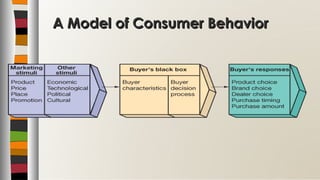
A Model of Consumer BehaviorA Model of Consumer Behavior
The company that understands how customers respond to
different product features, prices, and advertising appeals
has a great advantage over its competitors.
Marketing stimuli consists of the 4 Ps: Product, Price,
Place and Promotion. Other stimuli include major forces
and events in the environment like: economic,
technological, political and cultural.
All these stimuli enter the buyer’s black box, where they
are turned into a set of observable buyer responses:
product choice, brand choice, dealer choice, purchase
timing, and purchase amount.
Model of Consumer BehaviorModel of Consumer Behavior
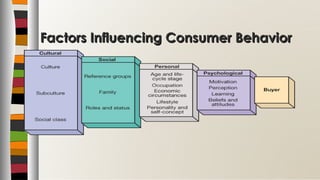
Personal Characteristics AffectingPersonal Characteristics Affecting
Consumer BehaviorConsumer Behavior
Cultural Factors
Social Factors
Personal Factors
Psychological Factors
Factors Influencing Consumer BehaviorFactors Influencing Consumer Behavior
Cultural FactorsCultural Factors
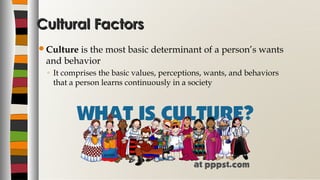
Culture is the most basic determinant of a person’s wants
and behavior
◦ It comprises the basic values, perceptions, wants, and behaviors
that a person learns continuously in a society
Cultural FactorsCultural Factors
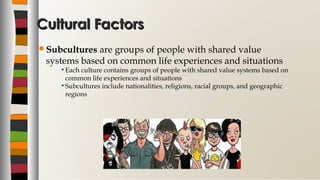
Subcultures are groups of people with shared value
systems based on common life experiences and situations
•Each culture contains groups of people with shared value systems based on
common life experiences and situations
•Subcultures include nationalities, religions, racial groups, and geographic
regions
Cultural FactorsCultural Factors
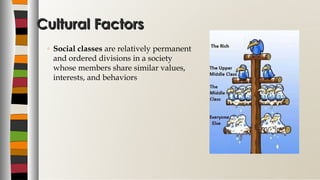
◦ Social classes are relatively permanent
and ordered divisions in a society
whose members share similar values,
interests, and behaviors
Social FactorsSocial Factors
Consumer behavior is influenced by:
◦ Consumers’ groups
◦ Family
◦ Social roles
◦ Status
Consumer GroupsConsumer Groups
An individual’s attitudes and behavior are influenced
by many small groups
Types of groups
◦ Membership groups – ex. Clubs, religious groups etc.
◦ Reference groups – serve as direct or indirect points of
comparison or reference in the forming of a person’s
attitudes and behavior
◦ Aspirational groups – to which people do not belong but
would like to
 Opinion leaders – people who have special skills, knowledge,
personality or other characteristics, exert influence on others.
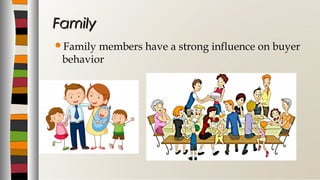
Family members have a strong influence on buyer
behavior
FamilyFamily
A person belongs to many groups: family, clubs,
and organizations
An individual’s position in each group can be
defined in terms of role and status
A role consists of the activities that a person is
expected to perform according to the persons
around him or her
Social RolesSocial Roles
Each role carries a status reflecting the general
esteem given to it by society
People often choose products that show their status
in society
StatusStatus
Online social
networks are online
communities where
people socialize or
exchange information
and opinions
Marketers must be
careful when tapping
into online social
networks
Online Social NetworksOnline Social Networks
Personal FactorsPersonal Factors
Age and Life-Cycle Stage
◦ The types of goods and services people buy change during their
lifetimes
◦ Preferences for leisure activities, travel destinations, food, and
entertainment are often age related
◦ Successful marketing to various age segments may require
specialized and targeted strategies
◦ This will almost certainly require segmented target publications
and database marketing
◦ Buying behavior is also shaped by the family life-cycle stages
Personal FactorsPersonal Factors
Occupation
◦ A person’s occupation affects the goods and services bought
Personal FactorsPersonal Factors
Economic Situation
◦ A person’s economic situation
greatly affects product choice
and the decision to purchase a
particular product
Personal FactorsPersonal Factors
Lifestyle
◦ People coming from the same subculture, social class,
and occupation may have quite different lifestyles
◦ A lifestyle is a person’s pattern of living as expressed in
his or her activities, interests, and opinions
Personal FactorsPersonal Factors
Personality is a person’s distinguishing psychological
characteristics that lead to relatively consistent and
lasting responses to his or her environment
Self-Concept is the complex mental pictures people
have of themselves, also known as self-image
Psychological FactorsPsychological Factors
Motivation
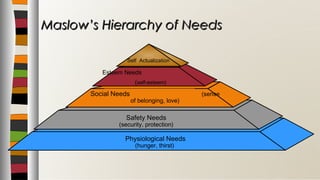
◦ Maslow’s Theory of Motivation
 Sought to explain why people are driven by particular needs at
particular times
Physiological Needs
(hunger, thirst)
Safety Needs
(security, protection)
Social Needs (sense
of belonging, love)
Esteem Needs
(self-esteem)
Self Actualization
Maslow’s Hierarchy of NeedsMaslow’s Hierarchy of Needs
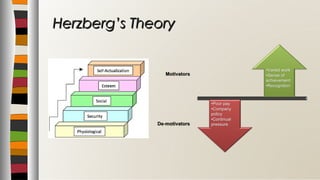
◦ Herzberg’s Theory
 A two-two factor theory that distinguishes dissatisfiers (factors
that cause dissatisfaction) and satisfiers (factors that cause
satisfaction)
Herzberg’s TheoryHerzberg’s Theory
Psychological FactorsPsychological Factors
Perception
◦ Selective Attention
 Consumers are constantly bombarded with information and will
screen out stimuli
◦ Selective Distortion
 Messages to do not always come across in the same way the sender
indented.
◦ Selective Retention
 People will forget much that they learn but will tend to retain
information that supports their attitudes and beliefs
Psychological FactorsPsychological Factors
Learning describes changes in an individual’s
behavior arising from experience
A belief is a descriptive thought that a person holds
about something
An attitude describes a person’s relatively consistent
evaluations, feelings, and tendencies toward an object
or an idea
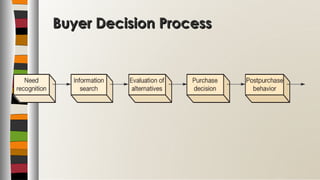
Buyer Decision ProcessBuyer Decision Process
Need RecognitionNeed Recognition
For the decision process to begin, a potential buyer
must first recognize a problem or need
Can be caused by internal or external stimuli
Information SearchInformation Search
 Information can be obtained from:
◦ Personal Sources
 Family, friends, neighbors, and acquaintances
◦ Commercial Sources
 Advertising, salespeople, dealers, packaging, and displays
◦ Public Sources
 Restaurant reviews, editorials in the travel section, consumer-
rating organizations
Evaluation of AlternativesEvaluation of Alternatives
Products are seen as bundles of product attributes
Customers rank attributes and form purchase
intentions
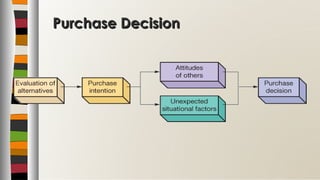
Purchase DecisionPurchase Decision
Post Purchase BehaviorPost Purchase Behavior
The smaller the gap between customer expectations
and perceived performance, the greater the customer’s
satisfaction
Cognitive dissonance is buyer discomfort caused by
post purchase conflict
THE ENDTHE END

Consumer markets and consumer buying behavior mmda

  • 1.
    TMarkPromo | M.Aldana‘14 Consumer Markets and ConsumerConsumer Markets and Consumer Buying BehaviorBuying Behavior
  • 2.
    In groups of8, discuss your process of buying. Say you want to buy a new laptop, what steps do you take? Start individually, and then synthesize them as a group. Summarize them in 5 steps. Write in a ¼ sheet of paper with the names of the members. Each group will then have a representative and write it down in the blackboard and explain. (next meeting) ActivityActivity
  • 3.
    Consumer Buying Behavior Consumer buying behavior refers to the buying behavior of final consumers – individuals & households who buy goods and services for personal consumption The central question for marketers is: ““How doHow do consumers respond to various marketing efforts theconsumers respond to various marketing efforts the company might use?”company might use?”
  • 4.
    Five Premises ofConsumer BehaviorFive Premises of Consumer Behavior Consumer behavior is purposeful and goal oriented The consumer has free choice Consumer behavior is a process Consumer behavior can be influenced There is a need for consumer education
  • 5.
    A Model ofConsumer BehaviorA Model of Consumer Behavior
  • 6.
    The company thatunderstands how customers respond to different product features, prices, and advertising appeals has a great advantage over its competitors. Marketing stimuli consists of the 4 Ps: Product, Price, Place and Promotion. Other stimuli include major forces and events in the environment like: economic, technological, political and cultural. All these stimuli enter the buyer’s black box, where they are turned into a set of observable buyer responses: product choice, brand choice, dealer choice, purchase timing, and purchase amount. Model of Consumer BehaviorModel of Consumer Behavior
  • 7.
    Personal Characteristics AffectingPersonalCharacteristics Affecting Consumer BehaviorConsumer Behavior Cultural Factors Social Factors Personal Factors Psychological Factors
  • 8.
    Factors Influencing ConsumerBehaviorFactors Influencing Consumer Behavior
  • 9.
    Cultural FactorsCultural Factors Cultureis the most basic determinant of a person’s wants and behavior ◦ It comprises the basic values, perceptions, wants, and behaviors that a person learns continuously in a society
  • 10.
    Cultural FactorsCultural Factors Subculturesare groups of people with shared value systems based on common life experiences and situations •Each culture contains groups of people with shared value systems based on common life experiences and situations •Subcultures include nationalities, religions, racial groups, and geographic regions
  • 11.
    Cultural FactorsCultural Factors ◦Social classes are relatively permanent and ordered divisions in a society whose members share similar values, interests, and behaviors
  • 12.
    Social FactorsSocial Factors Consumerbehavior is influenced by: ◦ Consumers’ groups ◦ Family ◦ Social roles ◦ Status
  • 13.
    Consumer GroupsConsumer Groups Anindividual’s attitudes and behavior are influenced by many small groups Types of groups ◦ Membership groups – ex. Clubs, religious groups etc. ◦ Reference groups – serve as direct or indirect points of comparison or reference in the forming of a person’s attitudes and behavior ◦ Aspirational groups – to which people do not belong but would like to  Opinion leaders – people who have special skills, knowledge, personality or other characteristics, exert influence on others.
  • 14.
    Family members havea strong influence on buyer behavior FamilyFamily
  • 15.
    A person belongsto many groups: family, clubs, and organizations An individual’s position in each group can be defined in terms of role and status A role consists of the activities that a person is expected to perform according to the persons around him or her Social RolesSocial Roles
  • 16.
    Each role carriesa status reflecting the general esteem given to it by society People often choose products that show their status in society StatusStatus
  • 17.
    Online social networks areonline communities where people socialize or exchange information and opinions Marketers must be careful when tapping into online social networks Online Social NetworksOnline Social Networks
  • 18.
    Personal FactorsPersonal Factors Ageand Life-Cycle Stage ◦ The types of goods and services people buy change during their lifetimes ◦ Preferences for leisure activities, travel destinations, food, and entertainment are often age related ◦ Successful marketing to various age segments may require specialized and targeted strategies ◦ This will almost certainly require segmented target publications and database marketing ◦ Buying behavior is also shaped by the family life-cycle stages
  • 19.
    Personal FactorsPersonal Factors Occupation ◦A person’s occupation affects the goods and services bought
  • 20.
    Personal FactorsPersonal Factors EconomicSituation ◦ A person’s economic situation greatly affects product choice and the decision to purchase a particular product
  • 21.
    Personal FactorsPersonal Factors Lifestyle ◦People coming from the same subculture, social class, and occupation may have quite different lifestyles ◦ A lifestyle is a person’s pattern of living as expressed in his or her activities, interests, and opinions
  • 22.
    Personal FactorsPersonal Factors Personalityis a person’s distinguishing psychological characteristics that lead to relatively consistent and lasting responses to his or her environment Self-Concept is the complex mental pictures people have of themselves, also known as self-image
  • 23.
    Psychological FactorsPsychological Factors Motivation ◦Maslow’s Theory of Motivation  Sought to explain why people are driven by particular needs at particular times
  • 24.
    Physiological Needs (hunger, thirst) SafetyNeeds (security, protection) Social Needs (sense of belonging, love) Esteem Needs (self-esteem) Self Actualization Maslow’s Hierarchy of NeedsMaslow’s Hierarchy of Needs
  • 25.
    ◦ Herzberg’s Theory A two-two factor theory that distinguishes dissatisfiers (factors that cause dissatisfaction) and satisfiers (factors that cause satisfaction) Herzberg’s TheoryHerzberg’s Theory
  • 26.
  • 27.
    Psychological FactorsPsychological Factors Perception ◦Selective Attention  Consumers are constantly bombarded with information and will screen out stimuli ◦ Selective Distortion  Messages to do not always come across in the same way the sender indented. ◦ Selective Retention  People will forget much that they learn but will tend to retain information that supports their attitudes and beliefs
  • 28.
    Psychological FactorsPsychological Factors Learningdescribes changes in an individual’s behavior arising from experience A belief is a descriptive thought that a person holds about something An attitude describes a person’s relatively consistent evaluations, feelings, and tendencies toward an object or an idea
  • 29.
  • 30.
    Need RecognitionNeed Recognition Forthe decision process to begin, a potential buyer must first recognize a problem or need Can be caused by internal or external stimuli
  • 31.
    Information SearchInformation Search Information can be obtained from: ◦ Personal Sources  Family, friends, neighbors, and acquaintances ◦ Commercial Sources  Advertising, salespeople, dealers, packaging, and displays ◦ Public Sources  Restaurant reviews, editorials in the travel section, consumer- rating organizations
  • 32.
    Evaluation of AlternativesEvaluationof Alternatives Products are seen as bundles of product attributes Customers rank attributes and form purchase intentions
  • 33.
  • 34.
    Post Purchase BehaviorPostPurchase Behavior The smaller the gap between customer expectations and perceived performance, the greater the customer’s satisfaction Cognitive dissonance is buyer discomfort caused by post purchase conflict
  • 35.