





TARGET MARKETS:
SEGMENTATION
AND EVALUATION
CMARKETING
M. Aldana
Faculty, SHTM
MARKETS
A market is a group of
individuals and/or
organizations that have a
desire or need for products in
a product class and have the
ability, willingness, and
authority to purchase those
products.
MARKETS
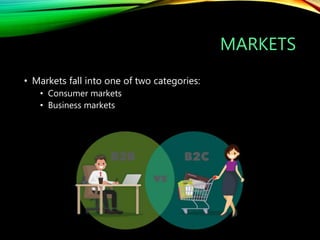
• Markets fall into one of two categories:
• Consumer markets
• Business markets
MARKETS
• Consumer Market consists of purchasers and household
members who intend to consume or benefit from the
purchased products and do not buy products to make a
profit.
• Also known as business-to-consumer (B2C) markets
MARKETS
• A Business Market consists of individuals or groups that
purchase a specific kind of product for one of three
purposes: resale, direct use in producing other products, or
use in daily operations.
• Also known as business-to-business (B2B) markets and can
be sub-classified into producer, reseller, government, and
institution markets
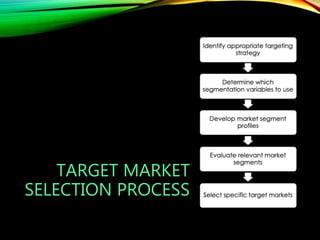
TARGET MARKET
SELECTION PROCESS
• Selecting a target market is the first of two major
components of developing a marketing strategy.
• Marketers may employ several methods for target market
selection, generally they follow a five-step process.
TARGET MARKET
SELECTION PROCESS
STEP 1 IDENTIFY THE
APPROPRIATE TARGETING
STRATEGY
• A target market is a group of people or organizations for
which a business creates and maintains a marketing mix
specifically designed to satisfy the needs of group members.
• The marketing strategy used to select a target market is
affected by target market characteristics.
STEP 1 IDENTIFY THE
APPROPRIATE TARGETING
STRATEGY
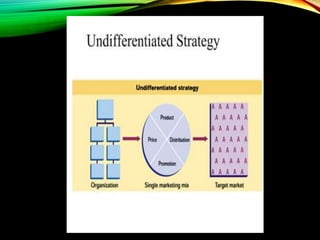
• Undifferentiated Targeting Strategy
• A strategy in which an organization designs a single marketing
mix and directs it at the entire market for a particular product
• Assumes that all customers in the target market have similar
needs, and thus the organization can satisfy most customers
with a single marketing mix with little or no variation.
STEP 1 IDENTIFY THE
APPROPRIATE TARGETING
STRATEGY
• Undifferentiated Targeting Strategy
• Effective under two conditions: First a large proportion of
customers in a total market must have similar needs for the
product, a situation termed a homogenous market
• Second, the organization must have the resources to develop a
single marketing mix that satisfies customers’ needs in a large
portion of a total market
STEP 1 IDENTIFY THE
APPROPRIATE TARGETING
STRATEGY
 Concentrated Targeting Strategy through Market
segmentation
› Sometimes, a market maybe comprised of individuals or
organizations with diverse product needs is called a
heterogeneous market. For this type of market, market
segmentation is the best approach. It is the process of
dividing a total market into groups with relatively similar
product needs to design a marketing mix that matches those
needs.
STEP 1 IDENTIFY THE
APPROPRIATE TARGETING
STRATEGY
 Concentrated Targeting Strategy through Market
segmentation
› A market segment consist of individuals, groups, or
segments that consist of people or organizations with
relatively similar product needs.
› The rationale for segmenting heterogeneous markets is that a
company will be most successful in developing a satisfying
marketing mix for a portion of a total market whose needs
are similar.
STEP 1 IDENTIFY THE
APPROPRIATE TARGETING
STRATEGY
• Concentrated Targeting Strategy through Market
segmentation
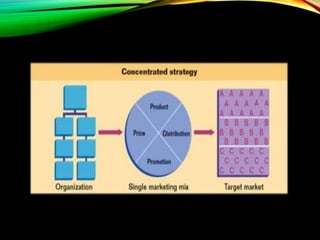
• When an organization directs its marketing efforts towards a
single market segment using one marketing mix, it is using
concentrated targeting strategy.
STEP 1 IDENTIFY THE
APPROPRIATE TARGETING
STRATEGY
• Differentiated Targeting Strategy through market
segmentation
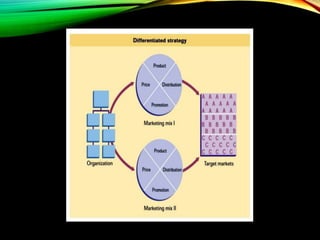
• A strategy in which an organization targets two or more
segments by developing a marketing mix for each segment.
• A benefit of a differentiated approach is that a firm may
increase sales within the total market because its marketing
mixes are aimed at more customers.
STEP 2: DETERMINE WHICH
SEGMENTATION VARIABLES
TO USE
• Segmentation variables are characteristics of individuals,
groups, or organizations, used to divide a market into
segments.
STEP 2: DETERMINE WHICH
SEGMENTATION VARIABLES
TO USE
 Demographic Variables
› Age
› Gender
› Race
› Ethnicity
› Income
› Education
› Occupation
› Family size, family life cycle
› Religion
› Social class
STEP 2: DETERMINE WHICH
SEGMENTATION VARIABLES
TO USE
 Geographic variables
› Region
› Urban, suburban or rural
› City size
› Country size
› Market density – number of potential customers within a unit
of land area
› Climate
› Terrain
› Micromarketing – an approach to market segmentation in
which organizations focus precise marketing efforts on very
small geographic markets
STEP 2: DETERMINE WHICH
SEGMENTATION VARIABLES
TO USE
• Psychographic variables
• Personality attributes
• Motives
• Lifestyles
STEP 2: DETERMINE WHICH
SEGMENTATION VARIABLES
TO USE
• Behavioristic variables
• Volume usage
• End use
• Benefit expectations
• Brand loyalty
• Price sensitivity
VARIABLES FOR
SEGMENTING BUSINESS
MARKETS
• Geographic Location
• Type of organization
• Customer size
• Product use
STEP 3 – DEVELOP MARKET
SEGMENT PROFILES
• A market segment profile describes the similarities among
potential customers within a segment and explains the
differences among people and organizations in different
segments.
• A profile may cover aspects such as demographic
characteristics, geographic factors, product benefits sought,
lifestyles, brand preferences, and usage rates.
STEP 3 – DEVELOP MARKET
SEGMENT PROFILES
• Marketers use market segment profiles to assess the degree
to which their products fit potential customers’ product
needs.
STEP 4 – EVALUATE RELEVANT
MARKET SEGMENTS
• After analyzing the market segment profiles, a marketer
should be able to narrow his or her focus to several
promising segments that warrant further analysis.
STEP 4 – EVALUATE RELEVANT
MARKET SEGMENTS
• Sales Estimates
• Market potential – total amount of a product that customers
will purchase within a specified period at a specific level of
industry-wide marketing activity.
• Company sales potential – maximum percentage share of a
market than an individual firm within an industry can expect to
capture for a specific product.
STEP 4 – EVALUATE RELEVANT
MARKET SEGMENTS
• Sales Estimates
• Two general approaches that measure company sales potential
are breakdown and buildup.
• Breakdown – marketing manager first develops a general
economic forecast for a specific period
• Buildup – marketing managers begins by estimating how
much of a product a potential buyer in a specific area will
purchase
STEP 4 – EVALUATE RELEVANT
MARKET SEGMENTS
• Competitive Assessment
 A market segment that initially seems attractive, but it will also be
attractive for other companies.
• Cost Estimates
• To fulfill the needs of a target segment, an organization must
develop and maintain a marketing mix that precisely meets the
wants and needs of that segment, which can be expensive.
STEP 5 – SELECT SPECIFIC
TARGET MARKETS
• Selecting appropriate target markets is important to an
organization’s effective adoption and use of the marketing
concept philosophy.
• Identifying the right target market is the key to
implementing a successful marketing strategy.
• Failure to do so can lead to low sales, high costs, and severe
financial losses.
DEVELOPING SALES
FORECASTS
• Sales Forecast – the amount of a product a company
expects to sell during a specific period at a specified level of
marketing activities.
• Executive judgment – forecasting method based on the
intuition of one or more executives
• Customer forecasting survey – a survey of customers
regarding the types and quantities of products they intend to
buy during a specific period
DEVELOPING SALES
FORECASTS
• Sales Forecast
• Sales Force forecasting survey – firm’s salespeople estimate
anticipated sales in their territories for a specific period.
• Expert forecasting survey – hires professionals to help
prepare the sales forecast.
• Delphi method – experts create initial forecasts, submit them
to the company for averaging, and have the results returned to
them so they can make individual refined forecasts.
DEVELOPING SALES
FORECASTS
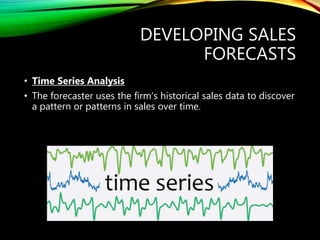
• Time Series Analysis
• The forecaster uses the firm’s historical sales data to discover
a pattern or patterns in sales over time.
TIME SERIES ANALYSIS
• Trend Analysis
• Focuses on aggregate sales data, such as company’s annual
sales figures, covering a period of many years to determine
whether annual sales are generally rising, falling, or staying
about the same
TIME SERIES ANALYSIS
• Cycle Analysis
• Analyzes sales figures for a three- to five-year period to
ascertain whether sales fluctuate in a consistent, periodic
manner
TIME SERIES ANALYSIS
• Seasonal analysis
• Study daily, weekly, or monthly sales figures to evaluate the
degree to which seasonal factors, such as climate and holiday
activities influence sales
TIME SERIES ANALYSIS
• Random factor analysis
• Forecaster attempts to attribute erratic sales variations to
random, nonrecurring events, such as a regional power failure,
a natural disaster, or political unrest in a foreign market
REGRESSION ANALYSIS
• Uses historical sales data.
• Seeks to find a relationship between past sales and one or
more variables, such as population, per capita income, or
gross domestic product.
MARKET TESTS
• Involves making a product available to buyers in one or
more test areas and measuring purchases and consumer
responses to the product, distribution, promotion, and price.

Lesson 6 cmarketing

  • 1.
  • 2.
    MARKETS A market isa group of individuals and/or organizations that have a desire or need for products in a product class and have the ability, willingness, and authority to purchase those products.
  • 3.
    MARKETS • Markets fallinto one of two categories: • Consumer markets • Business markets
  • 4.
    MARKETS • Consumer Marketconsists of purchasers and household members who intend to consume or benefit from the purchased products and do not buy products to make a profit. • Also known as business-to-consumer (B2C) markets
  • 5.
    MARKETS • A BusinessMarket consists of individuals or groups that purchase a specific kind of product for one of three purposes: resale, direct use in producing other products, or use in daily operations. • Also known as business-to-business (B2B) markets and can be sub-classified into producer, reseller, government, and institution markets
  • 6.
    TARGET MARKET SELECTION PROCESS •Selecting a target market is the first of two major components of developing a marketing strategy. • Marketers may employ several methods for target market selection, generally they follow a five-step process.
  • 7.
  • 8.
    STEP 1 IDENTIFYTHE APPROPRIATE TARGETING STRATEGY • A target market is a group of people or organizations for which a business creates and maintains a marketing mix specifically designed to satisfy the needs of group members. • The marketing strategy used to select a target market is affected by target market characteristics.
  • 9.
    STEP 1 IDENTIFYTHE APPROPRIATE TARGETING STRATEGY • Undifferentiated Targeting Strategy • A strategy in which an organization designs a single marketing mix and directs it at the entire market for a particular product • Assumes that all customers in the target market have similar needs, and thus the organization can satisfy most customers with a single marketing mix with little or no variation.
  • 10.
    STEP 1 IDENTIFYTHE APPROPRIATE TARGETING STRATEGY • Undifferentiated Targeting Strategy • Effective under two conditions: First a large proportion of customers in a total market must have similar needs for the product, a situation termed a homogenous market • Second, the organization must have the resources to develop a single marketing mix that satisfies customers’ needs in a large portion of a total market
  • 12.
    STEP 1 IDENTIFYTHE APPROPRIATE TARGETING STRATEGY  Concentrated Targeting Strategy through Market segmentation › Sometimes, a market maybe comprised of individuals or organizations with diverse product needs is called a heterogeneous market. For this type of market, market segmentation is the best approach. It is the process of dividing a total market into groups with relatively similar product needs to design a marketing mix that matches those needs.
  • 13.
    STEP 1 IDENTIFYTHE APPROPRIATE TARGETING STRATEGY  Concentrated Targeting Strategy through Market segmentation › A market segment consist of individuals, groups, or segments that consist of people or organizations with relatively similar product needs. › The rationale for segmenting heterogeneous markets is that a company will be most successful in developing a satisfying marketing mix for a portion of a total market whose needs are similar.
  • 14.
    STEP 1 IDENTIFYTHE APPROPRIATE TARGETING STRATEGY • Concentrated Targeting Strategy through Market segmentation • When an organization directs its marketing efforts towards a single market segment using one marketing mix, it is using concentrated targeting strategy.
  • 16.
    STEP 1 IDENTIFYTHE APPROPRIATE TARGETING STRATEGY • Differentiated Targeting Strategy through market segmentation • A strategy in which an organization targets two or more segments by developing a marketing mix for each segment. • A benefit of a differentiated approach is that a firm may increase sales within the total market because its marketing mixes are aimed at more customers.
  • 18.
    STEP 2: DETERMINEWHICH SEGMENTATION VARIABLES TO USE • Segmentation variables are characteristics of individuals, groups, or organizations, used to divide a market into segments.
  • 19.
    STEP 2: DETERMINEWHICH SEGMENTATION VARIABLES TO USE  Demographic Variables › Age › Gender › Race › Ethnicity › Income › Education › Occupation › Family size, family life cycle › Religion › Social class
  • 20.
    STEP 2: DETERMINEWHICH SEGMENTATION VARIABLES TO USE  Geographic variables › Region › Urban, suburban or rural › City size › Country size › Market density – number of potential customers within a unit of land area › Climate › Terrain › Micromarketing – an approach to market segmentation in which organizations focus precise marketing efforts on very small geographic markets
  • 21.
    STEP 2: DETERMINEWHICH SEGMENTATION VARIABLES TO USE • Psychographic variables • Personality attributes • Motives • Lifestyles
  • 22.
    STEP 2: DETERMINEWHICH SEGMENTATION VARIABLES TO USE • Behavioristic variables • Volume usage • End use • Benefit expectations • Brand loyalty • Price sensitivity
  • 23.
    VARIABLES FOR SEGMENTING BUSINESS MARKETS •Geographic Location • Type of organization • Customer size • Product use
  • 24.
    STEP 3 –DEVELOP MARKET SEGMENT PROFILES • A market segment profile describes the similarities among potential customers within a segment and explains the differences among people and organizations in different segments. • A profile may cover aspects such as demographic characteristics, geographic factors, product benefits sought, lifestyles, brand preferences, and usage rates.
  • 25.
    STEP 3 –DEVELOP MARKET SEGMENT PROFILES • Marketers use market segment profiles to assess the degree to which their products fit potential customers’ product needs.
  • 26.
    STEP 4 –EVALUATE RELEVANT MARKET SEGMENTS • After analyzing the market segment profiles, a marketer should be able to narrow his or her focus to several promising segments that warrant further analysis.
  • 27.
    STEP 4 –EVALUATE RELEVANT MARKET SEGMENTS • Sales Estimates • Market potential – total amount of a product that customers will purchase within a specified period at a specific level of industry-wide marketing activity. • Company sales potential – maximum percentage share of a market than an individual firm within an industry can expect to capture for a specific product.
  • 28.
    STEP 4 –EVALUATE RELEVANT MARKET SEGMENTS • Sales Estimates • Two general approaches that measure company sales potential are breakdown and buildup. • Breakdown – marketing manager first develops a general economic forecast for a specific period • Buildup – marketing managers begins by estimating how much of a product a potential buyer in a specific area will purchase
  • 29.
    STEP 4 –EVALUATE RELEVANT MARKET SEGMENTS • Competitive Assessment  A market segment that initially seems attractive, but it will also be attractive for other companies. • Cost Estimates • To fulfill the needs of a target segment, an organization must develop and maintain a marketing mix that precisely meets the wants and needs of that segment, which can be expensive.
  • 30.
    STEP 5 –SELECT SPECIFIC TARGET MARKETS • Selecting appropriate target markets is important to an organization’s effective adoption and use of the marketing concept philosophy. • Identifying the right target market is the key to implementing a successful marketing strategy. • Failure to do so can lead to low sales, high costs, and severe financial losses.
  • 31.
    DEVELOPING SALES FORECASTS • SalesForecast – the amount of a product a company expects to sell during a specific period at a specified level of marketing activities. • Executive judgment – forecasting method based on the intuition of one or more executives • Customer forecasting survey – a survey of customers regarding the types and quantities of products they intend to buy during a specific period
  • 32.
    DEVELOPING SALES FORECASTS • SalesForecast • Sales Force forecasting survey – firm’s salespeople estimate anticipated sales in their territories for a specific period. • Expert forecasting survey – hires professionals to help prepare the sales forecast. • Delphi method – experts create initial forecasts, submit them to the company for averaging, and have the results returned to them so they can make individual refined forecasts.
  • 33.
    DEVELOPING SALES FORECASTS • TimeSeries Analysis • The forecaster uses the firm’s historical sales data to discover a pattern or patterns in sales over time.
  • 34.
    TIME SERIES ANALYSIS •Trend Analysis • Focuses on aggregate sales data, such as company’s annual sales figures, covering a period of many years to determine whether annual sales are generally rising, falling, or staying about the same
  • 35.
    TIME SERIES ANALYSIS •Cycle Analysis • Analyzes sales figures for a three- to five-year period to ascertain whether sales fluctuate in a consistent, periodic manner
  • 36.
    TIME SERIES ANALYSIS •Seasonal analysis • Study daily, weekly, or monthly sales figures to evaluate the degree to which seasonal factors, such as climate and holiday activities influence sales
  • 37.
    TIME SERIES ANALYSIS •Random factor analysis • Forecaster attempts to attribute erratic sales variations to random, nonrecurring events, such as a regional power failure, a natural disaster, or political unrest in a foreign market
  • 38.
    REGRESSION ANALYSIS • Useshistorical sales data. • Seeks to find a relationship between past sales and one or more variables, such as population, per capita income, or gross domestic product.
  • 39.
    MARKET TESTS • Involvesmaking a product available to buyers in one or more test areas and measuring purchases and consumer responses to the product, distribution, promotion, and price.