Chapter Three Analyzing the Marketing Environment
Analyzing the Marketing Environment The Company’s Microenvironment The Company’s Macroenvironemnt Responding to the Marketing Environment Topic Outline
The Marketing Environment The marketing environment  includes the actors and forces outside marketing that affect marketing management’s ability to build and maintain successful relationships with target customers
The Marketing Environment Microenvironment  consists of the actors close to the company that affect its ability to serve its customers -- the company, suppliers, marketing intermediaries, customer markets, competitors, and publics
The Company’s Microenvironment Top management Finance R&D Purchasing Operations Accounting The Company
The Company’s Microenvironment Provide the resources to produce goods and services Treated as partners to provide customer value Suppliers
The Company’s Microenvironment Help the company to promote, sell and distribute its products to final buyers Marketing Intermediaries
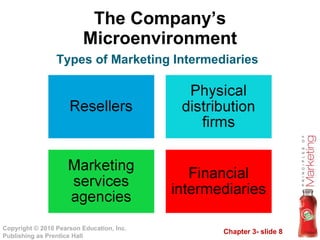
The Company’s Microenvironment Types of Marketing Intermediaries
The Company’s Microenvironment Firms must gain strategic advantage by positioning their offerings against competitors’ offerings Competitors
The Company’s Microenvironment Any group that has an actual or potential interest in or impact on an organization’s ability to achieve its objectives Financial publics Media publics Government publics Citizen-action publics Local publics General public Internal publics Publics
The Company’s Macroenvironment Demography  is the study of human populations in terms of size, density, location, age, gender, race, occupation, and other statistics Demographic environment is important because it involves people, and people make up markets Demographic trends include age, family structure, geographic population shifts, educational characteristics, and population diversity Demographic Environment
The Company’s Macroenvironment Changing age structure of the population Baby boomers include people born between 1946 and 1964 Most affluent Americans Demographic Environment
The Company’s Macroenvironment Generation X includes people born between 1965 and 1976 High parental divorce rates Cautious economic outlook Less materialistic Family comes first Lag behind on retirement savings Demographic Environment
The Company’s Macroenvironment Millennials (gen Y or echo boomers) include those born between 1977 and 2000 Comfortable with technology Includes: Tweens (ages 8 – 12) Teens (13 – 19) Young adults (20’s) Demographic Environment
The Company’s Macroenvironment Generational marketing  is important in segmenting people by lifestyle of life state instead of age Demographic Environment
The Company’s Macroenvironment More people are: Divorcing or separating Choosing not to marry Choosing to marrying later Marrying without intending to have children Increased number of working women Stay-at-home dads Demographic Environment
The Company’s Macroenvironment Growth in United States West and South and decline in Midwest and Northeast Moving from rural to metropolitan areas Changes in where people work Telecommuting Home office Divorcing or separating Demographic Environment
The Company’s Macroenvironment Changes in the workforce More educated More white collar Demographic Environment
The Company’s Macroenvironment Markets are becoming more diverse International National Includes: Ethnicity Gay and lesbian Disabled Demographic Environment Increased Diversity
The Company’s Macroenvironment Economic environment  consists of factors that affect consumer purchasing power and spending patterns Industrial economies are richer markets Subsistence economies consume most of their own agriculture and industrial output Economic Environment
The Company’s Macroenvironment Changes in income Value marketing involves ways to offer financially cautious buyers greater value—the right combination of quality and service at a fair price Economic Environment
The Company’s Macroenvironment Ernst Engel—Engel’s Law As income rises: The percentage spent on food declines The percentage spent on housing remains constant The percentage spent on savings increases Economic Environment Changes in Consumer Spending Patterns
The Company’s Macroenvironment Natural environment  involves the natural resources that are needed as inputs by marketers or that are affected by marketing activities Trends Shortages of raw materials Increased pollution Increase government intervention Environmentally sustainable strategies Natural  Environment
The Company’s Macroenvironment Most dramatic force in changing the marketplace Creates new products and opportunities Safety of new product always a concern Technological  Environment
The Company’s Macroenvironment Political environment  consists of laws, government agencies, and pressure groups that influence or limit various organizations and individuals in a given society Political  Environment
The Company’s Macroenvironment Legislation regulating business Increased legislation Changing government agency enforcement Increased emphasis on ethics Socially responsible behavior Cause-related marketing Political  Environment
The Company’s Macroenvironment Cultural environment  consists of institutions and other forces that affect a society’s basic values, perceptions, and behaviors Cultural Environment
The Company’s Macroenvironment Core beliefs and values  are persistent and are passed on from parents to children and are reinforced by schools, churches, businesses, and government Secondary beliefs and values  are more open to change and include people’s views of themselves, others, organizations, society, nature, and the universe Cultural Environment Persistence of Cultural Values
The Company’s Macroenvironment People’s view of themselves Yankelovich Monitor’s consumer segments: Do-It-Yourselfers—recent movers Adventurers People’s view of others More “cocooning” Cultural Environment Shifts in Secondary Cultural Values
The Company’s Macroenvironment People’s view of organizations People’s view of society Patriots defend it Reformers want to change it Malcontents want to leave it Cultural Environment Shifts in Secondary Cultural Values
The Company’s Macroenvironment People’s view of nature Some feel ruled by it Some feel in harmony with it Some seek to master it People’s view of the universe Renewed interest in spirituality Cultural Environment Shifts in Secondary Cultural Values
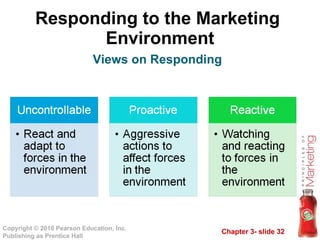
Responding to the Marketing  Environment Views on Responding

Module 2 scanning the marketing environment

  • 1.
    Chapter Three Analyzingthe Marketing Environment
  • 2.
    Analyzing the MarketingEnvironment The Company’s Microenvironment The Company’s Macroenvironemnt Responding to the Marketing Environment Topic Outline
  • 3.
    The Marketing EnvironmentThe marketing environment includes the actors and forces outside marketing that affect marketing management’s ability to build and maintain successful relationships with target customers
  • 4.
    The Marketing EnvironmentMicroenvironment consists of the actors close to the company that affect its ability to serve its customers -- the company, suppliers, marketing intermediaries, customer markets, competitors, and publics
  • 5.
    The Company’s MicroenvironmentTop management Finance R&D Purchasing Operations Accounting The Company
  • 6.
    The Company’s MicroenvironmentProvide the resources to produce goods and services Treated as partners to provide customer value Suppliers
  • 7.
    The Company’s MicroenvironmentHelp the company to promote, sell and distribute its products to final buyers Marketing Intermediaries
  • 8.
    The Company’s MicroenvironmentTypes of Marketing Intermediaries
  • 9.
    The Company’s MicroenvironmentFirms must gain strategic advantage by positioning their offerings against competitors’ offerings Competitors
  • 10.
    The Company’s MicroenvironmentAny group that has an actual or potential interest in or impact on an organization’s ability to achieve its objectives Financial publics Media publics Government publics Citizen-action publics Local publics General public Internal publics Publics
  • 11.
    The Company’s MacroenvironmentDemography is the study of human populations in terms of size, density, location, age, gender, race, occupation, and other statistics Demographic environment is important because it involves people, and people make up markets Demographic trends include age, family structure, geographic population shifts, educational characteristics, and population diversity Demographic Environment
  • 12.
    The Company’s MacroenvironmentChanging age structure of the population Baby boomers include people born between 1946 and 1964 Most affluent Americans Demographic Environment
  • 13.
    The Company’s MacroenvironmentGeneration X includes people born between 1965 and 1976 High parental divorce rates Cautious economic outlook Less materialistic Family comes first Lag behind on retirement savings Demographic Environment
  • 14.
    The Company’s MacroenvironmentMillennials (gen Y or echo boomers) include those born between 1977 and 2000 Comfortable with technology Includes: Tweens (ages 8 – 12) Teens (13 – 19) Young adults (20’s) Demographic Environment
  • 15.
    The Company’s MacroenvironmentGenerational marketing is important in segmenting people by lifestyle of life state instead of age Demographic Environment
  • 16.
    The Company’s MacroenvironmentMore people are: Divorcing or separating Choosing not to marry Choosing to marrying later Marrying without intending to have children Increased number of working women Stay-at-home dads Demographic Environment
  • 17.
    The Company’s MacroenvironmentGrowth in United States West and South and decline in Midwest and Northeast Moving from rural to metropolitan areas Changes in where people work Telecommuting Home office Divorcing or separating Demographic Environment
  • 18.
    The Company’s MacroenvironmentChanges in the workforce More educated More white collar Demographic Environment
  • 19.
    The Company’s MacroenvironmentMarkets are becoming more diverse International National Includes: Ethnicity Gay and lesbian Disabled Demographic Environment Increased Diversity
  • 20.
    The Company’s MacroenvironmentEconomic environment consists of factors that affect consumer purchasing power and spending patterns Industrial economies are richer markets Subsistence economies consume most of their own agriculture and industrial output Economic Environment
  • 21.
    The Company’s MacroenvironmentChanges in income Value marketing involves ways to offer financially cautious buyers greater value—the right combination of quality and service at a fair price Economic Environment
  • 22.
    The Company’s MacroenvironmentErnst Engel—Engel’s Law As income rises: The percentage spent on food declines The percentage spent on housing remains constant The percentage spent on savings increases Economic Environment Changes in Consumer Spending Patterns
  • 23.
    The Company’s MacroenvironmentNatural environment involves the natural resources that are needed as inputs by marketers or that are affected by marketing activities Trends Shortages of raw materials Increased pollution Increase government intervention Environmentally sustainable strategies Natural Environment
  • 24.
    The Company’s MacroenvironmentMost dramatic force in changing the marketplace Creates new products and opportunities Safety of new product always a concern Technological Environment
  • 25.
    The Company’s MacroenvironmentPolitical environment consists of laws, government agencies, and pressure groups that influence or limit various organizations and individuals in a given society Political Environment
  • 26.
    The Company’s MacroenvironmentLegislation regulating business Increased legislation Changing government agency enforcement Increased emphasis on ethics Socially responsible behavior Cause-related marketing Political Environment
  • 27.
    The Company’s MacroenvironmentCultural environment consists of institutions and other forces that affect a society’s basic values, perceptions, and behaviors Cultural Environment
  • 28.
    The Company’s MacroenvironmentCore beliefs and values are persistent and are passed on from parents to children and are reinforced by schools, churches, businesses, and government Secondary beliefs and values are more open to change and include people’s views of themselves, others, organizations, society, nature, and the universe Cultural Environment Persistence of Cultural Values
  • 29.
    The Company’s MacroenvironmentPeople’s view of themselves Yankelovich Monitor’s consumer segments: Do-It-Yourselfers—recent movers Adventurers People’s view of others More “cocooning” Cultural Environment Shifts in Secondary Cultural Values
  • 30.
    The Company’s MacroenvironmentPeople’s view of organizations People’s view of society Patriots defend it Reformers want to change it Malcontents want to leave it Cultural Environment Shifts in Secondary Cultural Values
  • 31.
    The Company’s MacroenvironmentPeople’s view of nature Some feel ruled by it Some feel in harmony with it Some seek to master it People’s view of the universe Renewed interest in spirituality Cultural Environment Shifts in Secondary Cultural Values
  • 32.
    Responding to theMarketing Environment Views on Responding