Prasanna venkatesh
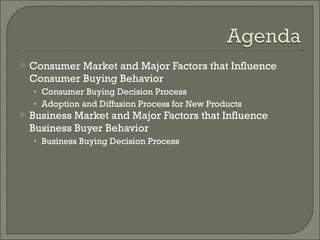
Consumer Market and Major Factors that Influence Consumer Buying Behavior Consumer Buying Decision Process Adoption and Diffusion Process for New Products Business Market and Major Factors that Influence Business Buyer Behavior Business Buying Decision Process
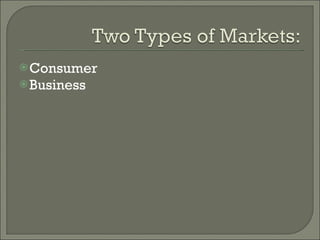
Consumer Business
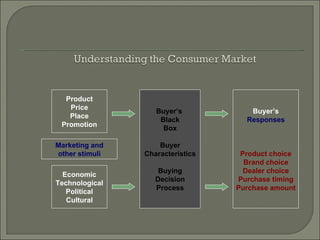
Product Price Place Promotion Economic Technological Political Cultural Buyer’s  Black Box Buyer Characteristics Buying Decision Process Buyer’s Responses Product choice Brand choice Dealer choice Purchase timing Purchase amount Marketing and other stimuli
Demographics (age, gender, income, etc.) Heredity and home environment Family life cycle Life changing events Cultural environment Social environment Situational environment Psychological Factors
Different types of needs drive behaviour to satisfy those needs in an order of precedence Most basic needs  fulfilled first Physiological Self- Actualization Esteem Social Safety
Think about  a specific major purchase you’ve made recently.  What buying process did you follow?  What major factors influenced your decision?
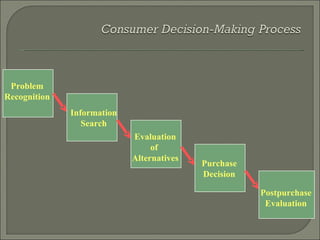
Problem Recognition Information Search Evaluation of  Alternatives Purchase Decision Postpurchase Evaluation
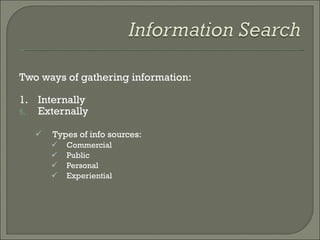
Two ways of gathering information: 1. Internally Externally Types of info sources: Commercial Public Personal Experiential
Decision to purchase a particular product may be based on several factors: Attitudes of Others Unexpected Situational Factors What other factors influence the Purchase Decision?
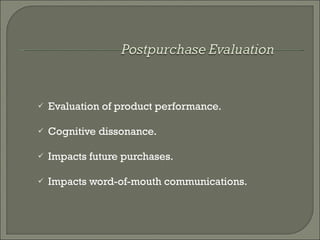
Evaluation of product performance. Cognitive dissonance. Impacts future purchases. Impacts word-of-mouth communications.
Adoption process:   the mental process through which an individual passes from first hearing about an innovation to final adoption Consists of 5 Stages (These are exactly as they indicate): Awareness Interest Evaluation Trial Adoption
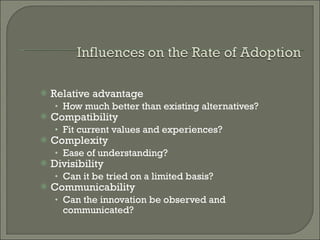
Relative advantage How much better than existing alternatives? Compatibility Fit current values and experiences? Complexity Ease of understanding? Divisibility Can it be tried on a limited basis? Communicability Can the innovation be observed and communicated?
Consumer Business
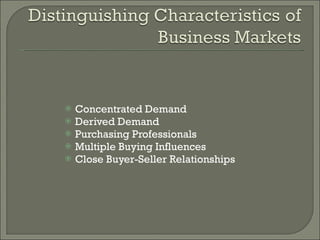
Concentrated Demand Derived Demand Purchasing Professionals Multiple Buying Influences Close Buyer-Seller Relationships
Identification of a need Establishment of specifications. Identification of alternatives. Identification of vendors. Evaluation of vendors. Selection of vendors. Negotiate purchase terms.
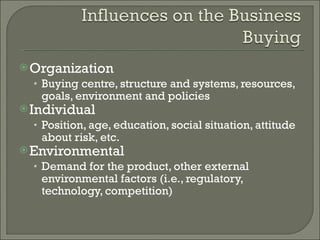
Organization Buying centre, structure and systems, resources, goals, environment and policies Individual Position, age, education, social situation, attitude about risk, etc. Environmental Demand for the product, other external environmental factors (i.e., regulatory, technology, competition)
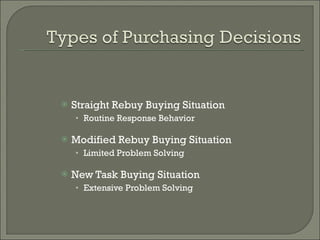
Straight Rebuy Buying Situation Routine Response Behavior Modified Rebuy Buying Situation Limited Problem Solving New Task Buying Situation Extensive Problem Solving
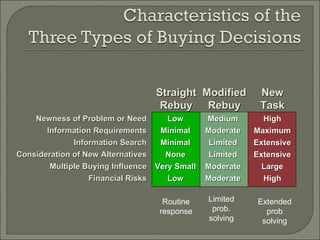
Newness of Problem or Need Information Requirements Information Search Consideration of New Alternatives Multiple Buying Influence Financial Risks Straight Rebuy Low Minimal Minimal None Very Small Low Routine response Modified Rebuy Medium Moderate Limited Limited Moderate Moderate Limited prob. solving New Task High Maximum Extensive Extensive Large High Extended prob solving

Consumer& business buying behaviour

  • 1.
  • 2.
    Consumer Market andMajor Factors that Influence Consumer Buying Behavior Consumer Buying Decision Process Adoption and Diffusion Process for New Products Business Market and Major Factors that Influence Business Buyer Behavior Business Buying Decision Process
  • 3.
  • 4.
    Product Price PlacePromotion Economic Technological Political Cultural Buyer’s Black Box Buyer Characteristics Buying Decision Process Buyer’s Responses Product choice Brand choice Dealer choice Purchase timing Purchase amount Marketing and other stimuli
  • 5.
    Demographics (age, gender,income, etc.) Heredity and home environment Family life cycle Life changing events Cultural environment Social environment Situational environment Psychological Factors
  • 6.
    Different types ofneeds drive behaviour to satisfy those needs in an order of precedence Most basic needs fulfilled first Physiological Self- Actualization Esteem Social Safety
  • 7.
    Think about a specific major purchase you’ve made recently. What buying process did you follow? What major factors influenced your decision?
  • 8.
    Problem Recognition InformationSearch Evaluation of Alternatives Purchase Decision Postpurchase Evaluation
  • 9.
    Two ways ofgathering information: 1. Internally Externally Types of info sources: Commercial Public Personal Experiential
  • 10.
    Decision to purchasea particular product may be based on several factors: Attitudes of Others Unexpected Situational Factors What other factors influence the Purchase Decision?
  • 11.
    Evaluation of productperformance. Cognitive dissonance. Impacts future purchases. Impacts word-of-mouth communications.
  • 12.
    Adoption process: the mental process through which an individual passes from first hearing about an innovation to final adoption Consists of 5 Stages (These are exactly as they indicate): Awareness Interest Evaluation Trial Adoption
  • 13.
    Relative advantage Howmuch better than existing alternatives? Compatibility Fit current values and experiences? Complexity Ease of understanding? Divisibility Can it be tried on a limited basis? Communicability Can the innovation be observed and communicated?
  • 14.
  • 15.
    Concentrated Demand DerivedDemand Purchasing Professionals Multiple Buying Influences Close Buyer-Seller Relationships
  • 16.
    Identification of aneed Establishment of specifications. Identification of alternatives. Identification of vendors. Evaluation of vendors. Selection of vendors. Negotiate purchase terms.
  • 17.
    Organization Buying centre,structure and systems, resources, goals, environment and policies Individual Position, age, education, social situation, attitude about risk, etc. Environmental Demand for the product, other external environmental factors (i.e., regulatory, technology, competition)
  • 18.
    Straight Rebuy BuyingSituation Routine Response Behavior Modified Rebuy Buying Situation Limited Problem Solving New Task Buying Situation Extensive Problem Solving
  • 19.
    Newness of Problemor Need Information Requirements Information Search Consideration of New Alternatives Multiple Buying Influence Financial Risks Straight Rebuy Low Minimal Minimal None Very Small Low Routine response Modified Rebuy Medium Moderate Limited Limited Moderate Moderate Limited prob. solving New Task High Maximum Extensive Extensive Large High Extended prob solving