
Market Targeting
Market Targeting
• Identifying Groups of Consumers
• Likely to Purchase a specific good or service
• Actual Selection of Segment a firm wants
• Defined as” The process of Evaluating each market segments
attractiveness and selecting one or more segments to enter”
Target Market
• The specific market focused by a firm to carry out its marketing
activities.
• Set of Buyers who share common needs or characteristics that the
company decides to serve
Tarket Marketing
• Overall marketing efforts taken by company to meet the requirements
of the target market.
Market Targeting
• Process whereby one or more of the market segments previously
identified are evaluated are selected.
• First essential step is Segmentation
Collectively called STP (Sementation , Targeting and Positioning)
Benefits of Market Targeting
• A firm can conduct a detailed analysis of different segments
identified and can select the best.
• Comparative Study b/w diff mkt segments.
• Helps to determine where and how to market its products and
services
• Nature and course of the marketing strategies can be decided
• Proper allocation and utilization of the resources (men, material,
money etc)
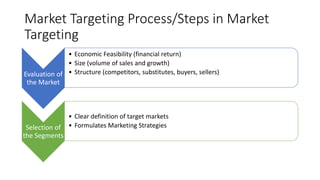
Market Targeting Process/Steps in Market
Targeting
Evaluation of
the Market
• Economic Feasibility (financial return)
• Size (volume of sales and growth)
• Structure (competitors, substitutes, buyers, sellers)
Selection of
the Segments
• Clear definition of target markets
• Formulates Marketing Strategies
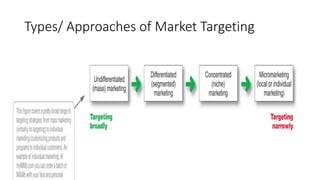
Types/ Approaches of Market Targeting
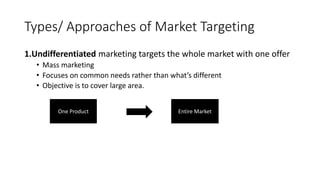
1.Undifferentiated marketing targets the whole market with one offer
• Mass marketing
• Focuses on common needs rather than what’s different
• Objective is to cover large area.
One Product Entire Market
Cont…
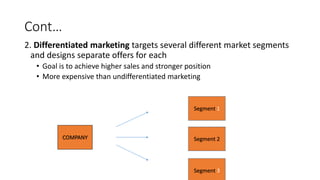
2. Differentiated marketing targets several different market segments
and designs separate offers for each
• Goal is to achieve higher sales and stronger position
• More expensive than undifferentiated marketing
COMPANY
Segment 1
Segment 3
Segment 2
Cont..
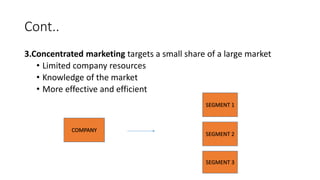
3.Concentrated marketing targets a small share of a large market
• Limited company resources
• Knowledge of the market
• More effective and efficient
COMPANY
SEGMENT 1
SEGMENT 2
SEGMENT 3
Types/ Approaches of Market Targeting

Market targeting

  • 1.
  • 2.
    Market Targeting • IdentifyingGroups of Consumers • Likely to Purchase a specific good or service • Actual Selection of Segment a firm wants • Defined as” The process of Evaluating each market segments attractiveness and selecting one or more segments to enter”
  • 3.
    Target Market • Thespecific market focused by a firm to carry out its marketing activities. • Set of Buyers who share common needs or characteristics that the company decides to serve
  • 4.
    Tarket Marketing • Overallmarketing efforts taken by company to meet the requirements of the target market.
  • 5.
    Market Targeting • Processwhereby one or more of the market segments previously identified are evaluated are selected. • First essential step is Segmentation Collectively called STP (Sementation , Targeting and Positioning)
  • 6.
    Benefits of MarketTargeting • A firm can conduct a detailed analysis of different segments identified and can select the best. • Comparative Study b/w diff mkt segments. • Helps to determine where and how to market its products and services • Nature and course of the marketing strategies can be decided • Proper allocation and utilization of the resources (men, material, money etc)
  • 7.
    Market Targeting Process/Stepsin Market Targeting Evaluation of the Market • Economic Feasibility (financial return) • Size (volume of sales and growth) • Structure (competitors, substitutes, buyers, sellers) Selection of the Segments • Clear definition of target markets • Formulates Marketing Strategies
  • 8.
    Types/ Approaches ofMarket Targeting 1.Undifferentiated marketing targets the whole market with one offer • Mass marketing • Focuses on common needs rather than what’s different • Objective is to cover large area. One Product Entire Market
  • 9.
    Cont… 2. Differentiated marketingtargets several different market segments and designs separate offers for each • Goal is to achieve higher sales and stronger position • More expensive than undifferentiated marketing COMPANY Segment 1 Segment 3 Segment 2
  • 10.
    Cont.. 3.Concentrated marketing targetsa small share of a large market • Limited company resources • Knowledge of the market • More effective and efficient COMPANY SEGMENT 1 SEGMENT 2 SEGMENT 3
  • 11.
    Types/ Approaches ofMarket Targeting