CONSUMER MOTIVATION
By Balachandar K
Reference Book: Consumer behavior, Schiffman & Kanuk
Motivation – Definition
 Motivation is the driving force within individuals that
impels them to action.
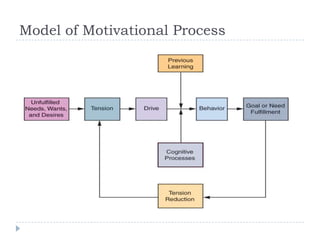
Model of Motivational Process
Needs
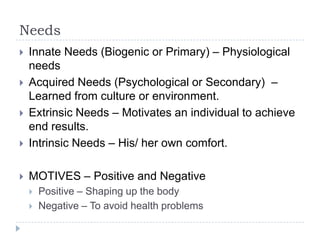
 Innate Needs (Biogenic or Primary) – Physiological
needs
 Acquired Needs (Psychological or Secondary) –
Learned from culture or environment.
 Extrinsic Needs – Motivates an individual to achieve
end results.
 Intrinsic Needs – His/ her own comfort.
 MOTIVES – Positive and Negative
 Positive – Shaping up the body
 Negative – To avoid health problems
GOALS
 Generic Goals
 Product Specific Goals
The selection of Goals
 Personal experiences
 Physical capacity
 Prevailing cultural norms & values
 Goals accessibility in the physical and social environment
 Individuals characteristics
 Positive and Negative Goal
 Positive Goal( Approach Object) – towards which
behavior is directed.
 Negative Goal ( Avoidance Object) – behavior which is
directed away.
 Promotion and Prevention Focus
 Promotion – growth and development.
 Prevention – safety and security.
 Utilitarian and Hedonic
 Utilitarian – Utility
 Hedonic – feelings, to enhance satisfaction
Interdependence of Needs and Goals
 Needs and goals are interdependent; neither exists
without the other.
 Individuals are more aware of their physiological
needs than are of their psychological needs.
Rational Vs Emotional Motives
 Rational – people choose product which gives most
utility (size, weight, price and miles)
 Emotional – people select goals according to
personal or subjective ( eg: pride, fear, affection or
status)
Dynamics of Motivation
 Needs are never fully satisfied
 Needs emerge as old needs are satisfied
 Success and failure influence goals:
 Substitute Goals
 Frustration
 Defense Mechanism
 Aggression – express anger.
 Rationalization – they say the goal is worthless.
 Regression – childish behavior.
 Withdrawal
 Projection – blaming others
 Daydreaming / fantasizing.
 Identification – solving the issue by comparing with others.
 Repression or suppression, Sublimation – avoid thinking about the goal
itself.
Arousal of Motives
 Physiological Arousal
 Emotional Arousal
 Cognitive Arousal
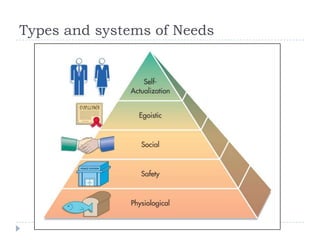
Types and systems of Needs
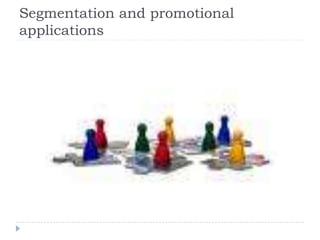
Segmentation and promotional
applications
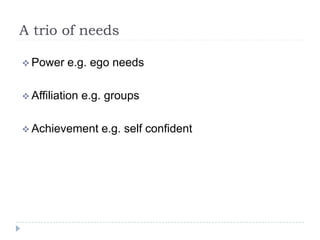
 Power e.g. ego needs
 Affiliation e.g. groups
 Achievement e.g. self confident
A trio of needs
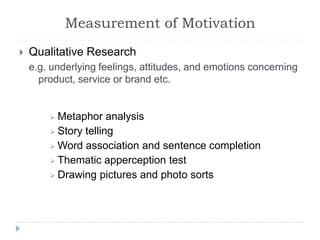
Measurement of Motivation
 Qualitative Research
e.g. underlying feelings, attitudes, and emotions concerning
product, service or brand etc.
 Metaphor analysis
 Story telling
 Word association and sentence completion
 Thematic apperception test
 Drawing pictures and photo sorts

Consumer motivation

  • 1.
    CONSUMER MOTIVATION By BalachandarK Reference Book: Consumer behavior, Schiffman & Kanuk
  • 2.
    Motivation – Definition Motivation is the driving force within individuals that impels them to action.
  • 3.
  • 4.
    Needs  Innate Needs(Biogenic or Primary) – Physiological needs  Acquired Needs (Psychological or Secondary) – Learned from culture or environment.  Extrinsic Needs – Motivates an individual to achieve end results.  Intrinsic Needs – His/ her own comfort.  MOTIVES – Positive and Negative  Positive – Shaping up the body  Negative – To avoid health problems
  • 5.
    GOALS  Generic Goals Product Specific Goals The selection of Goals  Personal experiences  Physical capacity  Prevailing cultural norms & values  Goals accessibility in the physical and social environment  Individuals characteristics
  • 6.
     Positive andNegative Goal  Positive Goal( Approach Object) – towards which behavior is directed.  Negative Goal ( Avoidance Object) – behavior which is directed away.  Promotion and Prevention Focus  Promotion – growth and development.  Prevention – safety and security.  Utilitarian and Hedonic  Utilitarian – Utility  Hedonic – feelings, to enhance satisfaction
  • 7.
    Interdependence of Needsand Goals  Needs and goals are interdependent; neither exists without the other.  Individuals are more aware of their physiological needs than are of their psychological needs.
  • 8.
    Rational Vs EmotionalMotives  Rational – people choose product which gives most utility (size, weight, price and miles)  Emotional – people select goals according to personal or subjective ( eg: pride, fear, affection or status)
  • 9.
    Dynamics of Motivation Needs are never fully satisfied  Needs emerge as old needs are satisfied  Success and failure influence goals:  Substitute Goals  Frustration  Defense Mechanism  Aggression – express anger.  Rationalization – they say the goal is worthless.  Regression – childish behavior.  Withdrawal  Projection – blaming others  Daydreaming / fantasizing.  Identification – solving the issue by comparing with others.  Repression or suppression, Sublimation – avoid thinking about the goal itself.
  • 10.
    Arousal of Motives Physiological Arousal  Emotional Arousal  Cognitive Arousal
  • 11.
  • 12.
  • 13.
     Power e.g.ego needs  Affiliation e.g. groups  Achievement e.g. self confident A trio of needs
  • 14.
    Measurement of Motivation Qualitative Research e.g. underlying feelings, attitudes, and emotions concerning product, service or brand etc.  Metaphor analysis  Story telling  Word association and sentence completion  Thematic apperception test  Drawing pictures and photo sorts