Consumer Decision Process:
Problem Recognition
Mrs.Puspanjali Bhandari
Types of Consumer Decisions
Extensive/Complex Decision Making
high involvement,
unfamiliar, expensive and/or infrequently bought
products.
 High degree of economic/ performance/
psychological risk.
Examples include cars, homes, computers,
education.
Information from the companies MM; friends and
relatives, store personnel etc.
Dissonance Reducing Buying behaviour
Consumer involvement is very high due to high
price and infrequent purchase
 Insignificance differences among brands.
Habitual Buying Behavior
consumer involvement is low
no significance difference among brands.
example : lighter or match box, milk, bread.
 For such brands tv commercials, news papers and
magazines build positive attitude of consumers
towards.
Purchases are frequent.
Variety Seeking Buying Behavior
Consumer involvement is very low
significance differences among brands.
brand switching is common.
Attract consumers by offering free samples, low
prices and special discounts.
Brand switching occurs for the sake of variety
rather than dissatisfaction.
example: chips, soaps, ice-cream etc.
Purchase Involvement
Level of involvement is the degree of information
processing and the amount of importance a
consumer attaches to a product while purchasing it.
In other words, it shows how involved the
customer is towards a product personally, socially
and economically.
Degree Product/Service Examples
Low Level
involvement
Short Life Fast moving consumer
goods. (Low cost &risk)
Eg: Matchbox, Toothpaste,
snacks,etc.
Medium level
involvement
Medium Furniture, crockery, ordinary
medical treatment (medium
level of risk & cost factor)
High Level
involvement
Long Automobiles, surgery,
purchase of immovable
assets, insurance policy etc.
(High level of risk and
expensive)
Low Involvement Purchase Decisions
These type of decisions are considered habitual
decisions. These are products or services that a
person buys on a regular basis and does not have to
do any research on. For example, a low-
involvement decision can include groceries,
laundry detergent, and household items that are
purchased all the time and the consumer already
knows what they want to buy.
Medium Involvement Purchase Decisions
These type of decisions are considered simple
decisions. A product or service that only requires
medium involvement can include a new pair of shoes.
The consumer will be more involved than they were
with household products but they are not necessarily
doing research on the new shoes they want to buy.
They will go to a store and try on different pairs of
shoes until they find the pair they want. This is a
simple decision that is made in the store and not over a
long amount of time.
High Involvement Purchase Decisions
Typically, the more money a consumer is going to
spend on a product, the more involved they will be
in the decision-making process. These types of
purchases can be expensive jewellery, vacations,
cars, and houses. These types of decisions take
time and requires research. The consumer will not
make the decision instantly, instead will compare
product or service such that to eliminate risk.
Types of Consumer Problems
Consumer encounters various types of problem in
their daily life. Either they involve low involvement
product , medium involvement product or high
involvement product. There are two types of
consumer problems;
Active Problem and
Inactive Problem
Active Problem
An active problem is one the consumer is aware of or
will become aware of in normal course of events.
Marketing strategy: Only require marketer to
convince consumers that its brand is the superior
solution
Inactive Problem
An inactive problem is one of which the consumer is
not aware.
Marketing strategy: Marketer must convince
consumers that they have the problem AND that their
brand is a superior solution.
Routine problems:
Expected, require immediate solution.
Emergency problems:
Not expected, require immediate solution.
Planning problems:
Expected, don’t require immediate solution.
Evolving problems:
Not expected, don’t require immediate
solution.
The Process of Problem Recognition
3–16
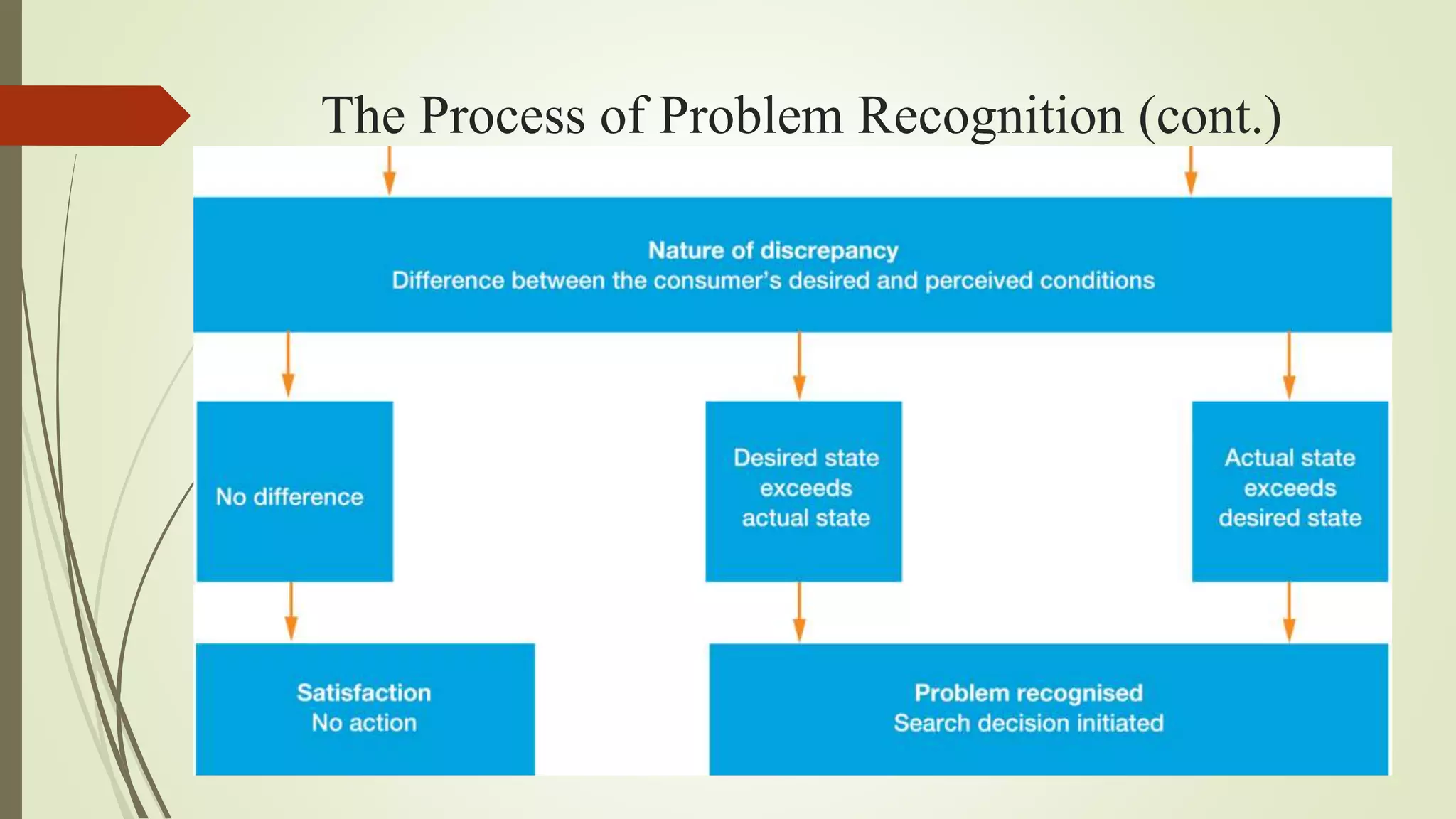
The Process of Problem Recognition (cont.)
3–17
The Desire to Resolve Recognised
Problems
Depends on two factors:
1. The magnitude of the discrepancy between the
desired state and the actual state.
2. The relative importance of the problem.
Uncontrollable Determinants of Problem
Recognition
Variety-seeking is a challenge to marketers because it
means that consumers switch brands for reasons
beyond a company’s control. Sensory-specific
satiety (declining satisfaction) consumers get bored
(satiated) with sensory attributes (consumption of
certain type of food) more than on non-sensory
attributes. Offering variety on key sensory attributes
can increase loyalty to the brand even if consumers
engage in variety seeking.
Marketing Strategy and Problem
Recognition
Discovering Consumer Problems
Responding to Consumer Problems
Helping Consumers Recognize Problems
Suppressing Problem Recognition
Discovering Consumer Problem
A wide variety of approaches are used to determine the
problems consumers face. –
Intuition: - the most common, however, the problem
identified may be of low importance to most
consumers.
Survey:- asks relatively large numbers of individuals
about the problems they are facing-
Focus Groups: composed of 8 to 12 similar individuals
brought together to discuss a particular topic; a
moderator is present to keep the discussion moving
and focused on the topic but otherwise free flowing.
Responding to Consumer Problems
Activating problem recognition: Generic problem
e.g. dairy foods. When the problem is latent or of
low importance.
selective e.g. one brand solution
Timing problem recognition
e.g. winter colds: Heater
Generator during Load sheading.
Suppressing problem recognition:
 Avoid upsetting habitual buyers.
 Effective quality control and distribution.
Helping Consumer Recognise their Problem
1. Generic Problem Recognition involves a
discrepancy that a variety of brands within a
product category can reduce. Increasing problem
recognition generally results in an expansion of
the total market.
2. Selective Problem Recognition involves a
discrepancy only one brand can solve. Firms
attempt to cause selective problem recognition to
gain or maintain market share
Suppressing the Problem
Occasionally information is introduced in the
market place that triggers problem recognition that
some marketers prefer to avoid. Obviously
marketers do not want their current customers to
recognize problems with their brands. Effective
quality control and distribution (limited out-of-
stock situations) are important in this effort.
Packages and package inserts that assure the
consumer of the wisdom of their purchase are also
common.
Package Inserts

Consumer decision process

  • 1.
    Consumer Decision Process: ProblemRecognition Mrs.Puspanjali Bhandari
  • 2.
  • 3.
    Extensive/Complex Decision Making highinvolvement, unfamiliar, expensive and/or infrequently bought products.  High degree of economic/ performance/ psychological risk. Examples include cars, homes, computers, education. Information from the companies MM; friends and relatives, store personnel etc.
  • 4.
    Dissonance Reducing Buyingbehaviour Consumer involvement is very high due to high price and infrequent purchase  Insignificance differences among brands.
  • 5.
    Habitual Buying Behavior consumerinvolvement is low no significance difference among brands. example : lighter or match box, milk, bread.  For such brands tv commercials, news papers and magazines build positive attitude of consumers towards. Purchases are frequent.
  • 6.
    Variety Seeking BuyingBehavior Consumer involvement is very low significance differences among brands. brand switching is common. Attract consumers by offering free samples, low prices and special discounts. Brand switching occurs for the sake of variety rather than dissatisfaction. example: chips, soaps, ice-cream etc.
  • 7.
    Purchase Involvement Level ofinvolvement is the degree of information processing and the amount of importance a consumer attaches to a product while purchasing it. In other words, it shows how involved the customer is towards a product personally, socially and economically.
  • 8.
    Degree Product/Service Examples LowLevel involvement Short Life Fast moving consumer goods. (Low cost &risk) Eg: Matchbox, Toothpaste, snacks,etc. Medium level involvement Medium Furniture, crockery, ordinary medical treatment (medium level of risk & cost factor) High Level involvement Long Automobiles, surgery, purchase of immovable assets, insurance policy etc. (High level of risk and expensive)
  • 9.
    Low Involvement PurchaseDecisions These type of decisions are considered habitual decisions. These are products or services that a person buys on a regular basis and does not have to do any research on. For example, a low- involvement decision can include groceries, laundry detergent, and household items that are purchased all the time and the consumer already knows what they want to buy.
  • 10.
    Medium Involvement PurchaseDecisions These type of decisions are considered simple decisions. A product or service that only requires medium involvement can include a new pair of shoes. The consumer will be more involved than they were with household products but they are not necessarily doing research on the new shoes they want to buy. They will go to a store and try on different pairs of shoes until they find the pair they want. This is a simple decision that is made in the store and not over a long amount of time.
  • 11.
    High Involvement PurchaseDecisions Typically, the more money a consumer is going to spend on a product, the more involved they will be in the decision-making process. These types of purchases can be expensive jewellery, vacations, cars, and houses. These types of decisions take time and requires research. The consumer will not make the decision instantly, instead will compare product or service such that to eliminate risk.
  • 12.
    Types of ConsumerProblems Consumer encounters various types of problem in their daily life. Either they involve low involvement product , medium involvement product or high involvement product. There are two types of consumer problems; Active Problem and Inactive Problem
  • 13.
    Active Problem An activeproblem is one the consumer is aware of or will become aware of in normal course of events. Marketing strategy: Only require marketer to convince consumers that its brand is the superior solution
  • 14.
    Inactive Problem An inactiveproblem is one of which the consumer is not aware. Marketing strategy: Marketer must convince consumers that they have the problem AND that their brand is a superior solution.
  • 15.
    Routine problems: Expected, requireimmediate solution. Emergency problems: Not expected, require immediate solution. Planning problems: Expected, don’t require immediate solution. Evolving problems: Not expected, don’t require immediate solution.
  • 16.
    The Process ofProblem Recognition 3–16
  • 17.
    The Process ofProblem Recognition (cont.) 3–17
  • 18.
    The Desire toResolve Recognised Problems Depends on two factors: 1. The magnitude of the discrepancy between the desired state and the actual state. 2. The relative importance of the problem.
  • 19.
    Uncontrollable Determinants ofProblem Recognition Variety-seeking is a challenge to marketers because it means that consumers switch brands for reasons beyond a company’s control. Sensory-specific satiety (declining satisfaction) consumers get bored (satiated) with sensory attributes (consumption of certain type of food) more than on non-sensory attributes. Offering variety on key sensory attributes can increase loyalty to the brand even if consumers engage in variety seeking.
  • 20.
    Marketing Strategy andProblem Recognition Discovering Consumer Problems Responding to Consumer Problems Helping Consumers Recognize Problems Suppressing Problem Recognition
  • 21.
    Discovering Consumer Problem Awide variety of approaches are used to determine the problems consumers face. – Intuition: - the most common, however, the problem identified may be of low importance to most consumers. Survey:- asks relatively large numbers of individuals about the problems they are facing- Focus Groups: composed of 8 to 12 similar individuals brought together to discuss a particular topic; a moderator is present to keep the discussion moving and focused on the topic but otherwise free flowing.
  • 22.
    Responding to ConsumerProblems Activating problem recognition: Generic problem e.g. dairy foods. When the problem is latent or of low importance. selective e.g. one brand solution
  • 23.
    Timing problem recognition e.g.winter colds: Heater Generator during Load sheading. Suppressing problem recognition:  Avoid upsetting habitual buyers.  Effective quality control and distribution.
  • 24.
    Helping Consumer Recognisetheir Problem 1. Generic Problem Recognition involves a discrepancy that a variety of brands within a product category can reduce. Increasing problem recognition generally results in an expansion of the total market. 2. Selective Problem Recognition involves a discrepancy only one brand can solve. Firms attempt to cause selective problem recognition to gain or maintain market share
  • 25.
    Suppressing the Problem Occasionallyinformation is introduced in the market place that triggers problem recognition that some marketers prefer to avoid. Obviously marketers do not want their current customers to recognize problems with their brands. Effective quality control and distribution (limited out-of- stock situations) are important in this effort. Packages and package inserts that assure the consumer of the wisdom of their purchase are also common.
  • 26.