Chapter Two:
Situational Influences


                         2-1
Chapter 2: Situational influences

  Part 1: Consumer decision process


                                      2-2
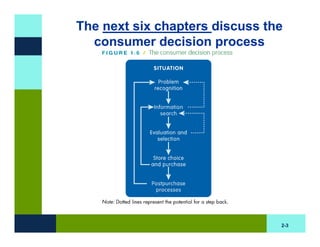
The next six chapters discuss the
  consumer decision process


                                2-3
Chapter 2: Situational influences
   Objectives – after studying this chapter you
   should understand:
1. Situations influence decisions
2. There are four main types of situations
3. The nature of situational influences
4. Situational influences can be categorised
   into five classes
5. Situational influences have implications for
   marketing strategy
6. The usefulness of the person-situation
   segmentation procedure

                                             2-4
The Nature of Situational Influence

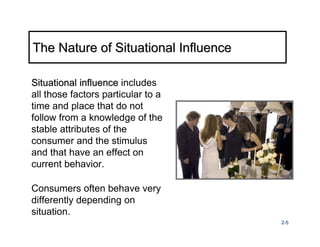
Situational influence includes
all those factors particular to a
time and place that do not
follow from a knowledge of the
stable attributes of the
consumer and the stimulus
and that have an effect on
current behavior.

Consumers often behave very
differently depending on
situation.
                                      2-5
Situational influences
• Situations influence consumer behavior
  – Four main types of situations
  – Can be categorized according to five
   main dimensions
  – Implications for marketing strategy


                                      2-6
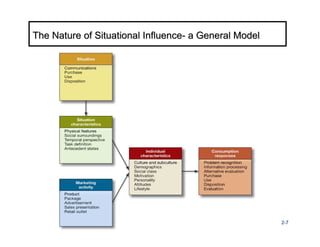
The Nature of Situational Influence- a General Model


                                                       2-7
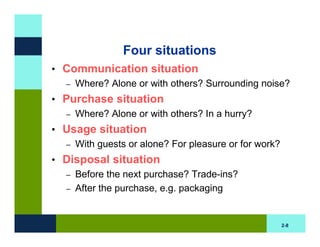
Four situations
• Communication situation
  – Where? Alone or with others? Surrounding noise?

• Purchase situation
  – Where? Alone or with others? In a hurry?

• Usage situation
  – With guests or alone? For pleasure or for work?

• Disposal situation
  – Before the next purchase? Trade-ins?
  – After the purchase, e.g. packaging


                                                      2-8
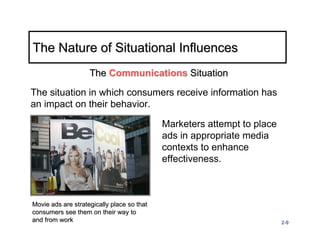
The Nature of Situational Influences
                    The Communications Situation

The situation in which consumers receive information has
an impact on their behavior.

                                            Marketers attempt to place
                                            ads in appropriate media
                                            contexts to enhance
                                            effectiveness.


Movie ads are strategically place so that
consumers see them on their way to
and from work                                                            2-9
The Nature of Situational Influences
                 The Purchase Situation

The situation in which a purchase is made can influence
consumer behavior.
                           Marketers must adapt
                           strategies to the purchase
                           situation.
                           Home purchases occur in a
                           unique social situation.
                           To succeed, realtors must take
                           the opportunity to develop
                           interpersonal relationships.
                                                          2-10
Consumer behaviour is
Product–Person–Situation specific


                                    2-11
The Nature of Situational Influences
                  The Usage Situation

Marketers need to understand the usage situations for
which their products are, or may become, appropriate.

      Research indicates that expanded usage situation
    strategies can produce major sales gains.
      Classic: Arm and Hammer baking soda, where
    many uses have been found and marketed resulting
    in increased sales.


                                                         2-12
The Nature of Situational Influences
                 The Disposition Situation

Consumers must frequently dispose of products or product
packages.
Disposal can create significant
social problems as well as
opportunities for marketers.
Some consumers consider ease
of disposition an important
product attribute.


                                     Appliances at a dump in the   2-13
                                     United Kingdom
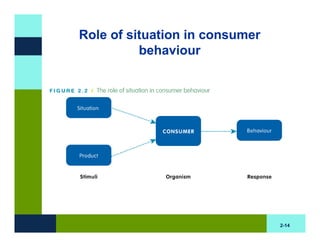
Role of situation in consumer
          behaviour


                                2-14
Five dimensions of
         situational influence
1. Physical surroundings
2. Social surroundings
3. Temporal perspectives
4. Task definition
5. Antecedent states


                                 2-15
Examples of physical surrounds
• Store location
• Interior decor
• Music
• Smell/aromas
• Temperature (air-conditioning or heating)
• Choice provided
  (by product category or across the
  categories)


                                              2-16
Situational Characteristics and
Consumption Behavior
                 Physical Surroundings
 Atmospherics is the sum of all the physical features of
 a retail environment.

      Atmospherics influences consumer judgments of
    the quality of the store and the store’s image.

     Atmosphere is referred to as servicescape when
    describing a service business such as a hospital,
    bank or restaurant.


                                                           2-17
Typology of service environments


                               2-18
Situational Characteristics and
Consumption Behavior
                   Physical Surroundings
Colors
Certain colors and color characteristics create feelings of
excitement and arousal which are related to attention.
Brighter colors are more
arousing than dull ones.
Warm colors such as
reds and yellows are
more arousing than cool
colors such as blues and
grays.
                                                              2-19
Situational Characteristics and
Consumption Behavior
                   Physical Surroundings
Aromas
There is increasing evidence that odors can affect consumer
shopping. Several aroma studies have found the following:
 1. A scented environment produced a greater intent to revisit
    the store, higher purchase intention for some items, and a
    reduced sense of time spent shopping.

 2. A pleasantly scented environment enhanced brand recall
    and evaluations particularly for unfamiliar brands.


                                                              2-20
Situational Characteristics and
Consumption Behavior
                  Physical Surroundings
Music
Music influences consumers’ moods, and in turn, influences a
variety of consumption behaviors.

    Firms exist to develop music programs to meet the
   unique needs of specific retailers.

     An emerging trend is having music more in the
   foreground so it becomes part of the shopping experience
   and drives store image.


                                                               2-21
Impact of background music
   on restaurant patrons


                             2-22
Situational Characteristics and
Consumption Behavior
                 Physical Surroundings
Crowding
Most consumers find feelings of crowding to be unpleasant
resulting in:
   •Less time in the store and less buying
   •Faster decisions and less use of information
Crowding can lead to less satisfactory purchases, unpleasant
shopping, and reduced likelihood of returning to the store.
Marketers need to design outlets to reduce crowding
perceptions.

                                                               2-23
Impact of physical density (crowding) on shopper
                   perceptions


                                              2-24
Situational Characteristics and
Consumption Behavior
                   Social Surroundings

Social surroundings are the other individuals present in the
particular situation.

     Social influence is a significant force.

    Individuals tend to comply with group expectations,
   particularly when the behavior is visible.

     Shopping is a highly visible activity.

     The use of many publicly consumed brands are
   subject to social influences.
                                                           2-25
Examples of social surroundings
• Types of customers in the store
• Queues and crowding
• Whether the consumer is likely to be known
  by others/recognised
• Whether there are high-profile
  people/celebrities shopping at that store
• Whether the product will be consumed
  privately or in the presence of others


                                              2-26
Effect of social situation on desired
          dessert attributes


                                        2-27
Situational Characteristics and
Consumption Behavior
                     Social Surroundings
Embarrassment is a negative emotion influenced both by the
product and the situation.

Certain products are more
embarrassing than others, and

Embarrassment is driven by the
presence of others.

For extremely sensitive products,
strategies include home delivery
options.

                                                             2-28
Situational Characteristics and
Consumption Behavior
                  Temporal Perspectives
 Temporal perspectives deal with the effect of time on
 consumer behavior.

Limited purchase time often
limits search
Internet shopping is growing
rapidly as a result of the time
pressures felt by consumers.


                                                         2-29
Examples of temporal influences
• Whether the product is seasonal
• Whether the product is urgently required
  (snack between lectures)
• Time available for shopping limited/excess
  (the product may be an excuse for shopping)
• How long the previous product lasted or was
  expected to last


                                             2-30
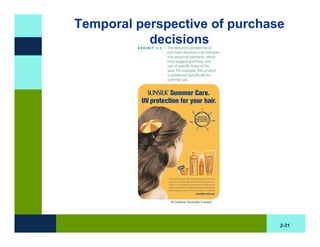
Temporal perspective of purchase
           decisions


                               2-31
Situational Characteristics and
Consumption Behavior
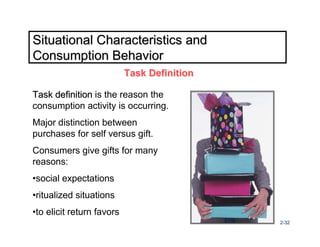
                           Task Definition

Task definition is the reason the
consumption activity is occurring.
Major distinction between
purchases for self versus gift.
Consumers give gifts for many
reasons:
•social expectations
•ritualized situations
•to elicit return favors
                                             2-32
Examples of task influences
• Is the product utilitarian or used as a status
  symbol?
• Is it a gift or for oneself?
• Must the product be long-lasting/tough?
  (e.g. an everyday watch)
  or decorative?
  (e.g. a dress watch)
• Is the product intended for several uses?
  (e.g. a family computer for study and internet
  access)

                                               2-33
Buying factors in gift-giving purchase
             situations


                                   2-34
Situational Characteristics and
Consumption Behavior
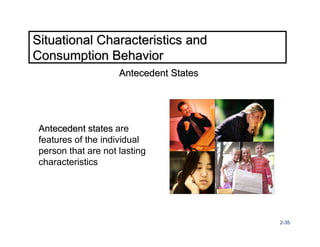
                     Antecedent States


 Antecedent states are
 features of the individual
 person that are not lasting
 characteristics


                                         2-35
Examples of antecedent states
• Moods
  – Feeling sad triggers buying sweets or seeing a
    funny movie
  – Feeling rejected triggers buying games’ software

• Momentary conditions
  – Can’t eat ice cream because teeth hurt
  – Can’t buy a book because the credit card was left
    at home
  – Buy more groceries because hungry before
    shopping


                                                  2-36
Situational Characteristics and
Consumption Behavior
                           Moods
Moods tend to be less intense than emotions and may
operate without the individual’s awareness.

    Although moods may affect all aspects of a person’s
   behavior, they generally do not completely interrupt
   ongoing behavior as an emotion might.

     Consumers actively manager their mood states,
   often seeking situations, activities, or objects that will
   alleviate negative moods or enhance positive ones.

                                                                2-37
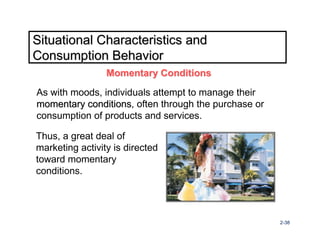
Situational Characteristics and
Consumption Behavior
                 Momentary Conditions

As with moods, individuals attempt to manage their
momentary conditions, often through the purchase or
           conditions
consumption of products and services.

Thus, a great deal of
marketing activity is directed
toward momentary
conditions.


                                                      2-38
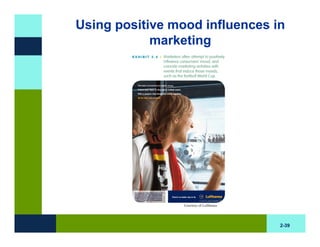
Using positive mood influences in
            marketing


                                2-39
Ritual situations

• A ritual situation can be described as a set
  of interrelated behaviours that occur in a
  structured format, which have symbolic
  meaning, and that occur in response to
  socially-defined occasions
• Important to marketers as they define
  consumption, e.g. anniversaries, seasonal
  gifts
• Traditions and rituals being continued and
  developed, e.g. Valentine's Day

                                             2-40
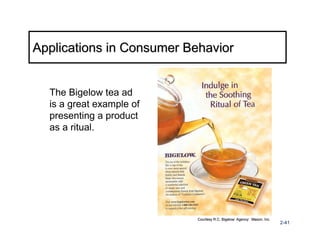
Applications in Consumer Behavior


  The Bigelow tea ad
  is a great example of
  presenting a product
  as a ritual.


                           Courtesy R.C. Bigelow: Agency: Mason, Inc.
                                                                        2-41
Situational influences and
            marketing strategy
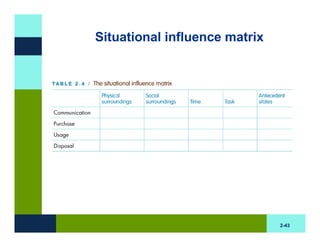
• Developing a situational influence matrix
• Positioning the product based on situation
• Segmenting the market based on usage
  situation
  –   alone
  –   in combination with other segmentation variable
  –   person/situation segmentation


                                                    2-42
Situational influence matrix


                               2-43
Usage situations and product positioning


                                      2-44
Situational Influences and Marketing
Strategy
Identify the different situations that might involve the
consumption of a product

Determine which products or brands are most likely to be
purchased or consumed across those situations.

     One method of dealing with this question is to jointly
   scale situations and products.


                                                              2-45
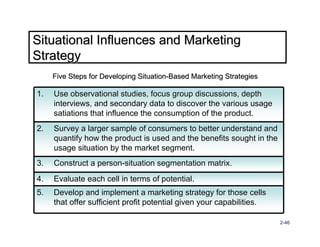
Situational Influences and Marketing
Strategy
     Five Steps for Developing Situation-Based Marketing Strategies

1.   Use observational studies, focus group discussions, depth
     interviews, and secondary data to discover the various usage
     satiations that influence the consumption of the product.
2.   Survey a larger sample of consumers to better understand and
     quantify how the product is used and the benefits sought in the
     usage situation by the market segment.
3.   Construct a person-situation segmentation matrix.
4.   Evaluate each cell in terms of potential.
5.   Develop and implement a marketing strategy for those cells
     that offer sufficient profit potential given your capabilities.

                                                                       2-46
Situational Influences and Marketing
Strategy


                                       2-47
Topics covered in this chapter
• There are four types of situational influence
• The nature of situational influence
• Dimensions of situation
  – Physical
  – Social
  – Time (temporal)
  – Task
  – Antecedent

• Situational influences and marketing
  strategy

                                            2-48

BB Chapter Two: Situational Influences

  • 1.
  • 2.
    Chapter 2: Situationalinfluences Part 1: Consumer decision process 2-2
  • 3.
    The next sixchapters discuss the consumer decision process 2-3
  • 4.
    Chapter 2: Situationalinfluences Objectives – after studying this chapter you should understand: 1. Situations influence decisions 2. There are four main types of situations 3. The nature of situational influences 4. Situational influences can be categorised into five classes 5. Situational influences have implications for marketing strategy 6. The usefulness of the person-situation segmentation procedure 2-4
  • 5.
    The Nature ofSituational Influence Situational influence includes all those factors particular to a time and place that do not follow from a knowledge of the stable attributes of the consumer and the stimulus and that have an effect on current behavior. Consumers often behave very differently depending on situation. 2-5
  • 6.
    Situational influences • Situationsinfluence consumer behavior – Four main types of situations – Can be categorized according to five main dimensions – Implications for marketing strategy 2-6
  • 7.
    The Nature ofSituational Influence- a General Model 2-7
  • 8.
    Four situations • Communicationsituation – Where? Alone or with others? Surrounding noise? • Purchase situation – Where? Alone or with others? In a hurry? • Usage situation – With guests or alone? For pleasure or for work? • Disposal situation – Before the next purchase? Trade-ins? – After the purchase, e.g. packaging 2-8
  • 9.
    The Nature ofSituational Influences The Communications Situation The situation in which consumers receive information has an impact on their behavior. Marketers attempt to place ads in appropriate media contexts to enhance effectiveness. Movie ads are strategically place so that consumers see them on their way to and from work 2-9
  • 10.
    The Nature ofSituational Influences The Purchase Situation The situation in which a purchase is made can influence consumer behavior. Marketers must adapt strategies to the purchase situation. Home purchases occur in a unique social situation. To succeed, realtors must take the opportunity to develop interpersonal relationships. 2-10
  • 11.
  • 12.
    The Nature ofSituational Influences The Usage Situation Marketers need to understand the usage situations for which their products are, or may become, appropriate. Research indicates that expanded usage situation strategies can produce major sales gains. Classic: Arm and Hammer baking soda, where many uses have been found and marketed resulting in increased sales. 2-12
  • 13.
    The Nature ofSituational Influences The Disposition Situation Consumers must frequently dispose of products or product packages. Disposal can create significant social problems as well as opportunities for marketers. Some consumers consider ease of disposition an important product attribute. Appliances at a dump in the 2-13 United Kingdom
  • 14.
    Role of situationin consumer behaviour 2-14
  • 15.
    Five dimensions of situational influence 1. Physical surroundings 2. Social surroundings 3. Temporal perspectives 4. Task definition 5. Antecedent states 2-15
  • 16.
    Examples of physicalsurrounds • Store location • Interior decor • Music • Smell/aromas • Temperature (air-conditioning or heating) • Choice provided (by product category or across the categories) 2-16
  • 17.
    Situational Characteristics and ConsumptionBehavior Physical Surroundings Atmospherics is the sum of all the physical features of a retail environment. Atmospherics influences consumer judgments of the quality of the store and the store’s image. Atmosphere is referred to as servicescape when describing a service business such as a hospital, bank or restaurant. 2-17
  • 18.
    Typology of serviceenvironments 2-18
  • 19.
    Situational Characteristics and ConsumptionBehavior Physical Surroundings Colors Certain colors and color characteristics create feelings of excitement and arousal which are related to attention. Brighter colors are more arousing than dull ones. Warm colors such as reds and yellows are more arousing than cool colors such as blues and grays. 2-19
  • 20.
    Situational Characteristics and ConsumptionBehavior Physical Surroundings Aromas There is increasing evidence that odors can affect consumer shopping. Several aroma studies have found the following: 1. A scented environment produced a greater intent to revisit the store, higher purchase intention for some items, and a reduced sense of time spent shopping. 2. A pleasantly scented environment enhanced brand recall and evaluations particularly for unfamiliar brands. 2-20
  • 21.
    Situational Characteristics and ConsumptionBehavior Physical Surroundings Music Music influences consumers’ moods, and in turn, influences a variety of consumption behaviors. Firms exist to develop music programs to meet the unique needs of specific retailers. An emerging trend is having music more in the foreground so it becomes part of the shopping experience and drives store image. 2-21
  • 22.
    Impact of backgroundmusic on restaurant patrons 2-22
  • 23.
    Situational Characteristics and ConsumptionBehavior Physical Surroundings Crowding Most consumers find feelings of crowding to be unpleasant resulting in: •Less time in the store and less buying •Faster decisions and less use of information Crowding can lead to less satisfactory purchases, unpleasant shopping, and reduced likelihood of returning to the store. Marketers need to design outlets to reduce crowding perceptions. 2-23
  • 24.
    Impact of physicaldensity (crowding) on shopper perceptions 2-24
  • 25.
    Situational Characteristics and ConsumptionBehavior Social Surroundings Social surroundings are the other individuals present in the particular situation. Social influence is a significant force. Individuals tend to comply with group expectations, particularly when the behavior is visible. Shopping is a highly visible activity. The use of many publicly consumed brands are subject to social influences. 2-25
  • 26.
    Examples of socialsurroundings • Types of customers in the store • Queues and crowding • Whether the consumer is likely to be known by others/recognised • Whether there are high-profile people/celebrities shopping at that store • Whether the product will be consumed privately or in the presence of others 2-26
  • 27.
    Effect of socialsituation on desired dessert attributes 2-27
  • 28.
    Situational Characteristics and ConsumptionBehavior Social Surroundings Embarrassment is a negative emotion influenced both by the product and the situation. Certain products are more embarrassing than others, and Embarrassment is driven by the presence of others. For extremely sensitive products, strategies include home delivery options. 2-28
  • 29.
    Situational Characteristics and ConsumptionBehavior Temporal Perspectives Temporal perspectives deal with the effect of time on consumer behavior. Limited purchase time often limits search Internet shopping is growing rapidly as a result of the time pressures felt by consumers. 2-29
  • 30.
    Examples of temporalinfluences • Whether the product is seasonal • Whether the product is urgently required (snack between lectures) • Time available for shopping limited/excess (the product may be an excuse for shopping) • How long the previous product lasted or was expected to last 2-30
  • 31.
    Temporal perspective ofpurchase decisions 2-31
  • 32.
    Situational Characteristics and ConsumptionBehavior Task Definition Task definition is the reason the consumption activity is occurring. Major distinction between purchases for self versus gift. Consumers give gifts for many reasons: •social expectations •ritualized situations •to elicit return favors 2-32
  • 33.
    Examples of taskinfluences • Is the product utilitarian or used as a status symbol? • Is it a gift or for oneself? • Must the product be long-lasting/tough? (e.g. an everyday watch) or decorative? (e.g. a dress watch) • Is the product intended for several uses? (e.g. a family computer for study and internet access) 2-33
  • 34.
    Buying factors ingift-giving purchase situations 2-34
  • 35.
    Situational Characteristics and ConsumptionBehavior Antecedent States Antecedent states are features of the individual person that are not lasting characteristics 2-35
  • 36.
    Examples of antecedentstates • Moods – Feeling sad triggers buying sweets or seeing a funny movie – Feeling rejected triggers buying games’ software • Momentary conditions – Can’t eat ice cream because teeth hurt – Can’t buy a book because the credit card was left at home – Buy more groceries because hungry before shopping 2-36
  • 37.
    Situational Characteristics and ConsumptionBehavior Moods Moods tend to be less intense than emotions and may operate without the individual’s awareness. Although moods may affect all aspects of a person’s behavior, they generally do not completely interrupt ongoing behavior as an emotion might. Consumers actively manager their mood states, often seeking situations, activities, or objects that will alleviate negative moods or enhance positive ones. 2-37
  • 38.
    Situational Characteristics and ConsumptionBehavior Momentary Conditions As with moods, individuals attempt to manage their momentary conditions, often through the purchase or conditions consumption of products and services. Thus, a great deal of marketing activity is directed toward momentary conditions. 2-38
  • 39.
    Using positive moodinfluences in marketing 2-39
  • 40.
    Ritual situations • Aritual situation can be described as a set of interrelated behaviours that occur in a structured format, which have symbolic meaning, and that occur in response to socially-defined occasions • Important to marketers as they define consumption, e.g. anniversaries, seasonal gifts • Traditions and rituals being continued and developed, e.g. Valentine's Day 2-40
  • 41.
    Applications in ConsumerBehavior The Bigelow tea ad is a great example of presenting a product as a ritual. Courtesy R.C. Bigelow: Agency: Mason, Inc. 2-41
  • 42.
    Situational influences and marketing strategy • Developing a situational influence matrix • Positioning the product based on situation • Segmenting the market based on usage situation – alone – in combination with other segmentation variable – person/situation segmentation 2-42
  • 43.
  • 44.
    Usage situations andproduct positioning 2-44
  • 45.
    Situational Influences andMarketing Strategy Identify the different situations that might involve the consumption of a product Determine which products or brands are most likely to be purchased or consumed across those situations. One method of dealing with this question is to jointly scale situations and products. 2-45
  • 46.
    Situational Influences andMarketing Strategy Five Steps for Developing Situation-Based Marketing Strategies 1. Use observational studies, focus group discussions, depth interviews, and secondary data to discover the various usage satiations that influence the consumption of the product. 2. Survey a larger sample of consumers to better understand and quantify how the product is used and the benefits sought in the usage situation by the market segment. 3. Construct a person-situation segmentation matrix. 4. Evaluate each cell in terms of potential. 5. Develop and implement a marketing strategy for those cells that offer sufficient profit potential given your capabilities. 2-46
  • 47.
    Situational Influences andMarketing Strategy 2-47
  • 48.
    Topics covered inthis chapter • There are four types of situational influence • The nature of situational influence • Dimensions of situation – Physical – Social – Time (temporal) – Task – Antecedent • Situational influences and marketing strategy 2-48