Consumer
motivation
By group 1
Motivation is the driving
force within individuals
that implies them to
action…….
2
3
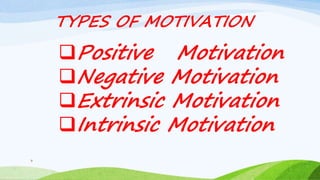
TYPES OF MOTIVATION
Positive Motivation
Negative Motivation
Extrinsic Motivation
Intrinsic Motivation
4
5
Previous
learning
Unfulfilled
Needs,Want
s and
Desires
Tension Driv
e
Behaviour
Goal or Need
Fulfillment
Cognitive
Processes
Tension
Reduction
Motivation process
6
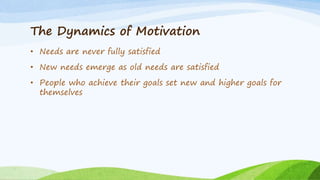
The Dynamics of Motivation
• Needs are never fully satisfied
• New needs emerge as old needs are satisfied
• People who achieve their goals set new and higher goals for
themselves
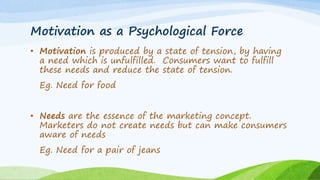
Motivation as a Psychological Force
• Motivation is produced by a state of tension, by having
a need which is unfulfilled. Consumers want to fulfill
these needs and reduce the state of tension.
Eg. Need for food
• Needs are the essence of the marketing concept.
Marketers do not create needs but can make consumers
aware of needs
Eg. Need for a pair of jeans
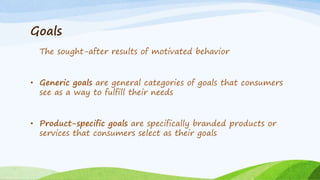
Goals
The sought-after results of motivated behavior
• Generic goals are general categories of goals that consumers
see as a way to fulfill their needs
• Product-specific goals are specifically branded products or
services that consumers select as their goals
Rational vs. Emotional Motives
Rationality implies that consumers select
goals based on totally objective criteria, such
as size, weight, price, or miles per gallon
Emotional motives imply the selection of
goals according to personal or subjective
criteria
Arousal of Motives
Physiological arousal (they get hungry)
Emotional arousal (frustrated)
Cognitive arousal (they read an ad that
made them think about their needs)
Environmental arousal (the weather
becomes cold)
Arousal of Motives
Physiological arousal (they get hungry)
Emotional arousal (frustrated)
Cognitive arousal (they read an ad that
made them think about their needs)
Environmental arousal (the weather
becomes cold)
Consumer Motivation
• Represents the drive to satisfy both physiological
and psychological needs through product
purchase and consumption
• Gives insights into why people buy certain
products
• Stems from consumer needs: industries have
been built around basic human needs
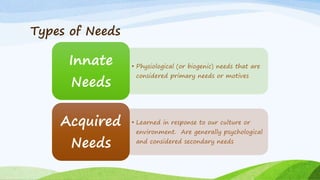
Types of Needs
• Physiological (or biogenic) needs that are
considered primary needs or motives
Innate
Needs
• Learned in response to our culture or
environment. Are generally psychological
and considered secondary needs
Acquired
Needs
Types of Needs
• Safety and Health Needs
Threats to our safety and health motivate
purchases for personal security and protection
• Need for Love and Companionship
Services and products help individuals find and
attract others
Products are often used as symbols of love and
caring
• Need for Financial Resources
• Social Image Needs
Conspicuous consumption:
purchases motivated to some
extent by the desire to show
other people how successful they
are
Companies reinforce the notion
that products enable users to
communicate their social image
• Need for Pleasure
Products, services, and
consumption activities provide
fun and excitement
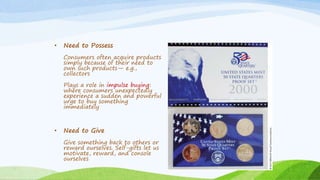
• Need to Possess
Consumers often acquire products
simply because of their need to
own such products— e.g.,
collectors
Plays a role in impulse buying:
where consumers unexpectedly
experience a sudden and powerful
urge to buy something
immediately
• Need to Give
Give something back to others or
reward ourselves. Self-gifts let us
motivate, reward, and console
ourselves
• Need for Information
Plays an important role in
persuasion —if an ad appears
when consumers need
information, they are more likely
to pay attention than when they
don’t need the information
One reason we read or watch TV
Fuels Internet usage
• Need for Variety
Marketers may introduce
different versions of original brand
Variety may become focus of
product positioning
Types of Needs
A Trio of Needs
Power (Ego needs)
• Individual’s desire to control environment
Affiliation (Social needs)
• Need for friendship, acceptance, and belonging
Achievement
• Need for personal accomplishment
• Closely related to egoistic and self-actualization needs
Motivational Conflict and Need Priorities
• Resolving motivational conflicts requires prioritizing needs
• Maslow’s hierarchy
Some needs take precedence over other needs—physiological needs
take top priority
Differences in the importance attached to various needs affects
how consumers evaluate products
Because of consumers’ different motivational priorities, companies
use benefit segmentation: dividing consumers into different
market segments based on benefits they seek from purchase and
consumption
The Challenge of Understanding
Consumer Motivation
Reasons underlying consumer motivation are not always
“obvious”
Research is necessary to discover real motivations behind
behaviors
People don’t always want to disclose real reasons for their
actions
People don’t always know why they do what they do —
unconscious motivation
Motivations change over time
Motivating Consumers
Motivating with Money
• Price cuts, specials, rebates, and coupons motivate purchase
• Resulting sales may increase, but profits may not
• Attracts consumers less likely to repeat
• Price reductions may increase price sensitivity
Motivating Consumers
Provide Other Incentives
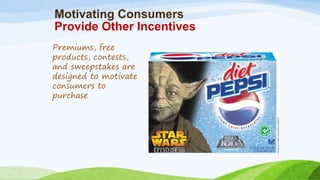
Premiums, free
products, contests,
and sweepstakes are
designed to motivate
consumers to
purchase
Motivating Consumers
Provide Other Incentives
• Premiums, free products, contests, and sweepstakes are
designed to motivate consumers to purchase
• There are limitations and shortcomings for this strategy in
addition to the products offered as a premium being valued
less (value-discounting hypothesis)
Motivating Consumers
Implement a Loyalty Program
• Motivate repeat buying by providing rewards to customers
based on how much business they do with the company
• Tracks consumer purchases and provides estimates of
Customer Lifetime Value
Motivating Consumers
Enhance Perceived Risk
• Perceived risk: consumers’
apprehensions about the
consequences of their
behavior (buying and
consuming the product)
• Greater perceived risk
increases search
• Educating consumers about
risks may motivate them to
make more informed choices
that reduce exposure to risk
Motivating Consumers
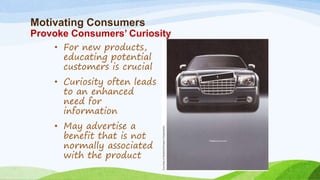
Provoke Consumers’ Curiosity
• For new products,
educating potential
customers is crucial
• Curiosity often leads
to an enhanced
need for
information
• May advertise a
benefit that is not
normally associated
with the product
Consumer motivation

Consumer motivation

  • 1.
  • 2.
    Motivation is thedriving force within individuals that implies them to action……. 2
  • 3.
    3 TYPES OF MOTIVATION PositiveMotivation Negative Motivation Extrinsic Motivation Intrinsic Motivation
  • 4.
  • 5.
  • 6.
    Previous learning Unfulfilled Needs,Want s and Desires Tension Driv e Behaviour Goalor Need Fulfillment Cognitive Processes Tension Reduction Motivation process 6
  • 7.
    The Dynamics ofMotivation • Needs are never fully satisfied • New needs emerge as old needs are satisfied • People who achieve their goals set new and higher goals for themselves
  • 8.
    Motivation as aPsychological Force • Motivation is produced by a state of tension, by having a need which is unfulfilled. Consumers want to fulfill these needs and reduce the state of tension. Eg. Need for food • Needs are the essence of the marketing concept. Marketers do not create needs but can make consumers aware of needs Eg. Need for a pair of jeans
  • 9.
    Goals The sought-after resultsof motivated behavior • Generic goals are general categories of goals that consumers see as a way to fulfill their needs • Product-specific goals are specifically branded products or services that consumers select as their goals
  • 10.
    Rational vs. EmotionalMotives Rationality implies that consumers select goals based on totally objective criteria, such as size, weight, price, or miles per gallon Emotional motives imply the selection of goals according to personal or subjective criteria
  • 11.
    Arousal of Motives Physiologicalarousal (they get hungry) Emotional arousal (frustrated) Cognitive arousal (they read an ad that made them think about their needs) Environmental arousal (the weather becomes cold)
  • 12.
    Arousal of Motives Physiologicalarousal (they get hungry) Emotional arousal (frustrated) Cognitive arousal (they read an ad that made them think about their needs) Environmental arousal (the weather becomes cold)
  • 13.
    Consumer Motivation • Representsthe drive to satisfy both physiological and psychological needs through product purchase and consumption • Gives insights into why people buy certain products • Stems from consumer needs: industries have been built around basic human needs
  • 14.
    Types of Needs •Physiological (or biogenic) needs that are considered primary needs or motives Innate Needs • Learned in response to our culture or environment. Are generally psychological and considered secondary needs Acquired Needs
  • 15.
    Types of Needs •Safety and Health Needs Threats to our safety and health motivate purchases for personal security and protection • Need for Love and Companionship Services and products help individuals find and attract others Products are often used as symbols of love and caring
  • 16.
    • Need forFinancial Resources • Social Image Needs Conspicuous consumption: purchases motivated to some extent by the desire to show other people how successful they are Companies reinforce the notion that products enable users to communicate their social image • Need for Pleasure Products, services, and consumption activities provide fun and excitement
  • 17.
    • Need toPossess Consumers often acquire products simply because of their need to own such products— e.g., collectors Plays a role in impulse buying: where consumers unexpectedly experience a sudden and powerful urge to buy something immediately • Need to Give Give something back to others or reward ourselves. Self-gifts let us motivate, reward, and console ourselves
  • 18.
    • Need forInformation Plays an important role in persuasion —if an ad appears when consumers need information, they are more likely to pay attention than when they don’t need the information One reason we read or watch TV Fuels Internet usage • Need for Variety Marketers may introduce different versions of original brand Variety may become focus of product positioning Types of Needs
  • 19.
    A Trio ofNeeds Power (Ego needs) • Individual’s desire to control environment Affiliation (Social needs) • Need for friendship, acceptance, and belonging Achievement • Need for personal accomplishment • Closely related to egoistic and self-actualization needs
  • 20.
    Motivational Conflict andNeed Priorities • Resolving motivational conflicts requires prioritizing needs • Maslow’s hierarchy Some needs take precedence over other needs—physiological needs take top priority Differences in the importance attached to various needs affects how consumers evaluate products Because of consumers’ different motivational priorities, companies use benefit segmentation: dividing consumers into different market segments based on benefits they seek from purchase and consumption
  • 22.
    The Challenge ofUnderstanding Consumer Motivation Reasons underlying consumer motivation are not always “obvious” Research is necessary to discover real motivations behind behaviors People don’t always want to disclose real reasons for their actions People don’t always know why they do what they do — unconscious motivation Motivations change over time
  • 23.
    Motivating Consumers Motivating withMoney • Price cuts, specials, rebates, and coupons motivate purchase • Resulting sales may increase, but profits may not • Attracts consumers less likely to repeat • Price reductions may increase price sensitivity
  • 24.
    Motivating Consumers Provide OtherIncentives Premiums, free products, contests, and sweepstakes are designed to motivate consumers to purchase
  • 25.
    Motivating Consumers Provide OtherIncentives • Premiums, free products, contests, and sweepstakes are designed to motivate consumers to purchase • There are limitations and shortcomings for this strategy in addition to the products offered as a premium being valued less (value-discounting hypothesis)
  • 26.
    Motivating Consumers Implement aLoyalty Program • Motivate repeat buying by providing rewards to customers based on how much business they do with the company • Tracks consumer purchases and provides estimates of Customer Lifetime Value
  • 27.
    Motivating Consumers Enhance PerceivedRisk • Perceived risk: consumers’ apprehensions about the consequences of their behavior (buying and consuming the product) • Greater perceived risk increases search • Educating consumers about risks may motivate them to make more informed choices that reduce exposure to risk
  • 28.
    Motivating Consumers Provoke Consumers’Curiosity • For new products, educating potential customers is crucial • Curiosity often leads to an enhanced need for information • May advertise a benefit that is not normally associated with the product

Editor's Notes

  • #8 Motivation is highly dynamic and constantly changes in response to life experiences. Motivations change as we age, interact with others, change careers, acquire wealth, become ill, marry or divorce, or pursue education. Humans constantly have needs. This is due in part to the fact that our needs are never fully satisfied, or once satisfied, reappear. Hunger is a good example of a need that is often not satisfied and reappears. As humans, we also develop new needs as we satisfy existing needs. The hierarch of effects model shows how we meet our lower-level needs first and then move up the hierarchy. Finally, our needs are based on the goals that we set for ourselves. If one sets a goal to enter politics, they may feel they need a law degree. However, if they are unsuccessful in getting accepted at law school, their needs may change and they may want to pursue a few years of work experience first and need to find a job.
  • #10 Continuing with our example of jeans, we can understand the types of goals that exist. When a consumer states they want a pair of jeans, they have stated a generic goal. When they announce they really want a pair of Calvin Klein jeans, then they have stated product-specific goals.
  • #11 There has been extensive research regarding rational versus emotional motives during purchase. Their existence has been tied to how consumers view marketing variables, including advertisements and pricing adjustments. Furthermore, it must be realized that the definition of emotional vs. rational motivation differs significantly from one consumer to another and in different situations.
  • #15 Eg. The need for food is more of an innate need and is considered a primary need. The need for a pair of jeans would be considered acquired. The need for clothing could be considered primary, but the need specifically for a pair of jeans is acquired, especially when they are a certain brand or designer jean.
  • #20 Some psychologists believe that this trio of needs exists for most consumers and that marketers can find a tie to motivation. Power refers to the individual’s desire to control other people and objects – it is tied to a type of ego needs. Affiliation is similar to Maslow’s social need and suggests that behavior is influenced by the desire for social ties. Finally, the need for achievement, like the other needs, will vary from individual to individual.