CONSUMER DECISION MAKING PROCESS
Learning Objectives Understand the three problem solving variations and when consumers use them. Thoroughly understand each stage of the consumer decision making process. Be familiar with low effort decision making tactics. Understand how situational influences affect the decision making process.
Problem Solving Variations Extended Problem Solving High perceived risk Typically expensive, infrequently purchased products Routine Problem Solving Low perceived risk  Purchases made out of habit or brand loyalty Typically inexpensive, frequently purchased product Limited Problem Solving Moderate perceived risk Consumer has limited time or energy
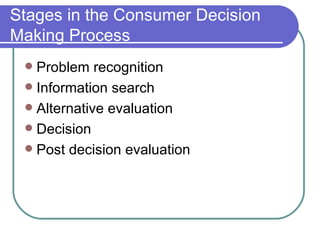
Stages in the Consumer Decision Making Process Problem recognition Information search Alternative evaluation Decision Post decision evaluation
Problem Recognition Occurs when the consumer sees a significant difference between his or her actual and ideal state. Where do we get our notion of what is ideal? personal expectations personal aspirations culture reference group marketing
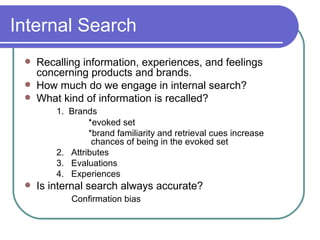
Internal Search Recalling information, experiences, and feelings concerning products and brands. How much do we engage in internal search? What kind of information is recalled? 1.  Brands  *evoked set *brand familiarity and retrieval cues increase   chances of being in the evoked set  2.  Attributes  3.  Evaluations 4.  Experiences Is internal search always accurate?   Confirmation bias
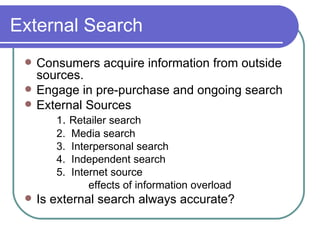
External Search Consumers acquire information from outside sources. Engage in pre-purchase and ongoing search External Sources 1 .  Retailer search 2.  Media search 3.  Interpersonal search 4.  Independent search 5.  Internet source  effects of information overload Is external search always accurate?
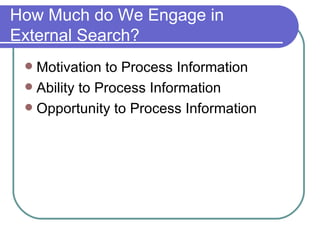
How Much do We Engage in External Search? Motivation to Process Information Ability to Process Information Opportunity to Process Information
Evaluation of Alternatives Identifying Alternatives evoked set and consideration set Identifying Evaluative Criteria  information search suggests criteria and identifies brands Evaluative criteria includes those criteria that are important to the consumer when rating product alternatives Firms try to identify evaluative criteria through market research.
Decision Consumers select and purchase the product alternative that best meets his or her evaluative criteria. Noncompensatory decision rules Compensatory decision rules
Post Decision Evaluation Process where consumer reevaluates the product as he uses it. Product performance is compared with consumer expectations. Satisfied customers Dissatisfied customers Cognitive dissonance
Low Effort Decision Making Heuristics Market Beliefs Brand Loyalty Habit Impulse Purchases Variety Seeking
Situational Influences Consumer behavior is influenced by the circumstances surrounding the purchase of a product. Social surroundings Physical surroundings Temporal effects Purchase task

Consumer Decision Making Process

  • 1.
  • 2.
    Learning Objectives Understandthe three problem solving variations and when consumers use them. Thoroughly understand each stage of the consumer decision making process. Be familiar with low effort decision making tactics. Understand how situational influences affect the decision making process.
  • 3.
    Problem Solving VariationsExtended Problem Solving High perceived risk Typically expensive, infrequently purchased products Routine Problem Solving Low perceived risk Purchases made out of habit or brand loyalty Typically inexpensive, frequently purchased product Limited Problem Solving Moderate perceived risk Consumer has limited time or energy
  • 4.
    Stages in theConsumer Decision Making Process Problem recognition Information search Alternative evaluation Decision Post decision evaluation
  • 5.
    Problem Recognition Occurswhen the consumer sees a significant difference between his or her actual and ideal state. Where do we get our notion of what is ideal? personal expectations personal aspirations culture reference group marketing
  • 6.
    Internal Search Recallinginformation, experiences, and feelings concerning products and brands. How much do we engage in internal search? What kind of information is recalled? 1. Brands *evoked set *brand familiarity and retrieval cues increase chances of being in the evoked set 2. Attributes 3. Evaluations 4. Experiences Is internal search always accurate? Confirmation bias
  • 7.
    External Search Consumersacquire information from outside sources. Engage in pre-purchase and ongoing search External Sources 1 . Retailer search 2. Media search 3. Interpersonal search 4. Independent search 5. Internet source effects of information overload Is external search always accurate?
  • 8.
    How Much doWe Engage in External Search? Motivation to Process Information Ability to Process Information Opportunity to Process Information
  • 9.
    Evaluation of AlternativesIdentifying Alternatives evoked set and consideration set Identifying Evaluative Criteria information search suggests criteria and identifies brands Evaluative criteria includes those criteria that are important to the consumer when rating product alternatives Firms try to identify evaluative criteria through market research.
  • 10.
    Decision Consumers selectand purchase the product alternative that best meets his or her evaluative criteria. Noncompensatory decision rules Compensatory decision rules
  • 11.
    Post Decision EvaluationProcess where consumer reevaluates the product as he uses it. Product performance is compared with consumer expectations. Satisfied customers Dissatisfied customers Cognitive dissonance
  • 12.
    Low Effort DecisionMaking Heuristics Market Beliefs Brand Loyalty Habit Impulse Purchases Variety Seeking
  • 13.
    Situational Influences Consumerbehavior is influenced by the circumstances surrounding the purchase of a product. Social surroundings Physical surroundings Temporal effects Purchase task