
Utility And Behavioral Factor
 Utility is define as the satisfaction derived
from the consumption of a commodity
which determines consumption and
demand behavior. As such, it is the
foundation of consumer’s behavior:
 Cultural Factors
 Social Factors
 Personal Factors
 Psychological Factors
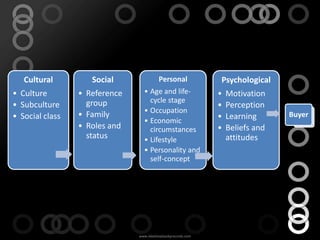
Cultural
• Culture
• Subculture
• Social class
Social
• Reference
group
• Family
• Roles and
status
Personal
• Age and life-
cycle stage
• Occupation
• Economic
circumstances
• Lifestyle
• Personality and
self-concept
Psychological
• Motivation
• Perception
• Learning
• Beliefs and
attitudes
Buyer
 Cultural Factors
Cultural Factors exert the broadest and
deepest influence on consumer
behavior. Culture is one of the most
fundamental determinant of person’s
wants and behavior. While lower
creatures are largely governed by
instinct.
 Social Factors
A consumer’s behavior is also influenced
by social factors such as the consumer’s
reference groups, family, and social roles
and statuses.
Reference Groups are those groups
that have a direct or indirect influence
on the person’s attitudes or behavior.
 Personal Factors
A buyer’s decision are also influence by
personal outward characteristic such as: the
buyer’s age and life cycle, occupation,
economic circumstances, lifestyle,
personality, and self-concept.
Psychological Factor
A Person’s purchases are also influence
by psychological factor: motivation,
perception, learning, and beliefs and
attitudes.
 Perception can be defined as the
process by which an individual selects,
organizes, and interprets information to
create meaningful picture of the world.
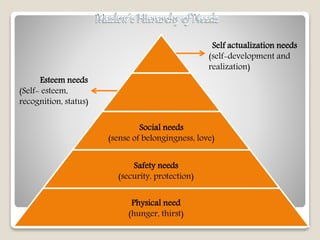
Self actualization needs
(self-development and
realization)
Esteem needs
(Self- esteem,
recognition, status)
Social needs
(sense of belongingness, love)
Safety needs
(security, protection)
Physical need
(hunger, thirst)
Hierarchy of Needs
Physical Needs – food clothing, shelter and
sleep.
 Safety needs – security, protection,
stability, freedom from fear and
anxiety, and need for structure and
limits.
 Social Needs – need for family and
friends, relationships and part of the
group.
 Esteem Needs – refer to the reaction
of the other towards, the individual,
how one views him/herself, and the
need for favorable judgment.
 Self-actualization Needs – the tendency,
in spite of the lower needs being
satisfied, to feel restless unless we
are doing what we think we are
capable of doing.
Consumer behavior

Consumer behavior

  • 2.
    Utility And BehavioralFactor  Utility is define as the satisfaction derived from the consumption of a commodity which determines consumption and demand behavior. As such, it is the foundation of consumer’s behavior:  Cultural Factors  Social Factors  Personal Factors  Psychological Factors
  • 3.
    Cultural • Culture • Subculture •Social class Social • Reference group • Family • Roles and status Personal • Age and life- cycle stage • Occupation • Economic circumstances • Lifestyle • Personality and self-concept Psychological • Motivation • Perception • Learning • Beliefs and attitudes Buyer
  • 4.
     Cultural Factors CulturalFactors exert the broadest and deepest influence on consumer behavior. Culture is one of the most fundamental determinant of person’s wants and behavior. While lower creatures are largely governed by instinct.
  • 5.
     Social Factors Aconsumer’s behavior is also influenced by social factors such as the consumer’s reference groups, family, and social roles and statuses. Reference Groups are those groups that have a direct or indirect influence on the person’s attitudes or behavior.
  • 6.
     Personal Factors Abuyer’s decision are also influence by personal outward characteristic such as: the buyer’s age and life cycle, occupation, economic circumstances, lifestyle, personality, and self-concept.
  • 7.
    Psychological Factor A Person’spurchases are also influence by psychological factor: motivation, perception, learning, and beliefs and attitudes.  Perception can be defined as the process by which an individual selects, organizes, and interprets information to create meaningful picture of the world.
  • 8.
    Self actualization needs (self-developmentand realization) Esteem needs (Self- esteem, recognition, status) Social needs (sense of belongingness, love) Safety needs (security, protection) Physical need (hunger, thirst)
  • 9.
    Hierarchy of Needs PhysicalNeeds – food clothing, shelter and sleep.  Safety needs – security, protection, stability, freedom from fear and anxiety, and need for structure and limits.  Social Needs – need for family and friends, relationships and part of the group.
  • 10.
     Esteem Needs– refer to the reaction of the other towards, the individual, how one views him/herself, and the need for favorable judgment.  Self-actualization Needs – the tendency, in spite of the lower needs being satisfied, to feel restless unless we are doing what we think we are capable of doing.