Factors influencing
Consumer Buyer Behavior
A model of consumer behaviour –
the 7 O’s framework
• Who constitute the market?
• What does the market buy?
• Why does the market buy?
• Who participates in buying?
• How does the market buy?
• When does the market buy?
• Where does the market buy?
• Occupants
• Objects
• Objectives
• Organizations
• Operations
• Occasions
• Outlets
Consumer Buying Behavior
• Consumer Buying Behavior refers to
the buying behavior of final
consumers (individuals &
households) who buy goods and
services for personal consumption.
• Study consumer behavior to answer:
“How do consumers respond to
marketing efforts the company might
use?”
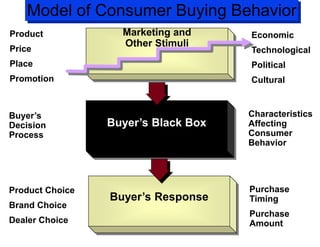
Model of Consumer Buying Behavior
Marketing and
Other Stimuli
Buyer’s Black Box
Buyer’s Response
Product
Price
Place
Promotion
Economic
Technological
Political
Cultural
Characteristics
Affecting
Consumer
Behavior
Buyer’s
Decision
Process
Product Choice
Brand Choice
Dealer Choice
Purchase
Timing
Purchase
Amount
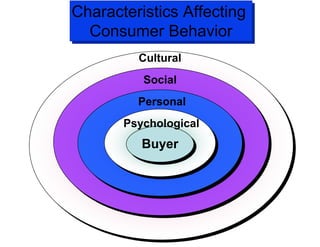
Characteristics Affecting
Consumer Behavior
Buyer
Psychological
Personal
Social
Cultural
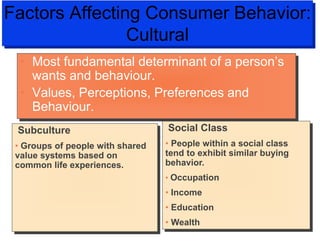
Factors Affecting Consumer Behavior:
Cultural
Social Class
• People within a social class
tend to exhibit similar buying
behavior.
• Occupation
• Income
• Education
• Wealth
• Most fundamental determinant of a person’s
wants and behaviour.
• Values, Perceptions, Preferences and
Behaviour.
Subculture
• Groups of people with shared
value systems based on
common life experiences.
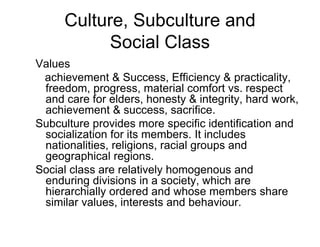
Culture, Subculture and
Social Class
Values
achievement & Success, Efficiency & practicality,
freedom, progress, material comfort vs. respect
and care for elders, honesty & integrity, hard work,
achievement & success, sacrifice.
Subculture provides more specific identification and
socialization for its members. It includes
nationalities, religions, racial groups and
geographical regions.
Social class are relatively homogenous and
enduring divisions in a society, which are
hierarchially ordered and whose members share
similar values, interests and behaviour.
Social Class- characteristics
• Tend to behave more alike than persons from
two different social classes
• Differ in dress, speech patterns, recreational
preferences
• Persons are perceived as occupying inferior or
superior positions.
• Social class is indicated bya cluster of
variables- for eg. Occupation, income, wealth,
education etc.
• Individuals can move up or down the social-
class ladder during their lifetime.
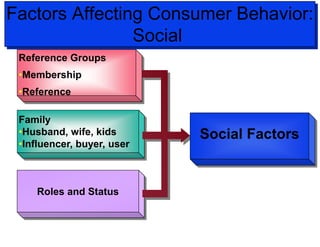
Factors Affecting Consumer Behavior:
Social
Reference Groups
•Membership
•Reference
Family
•Husband, wife, kids
•Influencer, buyer, user
Roles and Status
Social Factors
• A persons reference groups consist of all
the groups that have a direct or indirect
influence on the persons attitudes or
behaviours. Groups having a direct
influence on a person are called
membership group.
• Primary group vs. secondary group.
• Aspirational vs. dissociative groups.
• Opinion leader
• FAMILY : family of orientation and family
of procreation
• Roles and Status:
– Role consist of the activities a person is
expected to perform.
– Each role carries a status.
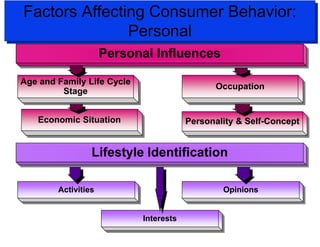
Factors Affecting Consumer Behavior:
Personal
Personal Influences
Age and Family Life Cycle
Stage
Occupation
Economic Situation
Lifestyle Identification
Activities Opinions
Interests
Personality & Self-Concept
Cultural
• Culture: the set of basic values,
perceptions, wants and behaviour
learned by a member of society from
family and other important institutions.
• Achievement and success, efficiency and
practicality, material comfort,
individualism, progress, fitness and
health, activity and involvement etc.
Cultural contd…
• Subculture: a group of people with
shared value systems based on common
life experience and situations.
• Nationalities, religions, racial groups and
geographic regions.
Cultural contd…
• Social Class: relatively permanent and
ordered divisions in a society whose
member share similar values, interests
and behaviour.
Characteristics of social class
• Persons within social class tend to behave
more alike than persons from two different
social class
• Persons are perceived as occupying inferior or
superior positions according to their social
class.
• Social class is not determined by a single
factor such as income but is measured as a
combination of occupation, income, education
and wealth.
• Individuals can move from one social class to
another-up or down during their lifetime.
• The social class may differ in their media
preferences.
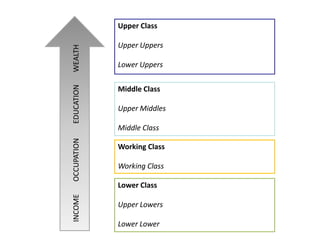
Upper Class
Upper Uppers
Lower Uppers
Middle Class
Upper Middles
Middle Class
Working Class
Working Class
Lower Class
Upper Lowers
Lower Lower
INCOME
OCCUPATION
EDUCATION
WEALTH
Social Factors
• Reference groups: a person’s reference
groups consist of all the groups that have a
direct (face to face) or indirect influence on
the person’s attitudes or behaviour. Groups
having a direct influence on a person are
called Membership Groups.
• Primary groups: family, friends, neighbours
• Secondary groups: religious, professional
• Aspiration group
• Dissociative group
• Opinion leader
Social Factors…
Family
• Family of orientation
• Family of procreation
Social Factors contd…
• Roles and Status: a role consist of the
activities that a person is expected to
perform according to the persons around
them. Each role carries a status reflecting
the general esteem given to it by the
society.
Personal Factors
• Occupation
• Economic Situation
• Lifestyle: a person’s pattern of living as
expressed in his or her activities, interest and
opinions
• Personality and Self-Concept: the unique
psychological characteristic that lead to relatively
consistent and lasting responses to one’s own
environment.
• Age and Life-cycle stage
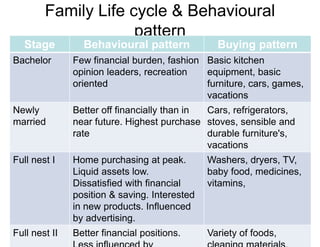
Family Life cycle & Behavioural
pattern
Stage Behavioural pattern Buying pattern
Bachelor Few financial burden, fashion
opinion leaders, recreation
oriented
Basic kitchen
equipment, basic
furniture, cars, games,
vacations
Newly
married
Better off financially than in
near future. Highest purchase
rate
Cars, refrigerators,
stoves, sensible and
durable furniture's,
vacations
Full nest I Home purchasing at peak.
Liquid assets low.
Dissatisfied with financial
position & saving. Interested
in new products. Influenced
by advertising.
Washers, dryers, TV,
baby food, medicines,
vitamins,
Full nest II Better financial positions. Variety of foods,
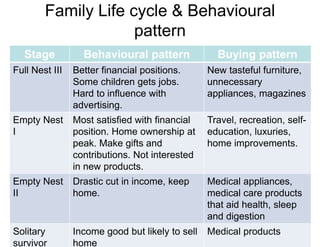
Family Life cycle & Behavioural
pattern
Stage Behavioural pattern Buying pattern
Full Nest III Better financial positions.
Some children gets jobs.
Hard to influence with
advertising.
New tasteful furniture,
unnecessary
appliances, magazines
Empty Nest
I
Most satisfied with financial
position. Home ownership at
peak. Make gifts and
contributions. Not interested
in new products.
Travel, recreation, self-
education, luxuries,
home improvements.
Empty Nest
II
Drastic cut in income, keep
home.
Medical appliances,
medical care products
that aid health, sleep
and digestion
Solitary
survivor
Income good but likely to sell
home
Medical products
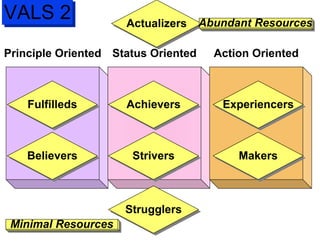
VALS 2
Principle Oriented Status Oriented Action Oriented
Achievers
Actualizers
Strugglers
Strivers
Fulfilleds
Believers
Experiencers
Makers
Abundant Resources
Minimal Resources
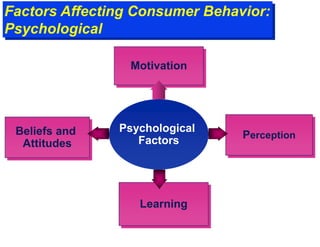
Factors Affecting Consumer Behavior:
Psychological
Psychological
Factors
Motivation
Perception
Learning
Beliefs and
Attitudes
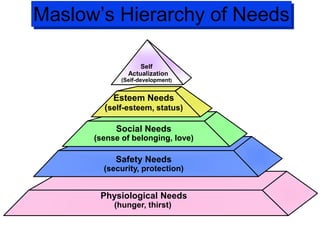
Maslow’s Hierarchy of Needs
Esteem Needs
(self-esteem, status)
Social Needs
(sense of belonging, love)
Safety Needs
(security, protection)
Physiological Needs
(hunger, thirst)
Self
Actualization
(Self-development)
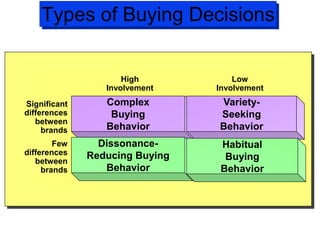
Types of Buying Decisions
Complex
Buying
Behavior
Dissonance-
Reducing Buying
Behavior
Variety-
Seeking
Behavior
Habitual
Buying
Behavior
High
Involvement
Significant
differences
between
brands
Few
differences
between
brands
Low
Involvement
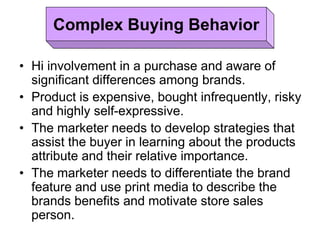
• Hi involvement in a purchase and aware of
significant differences among brands.
• Product is expensive, bought infrequently, risky
and highly self-expressive.
• The marketer needs to develop strategies that
assist the buyer in learning about the products
attribute and their relative importance.
• The marketer needs to differentiate the brand
feature and use print media to describe the
brands benefits and motivate store sales
person.
Complex Buying Behavior
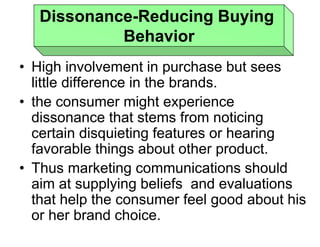
• High involvement in purchase but sees
little difference in the brands.
• the consumer might experience
dissonance that stems from noticing
certain disquieting features or hearing
favorable things about other product.
• Thus marketing communications should
aim at supplying beliefs and evaluations
that help the consumer feel good about his
or her brand choice.
Dissonance-Reducing Buying
Behavior
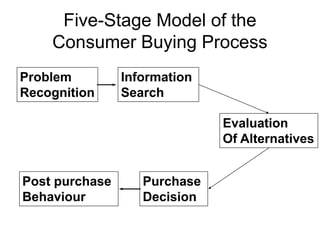
Five-Stage Model of the
Consumer Buying Process
Problem
Recognition
Information
Search
Evaluation
Of Alternatives
Post purchase
Behaviour
Purchase
Decision
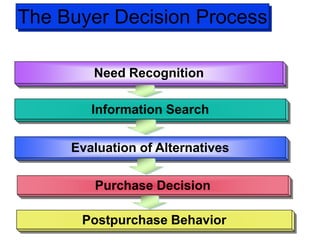
The Buyer Decision Process
Need Recognition
Information Search
Evaluation of Alternatives
Purchase Decision
Postpurchase Behavior
The Buyer Decision Process
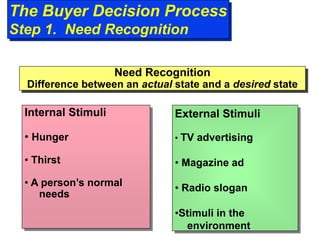
Step 1. Need Recognition
External Stimuli
• TV advertising
• Magazine ad
• Radio slogan
•Stimuli in the
environment
Internal Stimuli
• Hunger
• Thirst
• A person’s normal
needs
Need Recognition
Difference between an actual state and a desired state
The Buyer Decision Process
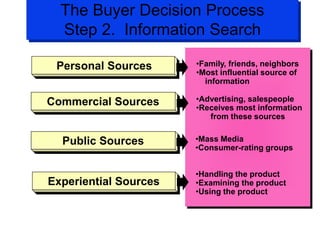
Step 2. Information Search
•Family, friends, neighbors
•Most influential source of
information
•Advertising, salespeople
•Receives most information
from these sources
•Mass Media
•Consumer-rating groups
•Handling the product
•Examining the product
•Using the product
Personal Sources
Commercial Sources
Public Sources
Experiential Sources
The Buyer Decision Process
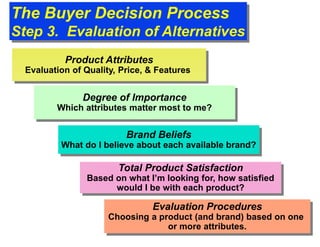
Step 3. Evaluation of Alternatives
Product Attributes
Evaluation of Quality, Price, & Features
Degree of Importance
Which attributes matter most to me?
Brand Beliefs
What do I believe about each available brand?
Total Product Satisfaction
Based on what I’m looking for, how satisfied
would I be with each product?
Evaluation Procedures
Choosing a product (and brand) based on one
or more attributes.
The Buyer Decision Process
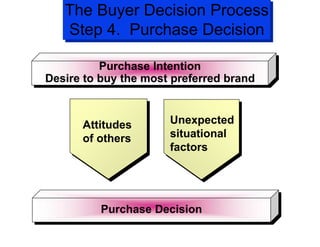
Step 4. Purchase Decision
Purchase Intention
Desire to buy the most preferred brand
Purchase Decision
Attitudes
of others
Unexpected
situational
factors
The Buyer Decision Process
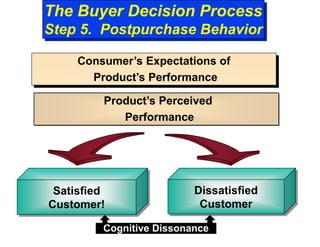
Step 5. Postpurchase Behavior
Consumer’s Expectations of
Product’s Performance
Dissatisfied
Customer
Satisfied
Customer!
Product’s Perceived
Performance
Cognitive Dissonance
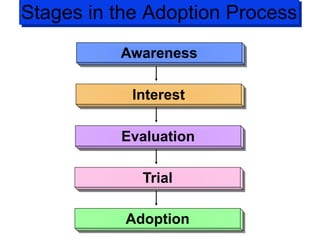
Stages in the Adoption Process
Awareness
Interest
Evaluation
Trial
Adoption
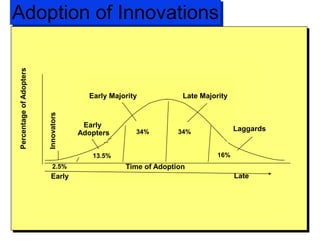
Adoption of Innovations
Percentage
of
Adopters
Time of Adoption
Early Late
Innovators
Early
Adopters
Early Majority
2.5%
13.5%
34% 34%
16%
Laggards
Late Majority
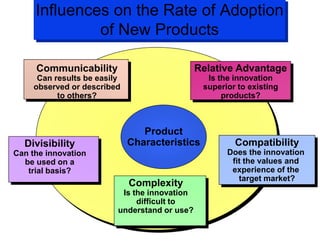
Influences on the Rate of Adoption
of New Products
Divisibility
Can the innovation
be used on a
trial basis?
Compatibility
Does the innovation
fit the values and
experience of the
target market?
Complexity
Is the innovation
difficult to
understand or use?
Relative Advantage
Is the innovation
superior to existing
products?
Communicability
Can results be easily
observed or described
to others?
Product
Characteristics

Consumer Behaviour- Factors influencing CB.ppt

  • 1.
  • 2.
    A model ofconsumer behaviour – the 7 O’s framework • Who constitute the market? • What does the market buy? • Why does the market buy? • Who participates in buying? • How does the market buy? • When does the market buy? • Where does the market buy?
  • 3.
    • Occupants • Objects •Objectives • Organizations • Operations • Occasions • Outlets
  • 4.
    Consumer Buying Behavior •Consumer Buying Behavior refers to the buying behavior of final consumers (individuals & households) who buy goods and services for personal consumption. • Study consumer behavior to answer: “How do consumers respond to marketing efforts the company might use?”
  • 5.
    Model of ConsumerBuying Behavior Marketing and Other Stimuli Buyer’s Black Box Buyer’s Response Product Price Place Promotion Economic Technological Political Cultural Characteristics Affecting Consumer Behavior Buyer’s Decision Process Product Choice Brand Choice Dealer Choice Purchase Timing Purchase Amount
  • 6.
  • 7.
    Factors Affecting ConsumerBehavior: Cultural Social Class • People within a social class tend to exhibit similar buying behavior. • Occupation • Income • Education • Wealth • Most fundamental determinant of a person’s wants and behaviour. • Values, Perceptions, Preferences and Behaviour. Subculture • Groups of people with shared value systems based on common life experiences.
  • 8.
    Culture, Subculture and SocialClass Values achievement & Success, Efficiency & practicality, freedom, progress, material comfort vs. respect and care for elders, honesty & integrity, hard work, achievement & success, sacrifice. Subculture provides more specific identification and socialization for its members. It includes nationalities, religions, racial groups and geographical regions. Social class are relatively homogenous and enduring divisions in a society, which are hierarchially ordered and whose members share similar values, interests and behaviour.
  • 9.
    Social Class- characteristics •Tend to behave more alike than persons from two different social classes • Differ in dress, speech patterns, recreational preferences • Persons are perceived as occupying inferior or superior positions. • Social class is indicated bya cluster of variables- for eg. Occupation, income, wealth, education etc. • Individuals can move up or down the social- class ladder during their lifetime.
  • 10.
    Factors Affecting ConsumerBehavior: Social Reference Groups •Membership •Reference Family •Husband, wife, kids •Influencer, buyer, user Roles and Status Social Factors
  • 11.
    • A personsreference groups consist of all the groups that have a direct or indirect influence on the persons attitudes or behaviours. Groups having a direct influence on a person are called membership group. • Primary group vs. secondary group. • Aspirational vs. dissociative groups. • Opinion leader
  • 12.
    • FAMILY :family of orientation and family of procreation • Roles and Status: – Role consist of the activities a person is expected to perform. – Each role carries a status.
  • 13.
    Factors Affecting ConsumerBehavior: Personal Personal Influences Age and Family Life Cycle Stage Occupation Economic Situation Lifestyle Identification Activities Opinions Interests Personality & Self-Concept
  • 14.
    Cultural • Culture: theset of basic values, perceptions, wants and behaviour learned by a member of society from family and other important institutions. • Achievement and success, efficiency and practicality, material comfort, individualism, progress, fitness and health, activity and involvement etc.
  • 15.
    Cultural contd… • Subculture:a group of people with shared value systems based on common life experience and situations. • Nationalities, religions, racial groups and geographic regions.
  • 16.
    Cultural contd… • SocialClass: relatively permanent and ordered divisions in a society whose member share similar values, interests and behaviour.
  • 17.
    Characteristics of socialclass • Persons within social class tend to behave more alike than persons from two different social class • Persons are perceived as occupying inferior or superior positions according to their social class. • Social class is not determined by a single factor such as income but is measured as a combination of occupation, income, education and wealth. • Individuals can move from one social class to another-up or down during their lifetime. • The social class may differ in their media preferences.
  • 18.
    Upper Class Upper Uppers LowerUppers Middle Class Upper Middles Middle Class Working Class Working Class Lower Class Upper Lowers Lower Lower INCOME OCCUPATION EDUCATION WEALTH
  • 19.
    Social Factors • Referencegroups: a person’s reference groups consist of all the groups that have a direct (face to face) or indirect influence on the person’s attitudes or behaviour. Groups having a direct influence on a person are called Membership Groups. • Primary groups: family, friends, neighbours • Secondary groups: religious, professional • Aspiration group • Dissociative group • Opinion leader
  • 20.
    Social Factors… Family • Familyof orientation • Family of procreation
  • 21.
    Social Factors contd… •Roles and Status: a role consist of the activities that a person is expected to perform according to the persons around them. Each role carries a status reflecting the general esteem given to it by the society.
  • 22.
    Personal Factors • Occupation •Economic Situation • Lifestyle: a person’s pattern of living as expressed in his or her activities, interest and opinions • Personality and Self-Concept: the unique psychological characteristic that lead to relatively consistent and lasting responses to one’s own environment. • Age and Life-cycle stage
  • 23.
    Family Life cycle& Behavioural pattern Stage Behavioural pattern Buying pattern Bachelor Few financial burden, fashion opinion leaders, recreation oriented Basic kitchen equipment, basic furniture, cars, games, vacations Newly married Better off financially than in near future. Highest purchase rate Cars, refrigerators, stoves, sensible and durable furniture's, vacations Full nest I Home purchasing at peak. Liquid assets low. Dissatisfied with financial position & saving. Interested in new products. Influenced by advertising. Washers, dryers, TV, baby food, medicines, vitamins, Full nest II Better financial positions. Variety of foods,
  • 24.
    Family Life cycle& Behavioural pattern Stage Behavioural pattern Buying pattern Full Nest III Better financial positions. Some children gets jobs. Hard to influence with advertising. New tasteful furniture, unnecessary appliances, magazines Empty Nest I Most satisfied with financial position. Home ownership at peak. Make gifts and contributions. Not interested in new products. Travel, recreation, self- education, luxuries, home improvements. Empty Nest II Drastic cut in income, keep home. Medical appliances, medical care products that aid health, sleep and digestion Solitary survivor Income good but likely to sell home Medical products
  • 25.
    VALS 2 Principle OrientedStatus Oriented Action Oriented Achievers Actualizers Strugglers Strivers Fulfilleds Believers Experiencers Makers Abundant Resources Minimal Resources
  • 26.
    Factors Affecting ConsumerBehavior: Psychological Psychological Factors Motivation Perception Learning Beliefs and Attitudes
  • 27.
    Maslow’s Hierarchy ofNeeds Esteem Needs (self-esteem, status) Social Needs (sense of belonging, love) Safety Needs (security, protection) Physiological Needs (hunger, thirst) Self Actualization (Self-development)
  • 28.
    Types of BuyingDecisions Complex Buying Behavior Dissonance- Reducing Buying Behavior Variety- Seeking Behavior Habitual Buying Behavior High Involvement Significant differences between brands Few differences between brands Low Involvement
  • 29.
    • Hi involvementin a purchase and aware of significant differences among brands. • Product is expensive, bought infrequently, risky and highly self-expressive. • The marketer needs to develop strategies that assist the buyer in learning about the products attribute and their relative importance. • The marketer needs to differentiate the brand feature and use print media to describe the brands benefits and motivate store sales person. Complex Buying Behavior
  • 30.
    • High involvementin purchase but sees little difference in the brands. • the consumer might experience dissonance that stems from noticing certain disquieting features or hearing favorable things about other product. • Thus marketing communications should aim at supplying beliefs and evaluations that help the consumer feel good about his or her brand choice. Dissonance-Reducing Buying Behavior
  • 31.
    Five-Stage Model ofthe Consumer Buying Process Problem Recognition Information Search Evaluation Of Alternatives Post purchase Behaviour Purchase Decision
  • 32.
    The Buyer DecisionProcess Need Recognition Information Search Evaluation of Alternatives Purchase Decision Postpurchase Behavior
  • 33.
    The Buyer DecisionProcess Step 1. Need Recognition External Stimuli • TV advertising • Magazine ad • Radio slogan •Stimuli in the environment Internal Stimuli • Hunger • Thirst • A person’s normal needs Need Recognition Difference between an actual state and a desired state
  • 34.
    The Buyer DecisionProcess Step 2. Information Search •Family, friends, neighbors •Most influential source of information •Advertising, salespeople •Receives most information from these sources •Mass Media •Consumer-rating groups •Handling the product •Examining the product •Using the product Personal Sources Commercial Sources Public Sources Experiential Sources
  • 35.
    The Buyer DecisionProcess Step 3. Evaluation of Alternatives Product Attributes Evaluation of Quality, Price, & Features Degree of Importance Which attributes matter most to me? Brand Beliefs What do I believe about each available brand? Total Product Satisfaction Based on what I’m looking for, how satisfied would I be with each product? Evaluation Procedures Choosing a product (and brand) based on one or more attributes.
  • 36.
    The Buyer DecisionProcess Step 4. Purchase Decision Purchase Intention Desire to buy the most preferred brand Purchase Decision Attitudes of others Unexpected situational factors
  • 37.
    The Buyer DecisionProcess Step 5. Postpurchase Behavior Consumer’s Expectations of Product’s Performance Dissatisfied Customer Satisfied Customer! Product’s Perceived Performance Cognitive Dissonance
  • 38.
    Stages in theAdoption Process Awareness Interest Evaluation Trial Adoption
  • 39.
    Adoption of Innovations Percentage of Adopters Timeof Adoption Early Late Innovators Early Adopters Early Majority 2.5% 13.5% 34% 34% 16% Laggards Late Majority
  • 40.
    Influences on theRate of Adoption of New Products Divisibility Can the innovation be used on a trial basis? Compatibility Does the innovation fit the values and experience of the target market? Complexity Is the innovation difficult to understand or use? Relative Advantage Is the innovation superior to existing products? Communicability Can results be easily observed or described to others? Product Characteristics