THE BASIC ECONOMIC 
PROBLEM 
SCARCITY, CHOICE AND 
OPPORTUNITY COST 
23/10/09 DAVID AKO (DE MEANEST)
The Basic Economic Problem 
• Key Lesson Objectives 
• Differentiate between needs and wants 
• Explain the basic economic problem 
• Define opportunity cost and illustrate the concept 
with examples 
• Identify and explain the classification of resources in 
economics 
• Define economics 
• Discuss the importance of studying economics 
• Use PPF to illustrate the concept of opportunity cost 
23/10/09 DAVID AKO (DE MEANEST)
Needs and Wants 
• Needs – the necessities of life e.g. Food, 
clothing, shelter, warmth, medical care 
• Wants – those things that make life enjoyable 
and pleasurable e.g. Designer clothes, cars, 
mansions 
Class Discussion: 
• Do needs and wants change over time? 
• Why is man never satisfied with material 
possessions? 
• Human wants are infinite/insatiable/unlimited 
23/10/09 DAVID AKO (DE MEANEST)
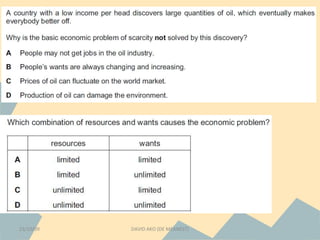
• Every need or want can be satisfied through the 
consumption of a good or service 
• Goods and services are produced with resources 
( factors of production) which are finite and 
have alternative uses. 
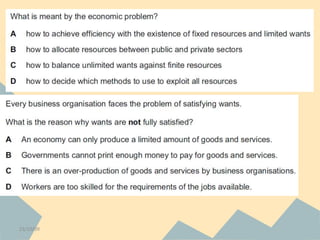
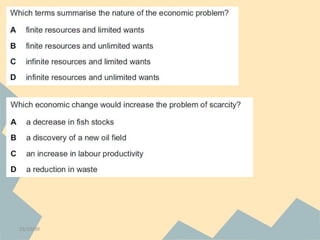
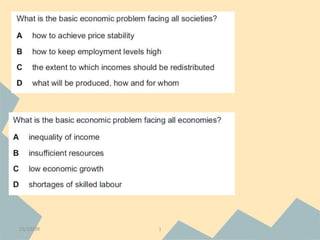
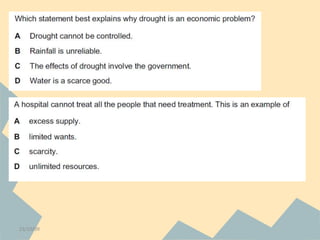
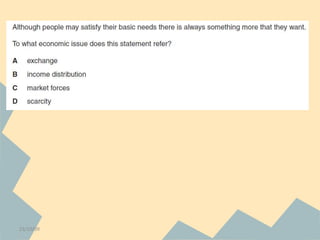
• The Basic /Fundamental economic problem is 
the scarcity of resources relative to human 
needs and wants 
a. Finite resources vrs infinite needs and wants 
b. Limited resources vrs unlimited needs and 
wants 
23/10/09 DAVID AKO (DE MEANEST)
23/10/09
23/10/09
23/10/09 )
23/10/09
23/10/09
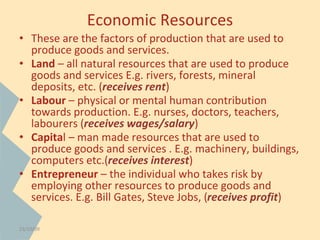
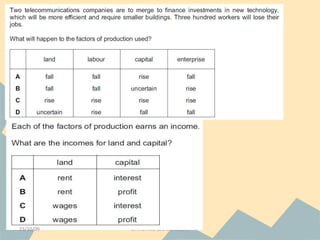
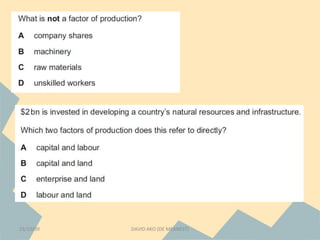
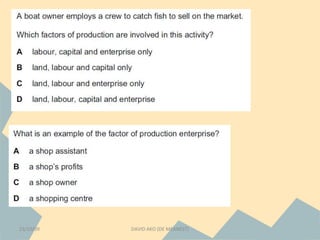
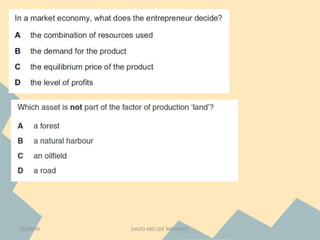
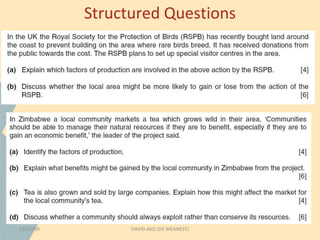
Economic Resources 
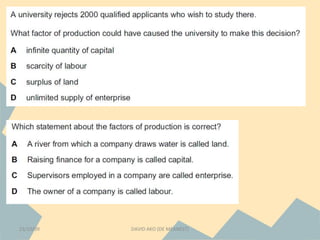
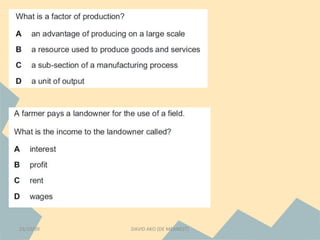
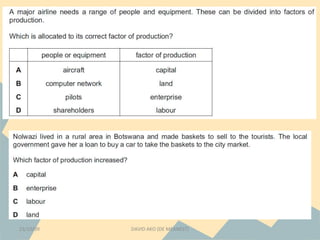
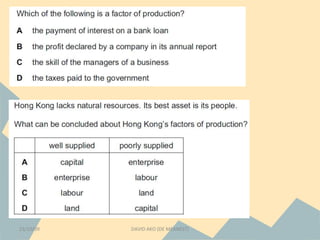
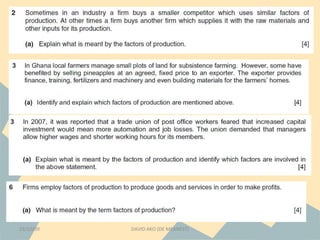
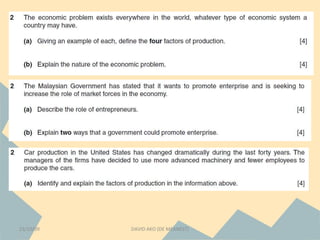
• These are the factors of production that are used to 
produce goods and services. 
• Land – all natural resources that are used to produce 
goods and services E.g. rivers, forests, mineral 
deposits, etc. (receives rent) 
• Labour – physical or mental human contribution 
towards production. E.g. nurses, doctors, teachers, 
labourers (receives wages/salary) 
• Capital – man made resources that are used to 
produce goods and services . E.g. machinery, buildings, 
computers etc.(receives interest) 
• Entrepreneur – the individual who takes risk by 
employing other resources to produce goods and 
services. E.g. Bill Gates, Steve Jobs, (receives profit) 
23/10/09
23/10/09 DAVID AKO (DE MEANEST)
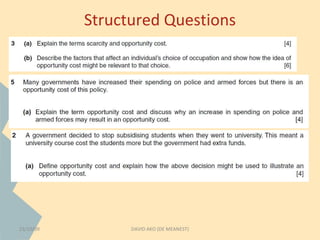
Structured Questions 
23/10/09 DAVID AKO (DE MEANEST)
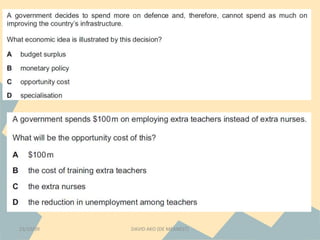
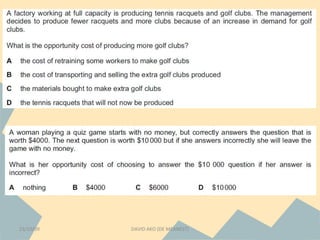
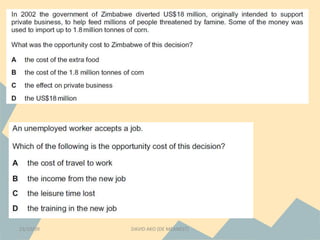
Choice and Opportunity Cost 
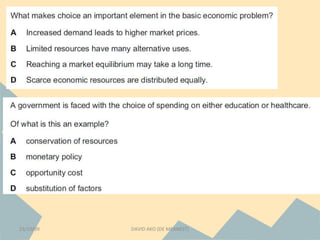
• Choice is imperative because of scarcity 
• The exercise of choice implies the sacrifice or 
forgoing of some other need or want 
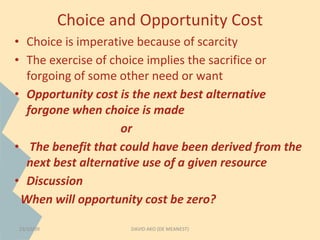
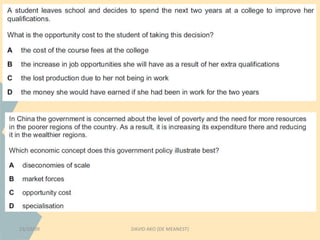
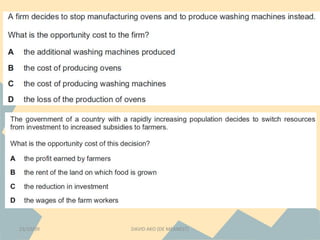
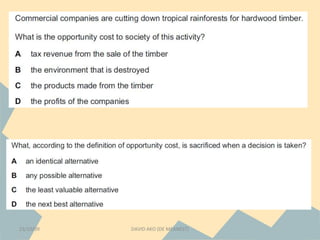
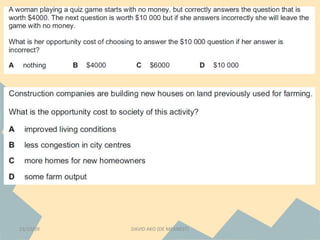
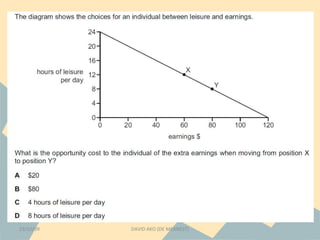
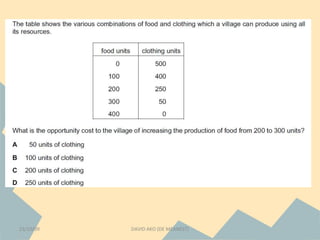
• Opportunity cost is the next best alternative 
forgone when choice is made 
or 
• The benefit that could have been derived from the 
next best alternative use of a given resource 
• Discussion 
When will opportunity cost be zero? 
23/10/09 DAVID AKO (DE MEANEST)
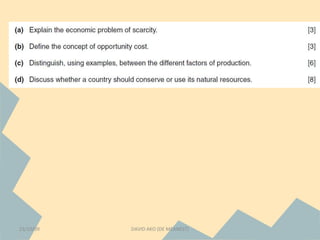
Structured Questions 
23/10/09 DAVID AKO (DE MEANEST)
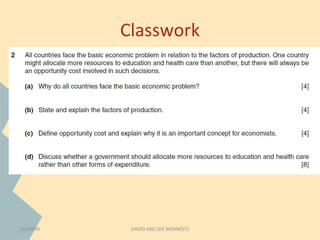
Classwork 
23/10/09 DAVID AKO (DE MEANEST)
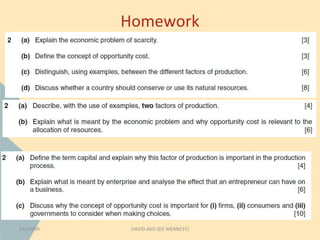
Homework 
23/10/09 DAVID AKO (DE MEANEST)
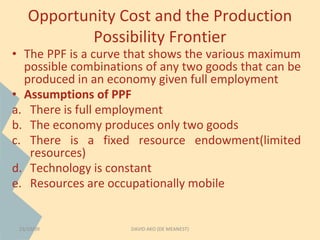
Opportunity Cost and the Production 
Possibility Frontier 
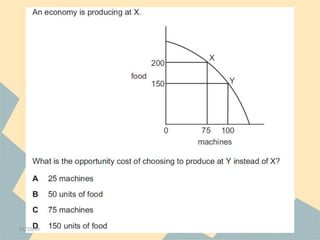
• The PPF is a curve that shows the various maximum 
possible combinations of any two goods that can be 
produced in an economy given full employment 
• Assumptions of PPF 
a. There is full employment 
b. The economy produces only two goods 
c. There is a fixed resource endowment(limited 
resources) 
d. Technology is constant 
e. Resources are occupationally mobile 
23/10/09 DAVID AKO (DE MEANEST)
Illustration of PPF 
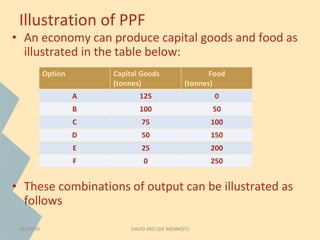
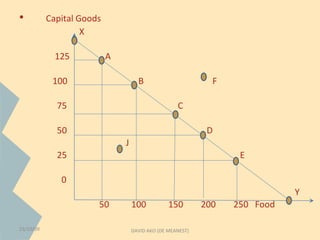
• An economy can produce capital goods and food as 
illustrated in the table below: 
Option Capital Goods 
(tonnes) 
• These combinations of output can be illustrated as 
follows 
DAVID AKO (DE MEANEST) 
Food 
(tonnes) 
A 125 0 
B 100 50 
C 75 100 
D 50 150 
E 25 200 
F 0 250 
23/10/09
• Capital Goods 
X 
125 A 
100 B F 
75 C 
50 D 
J 
25 E 
0 
Y 
50 100 150 200 250 Food 
23/10/09 DAVID AKO (DE MEANEST)
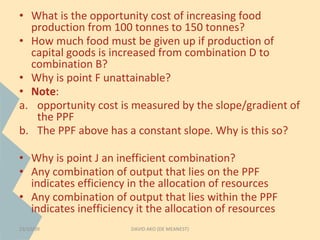
• What is the opportunity cost of increasing food 
production from 100 tonnes to 150 tonnes? 
• How much food must be given up if production of 
capital goods is increased from combination D to 
combination B? 
• Why is point F unattainable? 
• Note: 
a. opportunity cost is measured by the slope/gradient of 
the PPF 
b. The PPF above has a constant slope. Why is this so? 
• Why is point J an inefficient combination? 
• Any combination of output that lies on the PPF 
indicates efficiency in the allocation of resources 
• Any combination of output that lies within the PPF 
indicates inefficiency it the allocation of resources 
23/10/09 DAVID AKO (DE MEANEST)
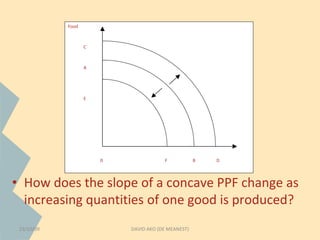
• How does the slope of a concave PPF change as 
increasing quantities of one good is produced? 
DAVID AKO (DE MEANEST) 
Food 
C 
A 
E 
0 F B D 
23/10/09
Shifts in the PPF 
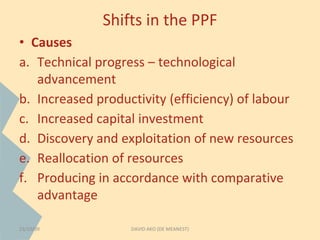
• Causes 
a. Technical progress – technological 
advancement 
b. Increased productivity (efficiency) of labour 
c. Increased capital investment 
d. Discovery and exploitation of new resources 
e. Reallocation of resources 
f. Producing in accordance with comparative 
advantage 
23/10/09 DAVID AKO (DE MEANEST)

Basic Economic Problems

  • 1.
    THE BASIC ECONOMIC PROBLEM SCARCITY, CHOICE AND OPPORTUNITY COST 23/10/09 DAVID AKO (DE MEANEST)
  • 2.
    The Basic EconomicProblem • Key Lesson Objectives • Differentiate between needs and wants • Explain the basic economic problem • Define opportunity cost and illustrate the concept with examples • Identify and explain the classification of resources in economics • Define economics • Discuss the importance of studying economics • Use PPF to illustrate the concept of opportunity cost 23/10/09 DAVID AKO (DE MEANEST)
  • 3.
    Needs and Wants • Needs – the necessities of life e.g. Food, clothing, shelter, warmth, medical care • Wants – those things that make life enjoyable and pleasurable e.g. Designer clothes, cars, mansions Class Discussion: • Do needs and wants change over time? • Why is man never satisfied with material possessions? • Human wants are infinite/insatiable/unlimited 23/10/09 DAVID AKO (DE MEANEST)
  • 4.
    • Every needor want can be satisfied through the consumption of a good or service • Goods and services are produced with resources ( factors of production) which are finite and have alternative uses. • The Basic /Fundamental economic problem is the scarcity of resources relative to human needs and wants a. Finite resources vrs infinite needs and wants b. Limited resources vrs unlimited needs and wants 23/10/09 DAVID AKO (DE MEANEST)
  • 5.
    23/10/09 DAVID AKO(DE MEANEST)
  • 6.
  • 7.
  • 8.
  • 9.
  • 10.
  • 11.
    Economic Resources •These are the factors of production that are used to produce goods and services. • Land – all natural resources that are used to produce goods and services E.g. rivers, forests, mineral deposits, etc. (receives rent) • Labour – physical or mental human contribution towards production. E.g. nurses, doctors, teachers, labourers (receives wages/salary) • Capital – man made resources that are used to produce goods and services . E.g. machinery, buildings, computers etc.(receives interest) • Entrepreneur – the individual who takes risk by employing other resources to produce goods and services. E.g. Bill Gates, Steve Jobs, (receives profit) 23/10/09
  • 12.
    23/10/09 DAVID AKO(DE MEANEST)
  • 13.
    23/10/09 DAVID AKO(DE MEANEST)
  • 14.
    23/10/09 DAVID AKO(DE MEANEST)
  • 15.
    23/10/09 DAVID AKO(DE MEANEST)
  • 16.
    23/10/09 DAVID AKO(DE MEANEST)
  • 17.
    23/10/09 DAVID AKO(DE MEANEST)
  • 18.
    23/10/09 DAVID AKO(DE MEANEST)
  • 19.
    23/10/09 DAVID AKO(DE MEANEST)
  • 20.
    Structured Questions 23/10/09DAVID AKO (DE MEANEST)
  • 21.
    23/10/09 DAVID AKO(DE MEANEST)
  • 22.
    23/10/09 DAVID AKO(DE MEANEST)
  • 23.
    Choice and OpportunityCost • Choice is imperative because of scarcity • The exercise of choice implies the sacrifice or forgoing of some other need or want • Opportunity cost is the next best alternative forgone when choice is made or • The benefit that could have been derived from the next best alternative use of a given resource • Discussion When will opportunity cost be zero? 23/10/09 DAVID AKO (DE MEANEST)
  • 24.
    23/10/09 DAVID AKO(DE MEANEST)
  • 25.
    23/10/09 DAVID AKO(DE MEANEST)
  • 26.
    23/10/09 DAVID AKO(DE MEANEST)
  • 27.
    23/10/09 DAVID AKO(DE MEANEST)
  • 28.
    23/10/09 DAVID AKO(DE MEANEST)
  • 29.
    23/10/09 DAVID AKO(DE MEANEST)
  • 30.
    23/10/09 DAVID AKO(DE MEANEST)
  • 31.
    23/10/09 DAVID AKO(DE MEANEST)
  • 32.
    Structured Questions 23/10/09DAVID AKO (DE MEANEST)
  • 33.
    Classwork 23/10/09 DAVIDAKO (DE MEANEST)
  • 34.
    23/10/09 DAVID AKO(DE MEANEST)
  • 35.
    Homework 23/10/09 DAVIDAKO (DE MEANEST)
  • 36.
    Opportunity Cost andthe Production Possibility Frontier • The PPF is a curve that shows the various maximum possible combinations of any two goods that can be produced in an economy given full employment • Assumptions of PPF a. There is full employment b. The economy produces only two goods c. There is a fixed resource endowment(limited resources) d. Technology is constant e. Resources are occupationally mobile 23/10/09 DAVID AKO (DE MEANEST)
  • 37.
    Illustration of PPF • An economy can produce capital goods and food as illustrated in the table below: Option Capital Goods (tonnes) • These combinations of output can be illustrated as follows DAVID AKO (DE MEANEST) Food (tonnes) A 125 0 B 100 50 C 75 100 D 50 150 E 25 200 F 0 250 23/10/09
  • 38.
    • Capital Goods X 125 A 100 B F 75 C 50 D J 25 E 0 Y 50 100 150 200 250 Food 23/10/09 DAVID AKO (DE MEANEST)
  • 39.
    • What isthe opportunity cost of increasing food production from 100 tonnes to 150 tonnes? • How much food must be given up if production of capital goods is increased from combination D to combination B? • Why is point F unattainable? • Note: a. opportunity cost is measured by the slope/gradient of the PPF b. The PPF above has a constant slope. Why is this so? • Why is point J an inefficient combination? • Any combination of output that lies on the PPF indicates efficiency in the allocation of resources • Any combination of output that lies within the PPF indicates inefficiency it the allocation of resources 23/10/09 DAVID AKO (DE MEANEST)
  • 40.
    23/10/09 DAVID AKO(DE MEANEST)
  • 41.
    23/10/09 DAVID AKO(DE MEANEST)
  • 42.
    23/10/09 DAVID AKO(DE MEANEST)
  • 43.
    • How doesthe slope of a concave PPF change as increasing quantities of one good is produced? DAVID AKO (DE MEANEST) Food C A E 0 F B D 23/10/09
  • 44.
    Shifts in thePPF • Causes a. Technical progress – technological advancement b. Increased productivity (efficiency) of labour c. Increased capital investment d. Discovery and exploitation of new resources e. Reallocation of resources f. Producing in accordance with comparative advantage 23/10/09 DAVID AKO (DE MEANEST)