Chapter 9

   Monopoly
The Monopoly Market Structure
   What is a monopoly exactly?
       A monopoly is a market structure characterized by:
           A single seller
           A unique product
           Impossible entry into the market
   Under a monopoly, the consumer has only one choice.
    Thus, they can either buy from the producer or not
    consume
   There are no close substitutes.
A Single Seller
   One single firm IS the industry.

   Local monopolies are more commonly observed in the
    real-world than national monopolies.
       Examples
Unique Products
 Why    do Monopolists have unique products?
    Absence of close substitutes
Impossible Entry
   Barriers to Entry are high
       It is different or impossible for a new firm to enter an industry
        due to:
           Ownership of Vital Resources
           Legal Barriers
           Economies of Scale
Ownership of Vital Resources

   A seller can create its own barrier to entry if it owns a
    significant portion of a key resource required for the
    production of the good or service.

   In practice, monopolies rarely arise for this reason. The
    market for most resources is national or even
    international, and ownership of most resources is
    dispersed among a large number of people and nations.
   Example
Legal Barriers
   Legal barriers to entry are the source of most present-
    day monopolies.

   Entry into the market or competition within the market
    are restricted by the granting of a public franchise,
    government license, patent, or copyright.
   Examples:
Economies of Scale
   Monopolies can emerge in time naturally because of the
    relationship between average cost and the scale of the
    operation.
   This is called “natural monopolies”
       Def: A natural monopoly is an industry in which the LRAC of
        production declines throughout the entire market.
       Natural monopoly provides an economic argument for
        regulated public utilities.
Economies of Scale
   When this happens a single firm can supply the entire
    market demand at a lower cost than two or more
    smaller firms.


   Markets characterized by economies of scale often
    become competitive over time because of technological
    advances or because of natural growth in the size of the
    market.
SOURCES OF MONOPOLY
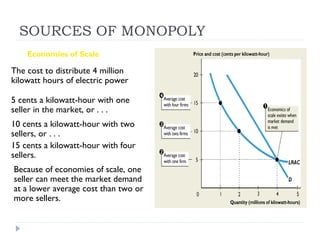
    Economies of Scale

The cost to distribute 4 million
kilowatt hours of electric power is

5 cents a kilowatt-hour with one
seller in the market, or . . .
10 cents a kilowatt-hour with two
sellers, or . . .
15 cents a kilowatt-hour with four
sellers.
Because of economies of scale, one
seller can meet the market demand
at a lower average cost than two or
more sellers.
Price and Output Decisions for a Monopolist
   The demand curve for a monopolist differs from the
    competitive firm because the monopolist is a price maker
    not taker.
       Def: A price maker is a firm that faces a downward sloping
        demand curve.
More Demand and some Marginal Revenue
    Demand and Marginal Revenue
        They are both negatively-sloped

    Demand
        Market demand is negatively-sloped. The monopolist faces
         a tradeoff between price and quantity sold.
        To obtain a higher price, the monopolist must lower
         quantity. Or, if it wants to sell a larger quantity, it must
         lower price.
MONOPOLY EQUILIBRIUM
   Demand and Marginal Revenue

       Marginal revenue is less than price

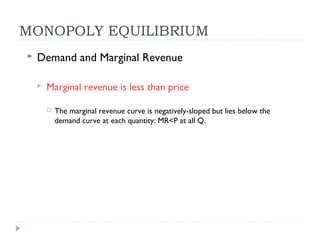
           The marginal revenue curve is negatively-sloped but lies below the
            demand curve at each quantity: MR<P at all Q.
MONOPOLY EQUILIBRIUM
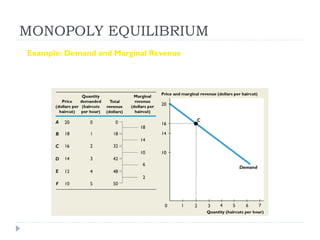
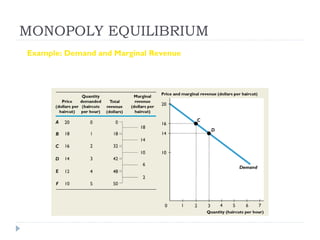
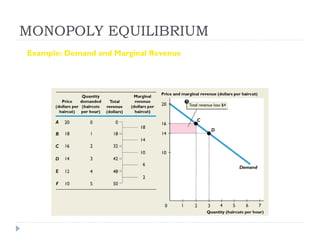
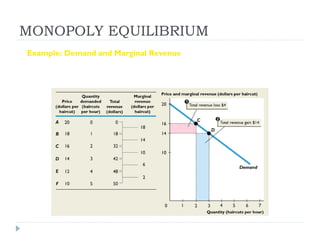
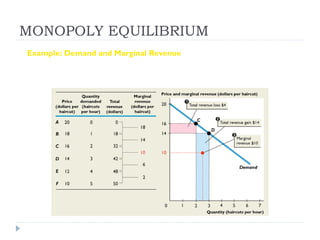
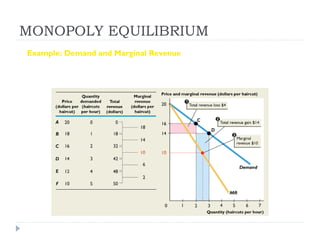
Example: Demand and Marginal Revenue

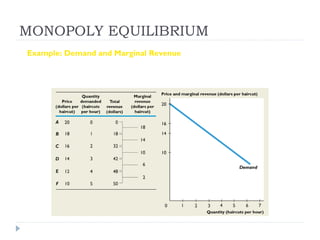
Calculate the marginal revenue generated along the demand curve.
MONOPOLY EQUILIBRIUM
Example: Demand and Marginal Revenue

If the price is $16, quantity demanded is 2 haircuts per hour.
MONOPOLY EQUILIBRIUM
Example: Demand and Marginal Revenue

If the price is $14, quantity demanded is 3 haircuts per hour.
MONOPOLY EQUILIBRIUM
Example: Demand and Marginal Revenue

Total revenue from two haircuts per hour decreases by $4.
MONOPOLY EQUILIBRIUM
Example: Demand and Marginal Revenue

Total revenue from the additional haircut is $14.
MONOPOLY EQUILIBRIUM
Example: Demand and Marginal Revenue

Marginal revenue from the additional haircut is $10.
MONOPOLY EQUILIBRIUM
Example: Demand and Marginal Revenue

The marginal revenue curve is negatively-sloped and lies below the
demand curve. Marginal revenue is less than price at each quantity.
MONOPOLY EQUILIBRIUM
Profit Maximization by a
Monopolist


The diagram shows the
monopolist’s
• average total cost (ATC),
• marginal cost (MC),
• demand (D),
• and marginal revenue (MR).

The monopolist maximizes profits
or minimizes losses by producing
the quantity at which marginal
revenue equals marginal cost.
MONOPOLY EQUILIBRIUM
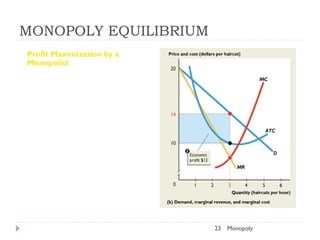
Profit Maximization by a
Monopolist


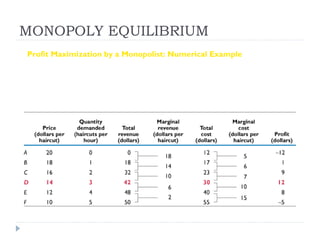
The equilibrium quantity is 3
haircuts per hour where MR=MC,
and
the equilibrium price is $14, shown
by the demand at the quantity 3.

The ATC of 3 haircuts is $10.

Because P>ATC at the equilibrium
quantity, the monopolist earns a
profit of $4 per haircut or $12 per
hour.

                                      23   Monopoly
MONOPOLY EQUILIBRIUM
Profit Maximization by a Monopolist: Numerical Example


The data in the table below verify that 3 haircuts per hour maximizes the
monopolist’s profit.
MONOPOLY EQUILIBRIUM
   Short-Run and Long-Run Equilibrium

       When a monopolist incurs short-run losses

           However, if a monopolist incurs economic losses in the short-
            run, it exits the market in the long-run. The long-run equilibrium
            quantity is zero.
MONOPOLY EQUILIBRIUM
   Short-Run and Long-Run Equilibrium

       When a monopolist earns short-run profits
Price Discrimination
   The monopolist may charge different prices to
    consumers to maximize profits.
       Def: Price discrimination occurs when a seller charges
        different prices for the same product that are not justified by
        cost differences.
       Selling a good or service at a number of different prices where
        the price differences do not reflect differences in cost but instead
        reflect differences in consumers’ price elasticities of demand.

   However, specific conditions must be met before the
    seller can act in this way.
Conditions for Price Discrimination
   The seller must be a price maker and therefore face a
    downward-sloping demand curve
   The seller must be able to segment the market
    distinguishing between consumers willing to pay different
    prices
   It must be impossible or too costly for customers to
    engage in arbitrage
How can a producer price discriminate
   Discriminating among groups of consumers

       Different prices for consumers with different elasticities. The market is
        segmented based on some easily distinguished characteristic of
        consumers—age, for example.
   Discriminating among units of a good

       The seller charges the same prices to all consumers but offers
        each consumer a lower price for a larger number of units
        bought—volume discounts, for example.
Price Discrimination with Two Groups of Consumers
                   (a)                                               (b)
per unit
Dollars


                                             Dollars per unit
$3.00


                              LRAC, MC      $1.50
                                                                                  LRAC, MC
 1.00                                        1.00
                   MR             D                                         MR’         D’

   0         400    Quantity per period                         0   500    Quantity per period
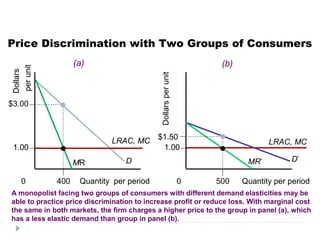
A monopolist facing two groups of consumers with different demand elasticities may be
able to practice price discrimination to increase profit or reduce loss. With marginal cost
the same in both markets, the firm charges a higher price to the group in panel (a), which
has a less elastic demand than group in panel (b).
Is Price Discrimination Unfair

    There is nothing evil or illegal about economic price
     discrimination. It simply means charging different
     prices for the same good or service unrelated to
     differences in cost.

    Price discrimination is common in all markets other
     than perfectly competitive markets.
Is Price Discrimination Unfair

    What are its effects:
        Increase seller’s profit, at least in the short run
        Enhance economic efficiency
        Conserve on scarce resources.
        Many buyers benefit because they are now paying a lower
         price
            Example: Movie Theatres- senior citizen and college students
             discounts
How does it increase the sellers profits

    Increases seller’s profits
        By observing different elasticities for the consumers the
         following can happen
            Reduce the price for buyers with elastic demand will increase TR
            Increase the price for buyers with inelastic demand will increase
             TR
            When the total quantity is not changing, then costs are not
             changing, but revenues are profits are HIGHER
What about efficiency
    Enhances economic efficiency
        We know that under a monopoly the output is under-
         produced. But price discrimination can fix this
         underproduction of the good
        A price-discriminating monopolist is able to sell a larger
         quantity than a single-price monopolist by reducing price
         only on the additional units sold, not on all units sold.
        Because the problem with monopoly is underproduction,
         increasing quantity enhances efficiency. The sum of
         producer and consumer surplus is higher in a monopoly
         market with price discrimination than in a market with a
         single-price monopolist.
MONOPOLY AND COMPETITION
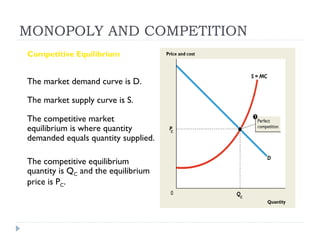
Competitive Equilibrium


The market demand curve is D.

The market supply curve is S.

The competitive market
equilibrium is where quantity
demanded equals quantity supplied.

The competitive equilibrium
quantity is QC and the equilibrium
price is PC.
MONOPOLY AND COMPETITION
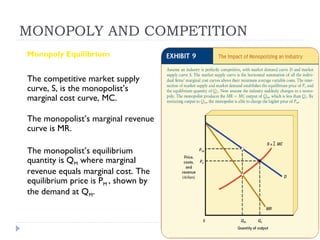
Monopoly Equilibrium


The competitive market supply
curve, S, is the monopolist’s
marginal cost curve, MC.

The monopolist’s marginal revenue
curve is MR.

The monopolist’s equilibrium
quantity is QM where marginal
revenue equals marginal cost. The
equilibrium price is PM , shown by
the demand at QM.
MONOPOLY AND COMPETITION
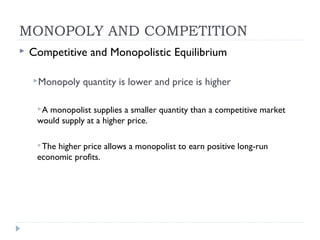
   Competitive and Monopolistic Equilibrium

    Monopoly    quantity is lower and price is higher

     Amonopolist supplies a smaller quantity than a competitive market
     would supply at a higher price.

     The higher price allows a monopolist to earn positive long-run
     economic profits.
MONOPOLY AND COMPETITION
   Economic Consequences of Monopoly

    The    absence of competition results in

        •   Inefficiency and deadweight loss
        •   Redistribution of wealth
MONOPOLY AND COMPETITION
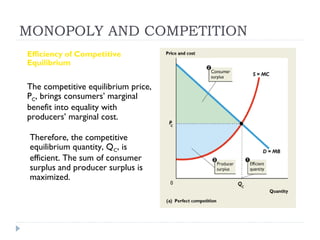
Efficiency of Competitive
Equilibrium


The competitive equilibrium price,
PC, brings consumers’ marginal
benefit into equality with
producers’ marginal cost.

 Therefore, the competitive
 equilibrium quantity, QC, is
 efficient. The sum of consumer
 surplus and producer surplus is
 maximized.
MONOPOLY AND COMPETITION
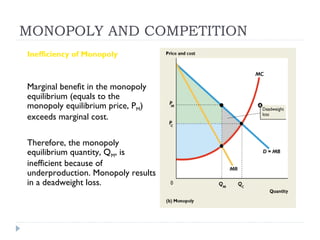
Inefficiency of Monopoly


Marginal benefit in the monopoly
equilibrium (equals to the
monopoly equilibrium price, PM)
exceeds marginal cost.

Therefore, the monopoly
equilibrium quantity, QM, is
inefficient because of
underproduction. Monopoly results
in a deadweight loss.
MONOPOLY AND COMPETITION
   Economic Consequences of Monopoly

    Redistribution   of wealth
MONOPOLY AND COMPETITION
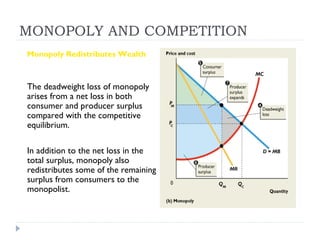
Monopoly Redistributes Wealth


The deadweight loss of monopoly
arises from a net loss in both
consumer and producer surplus
compared with the competitive
equilibrium.

In addition to the net loss in the
total surplus, monopoly also
redistributes some of the remaining
surplus from consumers to the
monopolist.

Chapter9 monopoly

  • 1.
    Chapter 9 Monopoly
  • 2.
    The Monopoly MarketStructure  What is a monopoly exactly?  A monopoly is a market structure characterized by:  A single seller  A unique product  Impossible entry into the market  Under a monopoly, the consumer has only one choice. Thus, they can either buy from the producer or not consume  There are no close substitutes.
  • 3.
    A Single Seller  One single firm IS the industry.  Local monopolies are more commonly observed in the real-world than national monopolies.  Examples
  • 5.
    Unique Products  Why do Monopolists have unique products?  Absence of close substitutes
  • 6.
    Impossible Entry  Barriers to Entry are high  It is different or impossible for a new firm to enter an industry due to:  Ownership of Vital Resources  Legal Barriers  Economies of Scale
  • 7.
    Ownership of VitalResources  A seller can create its own barrier to entry if it owns a significant portion of a key resource required for the production of the good or service.  In practice, monopolies rarely arise for this reason. The market for most resources is national or even international, and ownership of most resources is dispersed among a large number of people and nations.  Example
  • 8.
    Legal Barriers  Legal barriers to entry are the source of most present- day monopolies.  Entry into the market or competition within the market are restricted by the granting of a public franchise, government license, patent, or copyright.  Examples:
  • 9.
    Economies of Scale  Monopolies can emerge in time naturally because of the relationship between average cost and the scale of the operation.  This is called “natural monopolies”  Def: A natural monopoly is an industry in which the LRAC of production declines throughout the entire market.  Natural monopoly provides an economic argument for regulated public utilities.
  • 10.
    Economies of Scale  When this happens a single firm can supply the entire market demand at a lower cost than two or more smaller firms.  Markets characterized by economies of scale often become competitive over time because of technological advances or because of natural growth in the size of the market.
  • 11.
    SOURCES OF MONOPOLY Economies of Scale The cost to distribute 4 million kilowatt hours of electric power is 5 cents a kilowatt-hour with one seller in the market, or . . . 10 cents a kilowatt-hour with two sellers, or . . . 15 cents a kilowatt-hour with four sellers. Because of economies of scale, one seller can meet the market demand at a lower average cost than two or more sellers.
  • 12.
    Price and OutputDecisions for a Monopolist  The demand curve for a monopolist differs from the competitive firm because the monopolist is a price maker not taker.  Def: A price maker is a firm that faces a downward sloping demand curve.
  • 13.
    More Demand andsome Marginal Revenue  Demand and Marginal Revenue  They are both negatively-sloped  Demand  Market demand is negatively-sloped. The monopolist faces a tradeoff between price and quantity sold.  To obtain a higher price, the monopolist must lower quantity. Or, if it wants to sell a larger quantity, it must lower price.
  • 14.
    MONOPOLY EQUILIBRIUM  Demand and Marginal Revenue  Marginal revenue is less than price  The marginal revenue curve is negatively-sloped but lies below the demand curve at each quantity: MR<P at all Q.
  • 15.
    MONOPOLY EQUILIBRIUM Example: Demandand Marginal Revenue Calculate the marginal revenue generated along the demand curve.
  • 16.
    MONOPOLY EQUILIBRIUM Example: Demandand Marginal Revenue If the price is $16, quantity demanded is 2 haircuts per hour.
  • 17.
    MONOPOLY EQUILIBRIUM Example: Demandand Marginal Revenue If the price is $14, quantity demanded is 3 haircuts per hour.
  • 18.
    MONOPOLY EQUILIBRIUM Example: Demandand Marginal Revenue Total revenue from two haircuts per hour decreases by $4.
  • 19.
    MONOPOLY EQUILIBRIUM Example: Demandand Marginal Revenue Total revenue from the additional haircut is $14.
  • 20.
    MONOPOLY EQUILIBRIUM Example: Demandand Marginal Revenue Marginal revenue from the additional haircut is $10.
  • 21.
    MONOPOLY EQUILIBRIUM Example: Demandand Marginal Revenue The marginal revenue curve is negatively-sloped and lies below the demand curve. Marginal revenue is less than price at each quantity.
  • 22.
    MONOPOLY EQUILIBRIUM Profit Maximizationby a Monopolist The diagram shows the monopolist’s • average total cost (ATC), • marginal cost (MC), • demand (D), • and marginal revenue (MR). The monopolist maximizes profits or minimizes losses by producing the quantity at which marginal revenue equals marginal cost.
  • 23.
    MONOPOLY EQUILIBRIUM Profit Maximizationby a Monopolist The equilibrium quantity is 3 haircuts per hour where MR=MC, and the equilibrium price is $14, shown by the demand at the quantity 3. The ATC of 3 haircuts is $10. Because P>ATC at the equilibrium quantity, the monopolist earns a profit of $4 per haircut or $12 per hour. 23 Monopoly
  • 24.
    MONOPOLY EQUILIBRIUM Profit Maximizationby a Monopolist: Numerical Example The data in the table below verify that 3 haircuts per hour maximizes the monopolist’s profit.
  • 25.
    MONOPOLY EQUILIBRIUM  Short-Run and Long-Run Equilibrium  When a monopolist incurs short-run losses  However, if a monopolist incurs economic losses in the short- run, it exits the market in the long-run. The long-run equilibrium quantity is zero.
  • 26.
    MONOPOLY EQUILIBRIUM  Short-Run and Long-Run Equilibrium  When a monopolist earns short-run profits
  • 27.
    Price Discrimination  The monopolist may charge different prices to consumers to maximize profits.  Def: Price discrimination occurs when a seller charges different prices for the same product that are not justified by cost differences.  Selling a good or service at a number of different prices where the price differences do not reflect differences in cost but instead reflect differences in consumers’ price elasticities of demand.  However, specific conditions must be met before the seller can act in this way.
  • 28.
    Conditions for PriceDiscrimination  The seller must be a price maker and therefore face a downward-sloping demand curve  The seller must be able to segment the market distinguishing between consumers willing to pay different prices  It must be impossible or too costly for customers to engage in arbitrage
  • 29.
    How can aproducer price discriminate  Discriminating among groups of consumers  Different prices for consumers with different elasticities. The market is segmented based on some easily distinguished characteristic of consumers—age, for example.  Discriminating among units of a good  The seller charges the same prices to all consumers but offers each consumer a lower price for a larger number of units bought—volume discounts, for example.
  • 30.
    Price Discrimination withTwo Groups of Consumers (a) (b) per unit Dollars Dollars per unit $3.00 LRAC, MC $1.50 LRAC, MC 1.00 1.00 MR D MR’ D’ 0 400 Quantity per period 0 500 Quantity per period A monopolist facing two groups of consumers with different demand elasticities may be able to practice price discrimination to increase profit or reduce loss. With marginal cost the same in both markets, the firm charges a higher price to the group in panel (a), which has a less elastic demand than group in panel (b).
  • 31.
    Is Price DiscriminationUnfair  There is nothing evil or illegal about economic price discrimination. It simply means charging different prices for the same good or service unrelated to differences in cost.  Price discrimination is common in all markets other than perfectly competitive markets.
  • 32.
    Is Price DiscriminationUnfair  What are its effects:  Increase seller’s profit, at least in the short run  Enhance economic efficiency  Conserve on scarce resources.  Many buyers benefit because they are now paying a lower price  Example: Movie Theatres- senior citizen and college students discounts
  • 33.
    How does itincrease the sellers profits  Increases seller’s profits  By observing different elasticities for the consumers the following can happen  Reduce the price for buyers with elastic demand will increase TR  Increase the price for buyers with inelastic demand will increase TR  When the total quantity is not changing, then costs are not changing, but revenues are profits are HIGHER
  • 34.
    What about efficiency  Enhances economic efficiency  We know that under a monopoly the output is under- produced. But price discrimination can fix this underproduction of the good  A price-discriminating monopolist is able to sell a larger quantity than a single-price monopolist by reducing price only on the additional units sold, not on all units sold.  Because the problem with monopoly is underproduction, increasing quantity enhances efficiency. The sum of producer and consumer surplus is higher in a monopoly market with price discrimination than in a market with a single-price monopolist.
  • 35.
    MONOPOLY AND COMPETITION CompetitiveEquilibrium The market demand curve is D. The market supply curve is S. The competitive market equilibrium is where quantity demanded equals quantity supplied. The competitive equilibrium quantity is QC and the equilibrium price is PC.
  • 36.
    MONOPOLY AND COMPETITION MonopolyEquilibrium The competitive market supply curve, S, is the monopolist’s marginal cost curve, MC. The monopolist’s marginal revenue curve is MR. The monopolist’s equilibrium quantity is QM where marginal revenue equals marginal cost. The equilibrium price is PM , shown by the demand at QM.
  • 37.
    MONOPOLY AND COMPETITION  Competitive and Monopolistic Equilibrium Monopoly quantity is lower and price is higher Amonopolist supplies a smaller quantity than a competitive market would supply at a higher price. The higher price allows a monopolist to earn positive long-run economic profits.
  • 38.
    MONOPOLY AND COMPETITION  Economic Consequences of Monopoly The absence of competition results in • Inefficiency and deadweight loss • Redistribution of wealth
  • 39.
    MONOPOLY AND COMPETITION Efficiencyof Competitive Equilibrium The competitive equilibrium price, PC, brings consumers’ marginal benefit into equality with producers’ marginal cost. Therefore, the competitive equilibrium quantity, QC, is efficient. The sum of consumer surplus and producer surplus is maximized.
  • 40.
    MONOPOLY AND COMPETITION Inefficiencyof Monopoly Marginal benefit in the monopoly equilibrium (equals to the monopoly equilibrium price, PM) exceeds marginal cost. Therefore, the monopoly equilibrium quantity, QM, is inefficient because of underproduction. Monopoly results in a deadweight loss.
  • 41.
    MONOPOLY AND COMPETITION  Economic Consequences of Monopoly Redistribution of wealth
  • 42.
    MONOPOLY AND COMPETITION MonopolyRedistributes Wealth The deadweight loss of monopoly arises from a net loss in both consumer and producer surplus compared with the competitive equilibrium. In addition to the net loss in the total surplus, monopoly also redistributes some of the remaining surplus from consumers to the monopolist.

Editor's Notes