THEORY OF CONSUMER BEHAVIOR
UTILITY AND BEHAVIORAL FACTORS
 Utility is defined as the satisfaction derived from the consumption of a commodity which
determines consumption and demand behavior.
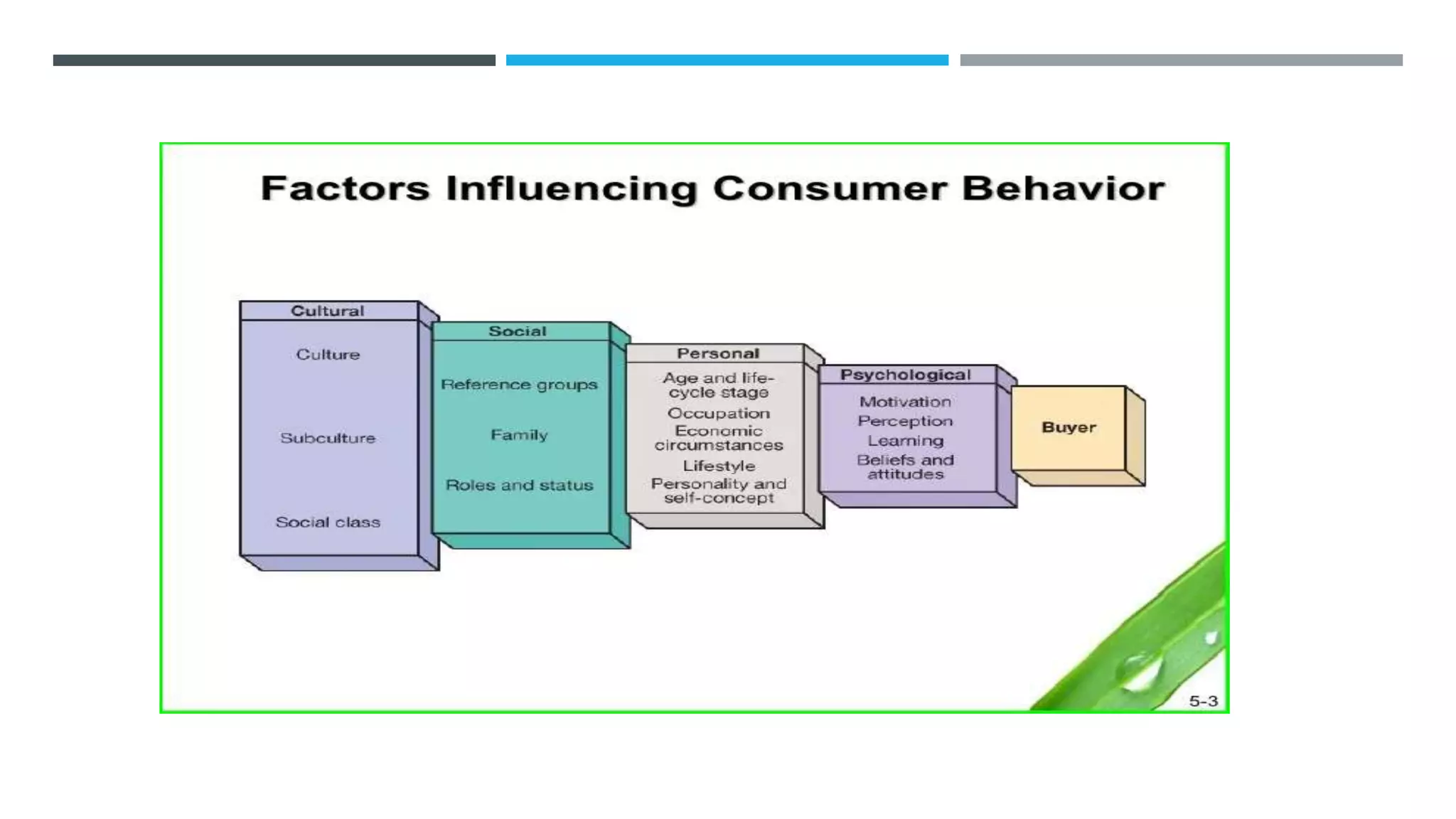
 It is represent the underlying cultural , social, personal, and psychological factors that affect
utility and consumption behavior. Inter – factor combinations filter different patterns of
consumption behavior down the line. Different consumption behavior can stem from, say,
variation within the cultural structure in combination with the cross – sections of the other
interlocking structures.
 In additions, the psychological factors reflect Maslow’s hierarchy of needs as influenced by
said interfactor combination.
CULTURAL FACTORS
 Cultural factors exert the broadest and deepest influence on consumer
behavior. Culture is one of the most fundamental determinants of a person's
wants and behaviors.
 While lower creatures are largely governed by instinct, ; human behavior is
largely learned.
 The child growing up in society learns a basic set of values, perceptions,
preferences and behavior through a process of socialization involving the
family and other key institution,
SOCIAL CLASSES SHOW DISTINCT PRODUCT AND BRAND
PREFERENCES.
 Komics – tend to be the reading materials for lower income classes while
magazines and newspapers are preferred by the middle and higher income
classes.
 Values of individuals or people are highly influenced by the cultural
environment. An American or a Western child is exposed to the values of
achievement and success, progress, material comfort, efficiency, and
practicality. A Filipino child, on the other hand, is exposed to the values of
hiya, pakikisama, social acceptance, and smooth interpersonal relationships.
SOCIAL FACTORS
 A consumer’s behavior is also influenced by social factors such as the consumer’s reference
groups, family and social roles and statuses.
 Reference groups are those groups that have a direct or indirect influence on the person’s
attitudes or behaviors.
 Members of the buyer’s family can exercise a strong influence on the buyer’s behavior. From
the parents, a person acquires an orientation toward religion, economics, personal ambitions,
love.
 Husband and wife involvement in purchases varies widely by product category.
 The kind of clothing that a teacher or a teenager wears reflects their respective roles and
status.
PERSONAL FACTORS
 A buyer’s decisions are also influenced by personal outward characteristics such as: the
buyer’s age and lifestyle, personality and self-concept.
 A person's occupation has an influence on the goods and service he buys.
 A person’s lifestyle and economic condition will affect the goods and service bought.
 The traditionalist would buy different kinds of goods from those who would like to
experiment, the sports minded – type of person would prefer different kinds pf goods from
those who are the stay – home types.
 A person’s personality and self –concept will influence his or her buying behavior.
PSYCHOLOGICAL FACTORS
 A person’s purchase are also influenced by psychological
factors: motivation, perception, learning, and beliefs and
attitudes.
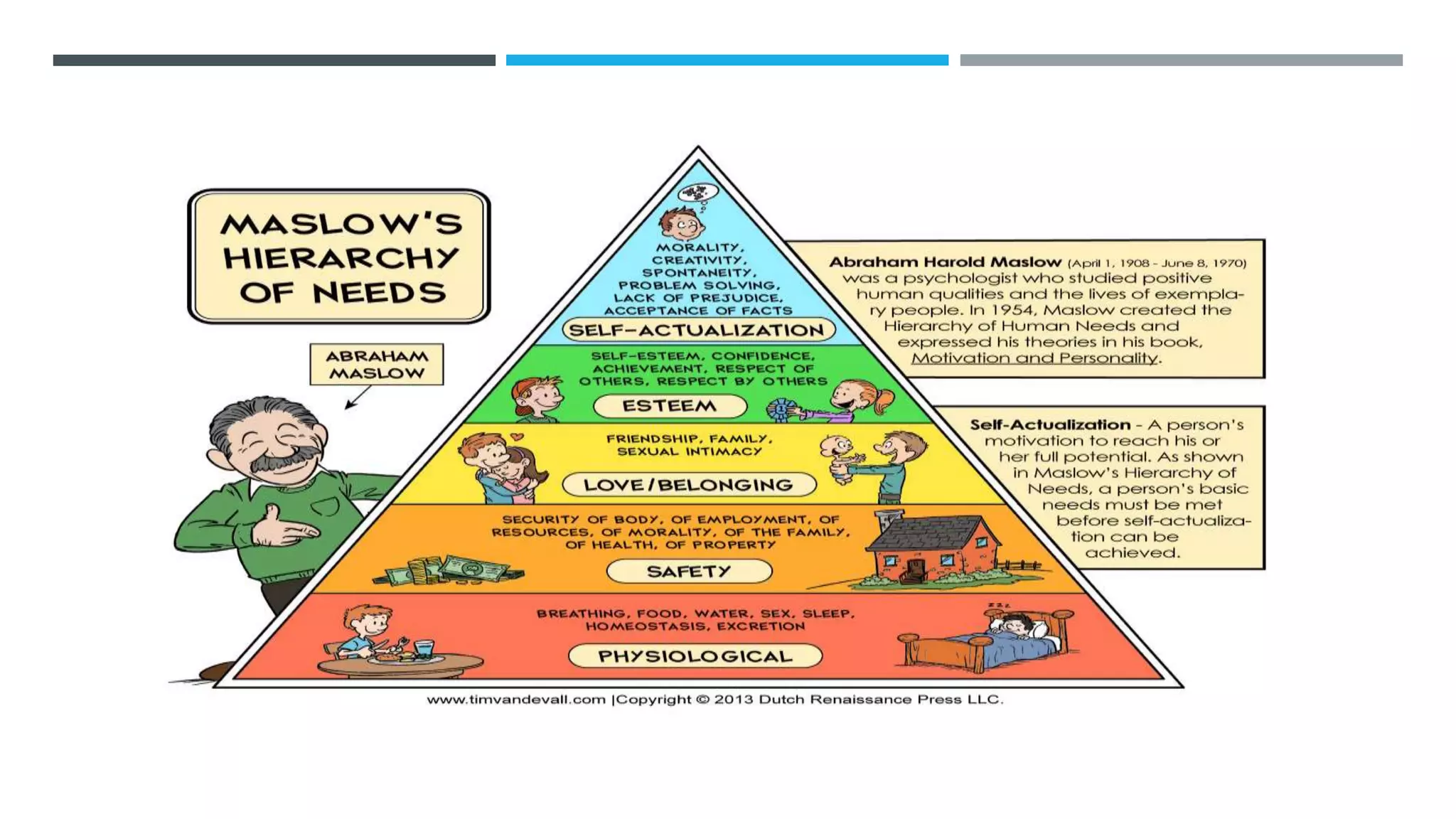
 Maslow’s Theory of Motivation. Abraham Maslow
explain why people are driven by particular needs at
particular times.
MASLOW’S HIERARCHY OF NEEDS ARE:
 Physiological needs
 Safety needs
 Social needs
 Esteem needs
 And Self – Actualization needs
 A motivated person is ready to act. How the motivated person acts in
influenced by his perception and learning of the situation. Two people may
act quite differently because their perception and learning of situation may be
different. One buyer may buy one brand of soft drinks while the second buyer
buys another brand.
 Perception can be defined as the process by which an individual selects,
organizes, and interpret information to create meaningful picture of the
world.
 A belief is a descriptive thought that a persons holds about something; while
an attitude describes a person’s enduring favorable and unfavorable cognitive
evaluations emotional feeling and action tendencies toward some object or
ideas
THE UTILITY FUNCTION
 Utility is the technical term for satisfaction. There is a functional; relationship
between utility and consumption as the need for the latter arises.
 As the consumption level increases, a positive marginal utility (MU) increases
total utility (TU), while the opposite is true when MU is negative.
 Marginal utility is also defined as the utility or dissatisfaction from the last unit
of consumption, depending on whether MU carrier a positive or negative sign.
CONSUMPTION
 The Indifference Curve
 The indifference curve together with the is cost in the next
section is a useful tool for analyzing consumption behavior on
the utility theory.
 An indifference curve contains varying combination in the
consumption of commodities that yield the same level total
utility.
THE LAW OF DIMINISHING MARGINAL UTILITY AND THE SHAPE OF
THE CURVE
Technically, the shape of the indifference curve is convex to the graph’s point of
origin due to the Law of Diminishing Returns. To maintain overall satisfaction,
one only has to give up less of good with increasing marginal utility(MU) to be
regained by more consumption of another with a decreasing MU.
But practically put, one becomes increasingly reluctant to give up a good (food
for example) that becomes scarcer and additionally more valuable (higher
marginal utility or MU), in exchange for another (clothing) that becomes more
abundant and additionally less satisfying.
HIERARCHY IF INDIFFERENCE CURVES
Indifference curve corresponds to a certain
level of utility. Therefore changing the
consumption levels of commodities at every
point of combination along the curve leads to
another indifference curve and utility level.
FIGURE HIERARCHY OF INDIFFERENCE CURVES
THE BUDGET LINE AND THE OPTIMUM COMBINATION
 What is optimum or best combination of consumption of
the commodities within a budgetary limit? The answer to
this questions lies in the relationship between the
indifference curve which represents what consumer likes
ad the budget line which limits affordability.
THE BUDGET LINE
 A budget line contains infinite points of
combinations of the commodity items that the
same budget can buy at a given prices.
 The aforementioned statement is quantitatively
expressed as follows, assuming food and clothing
as the commodities being purchased.
THE OPTIMUM COMBINATION
 The quantities of the commodities at any point along a
budget line indicate purchasing capacity. This, point,
together with the said purchase quantities coincides with
that of an indifference curve and hence, meets the latter’s
budget requirement. Simplify put, the consumer can
afford to have that much satisfaction.
DYNAMICS
 Prices can change to make goods relatively cheap or costly. The consumer then adjust to
maximize satisfaction by buying what cheaper in exchange for what is costlier. Originally
consuming less food and more clothing is now beyond the budget.
 The consumer is worse – off either as the same budget can only buy less of costlier if only to
maintain the food consumption.
 Every additional peso spent should yield the highest marginal utility passible. It therefore
follows that the consumer tends to spend more on the commodity that give this advantages.
If this commodity is sugar, the consumer spends more for it but only up to the point where
the utility gained from the last peso spent is exactly the same as in any other commodity.
INCOME AND SUBSTITUTION EFFECTS
 How does consumer equilibrium change with the price of a commodity items?
Assume two not-so-close substitutes, food and clothing where the price of the latter
is assumed to decrease.
 With the change in price, food shares in the potential increase in the consumption of
clothing. The potential increase in the consumption of clothing.
 The potential increase in the consumption of both commodities, if realized, is called
income effect.
 However the consumer is not only contented to realize this effect as the new
condition allows optimization by substitution, if realized is called substitution
effect.
 Substitution effect result in a net gain in satisfaction since and additional peso
is better spent on cheaper and more units of clothing instead of the costlier
units of goods.
 In particular, decrease in the price of clothing means more consumption, and
hence, from the last peso spent more satisfaction. In effect, the marginal
utility advantage of consuming more clothing instead of food leads the
consumer to substitutes the former for the latter until the equi - marginal
condition is fully met.
UTILITY AND DEMAND
DERIVATION OF THE DEMAND CURVE
 There nis a potential consumption for a certain commodity item given its
market price and the income of its potential consumers. This potential
consumption is also called demand which is the quantity that the consumers
are willing to buy.
 Moreover, as to how much of the given income is allocated for the product
depends on the influences of the other nonprice factors of demand such as
population.
 Therefore, the potential demand or a product at varying price levels and given
a certain degree of influence of the nonprice factors, determines its demand
curve.
CONSUMER SURPLUS
 The peso value that the consumer is willing to pay for certain volume of a commodity
is less than the peso value of the benefit from its consumption. This also means that
the utility units forgone in paying for the commodity item are less than the utility
units gained from their consumption.
 The net benefit from the exchange is called consumer’s surplus or additional
purchasing power.
 Consumer’s surplus is an indicator of social welfare and can help make correct social
decisions. For example, a substantial decrease in this surplus indicates the negative
impact of an increase in price on consumer’s welfare.
THE PARADOX OF VALUE
 The paradox of value is the answer to the question that troubled Adam Smith
in the 18th century, whose book. “the wealth of Nations, “ marked the
beginning of Modern Economics. The question is “How is it that water, which
is so useful, that life is impossible without it, has such a low price, where as
diamonds which are not quite necessary have such a high price?
 Despite its importance, the price of water is low as consumers are only willing
to any less for its abundance and how level of marginal utility. However, the
opposite is true for diamond which is scarce, The foregoing leads to the
distinction between Value in Use and Value in Exchange.

Theory of consumer behavior.pptx

  • 1.
  • 2.
    UTILITY AND BEHAVIORALFACTORS  Utility is defined as the satisfaction derived from the consumption of a commodity which determines consumption and demand behavior.  It is represent the underlying cultural , social, personal, and psychological factors that affect utility and consumption behavior. Inter – factor combinations filter different patterns of consumption behavior down the line. Different consumption behavior can stem from, say, variation within the cultural structure in combination with the cross – sections of the other interlocking structures.  In additions, the psychological factors reflect Maslow’s hierarchy of needs as influenced by said interfactor combination.
  • 3.
    CULTURAL FACTORS  Culturalfactors exert the broadest and deepest influence on consumer behavior. Culture is one of the most fundamental determinants of a person's wants and behaviors.  While lower creatures are largely governed by instinct, ; human behavior is largely learned.  The child growing up in society learns a basic set of values, perceptions, preferences and behavior through a process of socialization involving the family and other key institution,
  • 4.
    SOCIAL CLASSES SHOWDISTINCT PRODUCT AND BRAND PREFERENCES.  Komics – tend to be the reading materials for lower income classes while magazines and newspapers are preferred by the middle and higher income classes.  Values of individuals or people are highly influenced by the cultural environment. An American or a Western child is exposed to the values of achievement and success, progress, material comfort, efficiency, and practicality. A Filipino child, on the other hand, is exposed to the values of hiya, pakikisama, social acceptance, and smooth interpersonal relationships.
  • 5.
    SOCIAL FACTORS  Aconsumer’s behavior is also influenced by social factors such as the consumer’s reference groups, family and social roles and statuses.  Reference groups are those groups that have a direct or indirect influence on the person’s attitudes or behaviors.  Members of the buyer’s family can exercise a strong influence on the buyer’s behavior. From the parents, a person acquires an orientation toward religion, economics, personal ambitions, love.  Husband and wife involvement in purchases varies widely by product category.  The kind of clothing that a teacher or a teenager wears reflects their respective roles and status.
  • 7.
    PERSONAL FACTORS  Abuyer’s decisions are also influenced by personal outward characteristics such as: the buyer’s age and lifestyle, personality and self-concept.  A person's occupation has an influence on the goods and service he buys.  A person’s lifestyle and economic condition will affect the goods and service bought.  The traditionalist would buy different kinds of goods from those who would like to experiment, the sports minded – type of person would prefer different kinds pf goods from those who are the stay – home types.  A person’s personality and self –concept will influence his or her buying behavior.
  • 8.
    PSYCHOLOGICAL FACTORS  Aperson’s purchase are also influenced by psychological factors: motivation, perception, learning, and beliefs and attitudes.  Maslow’s Theory of Motivation. Abraham Maslow explain why people are driven by particular needs at particular times.
  • 9.
    MASLOW’S HIERARCHY OFNEEDS ARE:  Physiological needs  Safety needs  Social needs  Esteem needs  And Self – Actualization needs
  • 11.
     A motivatedperson is ready to act. How the motivated person acts in influenced by his perception and learning of the situation. Two people may act quite differently because their perception and learning of situation may be different. One buyer may buy one brand of soft drinks while the second buyer buys another brand.  Perception can be defined as the process by which an individual selects, organizes, and interpret information to create meaningful picture of the world.  A belief is a descriptive thought that a persons holds about something; while an attitude describes a person’s enduring favorable and unfavorable cognitive evaluations emotional feeling and action tendencies toward some object or ideas
  • 12.
    THE UTILITY FUNCTION Utility is the technical term for satisfaction. There is a functional; relationship between utility and consumption as the need for the latter arises.  As the consumption level increases, a positive marginal utility (MU) increases total utility (TU), while the opposite is true when MU is negative.  Marginal utility is also defined as the utility or dissatisfaction from the last unit of consumption, depending on whether MU carrier a positive or negative sign.
  • 13.
    CONSUMPTION  The IndifferenceCurve  The indifference curve together with the is cost in the next section is a useful tool for analyzing consumption behavior on the utility theory.  An indifference curve contains varying combination in the consumption of commodities that yield the same level total utility.
  • 14.
    THE LAW OFDIMINISHING MARGINAL UTILITY AND THE SHAPE OF THE CURVE Technically, the shape of the indifference curve is convex to the graph’s point of origin due to the Law of Diminishing Returns. To maintain overall satisfaction, one only has to give up less of good with increasing marginal utility(MU) to be regained by more consumption of another with a decreasing MU. But practically put, one becomes increasingly reluctant to give up a good (food for example) that becomes scarcer and additionally more valuable (higher marginal utility or MU), in exchange for another (clothing) that becomes more abundant and additionally less satisfying.
  • 16.
    HIERARCHY IF INDIFFERENCECURVES Indifference curve corresponds to a certain level of utility. Therefore changing the consumption levels of commodities at every point of combination along the curve leads to another indifference curve and utility level.
  • 17.
    FIGURE HIERARCHY OFINDIFFERENCE CURVES
  • 18.
    THE BUDGET LINEAND THE OPTIMUM COMBINATION  What is optimum or best combination of consumption of the commodities within a budgetary limit? The answer to this questions lies in the relationship between the indifference curve which represents what consumer likes ad the budget line which limits affordability.
  • 19.
    THE BUDGET LINE A budget line contains infinite points of combinations of the commodity items that the same budget can buy at a given prices.  The aforementioned statement is quantitatively expressed as follows, assuming food and clothing as the commodities being purchased.
  • 20.
    THE OPTIMUM COMBINATION The quantities of the commodities at any point along a budget line indicate purchasing capacity. This, point, together with the said purchase quantities coincides with that of an indifference curve and hence, meets the latter’s budget requirement. Simplify put, the consumer can afford to have that much satisfaction.
  • 21.
    DYNAMICS  Prices canchange to make goods relatively cheap or costly. The consumer then adjust to maximize satisfaction by buying what cheaper in exchange for what is costlier. Originally consuming less food and more clothing is now beyond the budget.  The consumer is worse – off either as the same budget can only buy less of costlier if only to maintain the food consumption.  Every additional peso spent should yield the highest marginal utility passible. It therefore follows that the consumer tends to spend more on the commodity that give this advantages. If this commodity is sugar, the consumer spends more for it but only up to the point where the utility gained from the last peso spent is exactly the same as in any other commodity.
  • 22.
    INCOME AND SUBSTITUTIONEFFECTS  How does consumer equilibrium change with the price of a commodity items? Assume two not-so-close substitutes, food and clothing where the price of the latter is assumed to decrease.  With the change in price, food shares in the potential increase in the consumption of clothing. The potential increase in the consumption of clothing.  The potential increase in the consumption of both commodities, if realized, is called income effect.  However the consumer is not only contented to realize this effect as the new condition allows optimization by substitution, if realized is called substitution effect.
  • 23.
     Substitution effectresult in a net gain in satisfaction since and additional peso is better spent on cheaper and more units of clothing instead of the costlier units of goods.  In particular, decrease in the price of clothing means more consumption, and hence, from the last peso spent more satisfaction. In effect, the marginal utility advantage of consuming more clothing instead of food leads the consumer to substitutes the former for the latter until the equi - marginal condition is fully met.
  • 24.
    UTILITY AND DEMAND DERIVATIONOF THE DEMAND CURVE  There nis a potential consumption for a certain commodity item given its market price and the income of its potential consumers. This potential consumption is also called demand which is the quantity that the consumers are willing to buy.  Moreover, as to how much of the given income is allocated for the product depends on the influences of the other nonprice factors of demand such as population.  Therefore, the potential demand or a product at varying price levels and given a certain degree of influence of the nonprice factors, determines its demand curve.
  • 25.
    CONSUMER SURPLUS  Thepeso value that the consumer is willing to pay for certain volume of a commodity is less than the peso value of the benefit from its consumption. This also means that the utility units forgone in paying for the commodity item are less than the utility units gained from their consumption.  The net benefit from the exchange is called consumer’s surplus or additional purchasing power.  Consumer’s surplus is an indicator of social welfare and can help make correct social decisions. For example, a substantial decrease in this surplus indicates the negative impact of an increase in price on consumer’s welfare.
  • 26.
    THE PARADOX OFVALUE  The paradox of value is the answer to the question that troubled Adam Smith in the 18th century, whose book. “the wealth of Nations, “ marked the beginning of Modern Economics. The question is “How is it that water, which is so useful, that life is impossible without it, has such a low price, where as diamonds which are not quite necessary have such a high price?  Despite its importance, the price of water is low as consumers are only willing to any less for its abundance and how level of marginal utility. However, the opposite is true for diamond which is scarce, The foregoing leads to the distinction between Value in Use and Value in Exchange.