Constructivis
  m Theory
           Chelsea T.


Vygotsky                Piaget
Key Points
Learning is an active process
Knowledge is constructed rather than acquired
Personal experiences and opinions of environment
construct knowledge
The knowledge process is different for each individual
Learners bring past experiences and cultural factors to
all experiences
Constructivism
             Theorists'
Vygotsky:
      - social learning precedes development
      - social interaction is a fundamental role in cognitive development
      - The More Knowledgeable Other (MKO): anyone who has a higher
      ability level than the learner
      - learning occurs in the Zone of Proximal Development (ZPD):
      distance between a student performing a task independently or
      with guidance
Piaget:
      - knowledge is built through experience
      - assimilation: incorporate new experiences into old experiences
      - accommodation: reframing new experiences into the mental
      capacity
      - depending on age, students can or can not understand
      - Four developmental stages are: sensorimotor, pre operations,
      concrete operations, and formal operations
Constructivism
          Theorists’ Con’t
Dewey:
      - meaningful activities must make students apply concepts they
      are learning
      - active learner: student must use sensory input and construct a
      meaning of it
      - reflective activity: activities must engage hands and the mind
Vico:
      - published a treatise on construction of knowledge
      - coined the term “constructivist”
Bruner:
      - categorization is key to learning, interpreting by similarities and
      differences
      - emphasizes the role of structure in learning
      - readiness for learning: you can teach at any stage of development in a
      way that fits the child’s cognitive abilities
      - spiral curriculum: revisit basic concepts over and over again to reach
      mastery
Teacher Role in
          Constructivism
Teachers are facilitators who aid the student in their own
understanding
Continual conversation with students and asking questions is key
Having students work together and helping each other answer
questions is one strategy
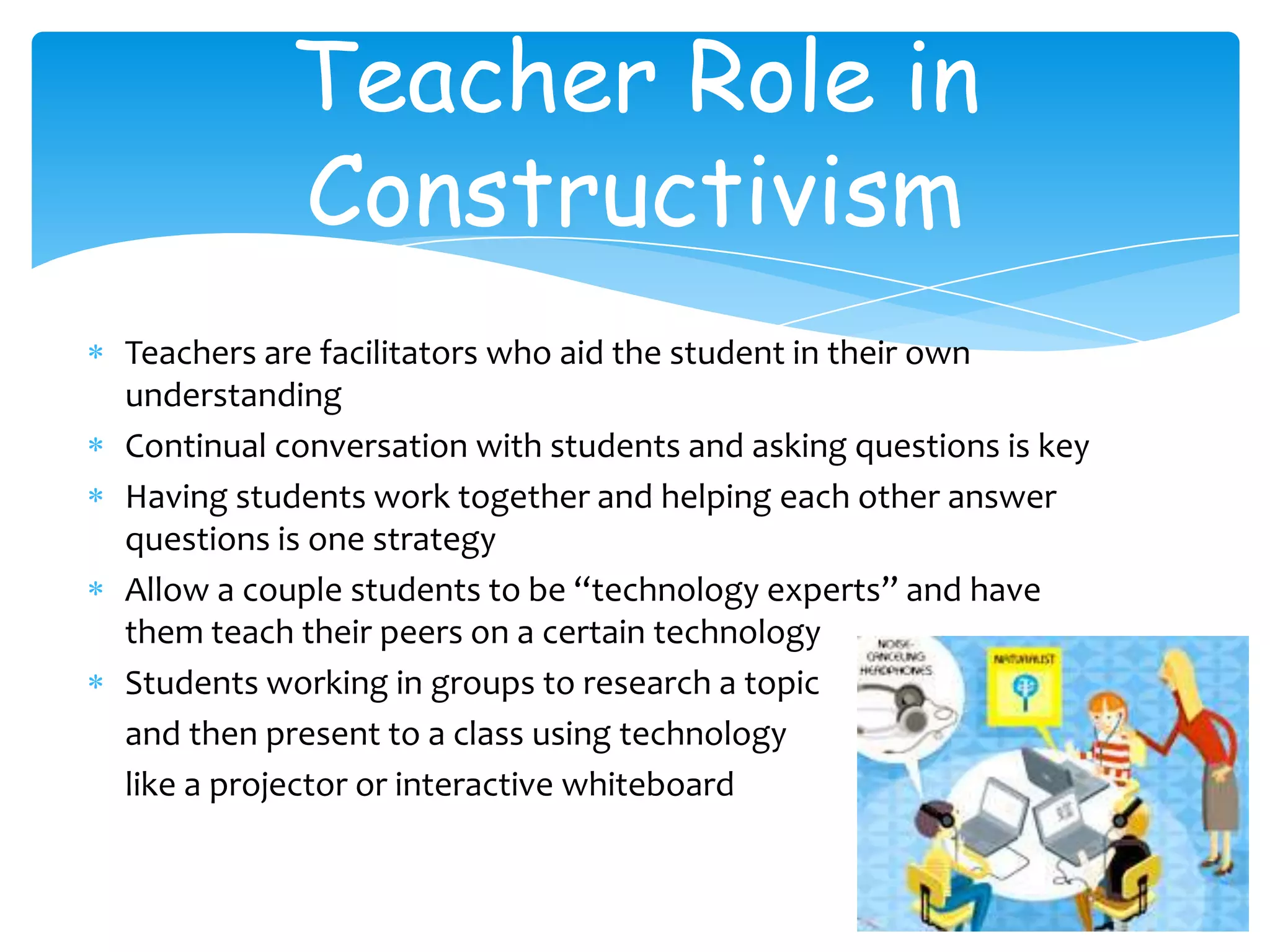
Allow a couple students to be “technology experts” and have
them teach their peers on a certain technology
Students working in groups to research a topic
and then present to a class using technology
like a projector or interactive whiteboard
Student Role in
         Constructivism
Students must come to their own conclusions while learning by
being challenged by the teacher
Students must cooperatively work with peers on group
assignments with and without technology
When using technology students must help “teach” peers and
answer questions
In group work students need to make their own understanding
and take responsibility for their individual learning
Personal Thoughts

I believe working hands on and learning from your
own mistakes is the best way to learn.
Group projects is a great way to build social and
cooperation skills
Peers teaching can be a great tool to explain things in
a different way
I plan to make my students active learners on
Works Cited

http://www.teach-
nology.com/currenttrends/constructivism/piaget/
http://www.exploratorium.edu/IFI/resources/construc
tivistlearning.html
http://mason.gmu.edu/~wwarrick/Portfolio/Products/
constructivism.html
http://www.lifecircles-
inc.com/Learningtheories/constructivism/bruner.html

Constructivism theory

  • 1.
    Constructivis mTheory Chelsea T. Vygotsky Piaget
  • 2.
    Key Points Learning isan active process Knowledge is constructed rather than acquired Personal experiences and opinions of environment construct knowledge The knowledge process is different for each individual Learners bring past experiences and cultural factors to all experiences
  • 3.
    Constructivism Theorists' Vygotsky: - social learning precedes development - social interaction is a fundamental role in cognitive development - The More Knowledgeable Other (MKO): anyone who has a higher ability level than the learner - learning occurs in the Zone of Proximal Development (ZPD): distance between a student performing a task independently or with guidance Piaget: - knowledge is built through experience - assimilation: incorporate new experiences into old experiences - accommodation: reframing new experiences into the mental capacity - depending on age, students can or can not understand - Four developmental stages are: sensorimotor, pre operations, concrete operations, and formal operations
  • 4.
    Constructivism Theorists’ Con’t Dewey: - meaningful activities must make students apply concepts they are learning - active learner: student must use sensory input and construct a meaning of it - reflective activity: activities must engage hands and the mind Vico: - published a treatise on construction of knowledge - coined the term “constructivist” Bruner: - categorization is key to learning, interpreting by similarities and differences - emphasizes the role of structure in learning - readiness for learning: you can teach at any stage of development in a way that fits the child’s cognitive abilities - spiral curriculum: revisit basic concepts over and over again to reach mastery
  • 5.
    Teacher Role in Constructivism Teachers are facilitators who aid the student in their own understanding Continual conversation with students and asking questions is key Having students work together and helping each other answer questions is one strategy Allow a couple students to be “technology experts” and have them teach their peers on a certain technology Students working in groups to research a topic and then present to a class using technology like a projector or interactive whiteboard
  • 6.
    Student Role in Constructivism Students must come to their own conclusions while learning by being challenged by the teacher Students must cooperatively work with peers on group assignments with and without technology When using technology students must help “teach” peers and answer questions In group work students need to make their own understanding and take responsibility for their individual learning
  • 7.
    Personal Thoughts I believeworking hands on and learning from your own mistakes is the best way to learn. Group projects is a great way to build social and cooperation skills Peers teaching can be a great tool to explain things in a different way I plan to make my students active learners on
  • 8.