EXISTENTIALISM
Philosophy of Education
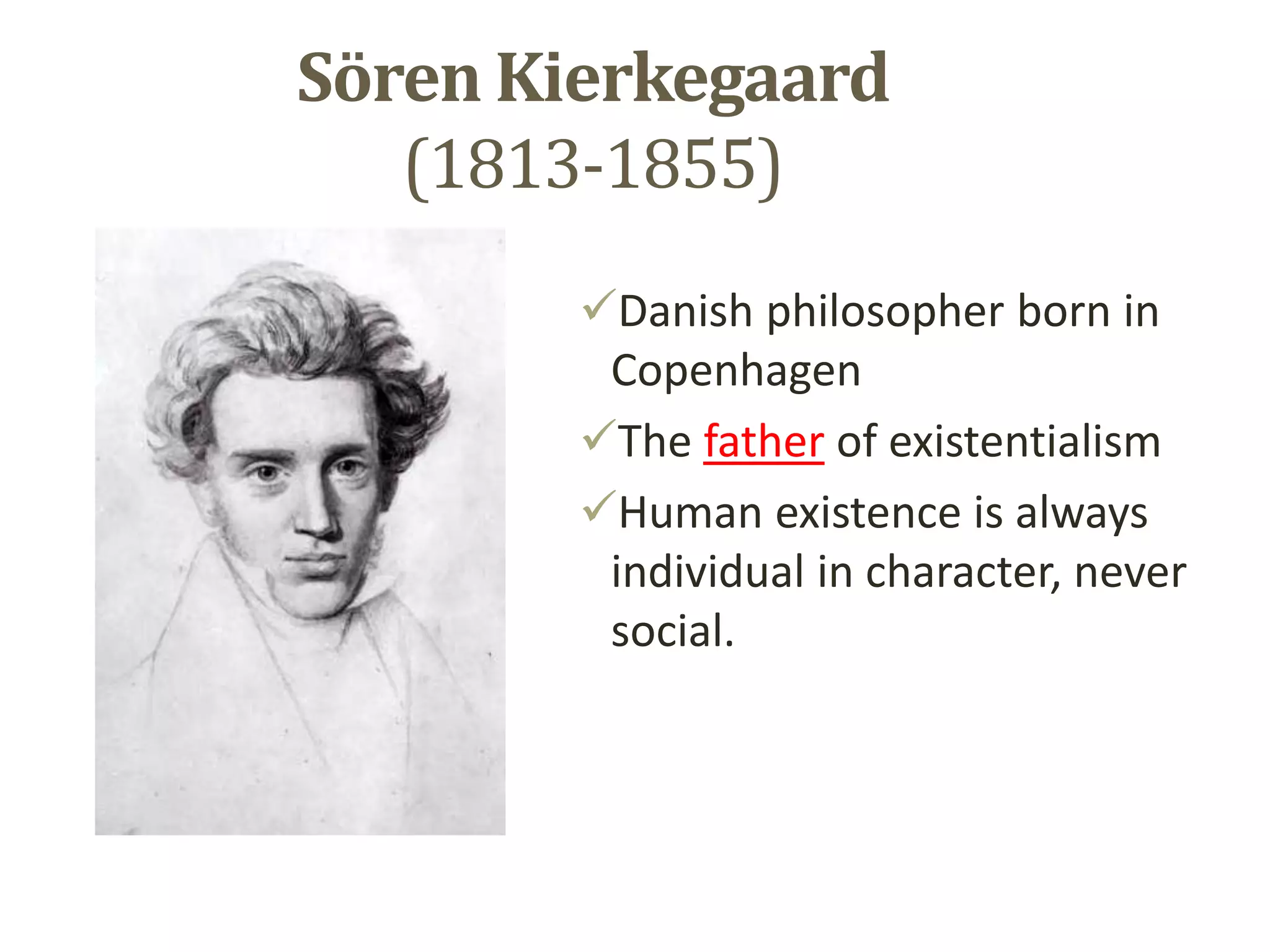
Sӧren Kierkegaard
(1813-1855)
Danish philosopher born in
Copenhagen
The father of existentialism
Human existence is always
individual in character, never
social.
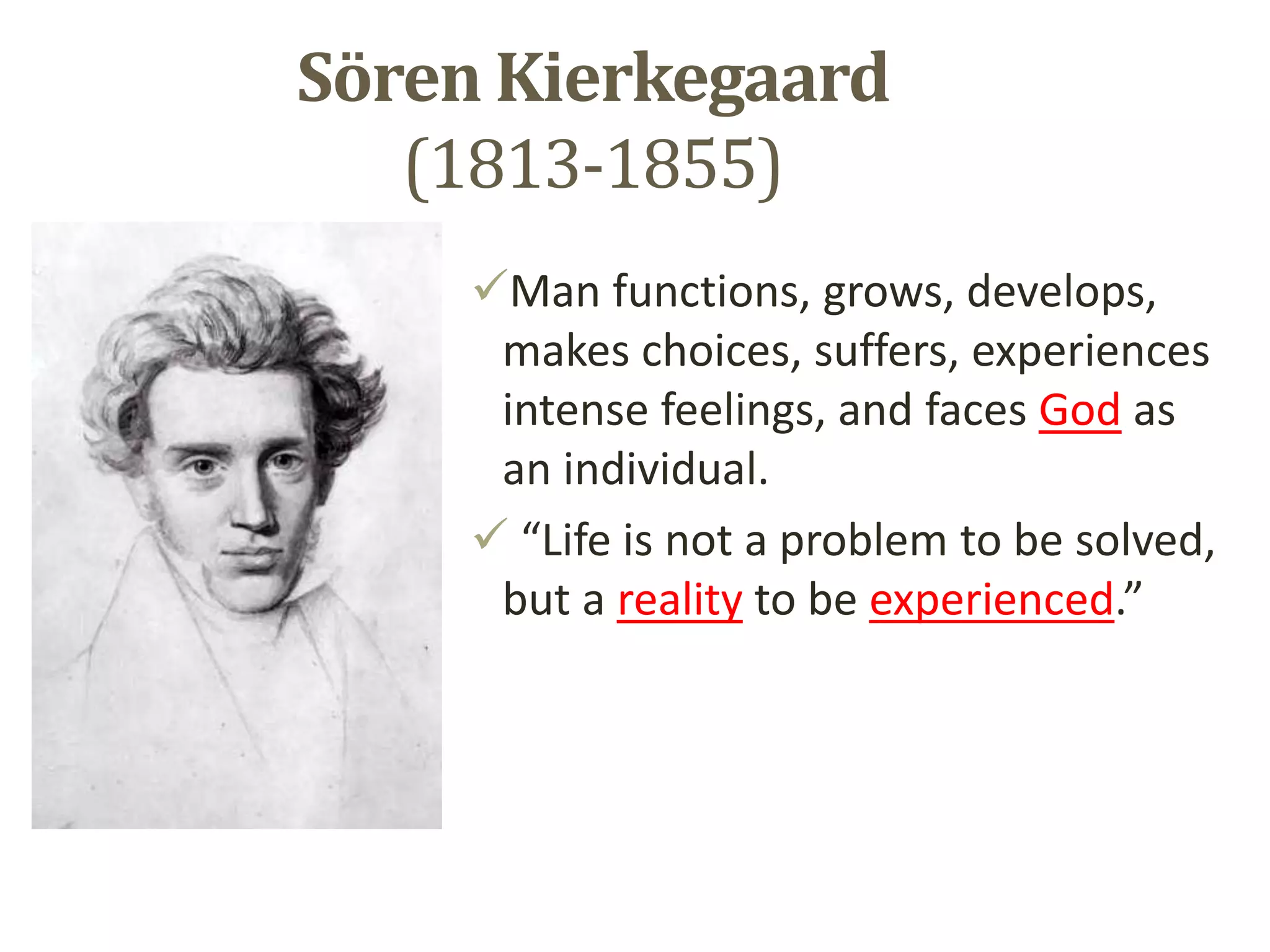
Sӧren Kierkegaard
(1813-1855)
Man functions, grows, develops,
makes choices, suffers, experiences
intense feelings, and faces God as
an individual.
 “Life is not a problem to be solved,
but a reality to be experienced.”
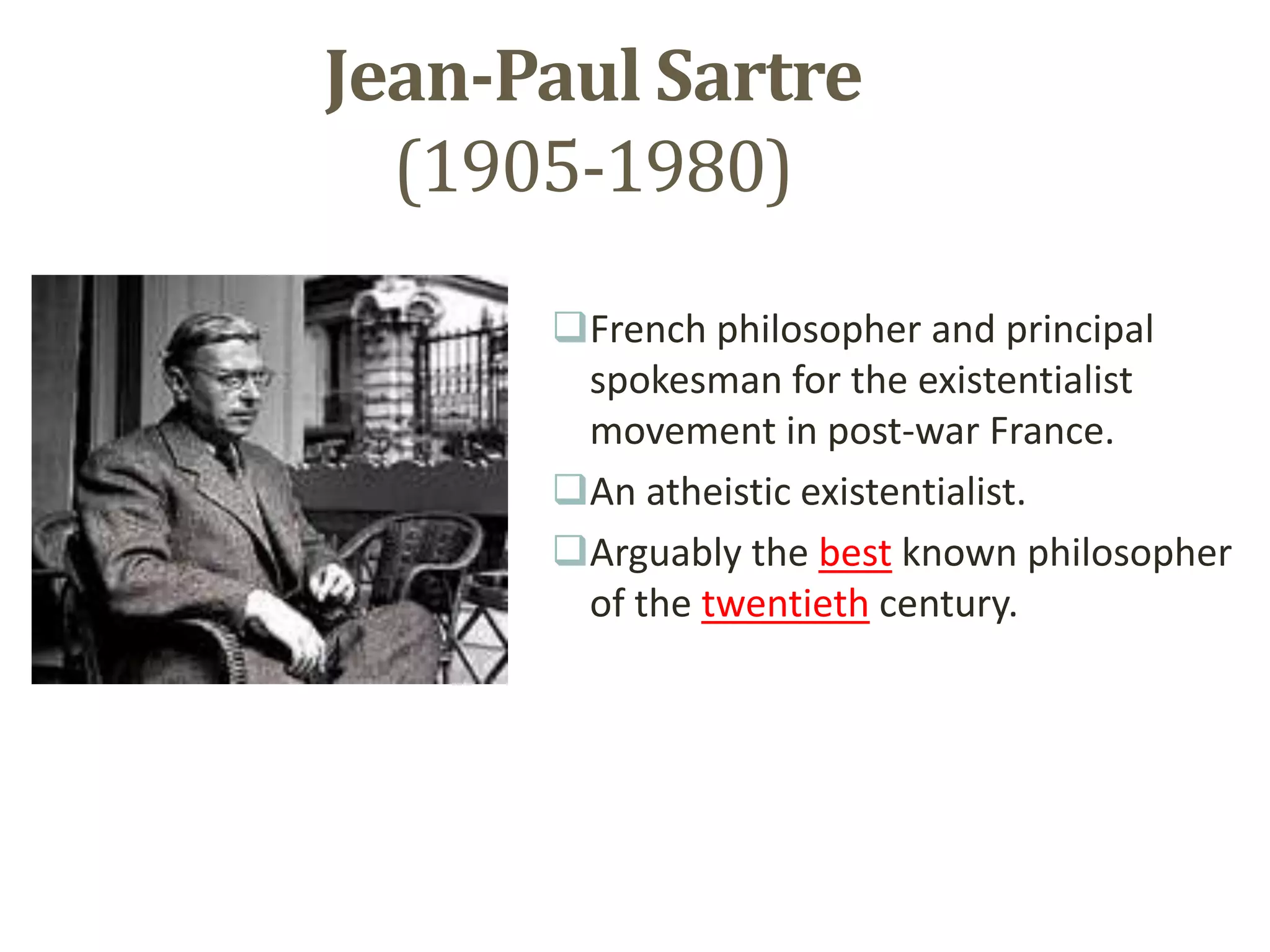
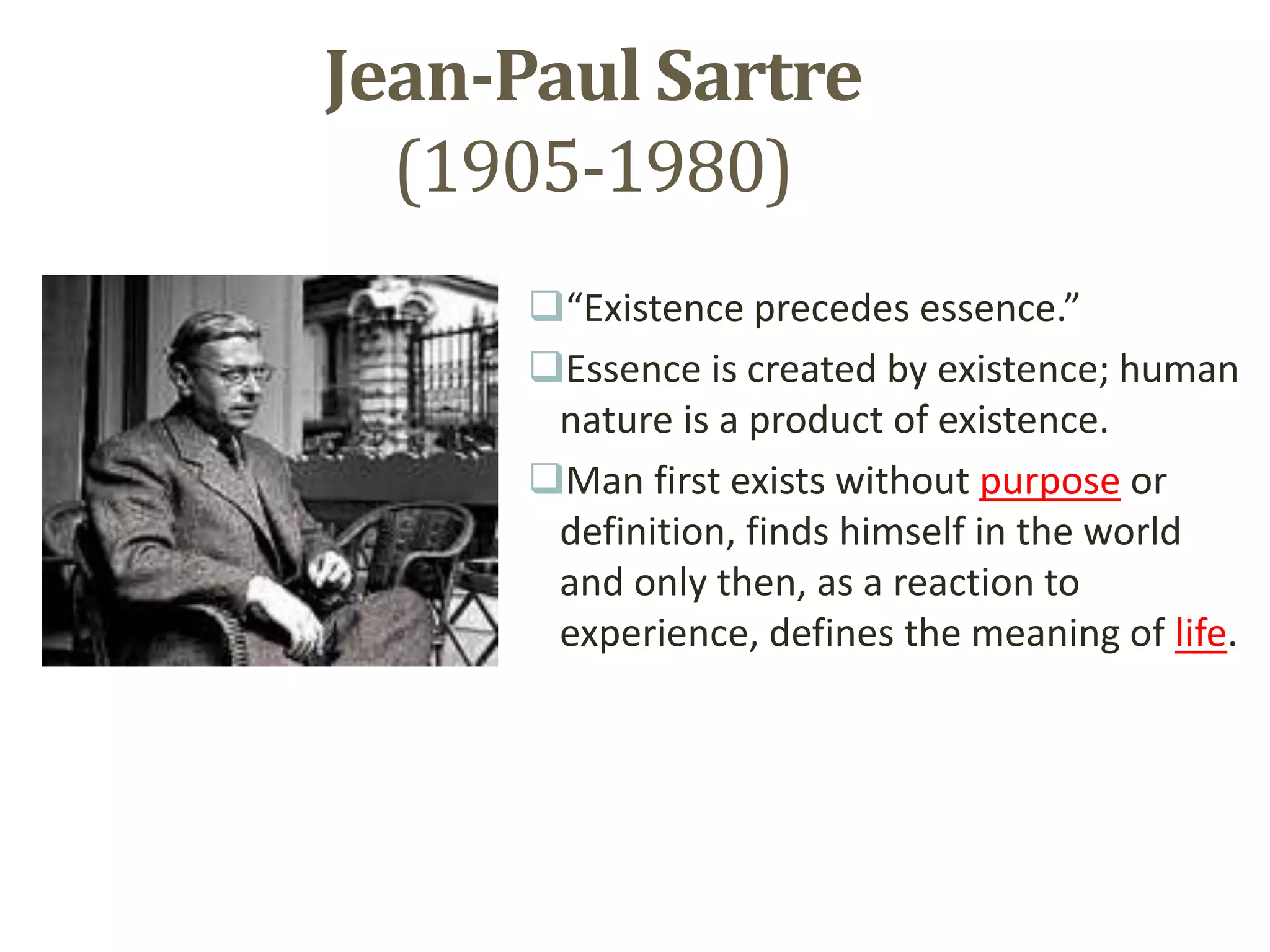
Jean-Paul Sartre
(1905-1980)
French philosopher and principal
spokesman for the existentialist
movement in post-war France.
An atheistic existentialist.
Arguably the best known philosopher
of the twentieth century.
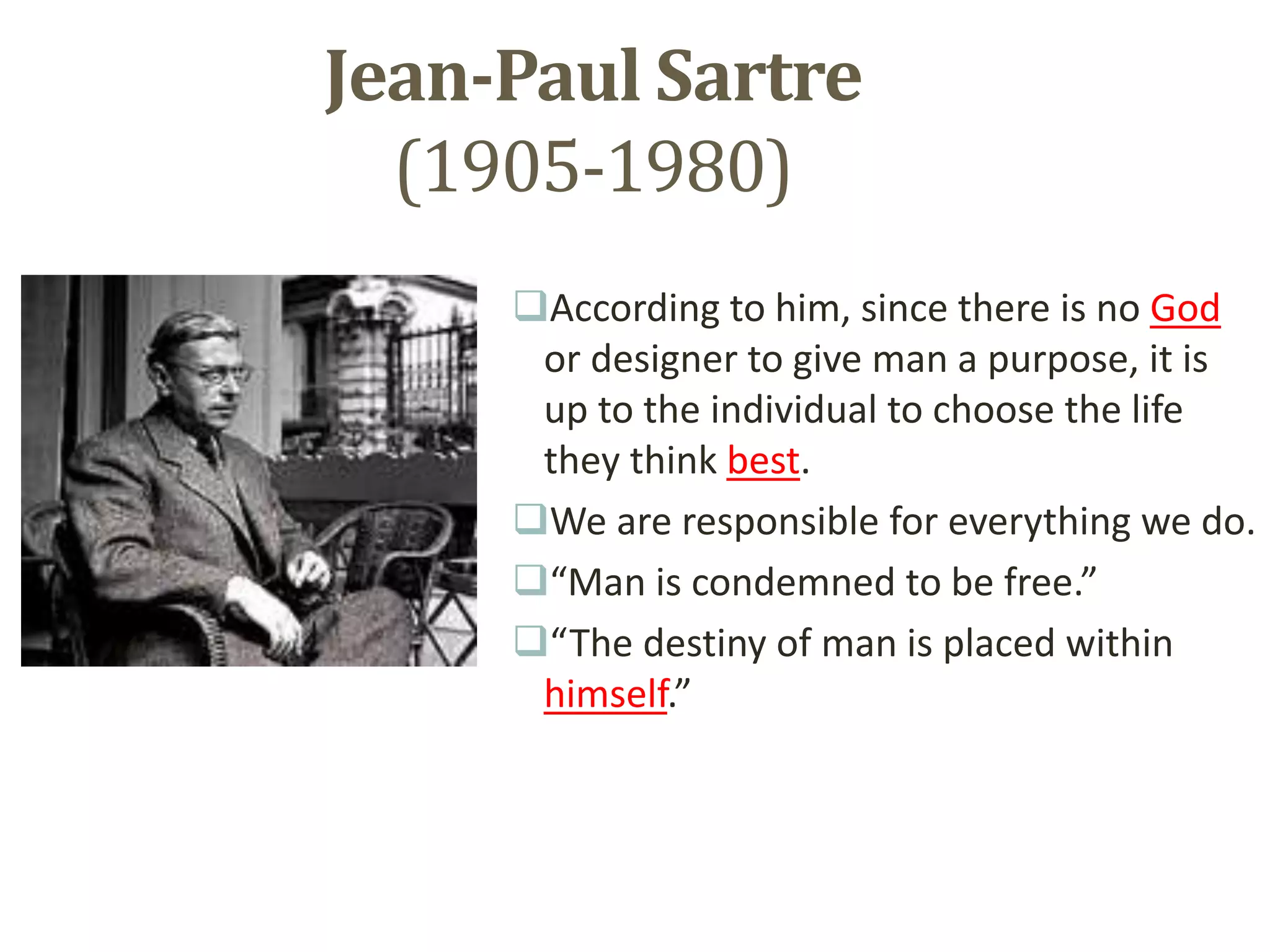
Jean-Paul Sartre
(1905-1980)
“Existence precedes essence.”
Essence is created by existence; human
nature is a product of existence.
Man first exists without purpose or
definition, finds himself in the world
and only then, as a reaction to
experience, defines the meaning of life.
Jean-Paul Sartre
(1905-1980)
According to him, since there is no God
or designer to give man a purpose, it is
up to the individual to choose the life
they think best.
We are responsible for everything we do.
“Man is condemned to be free.”
“The destiny of man is placed within
himself.”
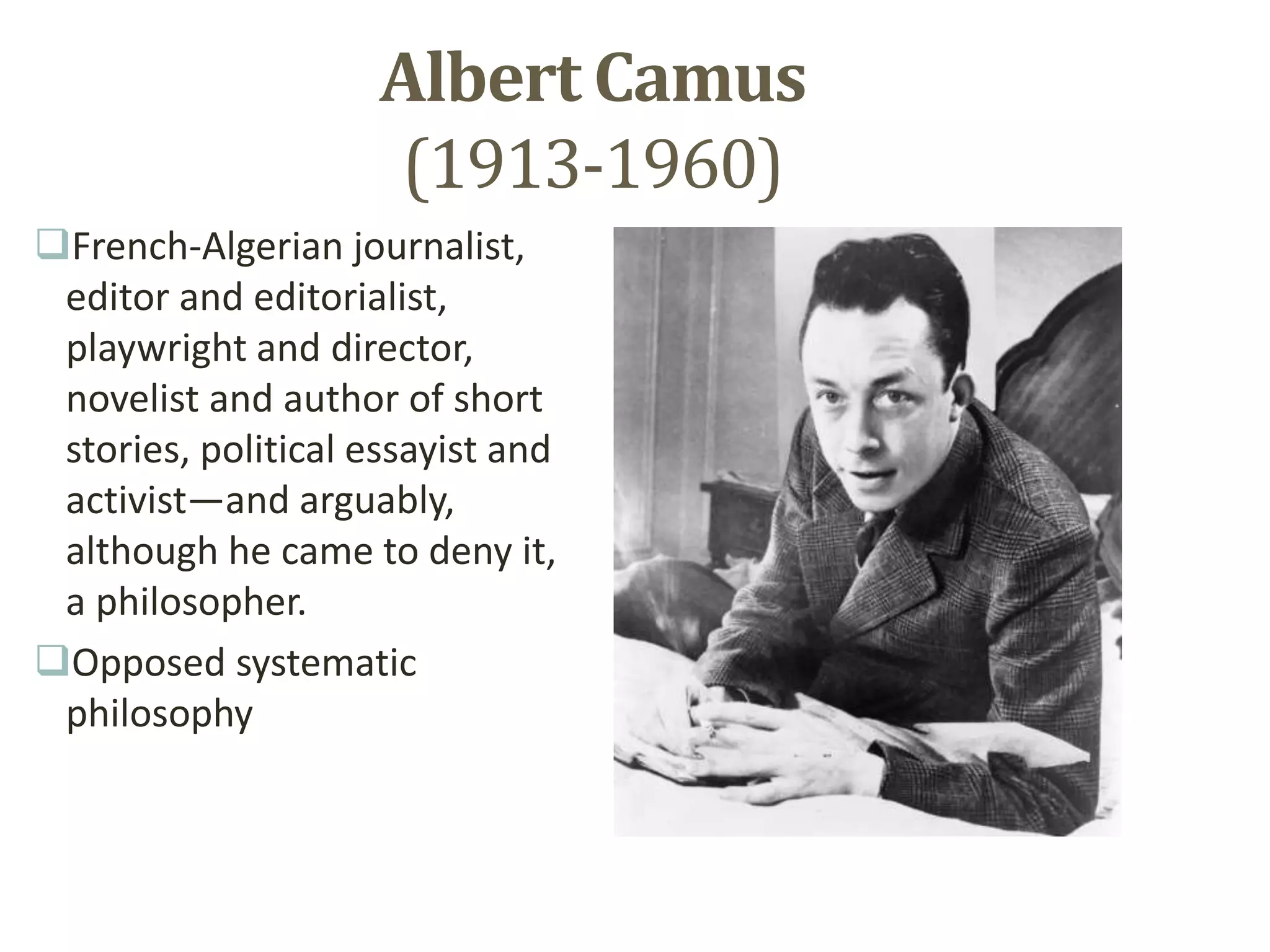
Albert Camus
(1913-1960)
French-Algerian journalist,
editor and editorialist,
playwright and director,
novelist and author of short
stories, political essayist and
activist—and arguably,
although he came to deny it,
a philosopher.
Opposed systematic
philosophy
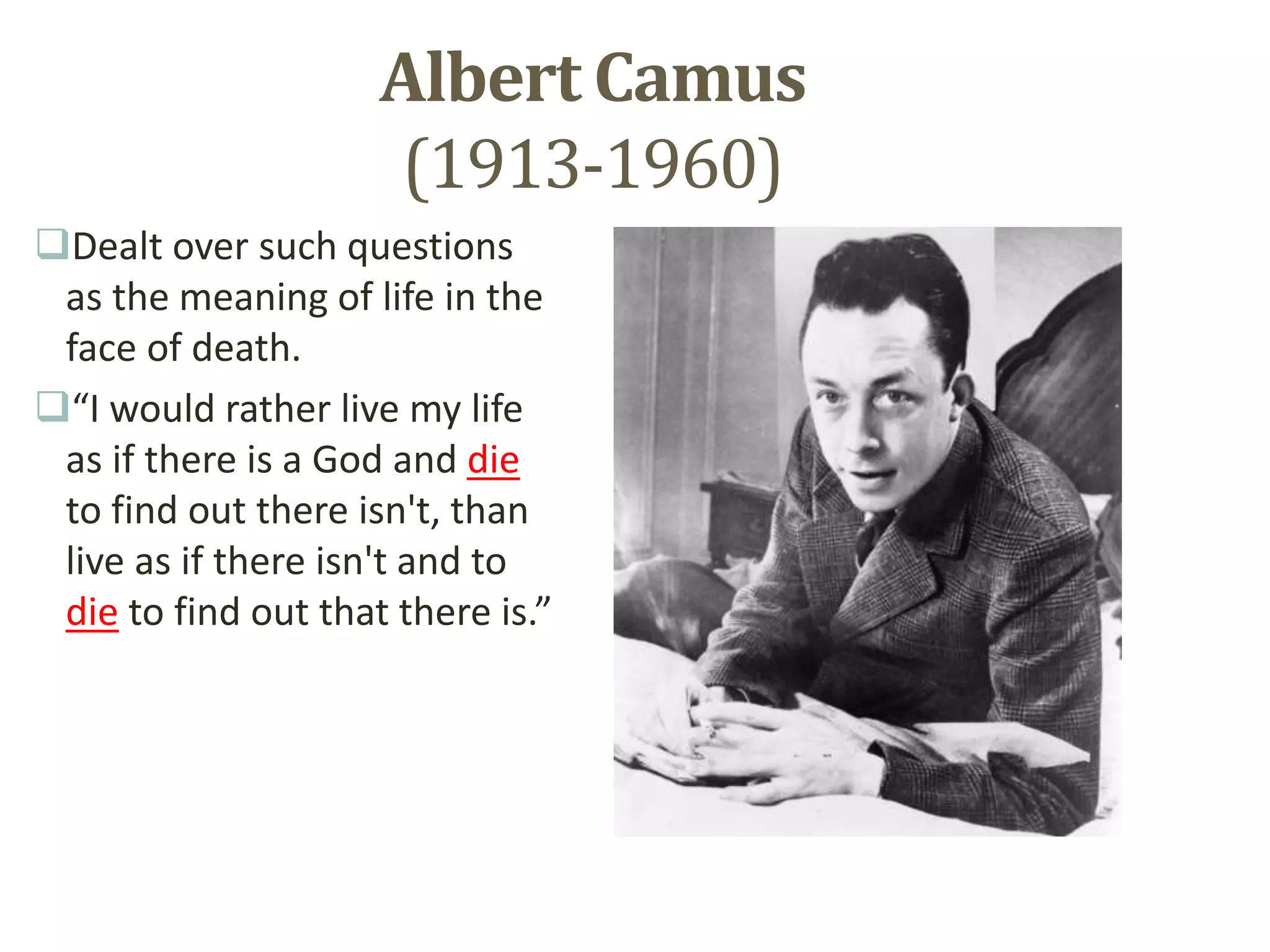
Albert Camus
(1913-1960)
Dealt over such questions
as the meaning of life in the
face of death.
“I would rather live my life
as if there is a God and die
to find out there isn't, than
live as if there isn't and to
die to find out that there is.”
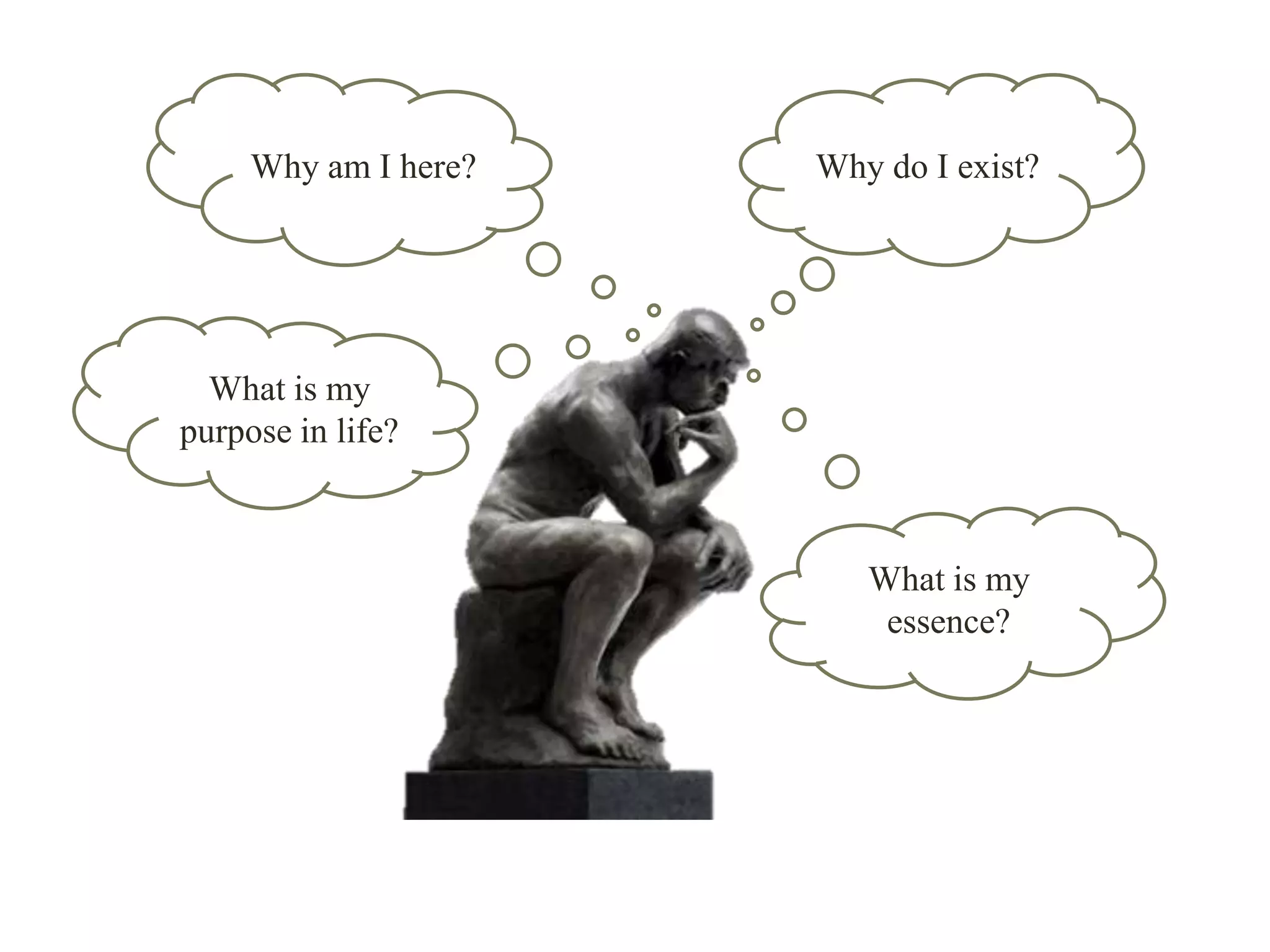
Why do I exist?Why am I here?
What is my
purpose in life?
What is my
essence?
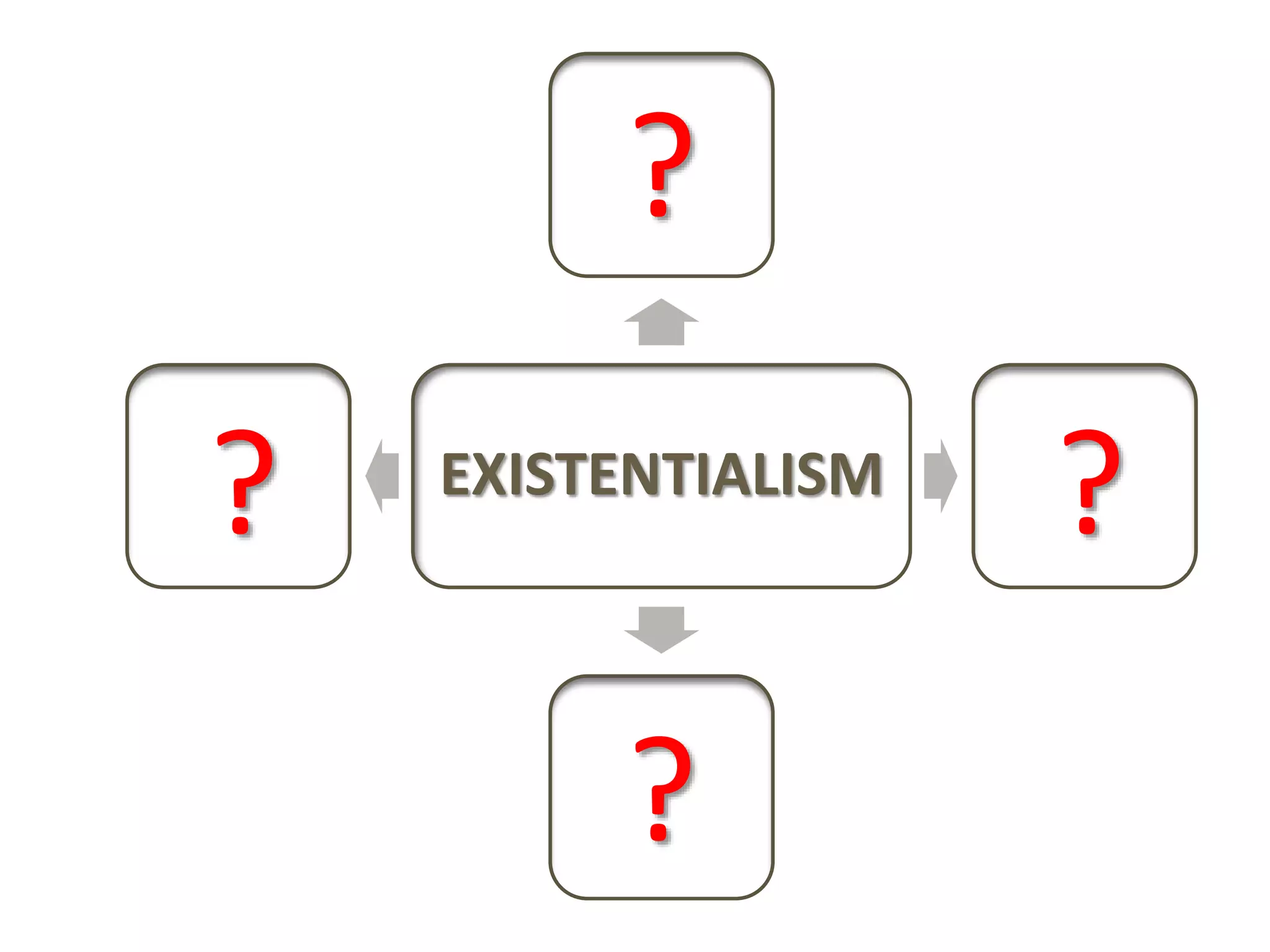
EXISTENTIALISM
Existence
Essence
Freedom
to
Choose
Responsibility
?
??
?
What is
EXISTENCE?
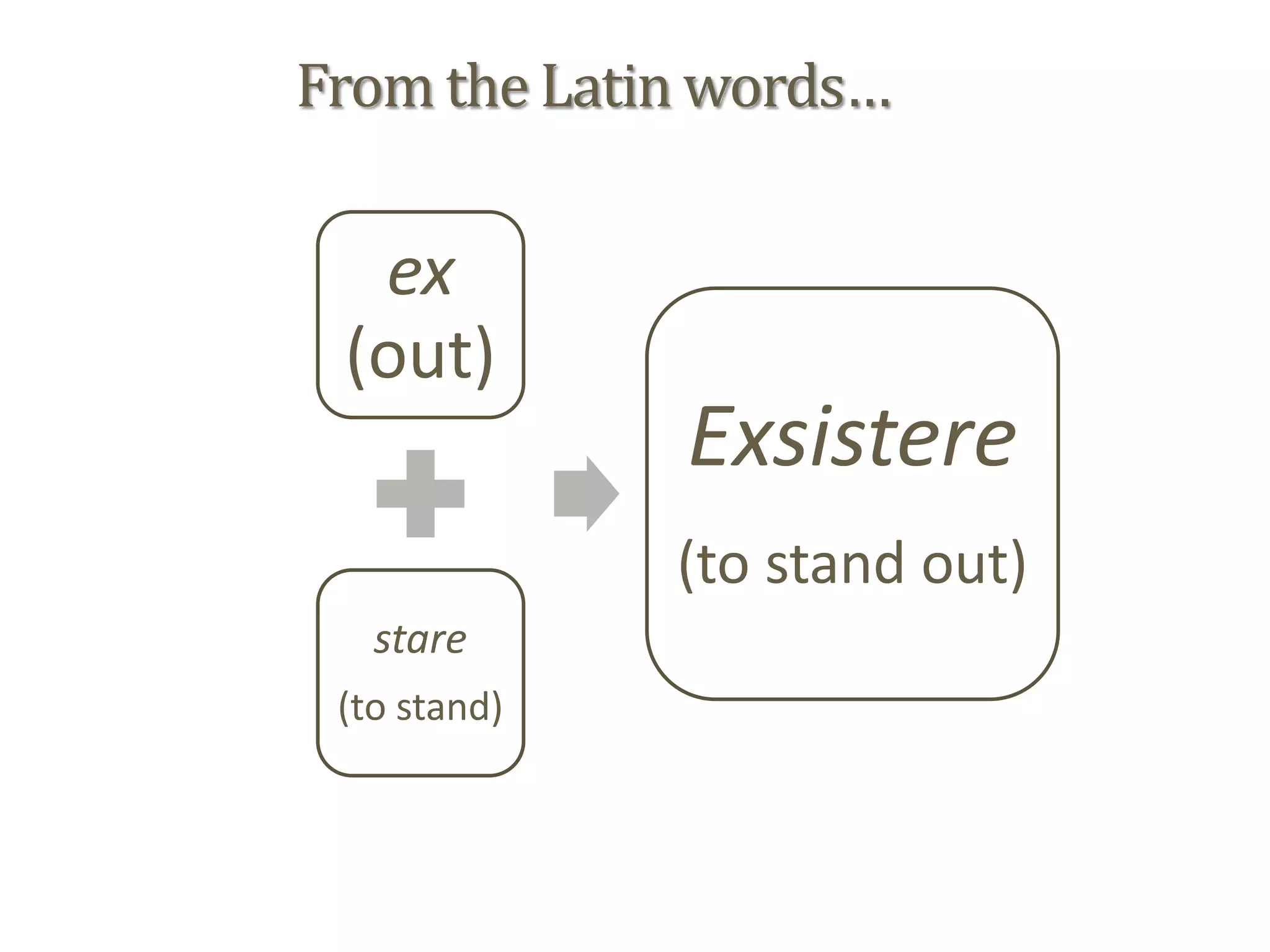
From the Latin words…
ex
(out)
stare
(to stand)
Exsistere
(to stand out)
…To appear
…To arise
…To become
…To be
What is ESSENCE?
…Meaning
…Purpose
…What it is
…Nature
What is Existentialism?
 It is subjective.
 Humans possess free will and stand in an
absurd and meaningless world or universe.
 Every individual is unique.
 Individuals have to take responsibility for their
own actions and shape their own destinies.
What is Existentialism?
 Emphasis on human responsibility and
judgment in ethical matters.
 The individual is the sole judge of his or her
own actions.
 Human freedom is understood precisely as the
freedom to choose.
What is Existentialism?
 “Existence precedes essence.”
 Human persons do not possess the essence;
they make choices that create their own
nature.
 Choice is vital and inevitable to human
existence; even the refusal to choose is a
choice.
What is Existentialism?
 “At birth, man lacks human nature, Man
creates himself; what he is, he himself made.
Man is only what he himself wills himself to be.
Man is nothing else but what he makes of
himself…” (Sahakian and Sahakian, pp. 563-
565)
What is Existentialism?
 The will enables man to make a conscious
decision of what he will be.
 Choice or decision makes one responsible for
the effects of his choice not only to himself but
also to others since his choice also affects
other people.
What is Existentialism?
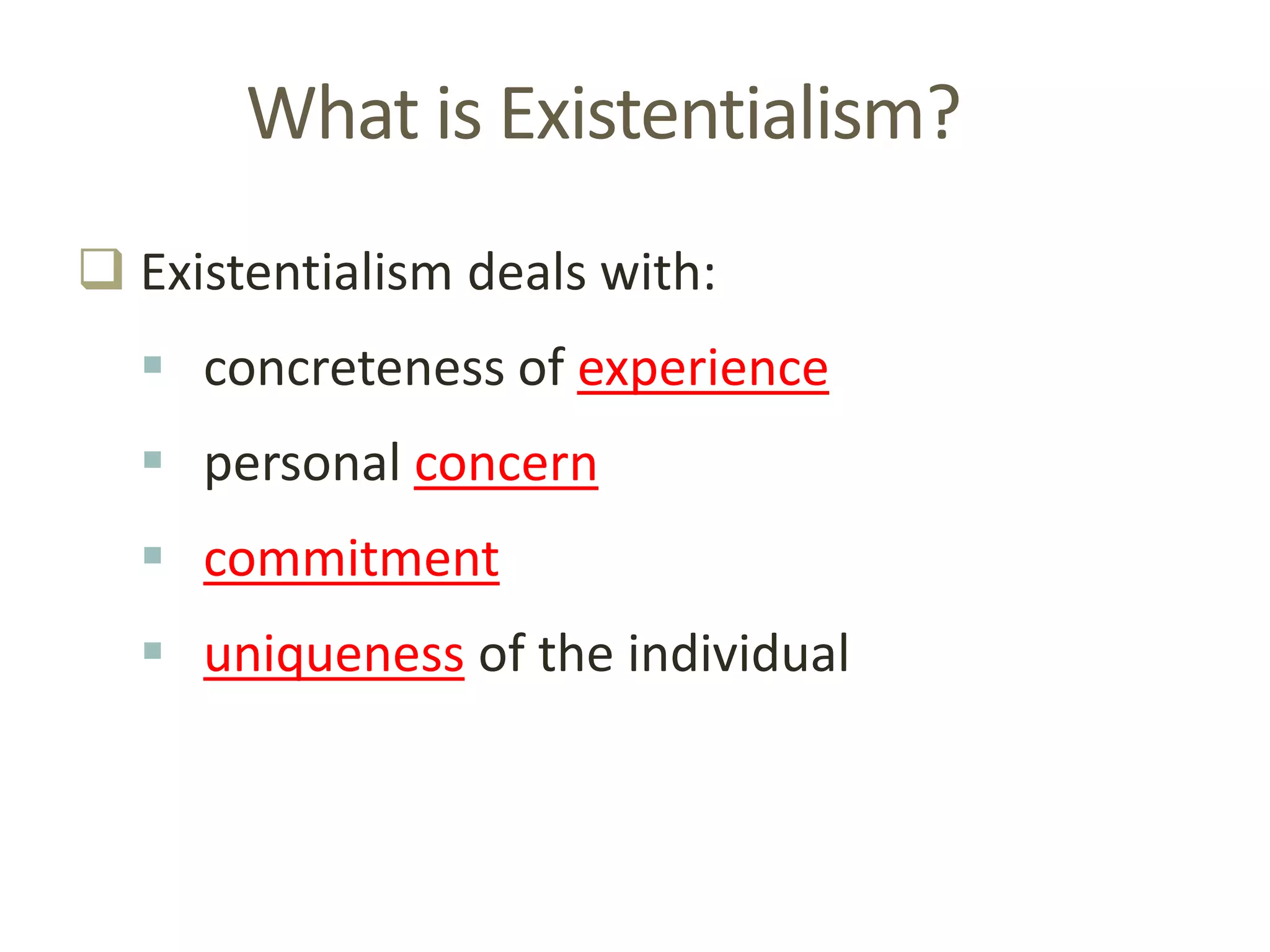
 Existentialism deals with:
 concreteness of experience
 personal concern
 commitment
 uniqueness of the individual
What is Existentialism?
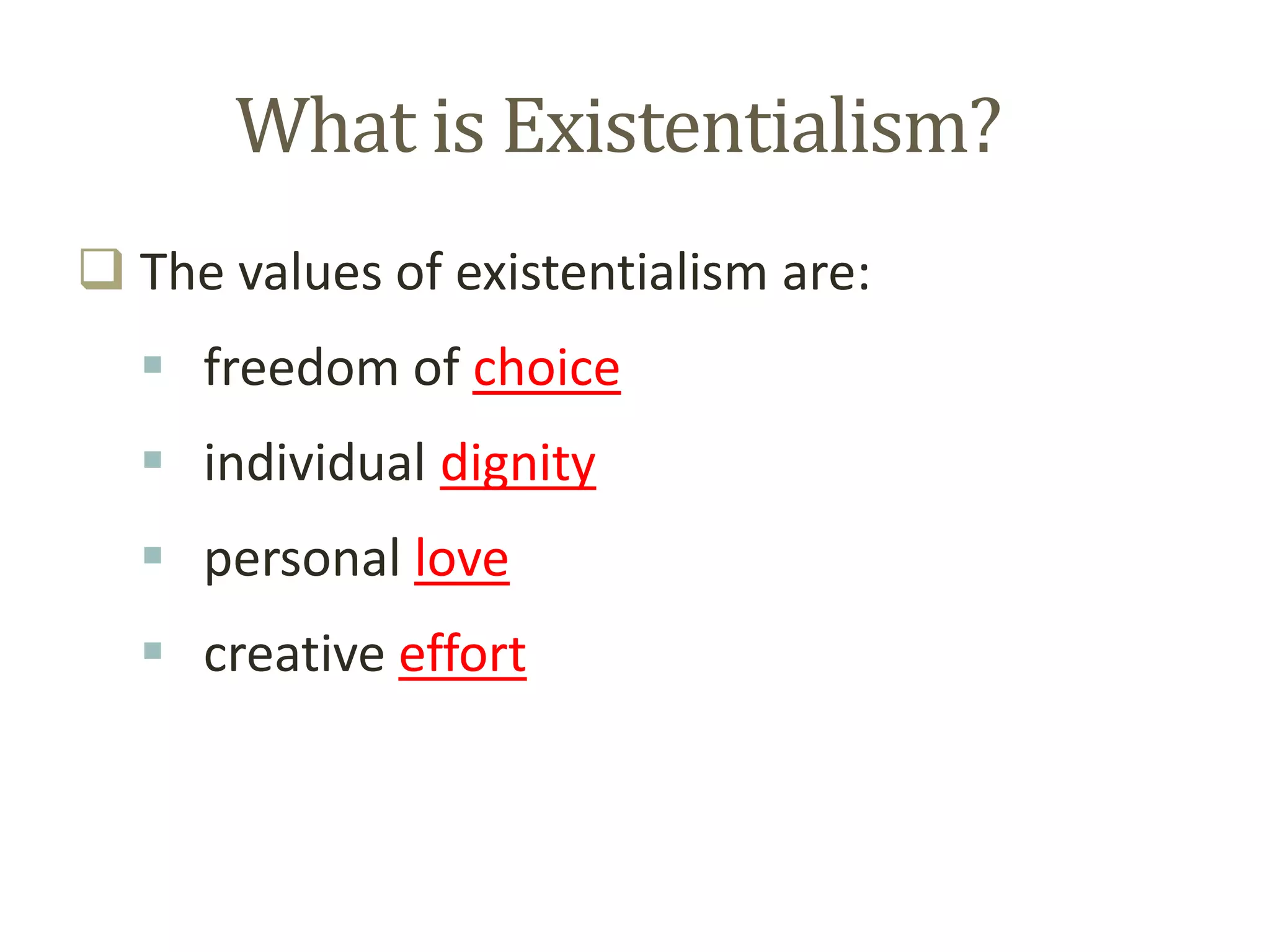
 The values of existentialism are:
 freedom of choice
 individual dignity
 personal love
 creative effort
What is Existentialism?
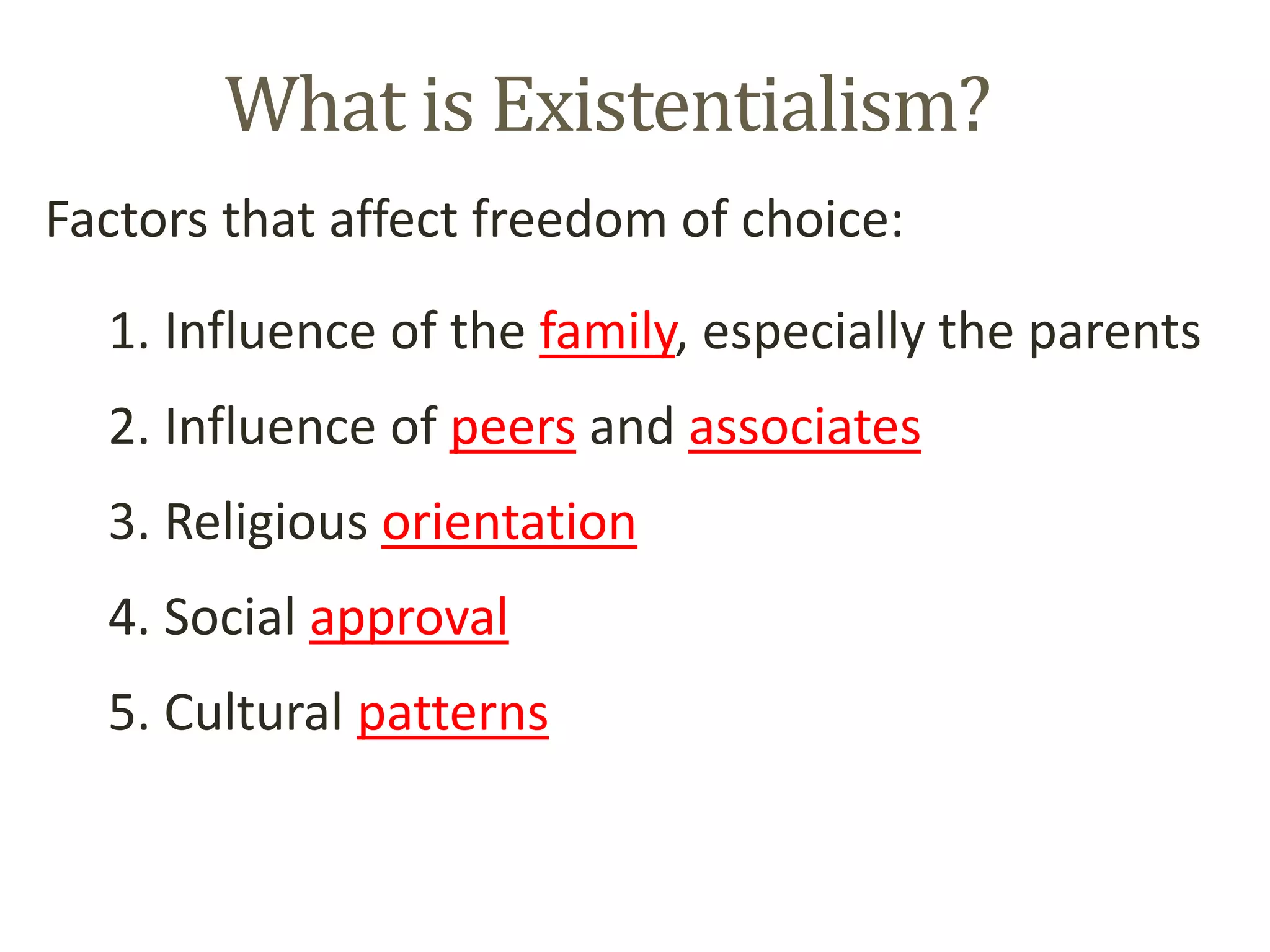
Factors that affect freedom of choice:
1. Influence of the family, especially the parents
2. Influence of peers and associates
3. Religious orientation
4. Social approval
5. Cultural patterns
What is Existentialism?
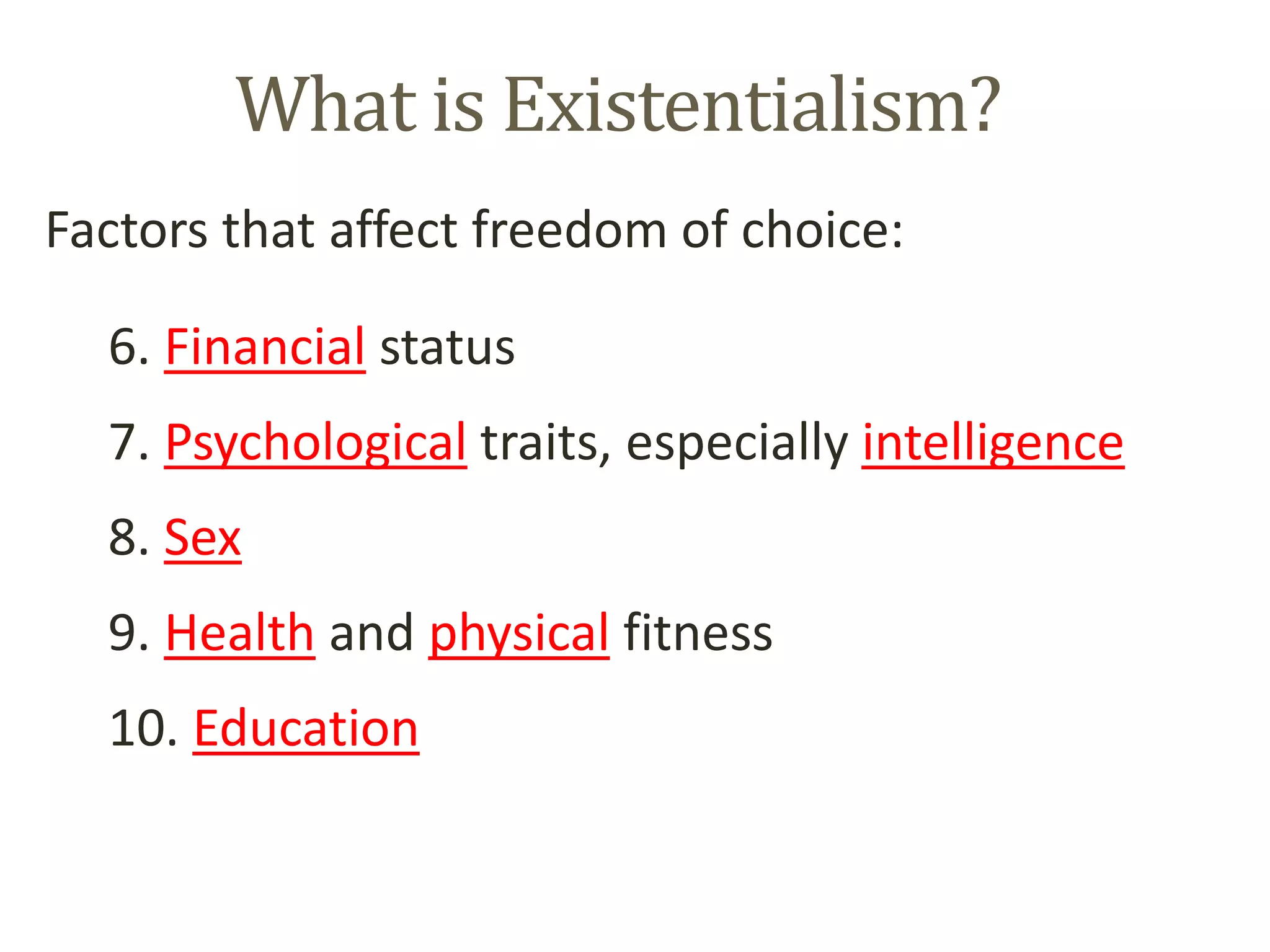
Factors that affect freedom of choice:
6. Financial status
7. Psychological traits, especially intelligence
8. Sex
9. Health and physical fitness
10. Education
What is Existentialism?
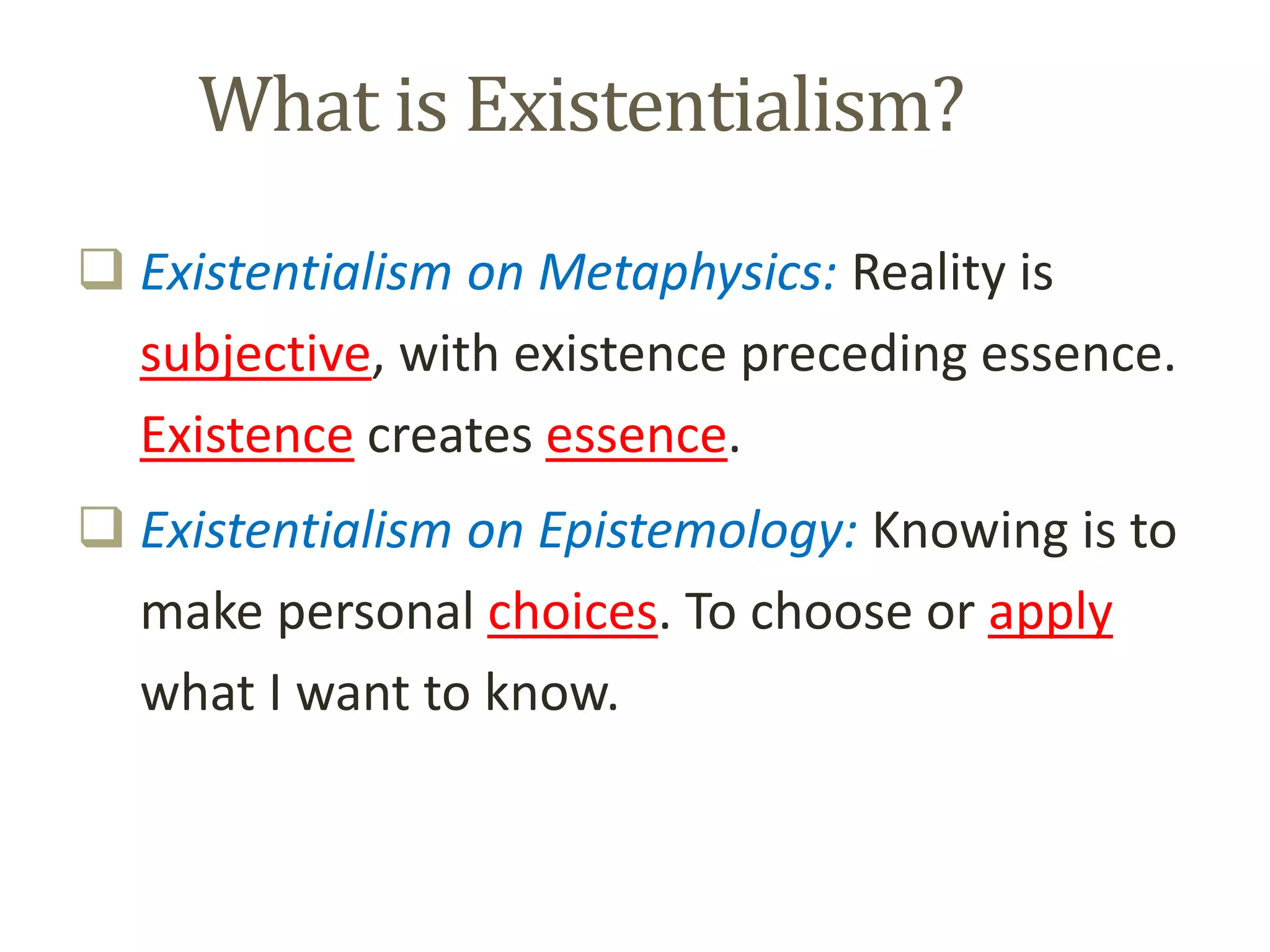
 Existentialism on Metaphysics: Reality is
subjective, with existence preceding essence.
Existence creates essence.
 Existentialism on Epistemology: Knowing is to
make personal choices. To choose or apply
what I want to know.
What is Existentialism?
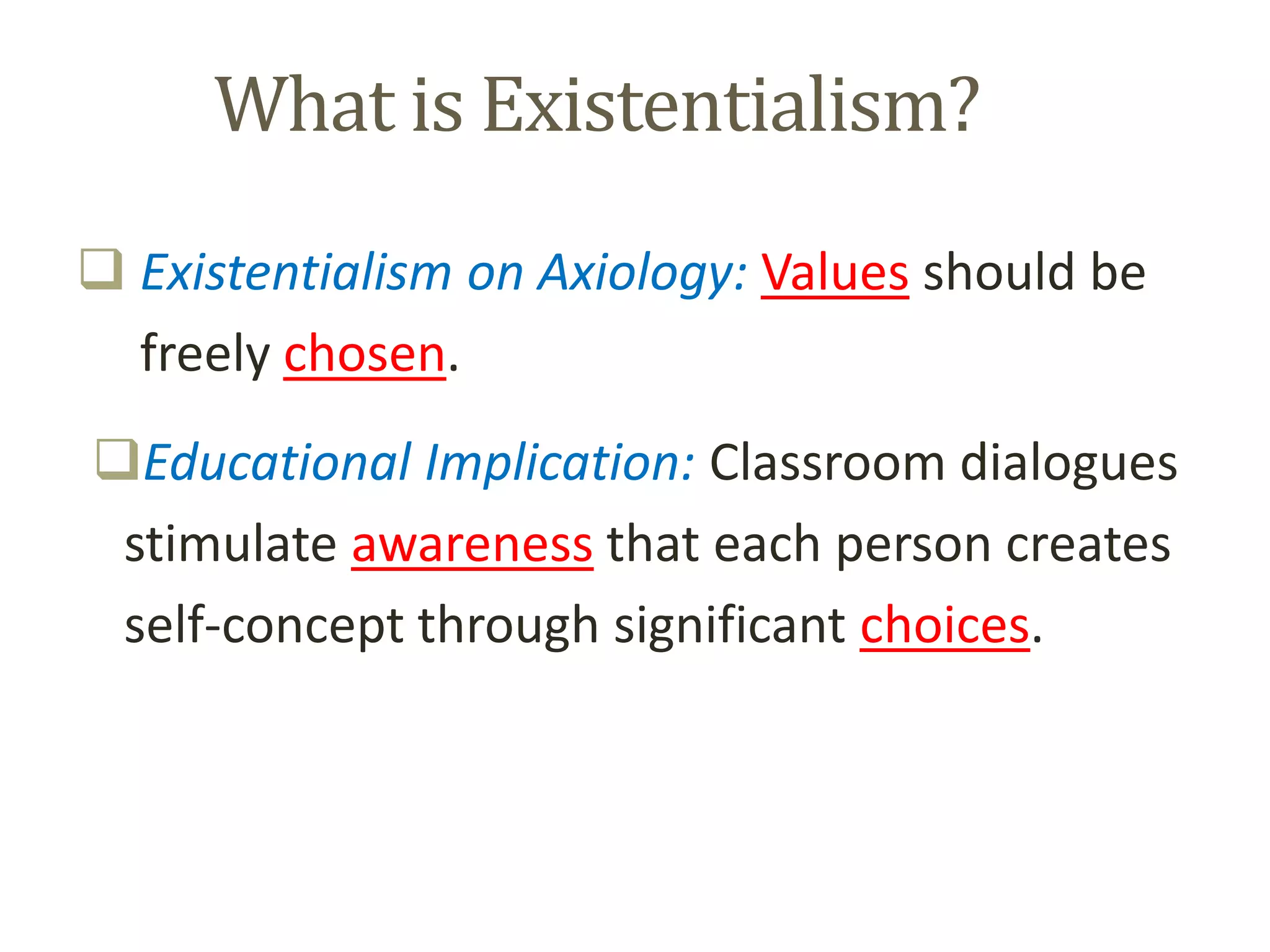
 Existentialism on Axiology: Values should be
freely chosen.
Educational Implication: Classroom dialogues
stimulate awareness that each person creates
self-concept through significant choices.
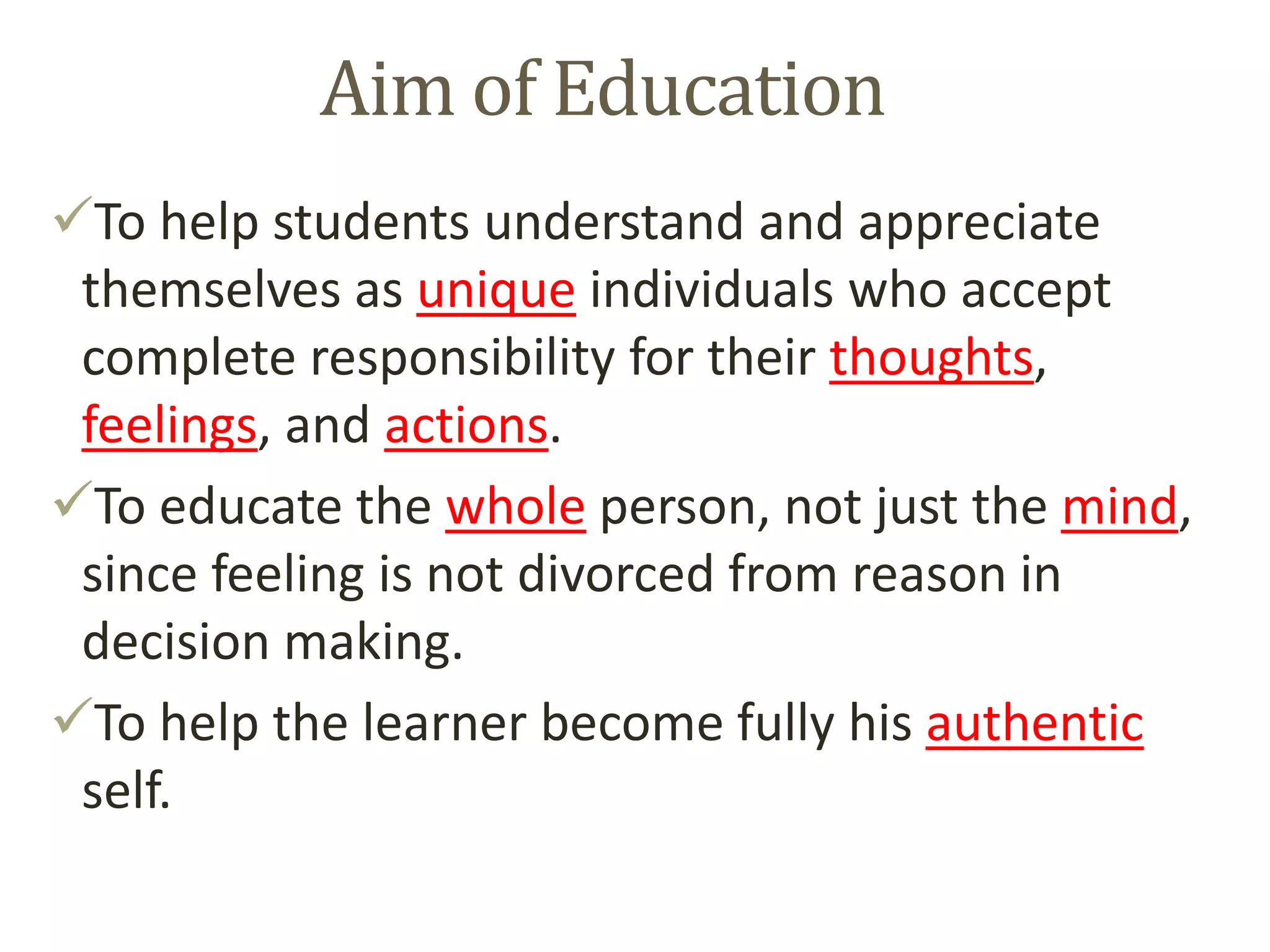
Aim of Education
To help students understand and appreciate
themselves as unique individuals who accept
complete responsibility for their thoughts,
feelings, and actions.
To educate the whole person, not just the mind,
since feeling is not divorced from reason in
decision making.
To help the learner become fully his authentic
self.
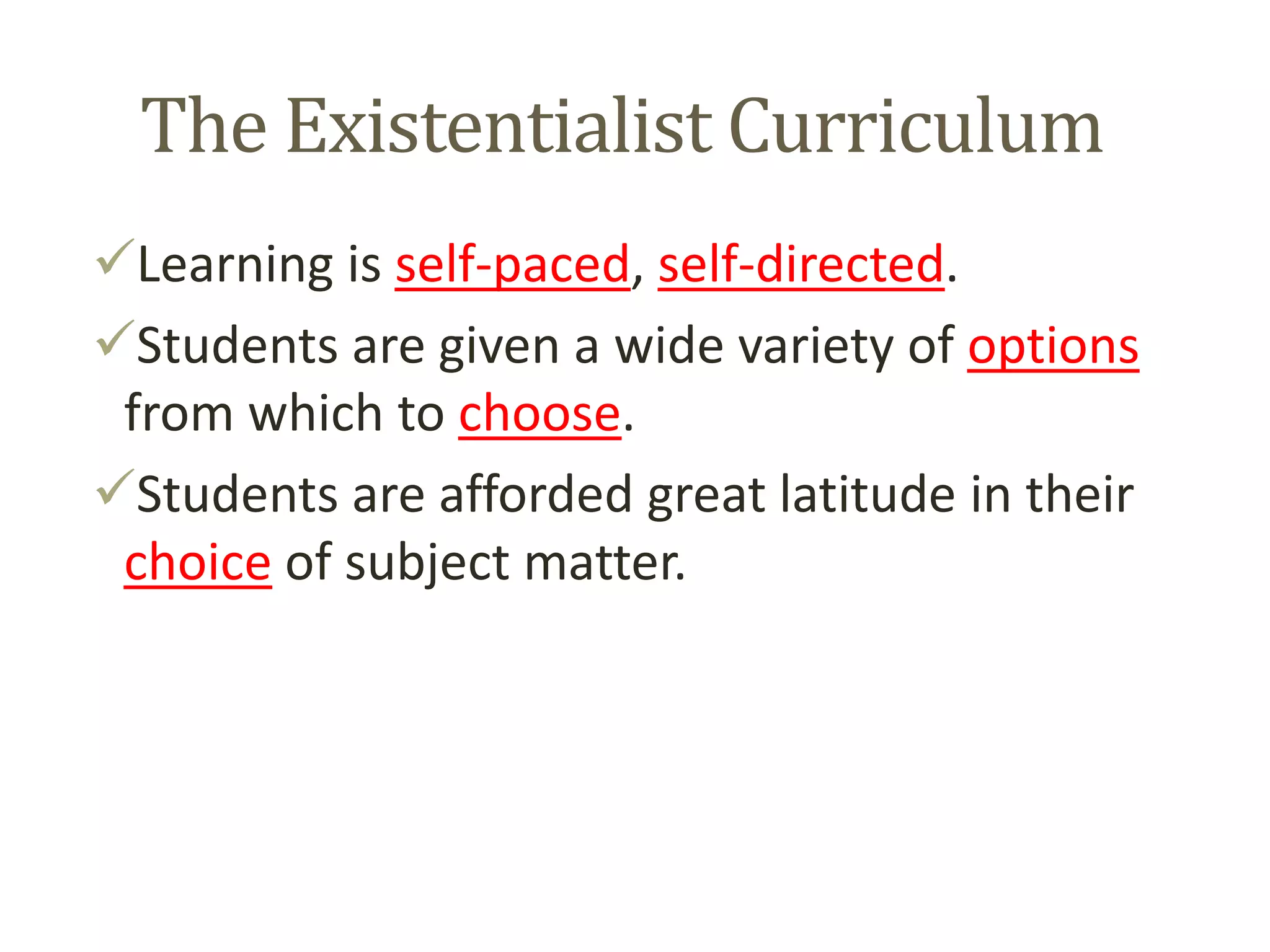
The Existentialist Curriculum
Learning is self-paced, self-directed.
Students are given a wide variety of options
from which to choose.
Students are afforded great latitude in their
choice of subject matter.
The Existentialist Curriculum
The humanities are given emphasis to provide
students with various experiences that will help
unleash their own creativity and self-expression.
The Existentialist Curriculum
Composed of fine arts, drama, creative
expression, literature, and philosophy.
Vocational education is seen more as a means
of teaching students about themselves and
their potentials than that of earning a
livelihood.
Methods of Teaching
Focus is on the individual.
In teaching history, existentialists focus on the
actions of historical individuals, who provide
possible models for the students’ own behavior,
rather than emphasizing historical events.
Methods of Teaching
In arts, existentialism encourages individual
creativity and imagination more than copying and
imitating established models. Creativity is an
expression of oneself.
In teaching values, teachers employ values
clarification strategy to help students know
themselves and their place in society. Here,
teachers remain non-judgmental and take care
not to impose their values on their students since
values are personal.
Methods of Teaching
Through values clarification strategy, the
learners will be able to practice sound moral
reasoning skills, choose the appropriate response
for a value conflict and commit themselves to
personal, moral, and societal values.
Values education is a matter of choice that goes
throughout existence.
Methods of Teaching
There should be private and open spaces in the
classroom to facilitate dialogues, small group
discussions, and individualization to lessen the
tension, formality, and constraint experienced by
the learners.
Criticism to any individual work is less important.
Role of Teachers
To help students define their own essence by
exposing them to various paths they take in life.
To create an environment in which they freely
choose their own preferred way.
To relates with each student openly and
honestly.
Role of Teachers
To assist and guide the learner in the process of
becoming intelligent, sensitive, choosing, and
acting individual who knows the obligation and
responsibility of freedom.
To help the individual identify and know himself
better.
Role of Teachers
To be a questioner
Poser of alternatives
Identifier of choices who challenges the learner
to become fully existent.
Role of Learners
To freely choose what subject/s they want to
study as long as they are interested in it.
To define their own essence or meaning of life.
Existentialism in Education

Existentialism in Education

  • 1.
  • 2.
    Sӧren Kierkegaard (1813-1855) Danish philosopherborn in Copenhagen The father of existentialism Human existence is always individual in character, never social.
  • 3.
    Sӧren Kierkegaard (1813-1855) Man functions,grows, develops, makes choices, suffers, experiences intense feelings, and faces God as an individual.  “Life is not a problem to be solved, but a reality to be experienced.”
  • 4.
    Jean-Paul Sartre (1905-1980) French philosopherand principal spokesman for the existentialist movement in post-war France. An atheistic existentialist. Arguably the best known philosopher of the twentieth century.
  • 5.
    Jean-Paul Sartre (1905-1980) “Existence precedesessence.” Essence is created by existence; human nature is a product of existence. Man first exists without purpose or definition, finds himself in the world and only then, as a reaction to experience, defines the meaning of life.
  • 6.
    Jean-Paul Sartre (1905-1980) According tohim, since there is no God or designer to give man a purpose, it is up to the individual to choose the life they think best. We are responsible for everything we do. “Man is condemned to be free.” “The destiny of man is placed within himself.”
  • 7.
    Albert Camus (1913-1960) French-Algerian journalist, editorand editorialist, playwright and director, novelist and author of short stories, political essayist and activist—and arguably, although he came to deny it, a philosopher. Opposed systematic philosophy
  • 8.
    Albert Camus (1913-1960) Dealt oversuch questions as the meaning of life in the face of death. “I would rather live my life as if there is a God and die to find out there isn't, than live as if there isn't and to die to find out that there is.”
  • 9.
    Why do Iexist?Why am I here? What is my purpose in life? What is my essence?
  • 10.
  • 11.
  • 12.
    From the Latinwords… ex (out) stare (to stand) Exsistere (to stand out)
  • 13.
  • 14.
  • 15.
  • 17.
    What is Existentialism? It is subjective.  Humans possess free will and stand in an absurd and meaningless world or universe.  Every individual is unique.  Individuals have to take responsibility for their own actions and shape their own destinies.
  • 18.
    What is Existentialism? Emphasis on human responsibility and judgment in ethical matters.  The individual is the sole judge of his or her own actions.  Human freedom is understood precisely as the freedom to choose.
  • 19.
    What is Existentialism? “Existence precedes essence.”  Human persons do not possess the essence; they make choices that create their own nature.  Choice is vital and inevitable to human existence; even the refusal to choose is a choice.
  • 20.
    What is Existentialism? “At birth, man lacks human nature, Man creates himself; what he is, he himself made. Man is only what he himself wills himself to be. Man is nothing else but what he makes of himself…” (Sahakian and Sahakian, pp. 563- 565)
  • 21.
    What is Existentialism? The will enables man to make a conscious decision of what he will be.  Choice or decision makes one responsible for the effects of his choice not only to himself but also to others since his choice also affects other people.
  • 22.
    What is Existentialism? Existentialism deals with:  concreteness of experience  personal concern  commitment  uniqueness of the individual
  • 23.
    What is Existentialism? The values of existentialism are:  freedom of choice  individual dignity  personal love  creative effort
  • 24.
    What is Existentialism? Factorsthat affect freedom of choice: 1. Influence of the family, especially the parents 2. Influence of peers and associates 3. Religious orientation 4. Social approval 5. Cultural patterns
  • 25.
    What is Existentialism? Factorsthat affect freedom of choice: 6. Financial status 7. Psychological traits, especially intelligence 8. Sex 9. Health and physical fitness 10. Education
  • 26.
    What is Existentialism? Existentialism on Metaphysics: Reality is subjective, with existence preceding essence. Existence creates essence.  Existentialism on Epistemology: Knowing is to make personal choices. To choose or apply what I want to know.
  • 27.
    What is Existentialism? Existentialism on Axiology: Values should be freely chosen. Educational Implication: Classroom dialogues stimulate awareness that each person creates self-concept through significant choices.
  • 28.
    Aim of Education Tohelp students understand and appreciate themselves as unique individuals who accept complete responsibility for their thoughts, feelings, and actions. To educate the whole person, not just the mind, since feeling is not divorced from reason in decision making. To help the learner become fully his authentic self.
  • 29.
    The Existentialist Curriculum Learningis self-paced, self-directed. Students are given a wide variety of options from which to choose. Students are afforded great latitude in their choice of subject matter.
  • 30.
    The Existentialist Curriculum Thehumanities are given emphasis to provide students with various experiences that will help unleash their own creativity and self-expression.
  • 31.
    The Existentialist Curriculum Composedof fine arts, drama, creative expression, literature, and philosophy. Vocational education is seen more as a means of teaching students about themselves and their potentials than that of earning a livelihood.
  • 32.
    Methods of Teaching Focusis on the individual. In teaching history, existentialists focus on the actions of historical individuals, who provide possible models for the students’ own behavior, rather than emphasizing historical events.
  • 33.
    Methods of Teaching Inarts, existentialism encourages individual creativity and imagination more than copying and imitating established models. Creativity is an expression of oneself. In teaching values, teachers employ values clarification strategy to help students know themselves and their place in society. Here, teachers remain non-judgmental and take care not to impose their values on their students since values are personal.
  • 34.
    Methods of Teaching Throughvalues clarification strategy, the learners will be able to practice sound moral reasoning skills, choose the appropriate response for a value conflict and commit themselves to personal, moral, and societal values. Values education is a matter of choice that goes throughout existence.
  • 35.
    Methods of Teaching Thereshould be private and open spaces in the classroom to facilitate dialogues, small group discussions, and individualization to lessen the tension, formality, and constraint experienced by the learners. Criticism to any individual work is less important.
  • 36.
    Role of Teachers Tohelp students define their own essence by exposing them to various paths they take in life. To create an environment in which they freely choose their own preferred way. To relates with each student openly and honestly.
  • 37.
    Role of Teachers Toassist and guide the learner in the process of becoming intelligent, sensitive, choosing, and acting individual who knows the obligation and responsibility of freedom. To help the individual identify and know himself better.
  • 38.
    Role of Teachers Tobe a questioner Poser of alternatives Identifier of choices who challenges the learner to become fully existent.
  • 39.
    Role of Learners Tofreely choose what subject/s they want to study as long as they are interested in it. To define their own essence or meaning of life.