CONSTRUCTIVIS
      M
  By: Chelsea Welk
What is Constructivism
            Theory?

• Constructivist theory, also known as
  constructivis, is based on a type of learning
  where the learner forms, or constructs,
  much of what he or she learns or
  comprehends.
• To put it simply, contructivists agree that
  students learn by doing.
More About Constructivism

• Constructivism is not teacher-directed of
  lecture-based.
• It focuses on the learner and what the
  learner comprehends
• It requires active participation in the
  learning process by using critical-thinking
  skills to analyze a problem.
Key Constructivists
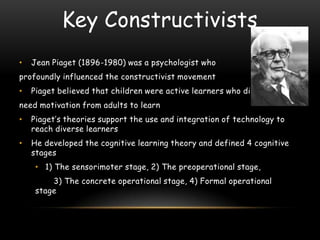
•   Jean Piaget (1896-1980) was a psychologist who
profoundly influenced the constructivist movement
•   Piaget believed that children were active learners who did not
need motivation from adults to learn
•   Piaget’s theories support the use and integration of technology to
    reach diverse learners
•   He developed the cognitive learning theory and defined 4 cognitive
    stages
     • 1) The sensorimoter stage, 2) The preoperational stage,
         3) The concrete operational stage, 4) Formal operational
     stage
Key Constructivists
•   Jerome Bruner (1915- ) is an American psychologist
and educator who said that learning is an active process
In which the learner constructs new ideas and concepts
Based on his current or past knowledge.
•   Bruner believes that constructivist learners are
Participatory learners and are actively engaged in the learning
process
•   Bruner believes that the teachers role should be to “encourage
    students through exploration and inquiry”.
•   His constructivist theory provides a framework for instruction
    based on the study of cognition
Key Constructivists
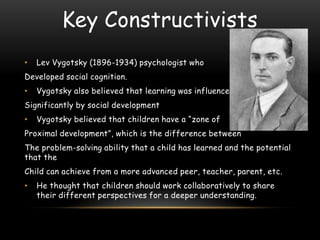
•   Lev Vygotsky (1896-1934) psychologist who
Developed social cognition.
•   Vygotsky also believed that learning was influenced
Significantly by social development
•   Vygotsky believed that children have a “zone of
Proximal development”, which is the difference between
The problem-solving ability that a child has learned and the potential
that the
Child can achieve from a more advanced peer, teacher, parent, etc.
•   He thought that children should work collaboratively to share
    their different perspectives for a deeper understanding.
Key Constructivists
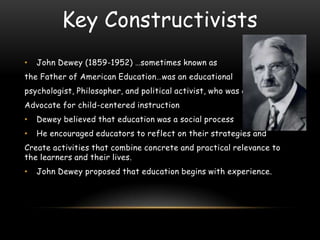
•   John Dewey (1859-1952) …sometimes known as
the Father of American Education…was an educational
psychologist, Philosopher, and political activist, who was an
Advocate for child-centered instruction
•   Dewey believed that education was a social process
•   He encouraged educators to reflect on their strategies and
Create activities that combine concrete and practical relevance to
the learners and their lives.
•   John Dewey proposed that education begins with experience.
Classroom Implications
• Without technology: Teachers can use constructivism to do
  group work, and always keep the learners actively involved
• With technology: Teachers can use the internet, iPads, and
  computer software to get the students actively involved in
  experiments, games online, online discussions, and so forth
• Below is a link for a video about the philosophy of a
  constructivist teacher:
           • http://www.youtube.com/watch?v=LxnpM5rJneA
For my Own Classroom…
• For my Own Classroom, I would incorporate constructivism
  in my day to day routine.
• I would do this through:
              • Field trips
              • Group work and collaboration
              • Experimentation
              • Group and class discussions
              • Student-based learning

Constructivism: chelsea

  • 1.
    CONSTRUCTIVIS M By: Chelsea Welk
  • 2.
    What is Constructivism Theory? • Constructivist theory, also known as constructivis, is based on a type of learning where the learner forms, or constructs, much of what he or she learns or comprehends. • To put it simply, contructivists agree that students learn by doing.
  • 3.
    More About Constructivism •Constructivism is not teacher-directed of lecture-based. • It focuses on the learner and what the learner comprehends • It requires active participation in the learning process by using critical-thinking skills to analyze a problem.
  • 4.
    Key Constructivists • Jean Piaget (1896-1980) was a psychologist who profoundly influenced the constructivist movement • Piaget believed that children were active learners who did not need motivation from adults to learn • Piaget’s theories support the use and integration of technology to reach diverse learners • He developed the cognitive learning theory and defined 4 cognitive stages • 1) The sensorimoter stage, 2) The preoperational stage, 3) The concrete operational stage, 4) Formal operational stage
  • 5.
    Key Constructivists • Jerome Bruner (1915- ) is an American psychologist and educator who said that learning is an active process In which the learner constructs new ideas and concepts Based on his current or past knowledge. • Bruner believes that constructivist learners are Participatory learners and are actively engaged in the learning process • Bruner believes that the teachers role should be to “encourage students through exploration and inquiry”. • His constructivist theory provides a framework for instruction based on the study of cognition
  • 6.
    Key Constructivists • Lev Vygotsky (1896-1934) psychologist who Developed social cognition. • Vygotsky also believed that learning was influenced Significantly by social development • Vygotsky believed that children have a “zone of Proximal development”, which is the difference between The problem-solving ability that a child has learned and the potential that the Child can achieve from a more advanced peer, teacher, parent, etc. • He thought that children should work collaboratively to share their different perspectives for a deeper understanding.
  • 7.
    Key Constructivists • John Dewey (1859-1952) …sometimes known as the Father of American Education…was an educational psychologist, Philosopher, and political activist, who was an Advocate for child-centered instruction • Dewey believed that education was a social process • He encouraged educators to reflect on their strategies and Create activities that combine concrete and practical relevance to the learners and their lives. • John Dewey proposed that education begins with experience.
  • 8.
    Classroom Implications • Withouttechnology: Teachers can use constructivism to do group work, and always keep the learners actively involved • With technology: Teachers can use the internet, iPads, and computer software to get the students actively involved in experiments, games online, online discussions, and so forth • Below is a link for a video about the philosophy of a constructivist teacher: • http://www.youtube.com/watch?v=LxnpM5rJneA
  • 9.
    For my OwnClassroom… • For my Own Classroom, I would incorporate constructivism in my day to day routine. • I would do this through: • Field trips • Group work and collaboration • Experimentation • Group and class discussions • Student-based learning