Constructivism By:Kathleenschiel
Key Points of ConstructivismThe constructivism theory argues that humans build new knowledge and meaning through experiences.
Students learn by doing
Learning is active rather than passive
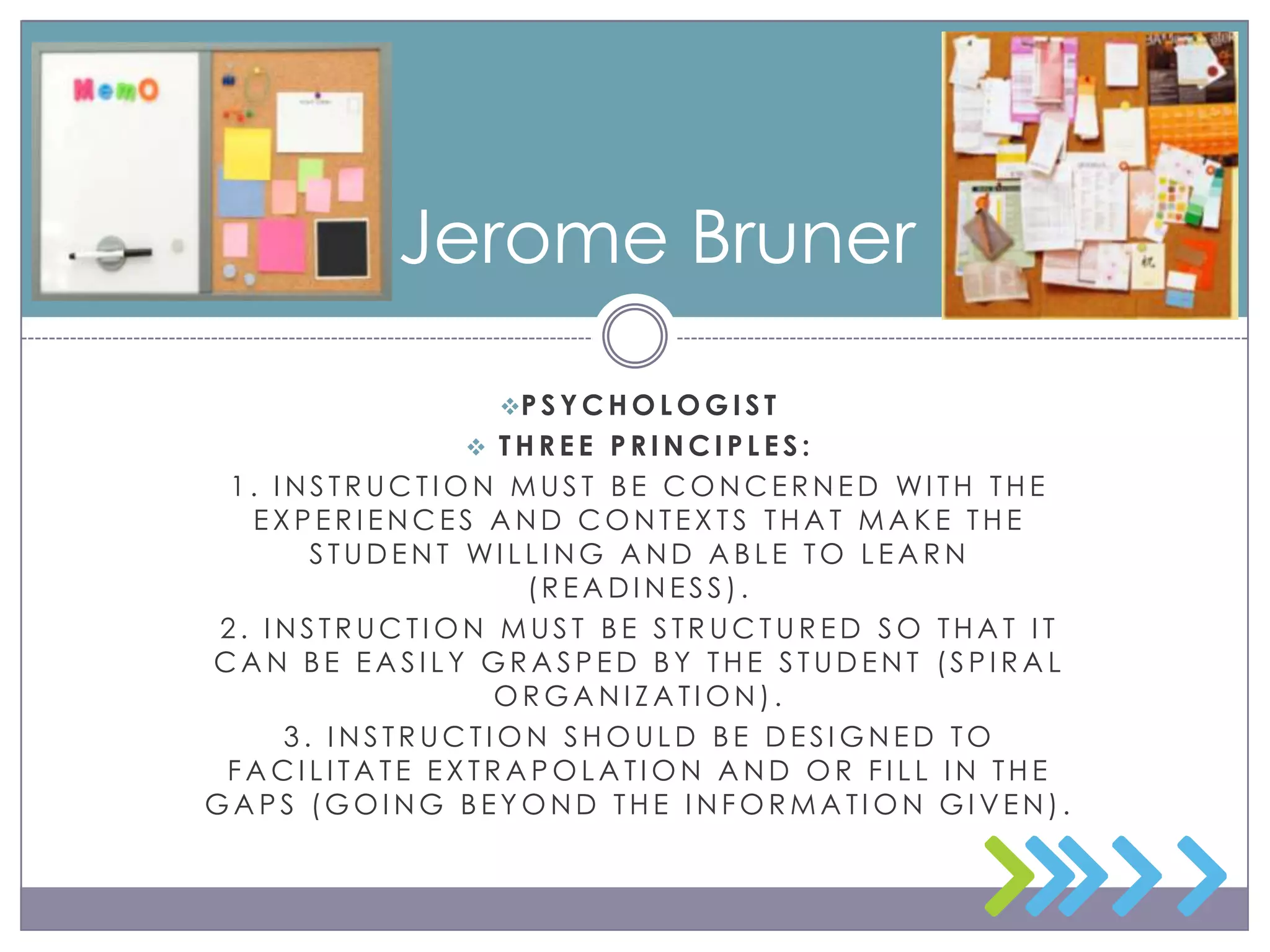
Great emphasis on social    interaction Key People Associated with ConstructivismJean PiagetJohn DeweyLev VygotskyJerome Bruner Jean Piaget (psychologist)Developed the cognitive learning theory after observing children for many years
Defined four cognitive stages:
Sensorimotor- (0-2yrs) learning takes place mainly through senses and motor actions
Preoperational- (2-6/7 yrs) when children begin to use symbols and images
Concrete operational- (age 7) children begin to think logically, can understand other points of view other than their own.
Formal operational- (age 12+/-) Children can think abstractly-understand cause and effect.“I hear and I forget, I see and I remember. I do and I understand.”           -Confucius

Learning theory

  • 1.
  • 2.
    Key Points ofConstructivismThe constructivism theory argues that humans build new knowledge and meaning through experiences.
  • 3.
  • 4.
    Learning is activerather than passive
  • 5.
    Great emphasis onsocial interaction Key People Associated with ConstructivismJean PiagetJohn DeweyLev VygotskyJerome Bruner Jean Piaget (psychologist)Developed the cognitive learning theory after observing children for many years
  • 6.
  • 7.
    Sensorimotor- (0-2yrs) learningtakes place mainly through senses and motor actions
  • 8.
    Preoperational- (2-6/7 yrs)when children begin to use symbols and images
  • 9.
    Concrete operational- (age7) children begin to think logically, can understand other points of view other than their own.
  • 10.
    Formal operational- (age12+/-) Children can think abstractly-understand cause and effect.“I hear and I forget, I see and I remember. I do and I understand.” -Confucius
  • 11.
  • 12.
    Three Principles:1.Instruction must be concerned with the experiences and contexts that make the student willing and able to learn (readiness).2. Instruction must be structured so that it can be easily grasped by the student (spiral organization).3. Instruction should be designed to facilitate extrapolation and or fill in the gaps (going beyond the information given).
  • 13.
  • 14.
    Theorized that learningtakes place within the context of the child’s social development and culture.
  • 15.
    Proposed that childrenhave a zone of proximal development (the difference between the problem solving ability and that a child has learned the potential that the child can achieve from collaboration with a more advanced partner.Lev Vygotsky
  • 16.
  • 17.
  • 18.
    Believed education isa social process
  • 19.
    Dewey’s name hasbeen linked to movements such as pragmatism
  • 20.
    Pragmatists believed thattheory is only as valuable as the practical effectiveness it has.
  • 21.
    Has been calledthe father of American education John Dewey
  • 22.
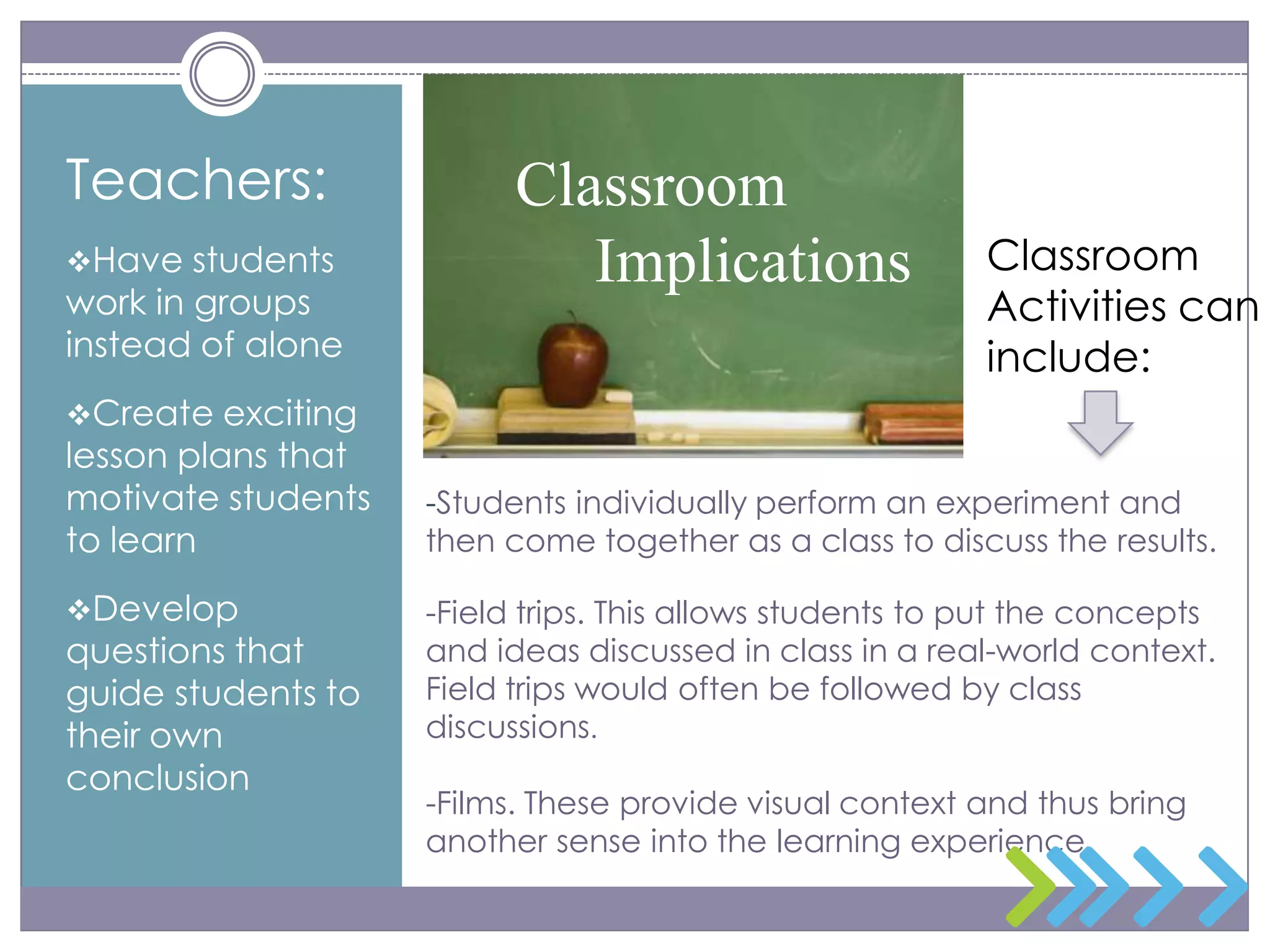
    Teachers: Have studentswork in groups instead of alone
  • 23.
    Create exciting lessonplans that motivate students to learn
  • 24.
    Develop questions thatguide students to their own conclusion Classroom ImplicationsClassroom Implications Classroom Activities can include:-Students individually perform an experiment and then come together as a class to discuss the results.-Field trips. This allows students to put the concepts and ideas discussed in class in a real-world context. Field trips would often be followed by class discussions.-Films. These provide visual context and thus bring another sense into the learning experience.
  • 25.
    Students:Apply their currentunderstandings to build new knowledge.Compare their understandings to that of their peers.Work collaboratively with others
  • 26.
    I would mostcertainly use constructivism in my classroom. I think having students work together to formulate their own conclusions is a great idea. I will try my hardest to make things interesting for everyone and have the student engaged in the lesson. I know I learn better when I am interested and I would love to see my students succeed.Ms. Schiel’s Classroom
  • 27.
    "Classroom." Online @ SFSU.Web. 19 Apr. 2010. <http://online.sfsu.edu/~foreman/itec800/finalprojects/eitankaplan/pages/classroom.htm>.“Constructivism." Funderstanding: Education and Training for Active Learners. Web. 19 Apr. 2010. <http://www.funderstanding.com/content/constructivism>.Hoover, Wesley A. "The Practice Implications of Constructivism - SEDL Letter, Constructivism, Volume IX, Number 3, August 1996." Welcome to SEDL: Advancing Research, Improving Education. Web. 19 Apr. 2010. <http://www.sedl.org/pubs/sedletter/v09n03/practice.html>.Shelly, Gary B. Teachers Discovering Computers: Integrating Technology and Digital Media in the Classroom. Boston, Mass.: Thomson/Course Technology, 2008. Print.Works Cited