Constructivism

 STEPHENIE CANNON
     EME 2040
Constructivism Definition

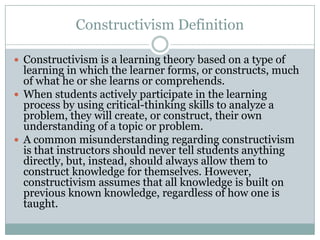
 Constructivism is a learning theory based on a type of
  learning in which the learner forms, or constructs, much
  of what he or she learns or comprehends.
 When students actively participate in the learning
  process by using critical-thinking skills to analyze a
  problem, they will create, or construct, their own
  understanding of a topic or problem.
 A common misunderstanding regarding constructivism
  is that instructors should never tell students anything
  directly, but, instead, should always allow them to
  construct knowledge for themselves. However,
  constructivism assumes that all knowledge is built on
  previous known knowledge, regardless of how one is
  taught.
Constructivism in the Classroom

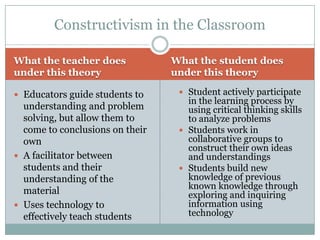
What the teacher does            What the student does
under this theory                under this theory

 Educators guide students to      Student actively participate
                                    in the learning process by
  understanding and problem         using critical thinking skills
  solving, but allow them to        to analyze problems
  come to conclusions on their     Students work in
  own                               collaborative groups to
                                    construct their own ideas
 A facilitator between             and understandings
  students and their               Students build new
  understanding of the              knowledge of previous
                                    known knowledge through
  material                          exploring and inquiring
 Uses technology to                information using
  effectively teach students        technology
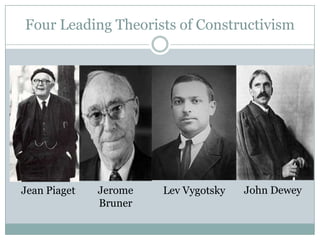
Four Leading Theorists of Constructivism


Jean Piaget   Jerome   Lev Vygotsky   John Dewey
              Bruner
Jean Piaget (1896-1980)

 Piaget believed that children were constructing new
  knowledge as they moved through four different
  cognitive stages, building on what they already knew.
 Piaget’s four cognitive stages were sensorimotor,
  preoperational, concrete operational, and formal
  operational.
 He believed children created adaptation, a cognitive
  understanding or development at any given time.
 Piaget concluded that children assimilate new
  knowledge as they experience new things and learn
  new information.
Piaget’s Cognitive Stages

 The first stage is the sensorimotor stage, when learning
  takes place primarily through the child’s senses and
  motor actions.
 The second stage is the preoperational stage, when
  children begin to use symbols and images and their
  imagination.
 The third stage is the concrete operational stage, when
  children begin to think logically and understand others
  point of view besides their own.
 The fourth stage is the formal operational stage, when
  children transition from concrete thinking to more
  abstract thinking.
Jerome Bruner (1915)

 Bruner was an American psychologist and educator
  that believed students learn when they are actively
  engaged in the learning process.
 His constructivist theory provides a framework for
  instruction based on the study of cognition, a
  concept that suggests that an individual progresses
  through different intellectual stages.
 He believed teachers should use technology, higher
  level thinking, and Socratic methods to encourage
  students to explore and inquiry information on their
  own.
Lev Vygotsky (1896-1934)

 Vygotsky was a Russian educational psychologist that
  developed the term social cognition, the belief that
  learning was influenced significantly by social
  development.
 He believed that a child’ social environment could
  positively or negatively affect the child’s cognitive
  development.
 Vygotsky strongly believed students should work in
  collaborative groups to share their different perspective
  with each other.
 He was also a proponent for scaffolding as a way to
  determine where a student was at cognitively and
  socially.
John Dewey (1859-1952)

 He was an educational psychologist, philosopher,
  and political activist who strongly believed in child-
  centered instruction.
 Created the Laboratory School (often called the
  Dewey School) in which students learned by doing
  and were allowed to construct, create, and actively
  participate in their curriculum.
 He was a strong advocate for progressive education,
  teaching the whole child, physically, mentally, and
  socially, not just facts and information.
Constructivism in MY Classroom

 As an educator, I will definitely use the
 Constructivist learning theory in my classroom. I will
 incorporate collaborative groups, critical-thinking
 activities, and hands-on curriculum using books,
 videos websites, and other forms of digital media and
 technology. I will incorporate child-centered
 instruction with traditional learning to accommodate
 to my students needs and learning styles.
Works Cited

 Bruner, Jerome. "575 Resource Page." 575 Resource Page.
    N.p., n.d. Web. 12 Apr. 2013.
   "Constructivism." Learning Theories RSS. Revood, 2013.
    Web. 12 Apr. 2013.
   "Jean Piaget." Wikipedia. Wikimedia Foundation, 9 Apr.
    2013. Web. 13 Apr. 2013.
   "John Dewey." Wikipedia. Wikimedia Foundation, 7 Apr.
    2013. Web. 12 Apr. 2013.
   "Lev Vygotsky." Wikipedia. Wikimedia Foundation, 7 Apr.
    2013. Web. 12 Apr. 2013.
   Shelly, Gary B., Glenda A. Gunter, and Randolph E. Gunter.
    Teachers Discovering Computers: Integrating Technology in
    a Connected World. Boston, MA: Course Technology Cengage
    Learning, 2012. Print.

Constructivism

  • 1.
  • 2.
    Constructivism Definition  Constructivismis a learning theory based on a type of learning in which the learner forms, or constructs, much of what he or she learns or comprehends.  When students actively participate in the learning process by using critical-thinking skills to analyze a problem, they will create, or construct, their own understanding of a topic or problem.  A common misunderstanding regarding constructivism is that instructors should never tell students anything directly, but, instead, should always allow them to construct knowledge for themselves. However, constructivism assumes that all knowledge is built on previous known knowledge, regardless of how one is taught.
  • 3.
    Constructivism in theClassroom What the teacher does What the student does under this theory under this theory  Educators guide students to  Student actively participate in the learning process by understanding and problem using critical thinking skills solving, but allow them to to analyze problems come to conclusions on their  Students work in own collaborative groups to construct their own ideas  A facilitator between and understandings students and their  Students build new understanding of the knowledge of previous known knowledge through material exploring and inquiring  Uses technology to information using effectively teach students technology
  • 4.
    Four Leading Theoristsof Constructivism Jean Piaget Jerome Lev Vygotsky John Dewey Bruner
  • 5.
    Jean Piaget (1896-1980) Piaget believed that children were constructing new knowledge as they moved through four different cognitive stages, building on what they already knew.  Piaget’s four cognitive stages were sensorimotor, preoperational, concrete operational, and formal operational.  He believed children created adaptation, a cognitive understanding or development at any given time.  Piaget concluded that children assimilate new knowledge as they experience new things and learn new information.
  • 6.
    Piaget’s Cognitive Stages The first stage is the sensorimotor stage, when learning takes place primarily through the child’s senses and motor actions.  The second stage is the preoperational stage, when children begin to use symbols and images and their imagination.  The third stage is the concrete operational stage, when children begin to think logically and understand others point of view besides their own.  The fourth stage is the formal operational stage, when children transition from concrete thinking to more abstract thinking.
  • 7.
    Jerome Bruner (1915) Bruner was an American psychologist and educator that believed students learn when they are actively engaged in the learning process.  His constructivist theory provides a framework for instruction based on the study of cognition, a concept that suggests that an individual progresses through different intellectual stages.  He believed teachers should use technology, higher level thinking, and Socratic methods to encourage students to explore and inquiry information on their own.
  • 8.
    Lev Vygotsky (1896-1934) Vygotsky was a Russian educational psychologist that developed the term social cognition, the belief that learning was influenced significantly by social development.  He believed that a child’ social environment could positively or negatively affect the child’s cognitive development.  Vygotsky strongly believed students should work in collaborative groups to share their different perspective with each other.  He was also a proponent for scaffolding as a way to determine where a student was at cognitively and socially.
  • 9.
    John Dewey (1859-1952) He was an educational psychologist, philosopher, and political activist who strongly believed in child- centered instruction.  Created the Laboratory School (often called the Dewey School) in which students learned by doing and were allowed to construct, create, and actively participate in their curriculum.  He was a strong advocate for progressive education, teaching the whole child, physically, mentally, and socially, not just facts and information.
  • 10.
    Constructivism in MYClassroom  As an educator, I will definitely use the Constructivist learning theory in my classroom. I will incorporate collaborative groups, critical-thinking activities, and hands-on curriculum using books, videos websites, and other forms of digital media and technology. I will incorporate child-centered instruction with traditional learning to accommodate to my students needs and learning styles.
  • 11.
    Works Cited  Bruner,Jerome. "575 Resource Page." 575 Resource Page. N.p., n.d. Web. 12 Apr. 2013.  "Constructivism." Learning Theories RSS. Revood, 2013. Web. 12 Apr. 2013.  "Jean Piaget." Wikipedia. Wikimedia Foundation, 9 Apr. 2013. Web. 13 Apr. 2013.  "John Dewey." Wikipedia. Wikimedia Foundation, 7 Apr. 2013. Web. 12 Apr. 2013.  "Lev Vygotsky." Wikipedia. Wikimedia Foundation, 7 Apr. 2013. Web. 12 Apr. 2013.  Shelly, Gary B., Glenda A. Gunter, and Randolph E. Gunter. Teachers Discovering Computers: Integrating Technology in a Connected World. Boston, MA: Course Technology Cengage Learning, 2012. Print.