WebMagic with WebQuest Alicia García de la Santa  &  Víctor R. González agarc123 @alerce.pntic.mec.es   [email_address] CFIE Valladolid II  –  http://cfievalladolid2.net (Teacher Training and Educational Innovation Centre in Valladolid, Spain, from the Consejería de Educación de la Junta de Castilla y León) Socrates Comenius 2.1  “Think, Construct & Communicate”   http://cfievalladolid2.net/thinkweb 20th Conference ESP Association with COMP@CT & ECOLE
The answer is yes and it is called… WebQuest Is there a “magic” potion for an eMagic educational exploitation of the Web? «Is it possible to integrate  Web browsing   with successfull   learning principles  to develop educational standards with the students in our classroom?»  Or, in other words:
The answer is yes and it is called ...   WebQuest It is the application of a  learning strategy  through  guided discovery  towards a process of work developed by the students, using the  resources of the WWW . In short, Webquest means  research, investigation through the Web .
According to  Bernie   Dodge : «There are at least two reasons that the World Wide Web is an exciting development for educators: Using the Web  breaks down the walls  that separate schools from everything else. Using the Web  forces active learning .  » Why the Web?
Active learning In Dodge´s own words  active learning  involves: «putting our students in situations which compel them to  read, speak, listen, think deeply, and write . While well delivered lectures are valuable and are not uncommon, sometimes the thinking required while attending a lecture is low level comprehension that goes from the ear to the writing hand and leaves the mind untouched. Active learning puts the  responsibility of organizing what is to be learned in the hands of the learners themselves , and ideally lends itself to a more diverse range of learning styles.»
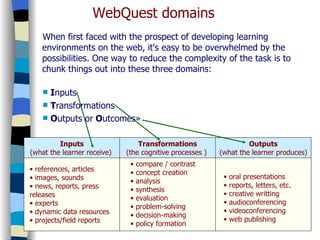
WebQuest domains When first faced with the prospect of developing learning environments on the web, it's easy to be overwhelmed by the possibilities. One way to reduce the complexity of the task is to chunk things out into these three domains: I nputs  T ransformations   O utputs or  O utcomes»  references, articles  images, sounds  news, reports, press releases  experts  dynamic data resources  projects/field reports  compare / contrast  concept creation   analysis  synthesis  evaluation  problem-solving  decision-making  policy formation   oral presentations  reports, letters, etc.  creative writting  audioconferencing  videoconferencing  web publishing  Outputs (what the learner produces)  Transformations (the cognitive processes )  Inputs (what the learner receive)
Web-What? ... WebQuest An indicator of the popularity of this strategy is the number of times that appears the term "WebQuest" in the WWW. A search engine as Google gives back  hundreds of thousands of references  (approximately 438,000 in September 2004, and 2,440,000 in March 2006). In the education specialized pages there are  collections of WebQuests , organized by levels and areas of contents at the disposal of whoever may want to use them directly in their classes, to adapt them to their students or just as a guidance to design their own. Bernie Dodge  has been named by eSchool News  as  one of the 30 main innovators in educative technology . In short, the WebQuest is fashionable. Perhaps it is by justified reasons and it is well worthy to know it in depth.
Dodge [1], the WebQuest designer, defines it as: "an  inquiry-oriented activity,  based on a  doable and engaging task , in which some or all of  the information  that learners interact with  comes from predefined resources on the Internet (and elsewhere) ”. Yoder [2] says that it is a: "type of  lesson plan ... that  incorporates links to, from and along the World Wide Web . The students are presented a scenario and a task,  usually a problem to solve or a project to complete . The students are given  Internet resources  and asked to  analyze and synthesize  the information and come up with their own  creative solutions ". In addition, the students solve the WebQuest forming  workteams  and adopting each one of them a perspective or specific  role , to which they have particular information. [1]  Some   Thoughts   About   WebQuest . Bernie Dodge (1995).  [2]  The   Student   WebQuest . Learning & Leading with Technology , vol. 26, no. 7. Yoder, M.B. (April 1999). Web-What? ... WebQuest
Web-What? ... WebQuest WebQuests do not require the use of complex, nor specialized software for the creation of multimedia files . One or several teachers simply need to have the following knowledge and capacities to create a WebQuest:  to know how to surf through the WWW,  to know how to suitably handle the search engines of information,  to have basic knowledge of HTML design for the hypertextual document creation and obviously,  to have a good command of the contents to be taught.  Summarizing, a  WebQuest is an attractive didactic activity for the students, that allows them to develop deep understanding .
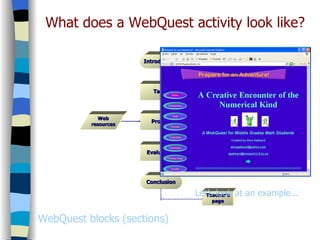
WebQuest   blocks  ( sections ) What does a WebQuest activity look like? Let’s   look   at   an   example ... Web resources Conclusion Evaluation Proccess Task Introduction Teacher’s page
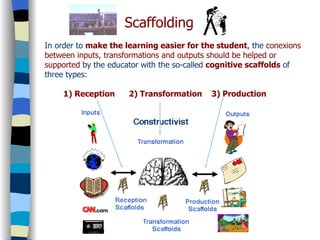
In order to  make the learning easier for the student , the  conexions between inputs, transformations and outputs should be helped or supported  by the educator with the so-called  cognitive scaffolds  of three types:   1) Reception  2) Transformation  3) Production Scaffolding
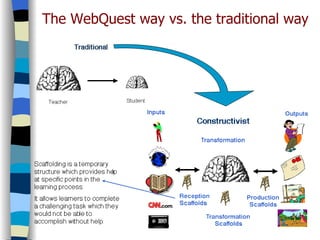
The WebQuest way vs. the traditional way
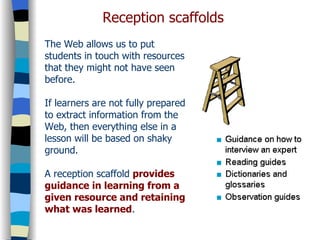
The Web allows us to put students in touch with resources that they might not have seen before. If learners are not fully prepared to extract information from the Web, then everything else in a lesson will be based on shaky ground. A reception scaffold  provides guidance in learning from a given resource and retaining what was learned .  Reception scaffolds
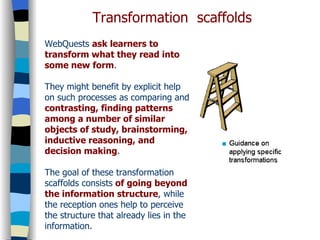
WebQuests  ask learners to transform what they read into some new form . They might benefit by explicit help on such processes as comparing and  contrasting, finding patterns among a number of similar objects of study, brainstorming, inductive reasoning, and decision making . The goal of these transformation scaffolds consists  of going beyond the information structure , while the reception ones help to perceive the structure that already lies in the information. Transformation  scaffolds
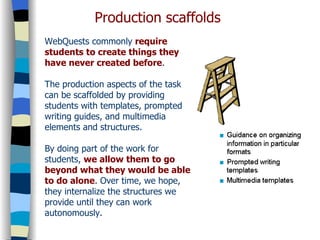
WebQuests commonly  require students to create things they have never created before . The production aspects of the task  can be scaffolded by providing students with templates, prompted writing guides, and multimedia elements and structures. By doing part of the work for students,  we allow them to go beyond what they would be able to do alone . Over time, we hope, they internalize the structures we provide until they can work autonomously.  Production scaffolds
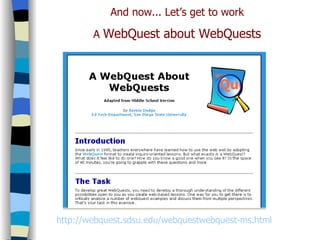
And now... Let’s get to work A  WebQuest about WebQuests http://webquest.sdsu.edu/webquestwebquest-ms.html
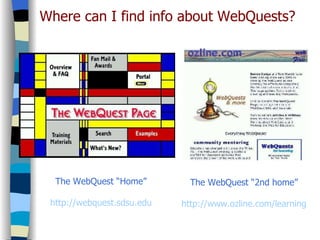
Where can I find info about WebQuests? The WebQuest “Home” http://webquest.sdsu.edu The WebQuest “2nd home” http://www.ozline.com/learning
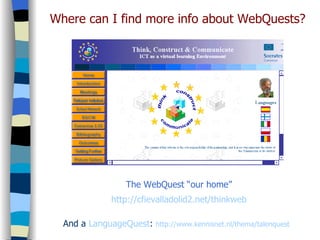
Where can I find more info about WebQuests? The WebQuest “our home” http://cfievalladolid2.net/ thinkweb And a  LanguageQuest :  http://www.kennisnet.nl/thema/talenquest
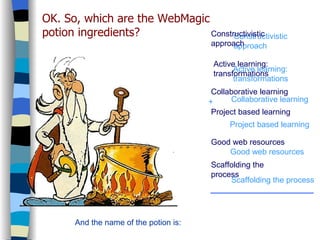
WebQuest Constructivistic approach Constructivistic approach Project based learning Scaffolding the process Collaborative learning Good web resources Active learning: transformations OK. So, which are the WebMagic potion ingredients? Active learning: transformations And the name of the potion is: Collaborative learning Project based learning Good web resources Scaffolding the process +

Web magic webquest

  • 1.
    WebMagic with WebQuestAlicia García de la Santa & Víctor R. González agarc123 @alerce.pntic.mec.es [email_address] CFIE Valladolid II – http://cfievalladolid2.net (Teacher Training and Educational Innovation Centre in Valladolid, Spain, from the Consejería de Educación de la Junta de Castilla y León) Socrates Comenius 2.1 “Think, Construct & Communicate” http://cfievalladolid2.net/thinkweb 20th Conference ESP Association with COMP@CT & ECOLE
  • 2.
    The answer isyes and it is called… WebQuest Is there a “magic” potion for an eMagic educational exploitation of the Web? «Is it possible to integrate Web browsing with successfull learning principles to develop educational standards with the students in our classroom?»  Or, in other words:
  • 3.
    The answer isyes and it is called ... WebQuest It is the application of a learning strategy through guided discovery towards a process of work developed by the students, using the resources of the WWW . In short, Webquest means research, investigation through the Web .
  • 4.
    According to Bernie Dodge : «There are at least two reasons that the World Wide Web is an exciting development for educators: Using the Web breaks down the walls that separate schools from everything else. Using the Web forces active learning . » Why the Web?
  • 5.
    Active learning InDodge´s own words active learning involves: «putting our students in situations which compel them to read, speak, listen, think deeply, and write . While well delivered lectures are valuable and are not uncommon, sometimes the thinking required while attending a lecture is low level comprehension that goes from the ear to the writing hand and leaves the mind untouched. Active learning puts the responsibility of organizing what is to be learned in the hands of the learners themselves , and ideally lends itself to a more diverse range of learning styles.»
  • 6.
    WebQuest domains Whenfirst faced with the prospect of developing learning environments on the web, it's easy to be overwhelmed by the possibilities. One way to reduce the complexity of the task is to chunk things out into these three domains: I nputs T ransformations  O utputs or O utcomes» references, articles images, sounds news, reports, press releases experts dynamic data resources projects/field reports compare / contrast concept creation  analysis synthesis evaluation problem-solving decision-making policy formation oral presentations reports, letters, etc. creative writting audioconferencing videoconferencing web publishing  Outputs (what the learner produces) Transformations (the cognitive processes ) Inputs (what the learner receive)
  • 7.
    Web-What? ... WebQuestAn indicator of the popularity of this strategy is the number of times that appears the term "WebQuest" in the WWW. A search engine as Google gives back hundreds of thousands of references (approximately 438,000 in September 2004, and 2,440,000 in March 2006). In the education specialized pages there are collections of WebQuests , organized by levels and areas of contents at the disposal of whoever may want to use them directly in their classes, to adapt them to their students or just as a guidance to design their own. Bernie Dodge has been named by eSchool News as one of the 30 main innovators in educative technology . In short, the WebQuest is fashionable. Perhaps it is by justified reasons and it is well worthy to know it in depth.
  • 8.
    Dodge [1], theWebQuest designer, defines it as: "an inquiry-oriented activity, based on a doable and engaging task , in which some or all of the information that learners interact with comes from predefined resources on the Internet (and elsewhere) ”. Yoder [2] says that it is a: "type of lesson plan ... that incorporates links to, from and along the World Wide Web . The students are presented a scenario and a task, usually a problem to solve or a project to complete . The students are given Internet resources and asked to analyze and synthesize the information and come up with their own creative solutions ". In addition, the students solve the WebQuest forming workteams and adopting each one of them a perspective or specific role , to which they have particular information. [1] Some Thoughts About WebQuest . Bernie Dodge (1995). [2] The Student WebQuest . Learning & Leading with Technology , vol. 26, no. 7. Yoder, M.B. (April 1999). Web-What? ... WebQuest
  • 9.
    Web-What? ... WebQuestWebQuests do not require the use of complex, nor specialized software for the creation of multimedia files . One or several teachers simply need to have the following knowledge and capacities to create a WebQuest: to know how to surf through the WWW, to know how to suitably handle the search engines of information, to have basic knowledge of HTML design for the hypertextual document creation and obviously, to have a good command of the contents to be taught. Summarizing, a WebQuest is an attractive didactic activity for the students, that allows them to develop deep understanding .
  • 10.
    WebQuest blocks ( sections ) What does a WebQuest activity look like? Let’s look at an example ... Web resources Conclusion Evaluation Proccess Task Introduction Teacher’s page
  • 11.
    In order to make the learning easier for the student , the conexions between inputs, transformations and outputs should be helped or supported by the educator with the so-called cognitive scaffolds of three types: 1) Reception 2) Transformation 3) Production Scaffolding
  • 12.
    The WebQuest wayvs. the traditional way
  • 13.
    The Web allowsus to put students in touch with resources that they might not have seen before. If learners are not fully prepared to extract information from the Web, then everything else in a lesson will be based on shaky ground. A reception scaffold provides guidance in learning from a given resource and retaining what was learned . Reception scaffolds
  • 14.
    WebQuests asklearners to transform what they read into some new form . They might benefit by explicit help on such processes as comparing and contrasting, finding patterns among a number of similar objects of study, brainstorming, inductive reasoning, and decision making . The goal of these transformation scaffolds consists of going beyond the information structure , while the reception ones help to perceive the structure that already lies in the information. Transformation scaffolds
  • 15.
    WebQuests commonly require students to create things they have never created before . The production aspects of the task can be scaffolded by providing students with templates, prompted writing guides, and multimedia elements and structures. By doing part of the work for students, we allow them to go beyond what they would be able to do alone . Over time, we hope, they internalize the structures we provide until they can work autonomously. Production scaffolds
  • 16.
    And now... Let’sget to work A WebQuest about WebQuests http://webquest.sdsu.edu/webquestwebquest-ms.html
  • 17.
    Where can Ifind info about WebQuests? The WebQuest “Home” http://webquest.sdsu.edu The WebQuest “2nd home” http://www.ozline.com/learning
  • 18.
    Where can Ifind more info about WebQuests? The WebQuest “our home” http://cfievalladolid2.net/ thinkweb And a LanguageQuest : http://www.kennisnet.nl/thema/talenquest
  • 19.
    WebQuest Constructivistic approachConstructivistic approach Project based learning Scaffolding the process Collaborative learning Good web resources Active learning: transformations OK. So, which are the WebMagic potion ingredients? Active learning: transformations And the name of the potion is: Collaborative learning Project based learning Good web resources Scaffolding the process +