Connected and Autonomous
Vehicles: The Enabling Technologies
The 2017 D-STOP Symposium
James Kuhr, Esq.
February, 2017
Overview
• Definitions
• Levels of Autonomy
• The Sensor Suite
• Semi Autonomous Features
• V2X
• An Immediate Timeline
Definitions
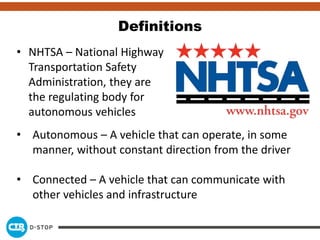
• NHTSA – National Highway
Transportation Safety
Administration, they are
the regulating body for
autonomous vehicles
• Autonomous – A vehicle that can operate, in some
manner, without constant direction from the driver
• Connected – A vehicle that can communicate with
other vehicles and infrastructure
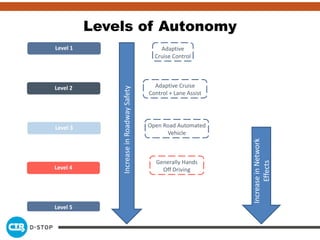
Levels of Autonomy
Level 1
Level 2
Level 3
Level 4
Adaptive
Cruise Control
Adaptive Cruise
Control + Lane Assist
Open Road Automated
Vehicle
Generally Hands
Off Driving
IncreaseinRoadwaySafety
IncreaseinNetwork
Effects
Level 5
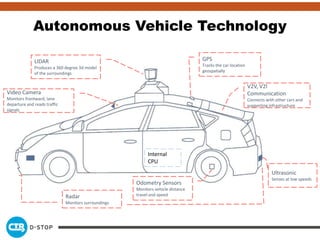
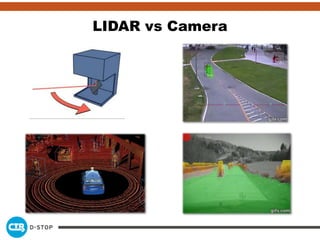
LIDAR
Produces a 360 degree 3d model
of the surroundings
Video Camera
Monitors frontward, lane
departure and reads traffic
signals
Radar
Monitors surroundings
Odometry Sensors
Monitors vehicle distance
travel and speed
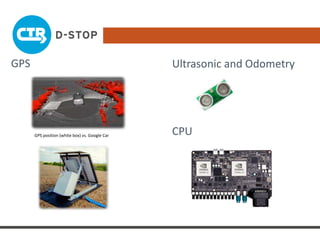
GPS
Tracks the car location
geospatially
Ultrasonic
Senses at low speeds
Internal
CPU
V2V, V2I
Communication
Connects with other cars and
supporting infrastructure
Autonomous Vehicle Technology
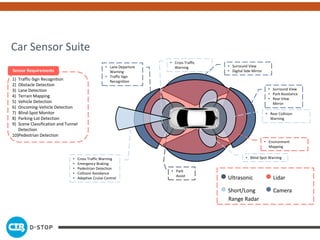
●Ultrasonic
●Short/Long
Range Radar
●Lidar
●Camera
• Surround View
• Digital Side Mirror
• Surround View
• Park Assistance
• Rear View
Mirror
• Rear Collision
Warning
• Park
Assist
• Blind Spot Warning
• Cross Traffic
Warning• Lane Departure
Warning
• Traffic Sign
Recognition
• Cross Traffic Warning
• Emergency Braking
• Pedestrian Detection
• Collision Avoidance
• Adaptive Cruise Control
• Environment
Mapping
Car Sensor Suite
1) Traffic-Sign Recognition
2) Obstacle Detection
3) Lane Detection
4) Terrain Mapping
5) Vehicle Detection
6) Oncoming-Vehicle Detection
7) Blind-Spot Monitor
8) Parking-Lot Detection
9) Scene Classification and Tunnel
Detection
10)Pedestrian Detection
Sensor Requirements
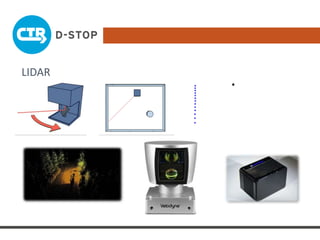
LIDAR
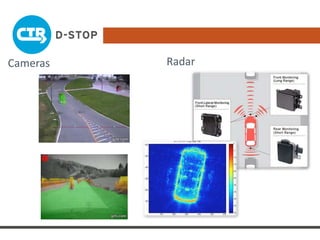
Cameras Radar
GPS
GPS position (white box) vs. Google Car
Ultrasonic and Odometry
CPU
LIDAR vs Camera
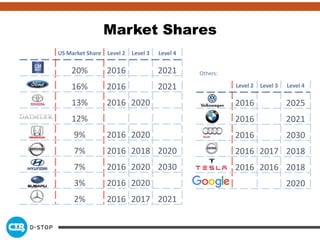
US Market Share Level 2 Level 3 Level 4
20% 2016 2021
16% 2016 2021
13% 2016 2020
12%
9% 2016 2020
7% 2016 2018 2020
7% 2016 2020 2030
3% 2016 2020
2% 2016 2017 2021
Level 2 Level 3 Level 4
2016 2025
2016 2021
2016 2030
2016 2017 2018
2016 2016 2018
2020
Others:
Market Shares
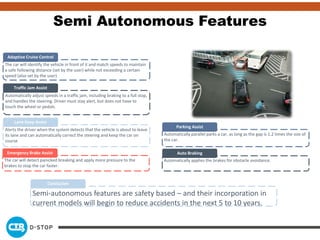
The car will identify the vehicle in front of it and match speeds to maintain
a safe following distance (set by the user) while not exceeding a certain
speed (also set by the user)
Adaptive Cruise Control
Automatically adjust speeds in a traffic jam, including braking to a full stop,
and handles the steering. Driver must stay alert, but does not have to
touch the wheel or pedals.
Traffic Jam Assist
Alerts the driver when the system detects that the vehicle is about to leave
its lane and can automatically correct the steering and keep the car on
course
Lane Keep Assist
The car will detect panicked breaking and apply more pressure to the
brakes to stop the car faster.
Emergency Brake Assist
Automatically parallel parks a car, as long as the gap is 1.2 times the size of
the car.
Parking Assist
Automatically applies the brakes for obstacle avoidance.
Auto Braking
Semi-autonomous features are safety based – and their incorporation in
current models will begin to reduce accidents in the next 5 to 10 years.
Conclusion
Semi Autonomous Features
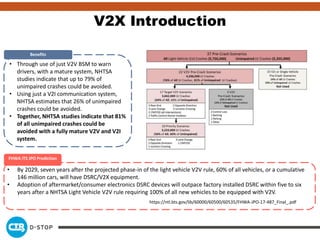
• Through use of just V2V BSM to warn
drivers, with a mature system, NHTSA
studies indicate that up to 79% of
unimpaired crashes could be avoided.
• Using just a V2I communication system,
NHTSA estimates that 26% of unimpaired
crashes could be avoided.
• Together, NHTSA studies indicate that 81%
of all unimpaired crashes could be
avoided with a fully mature V2V and V2I
system.
Benefits
V2X Introduction
• By 2029, seven years after the projected phase-in of the light vehicle V2V rule, 60% of all vehicles, or a cumulative
146 million cars, will have DSRC/V2X equipment.
• Adoption of aftermarket/consumer electronics DSRC devices will outpace factory installed DSRC within five to six
years after a NHTSA Light Vehicle V2V rule requiring 100% of all new vehicles to be equipped with V2V.
FHWA ITS JPO Prediction
https://ntl.bts.gov/lib/60000/60500/60535/FHWA-JPO-17-487_Final_.pdf
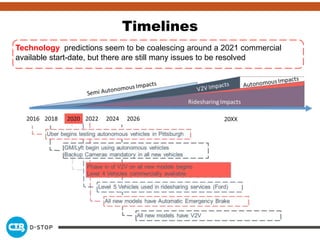
Timelines
Technology predictions seem to be coalescing around a 2021 commercial
available start-date, but there are still many issues to be resolved
Thank You!

Connected and Autonomous Vehicles: The Enabling Technologies

  • 1.
    Connected and Autonomous Vehicles:The Enabling Technologies The 2017 D-STOP Symposium James Kuhr, Esq. February, 2017
  • 2.
    Overview • Definitions • Levelsof Autonomy • The Sensor Suite • Semi Autonomous Features • V2X • An Immediate Timeline
  • 3.
    Definitions • NHTSA –National Highway Transportation Safety Administration, they are the regulating body for autonomous vehicles • Autonomous – A vehicle that can operate, in some manner, without constant direction from the driver • Connected – A vehicle that can communicate with other vehicles and infrastructure
  • 4.
    Levels of Autonomy Level1 Level 2 Level 3 Level 4 Adaptive Cruise Control Adaptive Cruise Control + Lane Assist Open Road Automated Vehicle Generally Hands Off Driving IncreaseinRoadwaySafety IncreaseinNetwork Effects Level 5
  • 5.
    LIDAR Produces a 360degree 3d model of the surroundings Video Camera Monitors frontward, lane departure and reads traffic signals Radar Monitors surroundings Odometry Sensors Monitors vehicle distance travel and speed GPS Tracks the car location geospatially Ultrasonic Senses at low speeds Internal CPU V2V, V2I Communication Connects with other cars and supporting infrastructure Autonomous Vehicle Technology
  • 6.
    ●Ultrasonic ●Short/Long Range Radar ●Lidar ●Camera • SurroundView • Digital Side Mirror • Surround View • Park Assistance • Rear View Mirror • Rear Collision Warning • Park Assist • Blind Spot Warning • Cross Traffic Warning• Lane Departure Warning • Traffic Sign Recognition • Cross Traffic Warning • Emergency Braking • Pedestrian Detection • Collision Avoidance • Adaptive Cruise Control • Environment Mapping Car Sensor Suite 1) Traffic-Sign Recognition 2) Obstacle Detection 3) Lane Detection 4) Terrain Mapping 5) Vehicle Detection 6) Oncoming-Vehicle Detection 7) Blind-Spot Monitor 8) Parking-Lot Detection 9) Scene Classification and Tunnel Detection 10)Pedestrian Detection Sensor Requirements
  • 7.
  • 8.
  • 9.
    GPS GPS position (whitebox) vs. Google Car Ultrasonic and Odometry CPU
  • 10.
  • 11.
    US Market ShareLevel 2 Level 3 Level 4 20% 2016 2021 16% 2016 2021 13% 2016 2020 12% 9% 2016 2020 7% 2016 2018 2020 7% 2016 2020 2030 3% 2016 2020 2% 2016 2017 2021 Level 2 Level 3 Level 4 2016 2025 2016 2021 2016 2030 2016 2017 2018 2016 2016 2018 2020 Others: Market Shares
  • 12.
    The car willidentify the vehicle in front of it and match speeds to maintain a safe following distance (set by the user) while not exceeding a certain speed (also set by the user) Adaptive Cruise Control Automatically adjust speeds in a traffic jam, including braking to a full stop, and handles the steering. Driver must stay alert, but does not have to touch the wheel or pedals. Traffic Jam Assist Alerts the driver when the system detects that the vehicle is about to leave its lane and can automatically correct the steering and keep the car on course Lane Keep Assist The car will detect panicked breaking and apply more pressure to the brakes to stop the car faster. Emergency Brake Assist Automatically parallel parks a car, as long as the gap is 1.2 times the size of the car. Parking Assist Automatically applies the brakes for obstacle avoidance. Auto Braking Semi-autonomous features are safety based – and their incorporation in current models will begin to reduce accidents in the next 5 to 10 years. Conclusion Semi Autonomous Features
  • 13.
    • Through useof just V2V BSM to warn drivers, with a mature system, NHTSA studies indicate that up to 79% of unimpaired crashes could be avoided. • Using just a V2I communication system, NHTSA estimates that 26% of unimpaired crashes could be avoided. • Together, NHTSA studies indicate that 81% of all unimpaired crashes could be avoided with a fully mature V2V and V2I system. Benefits V2X Introduction • By 2029, seven years after the projected phase-in of the light vehicle V2V rule, 60% of all vehicles, or a cumulative 146 million cars, will have DSRC/V2X equipment. • Adoption of aftermarket/consumer electronics DSRC devices will outpace factory installed DSRC within five to six years after a NHTSA Light Vehicle V2V rule requiring 100% of all new vehicles to be equipped with V2V. FHWA ITS JPO Prediction https://ntl.bts.gov/lib/60000/60500/60535/FHWA-JPO-17-487_Final_.pdf
  • 14.
    Timelines Technology predictions seemto be coalescing around a 2021 commercial available start-date, but there are still many issues to be resolved
  • 15.