Presented By :
Simran Sharma & Team
CONTENTS
Introduction
History
What is driverless car
How do it works
How safe is it
External cost
Economic effects of autonomous vehicles
Top feautures of autonomous cars
Advantages and disadvantages of autonomous
car
Advanatges of autonomous car
Disadvanatges of autonomous cars
 Conclusion
Introduction:
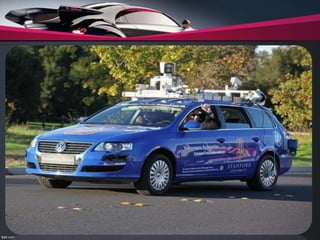
An autonomous car (also known as a driverless car, self-driving
car, robotic car, auto) and unmanned ground vehicle is a vehicle that
is capable of sensing its environment and navigating without human
input.
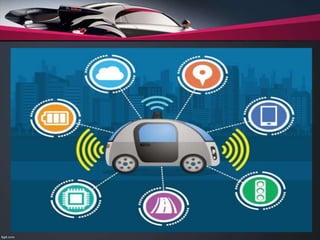
Autonomous cars use a variety of techniques to detect their surroundings,
such as radar, laser light, GPS, odometry and computer vision.
Advanced control systems interpret sensory information to identify
appropriate navigation paths, as well as obstacles and
relevant signage. Autonomous cars must have control systems that are
capable of analyzing sensory data to distinguish between different cars on
the road.
HISTORY:
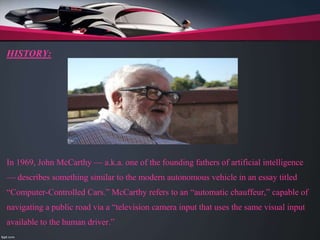
In 1969, John McCarthy — a.k.a. one of the founding fathers of artificial intelligence
— describes something similar to the modern autonomous vehicle in an essay titled
“Computer-Controlled Cars.” McCarthy refers to an “automatic chauffeur,” capable of
navigating a public road via a “television camera input that uses the same visual input
available to the human driver.”
WHAT IS A DRIVERLESS CAR?
It is a vehicle that can drive its self from one point to another without
assistance from a driver. In other words with an autopilot system.
(or)
A driverless car (sometimes called a self-driving car, an automated
car or an autonomous vehicle) is a robotic vehicle that is designed
to travel between destinations without a human operator. To qualify
as fully autonomous, a vehicle must be able to navigate without
human intervention to a predetermined destination over roads that
have not been adapted for its use.
How do it works –
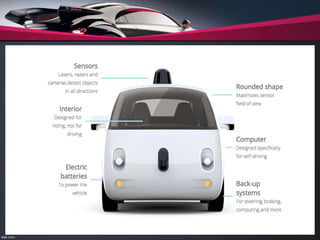
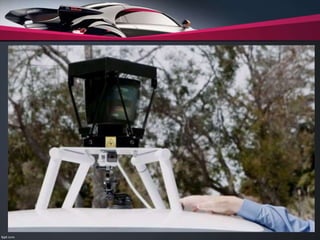
Powered by an electric motor with around a 100 mile range, the car uses a
combination of sensors and software to locate itself in the real world combined
with highly accurate digital maps. A GPS is used, just like the satellite navigation
systems in most cars, to get a rough location of the car, at which point radar,
lasers and cameras take over to monitor the world around the car, 360-
degrees.
The software can recognise objects, people, cars, road marking, signs and
traffic lights, obeying the rules of the road and allowing for multiple
unpredictable hazards, including
cyclists. It can even detect road works and safely navigate around them.
The new prototype has more sensors fitted to it that can see further (up to 600
feet in all directions) and in greater detail than the ones available on the
previous repurposed Lexus and Toyota vehicle.
How safe is it
The new car is the next evolution of Google’s self-driving car. While the new frame is
untested, the company’s previous versions have clocked up over 700,000 miles of testing
on public roads, mainly around California, including over 1,000 miles of driving in the
most complex situations and cities like San Francisco’s hills and busy streets.The car
itself is limited to 25 mph, which restricts it to certain roads, but also minimises the
kinetic energy it could carry into a crash if one should happen. The front of the car is also
made to be as kind to pedestrians as possible with a foam bumper and a flexible
windscreen that is designed to absorb energy from an impact with a person’s body.
Seat belts are also provided – a safety requirement for vehicles on the
road – while the car has redundant systems, a “fault-tolerant architecture”
as Google calls it, for both steering and braking, should the primary systems
fails; plus that emergency stop button that passengers can hit at any time.
External Cost:
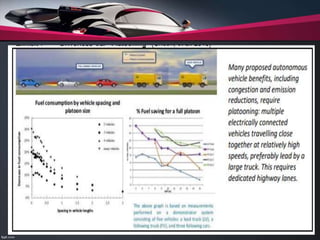
Advocates claim that autonomous driving will reduce external costs including traffic
congestion, energy consumption, pollution emissions, roadway and parking facility
costs, although those benefits are uncertain . To be more space and energy efficient
autonomous vehicles require dedicated lanes for platooning . This is only feasible on
grade separated highways.
Autonomous vehicles can increase congestion, energy, pollution and roadway costs. If
they strictly follow traffic laws and maximize caution, such as speed limits and
optimal spacing between vehicles, they will often delay other road users. Because
passengers tend to be more sensitive to acceleration than drivers, and some passengers
will rest or work, many users may program their vehicle for more gradual acceleration
and deceleration than what human drivers generally apply, reducing traffic speed.
Economic effects of autonomous vehicles:
When autonomous driving becomes a reality, what effects will it have on our economy and
society? Some people say it will bring fundamental changes. In the US, a series of organisations
in both business and academic spheres have estimated the economic effects of autonomous
vehicles.
According to an estimate by Intel Corporation and Strategy Analytics, announced in June 2017,
the economic effects of autonomous vehicles will total $7 trillion in 2050 (Figure 1). calculated
based on the assumption that fully automated Level 5 vehicles will be on the roads by 2050.
They also assumed that consumers and businesses will use Mobility-as-a-Service (MaaS)
offerings instead of owning cars, and those who had been commuting to work by car will
become passengers and spend the commuting time doing something else. As such, the estimate
reflects a very broad range of potential effects, which also include a wide variety of new
commercial services such as onboard dining and retailing.
Top Features of autonomous cars :
1. Autonomous choice
2. Personification of your vehicle
3. Sophisticated WiFi encryption
4. Electric power features to help the environment
5. The best navigation systems
6. Amped-up safety features
7. Easy parking features
Advantages and Disadvantages of Driverless Cars
Advantages of Driverless Cars
 Autonomous vehicles could bring about a massive reduction in
insurance premiums for car owners.
 Efficient travel also means fuel savings, cutting costs.
 Reduced need for safety gaps means that road capacities for vehicles
would be significantly increased.
 Passengers should experience a smoother riding experience.
 Self-aware cars would lead to a reduction in car theft.
Disadvantages of Driverless Cars
 Driverless cars would likely be out of the price range of most ordinary
people when generally introduced, likely costing over $100,000.
 Truck drivers and taxi drivers will lose their jobs, as autonomous
vehicles take over.
 A computer malfunction, even just a minor glitch, could cause worse
crashes than anything that human error might bring about.
 If the car crashes, without a driver, who's fault is it: Google/the software
designer, or the owner of the vehicle?
Conclusion
In conclusion, upon addressing the mechanics of the driverless car as well as its
benefits and potential issues, it is quite interesting to see how the world will actually
become by the year 2040. Is IEEE correct? Will the rite of passage of attaining one’s
driver license cease to exist? It is truly in the reader’s discretion to determine and
weigh the impacts that the driverless car will have on society in the future. Until then,
it is fascinating to see the effects this creation will have on the states in which it is
legalized as well as on the people that have chosen to experiment with it.
Despite the inherent benefits, autonomous vehicle technology must overcome many
social barriers. Much like the issues faced by the first automobiles, the influence of
mental models can impede the advancement of technology. However, new legislation
is creating opportunities for these cars to prove their viability. The ongoing research
and testing done by organizations such as Google and Stanford will only prove to
advance the acceptance of autonomous cars. As more states legalize driverless cars,
the social obstructions will give way, allowing for the largest revolution in personal
transportation since the introduction of automobile
autonomous car
autonomous car

autonomous car

  • 1.
    Presented By : SimranSharma & Team
  • 2.
    CONTENTS Introduction History What is driverlesscar How do it works How safe is it External cost Economic effects of autonomous vehicles Top feautures of autonomous cars Advantages and disadvantages of autonomous car Advanatges of autonomous car Disadvanatges of autonomous cars  Conclusion
  • 3.
    Introduction: An autonomous car(also known as a driverless car, self-driving car, robotic car, auto) and unmanned ground vehicle is a vehicle that is capable of sensing its environment and navigating without human input. Autonomous cars use a variety of techniques to detect their surroundings, such as radar, laser light, GPS, odometry and computer vision. Advanced control systems interpret sensory information to identify appropriate navigation paths, as well as obstacles and relevant signage. Autonomous cars must have control systems that are capable of analyzing sensory data to distinguish between different cars on the road.
  • 4.
    HISTORY: In 1969, JohnMcCarthy — a.k.a. one of the founding fathers of artificial intelligence — describes something similar to the modern autonomous vehicle in an essay titled “Computer-Controlled Cars.” McCarthy refers to an “automatic chauffeur,” capable of navigating a public road via a “television camera input that uses the same visual input available to the human driver.”
  • 5.
    WHAT IS ADRIVERLESS CAR? It is a vehicle that can drive its self from one point to another without assistance from a driver. In other words with an autopilot system. (or) A driverless car (sometimes called a self-driving car, an automated car or an autonomous vehicle) is a robotic vehicle that is designed to travel between destinations without a human operator. To qualify as fully autonomous, a vehicle must be able to navigate without human intervention to a predetermined destination over roads that have not been adapted for its use.
  • 7.
    How do itworks – Powered by an electric motor with around a 100 mile range, the car uses a combination of sensors and software to locate itself in the real world combined with highly accurate digital maps. A GPS is used, just like the satellite navigation systems in most cars, to get a rough location of the car, at which point radar, lasers and cameras take over to monitor the world around the car, 360- degrees. The software can recognise objects, people, cars, road marking, signs and traffic lights, obeying the rules of the road and allowing for multiple unpredictable hazards, including cyclists. It can even detect road works and safely navigate around them. The new prototype has more sensors fitted to it that can see further (up to 600 feet in all directions) and in greater detail than the ones available on the previous repurposed Lexus and Toyota vehicle.
  • 9.
    How safe isit The new car is the next evolution of Google’s self-driving car. While the new frame is untested, the company’s previous versions have clocked up over 700,000 miles of testing on public roads, mainly around California, including over 1,000 miles of driving in the most complex situations and cities like San Francisco’s hills and busy streets.The car itself is limited to 25 mph, which restricts it to certain roads, but also minimises the kinetic energy it could carry into a crash if one should happen. The front of the car is also made to be as kind to pedestrians as possible with a foam bumper and a flexible windscreen that is designed to absorb energy from an impact with a person’s body. Seat belts are also provided – a safety requirement for vehicles on the road – while the car has redundant systems, a “fault-tolerant architecture” as Google calls it, for both steering and braking, should the primary systems fails; plus that emergency stop button that passengers can hit at any time.
  • 11.
    External Cost: Advocates claimthat autonomous driving will reduce external costs including traffic congestion, energy consumption, pollution emissions, roadway and parking facility costs, although those benefits are uncertain . To be more space and energy efficient autonomous vehicles require dedicated lanes for platooning . This is only feasible on grade separated highways. Autonomous vehicles can increase congestion, energy, pollution and roadway costs. If they strictly follow traffic laws and maximize caution, such as speed limits and optimal spacing between vehicles, they will often delay other road users. Because passengers tend to be more sensitive to acceleration than drivers, and some passengers will rest or work, many users may program their vehicle for more gradual acceleration and deceleration than what human drivers generally apply, reducing traffic speed.
  • 13.
    Economic effects ofautonomous vehicles: When autonomous driving becomes a reality, what effects will it have on our economy and society? Some people say it will bring fundamental changes. In the US, a series of organisations in both business and academic spheres have estimated the economic effects of autonomous vehicles. According to an estimate by Intel Corporation and Strategy Analytics, announced in June 2017, the economic effects of autonomous vehicles will total $7 trillion in 2050 (Figure 1). calculated based on the assumption that fully automated Level 5 vehicles will be on the roads by 2050. They also assumed that consumers and businesses will use Mobility-as-a-Service (MaaS) offerings instead of owning cars, and those who had been commuting to work by car will become passengers and spend the commuting time doing something else. As such, the estimate reflects a very broad range of potential effects, which also include a wide variety of new commercial services such as onboard dining and retailing.
  • 14.
    Top Features ofautonomous cars : 1. Autonomous choice 2. Personification of your vehicle 3. Sophisticated WiFi encryption 4. Electric power features to help the environment 5. The best navigation systems 6. Amped-up safety features 7. Easy parking features
  • 16.
    Advantages and Disadvantagesof Driverless Cars Advantages of Driverless Cars  Autonomous vehicles could bring about a massive reduction in insurance premiums for car owners.  Efficient travel also means fuel savings, cutting costs.  Reduced need for safety gaps means that road capacities for vehicles would be significantly increased.  Passengers should experience a smoother riding experience.  Self-aware cars would lead to a reduction in car theft.
  • 18.
    Disadvantages of DriverlessCars  Driverless cars would likely be out of the price range of most ordinary people when generally introduced, likely costing over $100,000.  Truck drivers and taxi drivers will lose their jobs, as autonomous vehicles take over.  A computer malfunction, even just a minor glitch, could cause worse crashes than anything that human error might bring about.  If the car crashes, without a driver, who's fault is it: Google/the software designer, or the owner of the vehicle?
  • 20.
    Conclusion In conclusion, uponaddressing the mechanics of the driverless car as well as its benefits and potential issues, it is quite interesting to see how the world will actually become by the year 2040. Is IEEE correct? Will the rite of passage of attaining one’s driver license cease to exist? It is truly in the reader’s discretion to determine and weigh the impacts that the driverless car will have on society in the future. Until then, it is fascinating to see the effects this creation will have on the states in which it is legalized as well as on the people that have chosen to experiment with it. Despite the inherent benefits, autonomous vehicle technology must overcome many social barriers. Much like the issues faced by the first automobiles, the influence of mental models can impede the advancement of technology. However, new legislation is creating opportunities for these cars to prove their viability. The ongoing research and testing done by organizations such as Google and Stanford will only prove to advance the acceptance of autonomous cars. As more states legalize driverless cars, the social obstructions will give way, allowing for the largest revolution in personal transportation since the introduction of automobile