Driverless
Vehcile
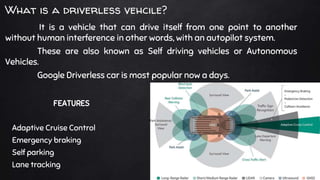
What is a driverless vehcile?
It is a vehicle that can drive itself from one point to another
without human interference in other words, with an autopilot system.
These are also known as Self driving vehicles or Autonomous
Vehicles.
Google Driverless car is most popular now a days.
FEATURES
Adaptive Cruise Control
Emergency braking
Self parking
Lane tracking
2
Contents!
1. Different stages of Autonomous Vehicles
2. Sensor Technology in Autonomous Vehicle
3. Systems using these senors
4. Advantages and Disadvantages
3
Different stages
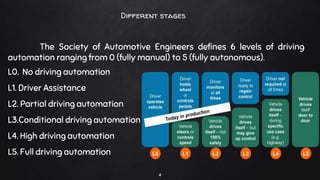
The Society of Automotive Engineers defines 6 levels of driving
automation ranging from 0 (fully manual) to 5 (fully autonomous).
L0. No driving automation
L1. Driver Assistance
L2. Partial driving automation
L3.Conditional driving automation
L4. High driving automation
L5. Full driving automation
4
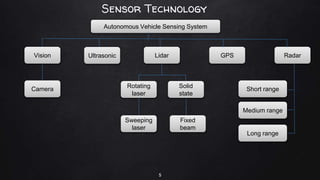
Sensor Technology
5
Autonomous Vehicle Sensing System
UltrasonicVision Lidar RadarGPS
Camera Rotating
laser
Solid
state
Sweeping
laser
Fixed
beam
Short range
Medium range
Long range
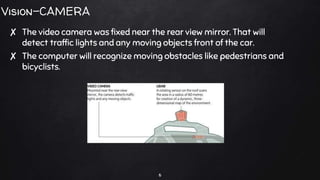
Vision-CAMERA
✘ The video camera was fixed near the rear view mirror. That will
detect traffic lights and any moving objects front of the car.
✘ The computer will recognize moving obstacles like pedestrians and
bicyclists.
6
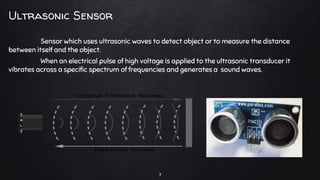
Sensor which uses ultrasonic waves to detect object or to measure the distance
between itself and the object.
When an electrical pulse of high voltage is applied to the ultrasonic transducer it
vibrates across a specific spectrum of frequencies and generates a sound waves.
Ultrasonic Sensor
7
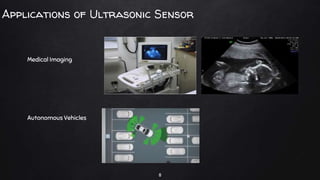
Applications of Ultrasonic Sensor
Medical Imaging
Autonomous Vehicles
8
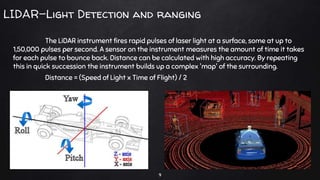
LIDAR-Light Detection and ranging
The LiDAR instrument fires rapid pulses of laser light at a surface, some at up to
1,50,000 pulses per second. A sensor on the instrument measures the amount of time it takes
for each pulse to bounce back. Distance can be calculated with high accuracy. By repeating
this in quick succession the instrument builds up a complex 'map' of the surrounding.
Distance = (Speed of Light x Time of Flight) / 2
9
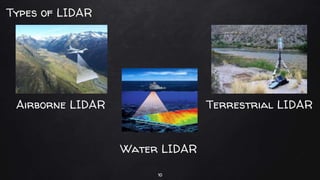
Types of LIDAR
10
Airborne LIDAR Terrestrial LIDAR
Water LIDAR
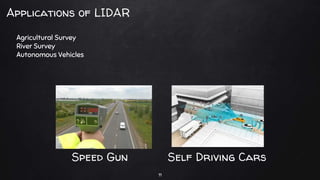
Applications of LIDAR
11
Speed Gun Self Driving Cars
Agricultural Survey
River Survey
Autonomous Vehicles
GPS
12
You are on the planet, at least four GPS satellites are ‘visible’ at any time. Each one
transmits information about its position and the current time at regular intervals. These
signals, travelling at the speed of light, are intercepted by your GPS receiver, which calculates
how far away each satellite is based on how long it took for the messages to arrive.
Once it has information on how far away at least three satellites are, your GPS
receiver can pinpoint your location using a process called trilateration.
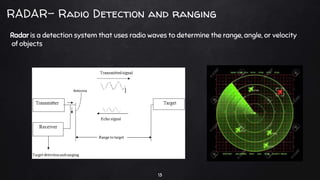
RADAR- Radio Detection and ranging
13
Radar is a detection system that uses radio waves to determine the range, angle, or velocity
of objects
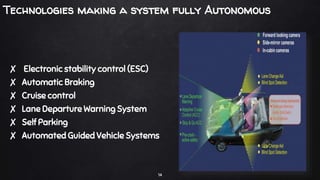
Technologies making a system fully Autonomous
✘ Electronic stability control (ESC)
✘ Automatic Braking
✘ Cruise control
✘ Lane Departure Warning System
✘ Self Parking
✘ Automated Guided Vehicle Systems
14
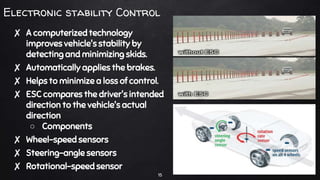
Electronic stability Control
✘ A computerized technology
improves vehicle's stability by
detecting and minimizing skids.
✘ Automatically applies the brakes.
✘ Helps to minimize a loss of control.
✘ ESC compares the driver's intended
direction to the vehicle's actual
direction
○ Components
✘ Wheel-speed sensors
✘ Steering-angle sensors
✘ Rotational-speed sensor
15
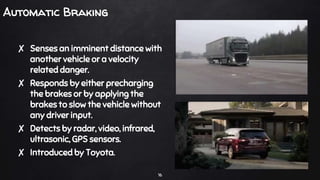
Automatic Braking
✘ Senses an imminent distance with
another vehicle or a velocity
related danger.
✘ Responds by either precharging
the brakes or by applying the
brakes to slow the vehicle without
any driver input.
✘ Detects by radar, video, infrared,
ultrasonic, GPS sensors.
✘ Introduced by Toyota.
16
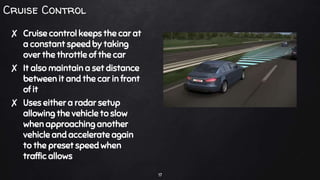
Cruise Control
✘ Cruise control keeps the car at
a constant speed by taking
over the throttle of the car
✘ It also maintain a set distance
between it and the car in front
of it
✘ Uses either a radar setup
allowing the vehicle to slow
when approaching another
vehicle and accelerate again
to the preset speed when
traffic allows
17
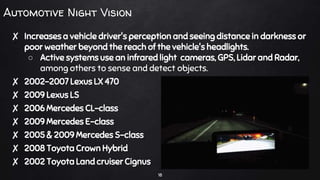
Automotive Night Vision
✘ Increases a vehicle driver's perception and seeing distance in darkness or
poor weather beyond the reach of the vehicle's headlights.
○ Active systems use an infrared light cameras, GPS, Lidar and Radar,
among others to sense and detect objects.
✘ 2002-2007 Lexus LX 470
✘ 2009 Lexus LS
✘ 2006 Mercedes CL-class
✘ 2009 Mercedes E-class
✘ 2005 & 2009 Mercedes S-class
✘ 2008 Toyota Crown Hybrid
✘ 2002 Toyota Land cruiser Cignus
18
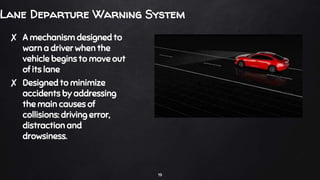
Lane Departure Warning System
✘ A mechanism designed to
warn a driver when the
vehicle begins to move out
of its lane
✘ Designed to minimize
accidents by addressing
the main causes of
collisions: driving error,
distraction and
drowsiness.
19
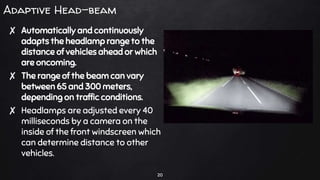
Adaptive Head-beam
✘ Automatically and continuously
adapts the headlamp range to the
distance of vehicles ahead or which
are oncoming.
✘ The range of the beam can vary
between 65 and 300 meters,
depending on traffic conditions.
✘ Headlamps are adjusted every 40
milliseconds by a camera on the
inside of the front windscreen which
can determine distance to other
vehicles.
20
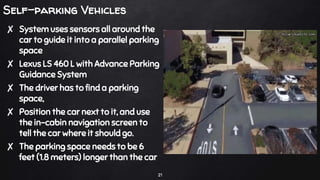
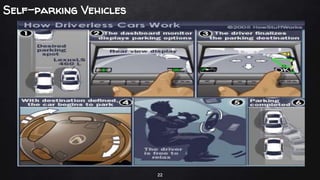
Self-parking Vehicles
✘ System uses sensors all around the
car to guide it into a parallel parking
space
✘ Lexus LS 460 L with Advance Parking
Guidance System
✘ The driver has to find a parking
space,
✘ Position the car next to it, and use
the in-cabin navigation screen to
tell the car where it should go.
✘ The parking space needs to be 6
feet (1.8 meters) longer than the car
21
Self-parking Vehicles
22
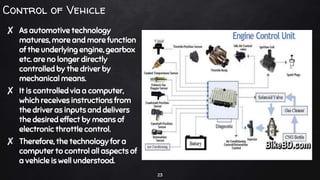
Control of Vehicle
✘ As automotive technology
matures, more and more function
of the underlying engine, gearbox
etc. are no longer directly
controlled by the driver by
mechanical means.
✘ It is controlled via a computer,
which receives instructions from
the driver as inputs and delivers
the desired effect by means of
electronic throttle control.
✘ Therefore, the technology for a
computer to control all aspects of
a vehicle is well understood.
23
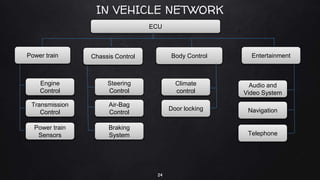
IN VEHICLE NETWORK
24
ECU
Chassis ControlPower train Body Control Entertainment
Audio and
Video System
Navigation
Telephone
Engine
Control
Transmission
Control
Power train
Sensors
Steering
Control
Air-Bag
Control
Braking
System
Climate
control
Door locking
Advantages
✘ Managing traffic flow to increase road capacity.
✘ Relieving vehicle occupants from driving allowing them to
concentrate on other tasks or to rest during their journeys.
✘ To avoid accidents .
✘ Increasing roadway capacity by reducing the distances between
cars.
✘ The current location of vehicle can be determine using global
positioning system (G.P.S) .
✘ Fuel efficient driving, saves 10-15% of fuel
25
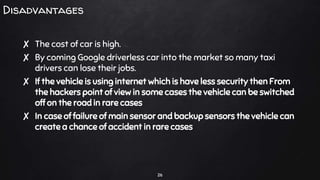
Disadvantages
✘ The cost of car is high.
✘ By coming Google driverless car into the market so many taxi
drivers can lose their jobs.
✘ If the vehicle is using internet which is have less security then From
the hackers point of view in some cases the vehicle can be switched
off on the road in rare cases
✘ In case of failure of main sensor and backup sensors the vehicle can
create a chance of accident in rare cases
26
thanks!
Any questions?

Autonomous vehicle

  • 1.
  • 2.
    What is adriverless vehcile? It is a vehicle that can drive itself from one point to another without human interference in other words, with an autopilot system. These are also known as Self driving vehicles or Autonomous Vehicles. Google Driverless car is most popular now a days. FEATURES Adaptive Cruise Control Emergency braking Self parking Lane tracking 2
  • 3.
    Contents! 1. Different stagesof Autonomous Vehicles 2. Sensor Technology in Autonomous Vehicle 3. Systems using these senors 4. Advantages and Disadvantages 3
  • 4.
    Different stages The Societyof Automotive Engineers defines 6 levels of driving automation ranging from 0 (fully manual) to 5 (fully autonomous). L0. No driving automation L1. Driver Assistance L2. Partial driving automation L3.Conditional driving automation L4. High driving automation L5. Full driving automation 4
  • 5.
    Sensor Technology 5 Autonomous VehicleSensing System UltrasonicVision Lidar RadarGPS Camera Rotating laser Solid state Sweeping laser Fixed beam Short range Medium range Long range
  • 6.
    Vision-CAMERA ✘ The videocamera was fixed near the rear view mirror. That will detect traffic lights and any moving objects front of the car. ✘ The computer will recognize moving obstacles like pedestrians and bicyclists. 6
  • 7.
    Sensor which usesultrasonic waves to detect object or to measure the distance between itself and the object. When an electrical pulse of high voltage is applied to the ultrasonic transducer it vibrates across a specific spectrum of frequencies and generates a sound waves. Ultrasonic Sensor 7
  • 8.
    Applications of UltrasonicSensor Medical Imaging Autonomous Vehicles 8
  • 9.
    LIDAR-Light Detection andranging The LiDAR instrument fires rapid pulses of laser light at a surface, some at up to 1,50,000 pulses per second. A sensor on the instrument measures the amount of time it takes for each pulse to bounce back. Distance can be calculated with high accuracy. By repeating this in quick succession the instrument builds up a complex 'map' of the surrounding. Distance = (Speed of Light x Time of Flight) / 2 9
  • 10.
    Types of LIDAR 10 AirborneLIDAR Terrestrial LIDAR Water LIDAR
  • 11.
    Applications of LIDAR 11 SpeedGun Self Driving Cars Agricultural Survey River Survey Autonomous Vehicles
  • 12.
    GPS 12 You are onthe planet, at least four GPS satellites are ‘visible’ at any time. Each one transmits information about its position and the current time at regular intervals. These signals, travelling at the speed of light, are intercepted by your GPS receiver, which calculates how far away each satellite is based on how long it took for the messages to arrive. Once it has information on how far away at least three satellites are, your GPS receiver can pinpoint your location using a process called trilateration.
  • 13.
    RADAR- Radio Detectionand ranging 13 Radar is a detection system that uses radio waves to determine the range, angle, or velocity of objects
  • 14.
    Technologies making asystem fully Autonomous ✘ Electronic stability control (ESC) ✘ Automatic Braking ✘ Cruise control ✘ Lane Departure Warning System ✘ Self Parking ✘ Automated Guided Vehicle Systems 14
  • 15.
    Electronic stability Control ✘A computerized technology improves vehicle's stability by detecting and minimizing skids. ✘ Automatically applies the brakes. ✘ Helps to minimize a loss of control. ✘ ESC compares the driver's intended direction to the vehicle's actual direction ○ Components ✘ Wheel-speed sensors ✘ Steering-angle sensors ✘ Rotational-speed sensor 15
  • 16.
    Automatic Braking ✘ Sensesan imminent distance with another vehicle or a velocity related danger. ✘ Responds by either precharging the brakes or by applying the brakes to slow the vehicle without any driver input. ✘ Detects by radar, video, infrared, ultrasonic, GPS sensors. ✘ Introduced by Toyota. 16
  • 17.
    Cruise Control ✘ Cruisecontrol keeps the car at a constant speed by taking over the throttle of the car ✘ It also maintain a set distance between it and the car in front of it ✘ Uses either a radar setup allowing the vehicle to slow when approaching another vehicle and accelerate again to the preset speed when traffic allows 17
  • 18.
    Automotive Night Vision ✘Increases a vehicle driver's perception and seeing distance in darkness or poor weather beyond the reach of the vehicle's headlights. ○ Active systems use an infrared light cameras, GPS, Lidar and Radar, among others to sense and detect objects. ✘ 2002-2007 Lexus LX 470 ✘ 2009 Lexus LS ✘ 2006 Mercedes CL-class ✘ 2009 Mercedes E-class ✘ 2005 & 2009 Mercedes S-class ✘ 2008 Toyota Crown Hybrid ✘ 2002 Toyota Land cruiser Cignus 18
  • 19.
    Lane Departure WarningSystem ✘ A mechanism designed to warn a driver when the vehicle begins to move out of its lane ✘ Designed to minimize accidents by addressing the main causes of collisions: driving error, distraction and drowsiness. 19
  • 20.
    Adaptive Head-beam ✘ Automaticallyand continuously adapts the headlamp range to the distance of vehicles ahead or which are oncoming. ✘ The range of the beam can vary between 65 and 300 meters, depending on traffic conditions. ✘ Headlamps are adjusted every 40 milliseconds by a camera on the inside of the front windscreen which can determine distance to other vehicles. 20
  • 21.
    Self-parking Vehicles ✘ Systemuses sensors all around the car to guide it into a parallel parking space ✘ Lexus LS 460 L with Advance Parking Guidance System ✘ The driver has to find a parking space, ✘ Position the car next to it, and use the in-cabin navigation screen to tell the car where it should go. ✘ The parking space needs to be 6 feet (1.8 meters) longer than the car 21
  • 22.
  • 23.
    Control of Vehicle ✘As automotive technology matures, more and more function of the underlying engine, gearbox etc. are no longer directly controlled by the driver by mechanical means. ✘ It is controlled via a computer, which receives instructions from the driver as inputs and delivers the desired effect by means of electronic throttle control. ✘ Therefore, the technology for a computer to control all aspects of a vehicle is well understood. 23
  • 24.
    IN VEHICLE NETWORK 24 ECU ChassisControlPower train Body Control Entertainment Audio and Video System Navigation Telephone Engine Control Transmission Control Power train Sensors Steering Control Air-Bag Control Braking System Climate control Door locking
  • 25.
    Advantages ✘ Managing trafficflow to increase road capacity. ✘ Relieving vehicle occupants from driving allowing them to concentrate on other tasks or to rest during their journeys. ✘ To avoid accidents . ✘ Increasing roadway capacity by reducing the distances between cars. ✘ The current location of vehicle can be determine using global positioning system (G.P.S) . ✘ Fuel efficient driving, saves 10-15% of fuel 25
  • 26.
    Disadvantages ✘ The costof car is high. ✘ By coming Google driverless car into the market so many taxi drivers can lose their jobs. ✘ If the vehicle is using internet which is have less security then From the hackers point of view in some cases the vehicle can be switched off on the road in rare cases ✘ In case of failure of main sensor and backup sensors the vehicle can create a chance of accident in rare cases 26
  • 27.