© 2017, Robert W. Heath Jr.
Flying with SAVES
Dr. Nuria Gonzalez-Prelcic
SAVES Assistant Director
Motivation
2
Motivation
3
3
It is the right time for SAVES to go aerial!
SAVES has addressed many aspects
of vehicular engineering for ground
vehicles during its first year of life
Problems like collaborative sensing,
vehicular communication, map making
or navigation have common aspects in
aerial and ground scenarios
Drone-based systems are
driving disruptive
applications in the market
Taking SAVES to the skies
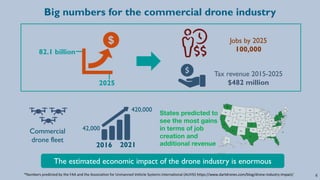
Big numbers for the commercial drone industry
4*Numbers predicted by the FAA and the Association for Unmanned Vehicle Systems International (AUVSI) https://www.dartdrones.com/blog/drone-industry-impact/
2025
82.1 billion
Tax revenue 2015-2025
$482 million
Jobs by 2025
100,000
The estimated economic impact of the drone industry is enormous
Commercial
drone fleet
42,000
420,000
2016 2021
States predicted to
see the most gains
in terms of job
creation and
additional revenue
5
Aerial vehicles
UAVs as imaging
sensors
UAVs for
wireless
UAVs for sensing
and monitoring
UAVs for
transportation
TECHNOLOGIES
SENSING + COMMUNICATION in drones enables revolutionary applications
10
Technologies for disruptive UAV applications
Positioning/mapping/
navigation
Collaborative
sensing
MIMO
communication
SAVES faculties are well positioned on key UAV technologies
Autonomy levels
11
Different autonomy levels require different technologies
Fully automated
operation with high
connectivity
Automated
navigation with
moderate rate
communication
GPS available
Automated
development of a
task/control signals
through
communication
possible/distributed
computation
possible
Fully automated
operation with moderate
connectivity
Automated
navigation with
high rate
communication
GPS available
Automated
development of a
task/control signals
through
communication
possible/distributed
computation
possible
Autonomous
operation
Autonomous
development of
a task
Autonomous
navigation when
communication/GPS
not available
NO CONNECTIVITY MODERATE/HIGH CONNECTIVITY
On going
research
12
Core networkGateway
Aerial communication expertise
13
MmWave MIMO for air-to-
air communication
Capacity analysis
PHY design
Channel models for the mmWave
A2G and A2A channels
Network topologies for
A2G and A2A @
mmWave
MU millimeter wave MIMO
for A2G
Initial work supported
by LMCO
14
Trajectory planning, obstacle
avoidance
14
Different drone applications
require different on-board
sensors
GPS signal may not be available
in certain environments
(canyons, forests, etc.)
How can the drone navigate
autonomously with the set of
sensors required by the
application and no
GPS/communication?
Develop and evaluate navigation algorithms
using one camera/two
cameras/camera+radar/etc.
Navigating without GPS
Example: navigating with an on board camera
UAV based traffic monitoring
15
Video feed over WiFi/cellular
Video Processing
Data Processing
CLOUD
the unbiased result, we avoided choosing consecutive fram
in the same testing data set. For each data set, we calculat
the ratio of number of vehicles being detected and the to
number of vehicles. Then we average the ratios we got fro
all of the data sets. Furthermore, we repeated the process t
times from generating testing sets to averaging the ratios.
An example of the output of the tracking algorithm can
seen in Fig. 7 (a) and (b). In order to observe the tracki
results, we assigned each detected vehicle a unique numb
and display it. For each real-world aerial video as an inp
data set, we observed if the assigned number of a vehic
changed from its entering to the screen to its exit. The res
shows that unique numbers assigned to vehicles do not chan
for every testing video.
(a)
Video feed over WiFiVVideo feed over
Video Processing
Data Processing
Web Application
Fig. 4: Illustration of our experimental setup.eps
network between them, and the computer can access the UAV
and the controller over the provided IP address. After deciding
on a UAV, we chose a GoPro 4 camera for the system. The
GoPro 4 camera is compatible with the 3DR Solo gimble,
and it has adjustable frame rate and resolution that makes it
possible to collect different types of data.
Fig. 6: Overview of the structure of the traffic monitori
application.
contour detection, when the color of the vehicle and the co
of background are very similar, it cannot generate good resul
The Haar cascade model can detect cars accurately even wh
the drone shifts. By training with a large number of pictur
its accuracy can be increased steadily.
We chose the OpenCV module in Python to implement t
Haar cascade model. OpenCV’s open-source library of ima
processing functions allows us to process the input vid
Video feed over WiFiVVideo feed over
Video Processing
Data Processing
Web Application
Fig. 4: Illustration of our experimental setup.eps
network between them, and the computer can access the UAV
and the controller over the provided IP address. After deciding
on a UAV, we chose a GoPro 4 camera for the system. The
GoPro 4 camera is compatible with the 3DR Solo gimble,
and it has adjustable frame rate and resolution that makes it
possible to collect different types of data.
Fig. 5: 3DR Solo quadcopter equipped with a GoPro 4 camera.
The general processing steps are illustrated in Fig. 6. The
computer module is composed of three submodules: video
processing, data processing, and web application. Users make
monitoring request via a web application. After they enter the
location information, the web application takes the request and
generates a flight script that can be sent to the drone over
Wi-Fi. Then the drone flies to the desired location and start
collecting video.
For software decisions, the methods we tested to detect
vehicles are background subtraction [14], contour detection
[15], and the Haar cascade model. Background subtraction
and contour detection are the most common methods being
applied to vehicle detection. After running the background
subtraction algorithm, we found that it is inaccurate when
the drone’s position shift during video taking process. As for
Fig. 6: Overview of the structure of the traffic monitoring
application.
contour detection, when the color of the vehicle and the color
of background are very similar, it cannot generate good results.
The Haar cascade model can detect cars accurately even when
the drone shifts. By training with a large number of pictures,
its accuracy can be increased steadily.
We chose the OpenCV module in Python to implement the
Haar cascade model. OpenCV’s open-source library of image
processing functions allows us to process the input video
frame by frame and implement vehicle detection functions.
Even though MATLAB has similar functionalities for video
processing, it operates much slower than the OpenCV and
Python combination. Furthermore, based on our experience,
MATLAB needs more RAM and delay real-time processing
compared with OpenCV. After all the hardware and software
decisions, our first step is to get access to drone video feed
through the computer. We use VLC media player to view
the live video captured by the camera. Therefore, one of
the hardware requirements for the system is a computer with
VLC installed. The computer communicates with the drone by
connecting to the drone’s Wi-Fi and building a TCP connection
with a Telnet client. To build a TCP connection, an SDP file
including the TCP parameters is needed.
V. RESULTS
Before testing the experimental system, we collected 3750
vehicle and non-vehicle images to train the Haar cascade
model. The images were captured from the aerial video filmed
in several areas in Austin, Texas. We used the built-in sample
generating functions in OpenCV to apply distortions to the
input images, and to label data. After that, we flew the UAV
and recorded different sets of aerial videos captured at different
heights and times for testing the system.
The detection accuracy of our system lies in the range 83-
90% for any given frame. To compute the detection accuracy,
we chose frame samples from the input videos. In order to get
Project ideas
16
Summary of ideas
17
Navigating in a team without
GPS and connectivity Joint positioning and
communication using 5G
signalsSLAM aided mmWave
communication
Channel variation
models for A2G/A2A
Leveraging cellular
infrastructure
for automated operation
Managing/leveraging interference
in sub 6-GHz networks
Designing mmWave
hotspots
Infrastructure to support
automated flying Integrating autonomous
and manned vehicles
3D coverage maps for
trajectory planning
Trajectory planning, obstacle
avoidance
Operating in a team without connectivity with the
infrastructure
18
How to implement team
navigation, which sensing data have
to be shared between UAVs? how
performance depends on data rate?
Collaborative sensing
framework for task
development
19
Assume drones are equipped with
mmWave MIMO transceivers
How to use the mmWave
communication signal for positioning?
Prior work on joint positioning and
communication does not consider high
mobility conditions in aerial scenarios
Develop joint positioning and
communication algorithms at mmWave
for the aerial environment
Location of the
aerial BS is known
with some errorLocation of the
aerial MS or
distance to aerial
BS are unknown
Joint positioning and communication using 5G signals
SLAM is a popular solution for
localization and mapping that can be
used for drone navigation
20
Infrared imaging
Radar
4K video
Communications relay
Air-to-ground link
Aerial access point
Networked airborne users
in a rescue mission
Some applications may require high data
rate A2A/A2G communication links
Use drone navigation algorithms to aid millimeter wave beam alignment and reduce
communication overhead by mapping SLAM outputs and channel estimates
PI: Profs. Nuria Gonzalez-Prelcic and Robert Heath
SLAM aided mmwave communication
Developing a channel variation model for mmWave A2G/A2A
links
21
Trajectory
1 2 3 4 5 6 7 8
Distance from start point [m]
0
20
40
60
80
100
120
140
160
180
Angle[deg]
Azimuth of Departure
AoA serie
generated from
Quadriga*
Incorporate high mobility and spatial
consistency into the A2A and A2G
channel models
A channel variation model is the key to develop channel tracking
algorithms to reduce training overhead for beamformers update
Leveraging cellular infrastructure
for automated operation
22
Cellular infrastructure can
supplement aerial traffic
management
Cellular infrastructure can
play a roll for drone
localization and tracking
Sensing at the infrastructure
provides distributed tracking
without high power radar
Processing can be offloaded to a
centralized processor, cell edge, or cloud
23
LOS conditions in the A2G channel
impact interference level at the UAV
Design MIMO strategies at the UAV to mitigate multi-BS interference
Managing/leveraging interference in sub 6-GHz networks
Interference
Designing mmWave hotspots
24
Air-to-ground link
Aerial access point
Air-to-air link
Develop MU MIMO strategies for mixed
aerial-ground networks
Optimize location of aerial access point
to maximize coverage
Integrating autonomous and manned vehicles
25
Study the ways that autonomous
airplanes may be integrated with
manned vehicles, starting withVFR, in
the next five years
Identify critical and optional
components in the aircraft and on
the ground to support such
operations
ADS-B for position location
Radio
Cameras to detect legacy aircraft
Speech processing
Sensor
fusion
Radar altimeter
Radar for collision avoidance
Infrastructure to support automated flying
26
How to use the communication
signals and sensor fusion to aid
positioning?
Design trajectory planning algorithms which
account for dynamic coverage maps of the
environment
How can sensing at the infrastructure
enhance situational awareness in mixed
piloted and automated environments?
Study the role of cellular
infrastructure in supporting
automated flying, including new
modes of communication at higher
rates and also sensing at the base
station
27
(x,y,z)
GPS signal
Cellular coverage
Wi-Fi signal
Design trajectory planning algorithms which account for dynamic coverage
maps of the environment including communication and sensing
3D coverage maps for trajectory planning
Thanks!
29

Flying with SAVES

  • 1.
    © 2017, RobertW. Heath Jr. Flying with SAVES Dr. Nuria Gonzalez-Prelcic SAVES Assistant Director
  • 2.
  • 3.
    Motivation 3 3 It is theright time for SAVES to go aerial! SAVES has addressed many aspects of vehicular engineering for ground vehicles during its first year of life Problems like collaborative sensing, vehicular communication, map making or navigation have common aspects in aerial and ground scenarios Drone-based systems are driving disruptive applications in the market Taking SAVES to the skies
  • 4.
    Big numbers forthe commercial drone industry 4*Numbers predicted by the FAA and the Association for Unmanned Vehicle Systems International (AUVSI) https://www.dartdrones.com/blog/drone-industry-impact/ 2025 82.1 billion Tax revenue 2015-2025 $482 million Jobs by 2025 100,000 The estimated economic impact of the drone industry is enormous Commercial drone fleet 42,000 420,000 2016 2021 States predicted to see the most gains in terms of job creation and additional revenue
  • 5.
    5 Aerial vehicles UAVs asimaging sensors UAVs for wireless UAVs for sensing and monitoring UAVs for transportation TECHNOLOGIES SENSING + COMMUNICATION in drones enables revolutionary applications
  • 6.
    10 Technologies for disruptiveUAV applications Positioning/mapping/ navigation Collaborative sensing MIMO communication SAVES faculties are well positioned on key UAV technologies
  • 7.
    Autonomy levels 11 Different autonomylevels require different technologies Fully automated operation with high connectivity Automated navigation with moderate rate communication GPS available Automated development of a task/control signals through communication possible/distributed computation possible Fully automated operation with moderate connectivity Automated navigation with high rate communication GPS available Automated development of a task/control signals through communication possible/distributed computation possible Autonomous operation Autonomous development of a task Autonomous navigation when communication/GPS not available NO CONNECTIVITY MODERATE/HIGH CONNECTIVITY
  • 8.
  • 9.
    Core networkGateway Aerial communicationexpertise 13 MmWave MIMO for air-to- air communication Capacity analysis PHY design Channel models for the mmWave A2G and A2A channels Network topologies for A2G and A2A @ mmWave MU millimeter wave MIMO for A2G Initial work supported by LMCO
  • 10.
    14 Trajectory planning, obstacle avoidance 14 Differentdrone applications require different on-board sensors GPS signal may not be available in certain environments (canyons, forests, etc.) How can the drone navigate autonomously with the set of sensors required by the application and no GPS/communication? Develop and evaluate navigation algorithms using one camera/two cameras/camera+radar/etc. Navigating without GPS Example: navigating with an on board camera
  • 11.
    UAV based trafficmonitoring 15 Video feed over WiFi/cellular Video Processing Data Processing CLOUD the unbiased result, we avoided choosing consecutive fram in the same testing data set. For each data set, we calculat the ratio of number of vehicles being detected and the to number of vehicles. Then we average the ratios we got fro all of the data sets. Furthermore, we repeated the process t times from generating testing sets to averaging the ratios. An example of the output of the tracking algorithm can seen in Fig. 7 (a) and (b). In order to observe the tracki results, we assigned each detected vehicle a unique numb and display it. For each real-world aerial video as an inp data set, we observed if the assigned number of a vehic changed from its entering to the screen to its exit. The res shows that unique numbers assigned to vehicles do not chan for every testing video. (a) Video feed over WiFiVVideo feed over Video Processing Data Processing Web Application Fig. 4: Illustration of our experimental setup.eps network between them, and the computer can access the UAV and the controller over the provided IP address. After deciding on a UAV, we chose a GoPro 4 camera for the system. The GoPro 4 camera is compatible with the 3DR Solo gimble, and it has adjustable frame rate and resolution that makes it possible to collect different types of data. Fig. 6: Overview of the structure of the traffic monitori application. contour detection, when the color of the vehicle and the co of background are very similar, it cannot generate good resul The Haar cascade model can detect cars accurately even wh the drone shifts. By training with a large number of pictur its accuracy can be increased steadily. We chose the OpenCV module in Python to implement t Haar cascade model. OpenCV’s open-source library of ima processing functions allows us to process the input vid Video feed over WiFiVVideo feed over Video Processing Data Processing Web Application Fig. 4: Illustration of our experimental setup.eps network between them, and the computer can access the UAV and the controller over the provided IP address. After deciding on a UAV, we chose a GoPro 4 camera for the system. The GoPro 4 camera is compatible with the 3DR Solo gimble, and it has adjustable frame rate and resolution that makes it possible to collect different types of data. Fig. 5: 3DR Solo quadcopter equipped with a GoPro 4 camera. The general processing steps are illustrated in Fig. 6. The computer module is composed of three submodules: video processing, data processing, and web application. Users make monitoring request via a web application. After they enter the location information, the web application takes the request and generates a flight script that can be sent to the drone over Wi-Fi. Then the drone flies to the desired location and start collecting video. For software decisions, the methods we tested to detect vehicles are background subtraction [14], contour detection [15], and the Haar cascade model. Background subtraction and contour detection are the most common methods being applied to vehicle detection. After running the background subtraction algorithm, we found that it is inaccurate when the drone’s position shift during video taking process. As for Fig. 6: Overview of the structure of the traffic monitoring application. contour detection, when the color of the vehicle and the color of background are very similar, it cannot generate good results. The Haar cascade model can detect cars accurately even when the drone shifts. By training with a large number of pictures, its accuracy can be increased steadily. We chose the OpenCV module in Python to implement the Haar cascade model. OpenCV’s open-source library of image processing functions allows us to process the input video frame by frame and implement vehicle detection functions. Even though MATLAB has similar functionalities for video processing, it operates much slower than the OpenCV and Python combination. Furthermore, based on our experience, MATLAB needs more RAM and delay real-time processing compared with OpenCV. After all the hardware and software decisions, our first step is to get access to drone video feed through the computer. We use VLC media player to view the live video captured by the camera. Therefore, one of the hardware requirements for the system is a computer with VLC installed. The computer communicates with the drone by connecting to the drone’s Wi-Fi and building a TCP connection with a Telnet client. To build a TCP connection, an SDP file including the TCP parameters is needed. V. RESULTS Before testing the experimental system, we collected 3750 vehicle and non-vehicle images to train the Haar cascade model. The images were captured from the aerial video filmed in several areas in Austin, Texas. We used the built-in sample generating functions in OpenCV to apply distortions to the input images, and to label data. After that, we flew the UAV and recorded different sets of aerial videos captured at different heights and times for testing the system. The detection accuracy of our system lies in the range 83- 90% for any given frame. To compute the detection accuracy, we chose frame samples from the input videos. In order to get
  • 12.
  • 13.
    Summary of ideas 17 Navigatingin a team without GPS and connectivity Joint positioning and communication using 5G signalsSLAM aided mmWave communication Channel variation models for A2G/A2A Leveraging cellular infrastructure for automated operation Managing/leveraging interference in sub 6-GHz networks Designing mmWave hotspots Infrastructure to support automated flying Integrating autonomous and manned vehicles 3D coverage maps for trajectory planning
  • 14.
    Trajectory planning, obstacle avoidance Operatingin a team without connectivity with the infrastructure 18 How to implement team navigation, which sensing data have to be shared between UAVs? how performance depends on data rate? Collaborative sensing framework for task development
  • 15.
    19 Assume drones areequipped with mmWave MIMO transceivers How to use the mmWave communication signal for positioning? Prior work on joint positioning and communication does not consider high mobility conditions in aerial scenarios Develop joint positioning and communication algorithms at mmWave for the aerial environment Location of the aerial BS is known with some errorLocation of the aerial MS or distance to aerial BS are unknown Joint positioning and communication using 5G signals
  • 16.
    SLAM is apopular solution for localization and mapping that can be used for drone navigation 20 Infrared imaging Radar 4K video Communications relay Air-to-ground link Aerial access point Networked airborne users in a rescue mission Some applications may require high data rate A2A/A2G communication links Use drone navigation algorithms to aid millimeter wave beam alignment and reduce communication overhead by mapping SLAM outputs and channel estimates PI: Profs. Nuria Gonzalez-Prelcic and Robert Heath SLAM aided mmwave communication
  • 17.
    Developing a channelvariation model for mmWave A2G/A2A links 21 Trajectory 1 2 3 4 5 6 7 8 Distance from start point [m] 0 20 40 60 80 100 120 140 160 180 Angle[deg] Azimuth of Departure AoA serie generated from Quadriga* Incorporate high mobility and spatial consistency into the A2A and A2G channel models A channel variation model is the key to develop channel tracking algorithms to reduce training overhead for beamformers update
  • 18.
    Leveraging cellular infrastructure forautomated operation 22 Cellular infrastructure can supplement aerial traffic management Cellular infrastructure can play a roll for drone localization and tracking Sensing at the infrastructure provides distributed tracking without high power radar Processing can be offloaded to a centralized processor, cell edge, or cloud
  • 19.
    23 LOS conditions inthe A2G channel impact interference level at the UAV Design MIMO strategies at the UAV to mitigate multi-BS interference Managing/leveraging interference in sub 6-GHz networks Interference
  • 20.
    Designing mmWave hotspots 24 Air-to-groundlink Aerial access point Air-to-air link Develop MU MIMO strategies for mixed aerial-ground networks Optimize location of aerial access point to maximize coverage
  • 21.
    Integrating autonomous andmanned vehicles 25 Study the ways that autonomous airplanes may be integrated with manned vehicles, starting withVFR, in the next five years Identify critical and optional components in the aircraft and on the ground to support such operations ADS-B for position location Radio Cameras to detect legacy aircraft Speech processing Sensor fusion Radar altimeter Radar for collision avoidance
  • 22.
    Infrastructure to supportautomated flying 26 How to use the communication signals and sensor fusion to aid positioning? Design trajectory planning algorithms which account for dynamic coverage maps of the environment How can sensing at the infrastructure enhance situational awareness in mixed piloted and automated environments? Study the role of cellular infrastructure in supporting automated flying, including new modes of communication at higher rates and also sensing at the base station
  • 23.
    27 (x,y,z) GPS signal Cellular coverage Wi-Fisignal Design trajectory planning algorithms which account for dynamic coverage maps of the environment including communication and sensing 3D coverage maps for trajectory planning
  • 24.