PRESENTED BY:
Avinash.reddi
CONTENTS
1)INTRODUCTION
2) TYPES OF SAFETY SYSTEMS
 AIR BAGS
 SEAT BELT
 ANTI LOCK BRACKING SYSTEM
 COLLISION WARNING SYSTEM
 BLIND SPOT DETECTOR
 ELECTRONIC STABILITY CONTROL
 CRUISE CONTROL
 VECHILE BLIND SPOT
INTRODUCTION
 WHAT?
 WHY?
 WHEN?
 WHAT IS AUTOMOBILE SAFETY SYSTEM?
 WHY IT IS SO MUCH IMPORTANT OR WHY
SHOULD WE ADOPT IT?
 WHEN IT WAS FIRST STARTED TO ENHANCE
SAFETY SYSTEM?
 Automobile safety is the study and practice of design,
construction, equipment and regulation to minimize the
occurrence and consequences of traffic collisions. Road traffic
safety more broadly includes roadway design.
 However, automobile accidents have still been the leading
cause of injuries and death in most countries. Car safety also
pertains to necessary car safety features. This is incorporated
in our car to protect us and other passengers from injury and
death during a collision or crash.
 One of the first formal academic studies into improving
vehicle safety was by Cornell Aeronautical Laboratory of
Buffalo, New York. The main conclusion of their extensive
report is the crucial importance of seat belts and padded
dashboards
AIRBAGS
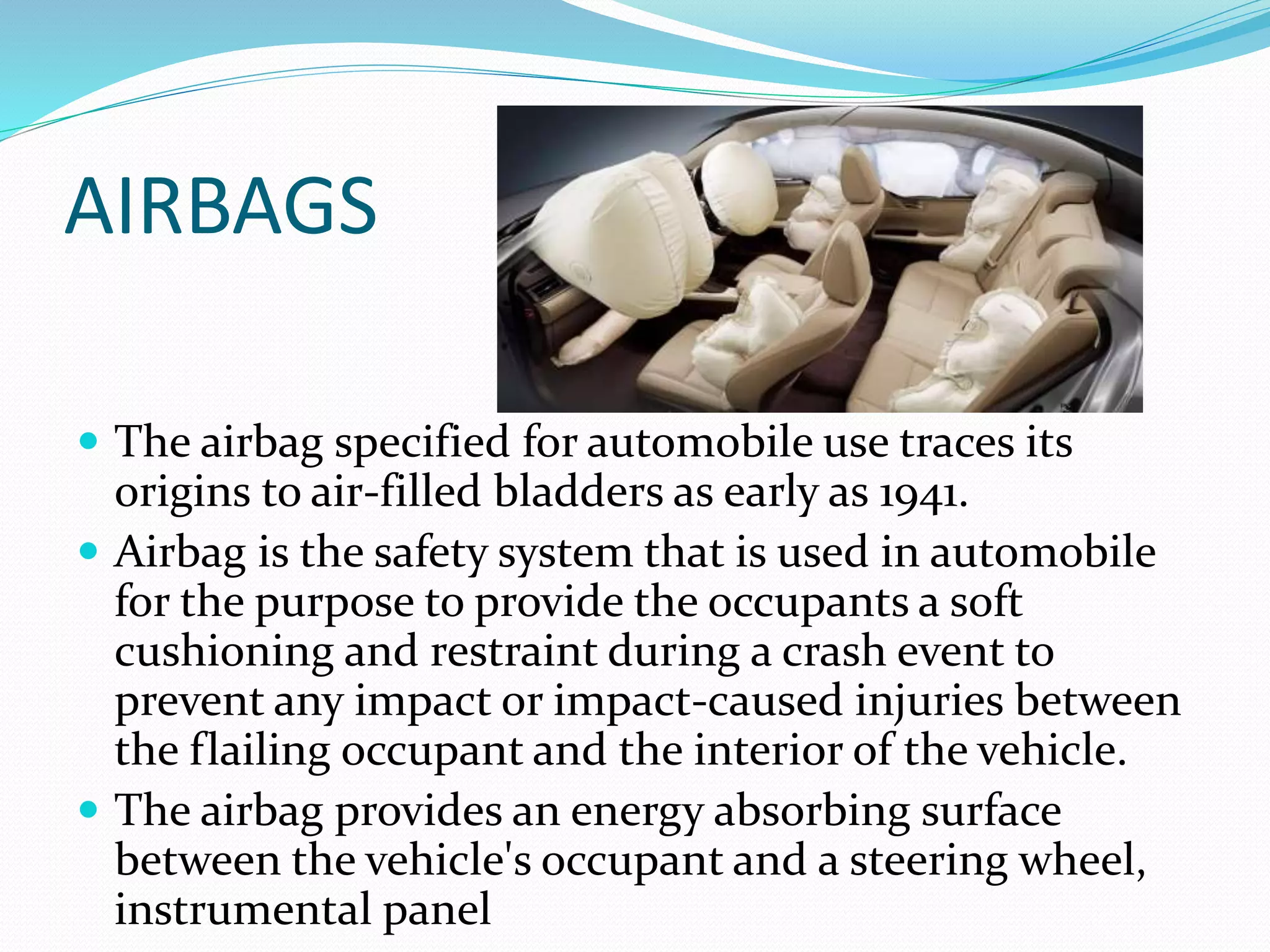
 The airbag specified for automobile use traces its
origins to air-filled bladders as early as 1941.
 Airbag is the safety system that is used in automobile
for the purpose to provide the occupants a soft
cushioning and restraint during a crash event to
prevent any impact or impact-caused injuries between
the flailing occupant and the interior of the vehicle.
 The airbag provides an energy absorbing surface
between the vehicle's occupant and a steering wheel,
instrumental panel
SEAT BELTS
 Seat belts is a basic safety tool that is used for the
safety purpose of passenger inside the car or vehicle.
 A seat belt functions to reduce the likelihood of death
or serious injury in a traffic collision by reducing the
force of secondary impacts.
 Seat belts were invented by English engineer George
Clayey in the mid-19th century , though Edward J.
Claghorn of New York, was granted the first patent on
February 10, 1885 for a safety belt
ABS:- ANTI LOCK BRAKING SYSTEM
 An anti-lock braking system or anti-skid braking
system (ABS) is an automobile safety system that
allows the wheels on a motor vehicle to maintain
tractivecontact with the road surface according to
driver inputs while braking.
 This prevent the wheels from locking up (ceasing
rotation) and avoiding uncontrolled skidding
MAIN COMPONENTS OF ABS
 Speed sensors
 Valves
 pump
 Controller
COLLISION WARNING SYSTEM
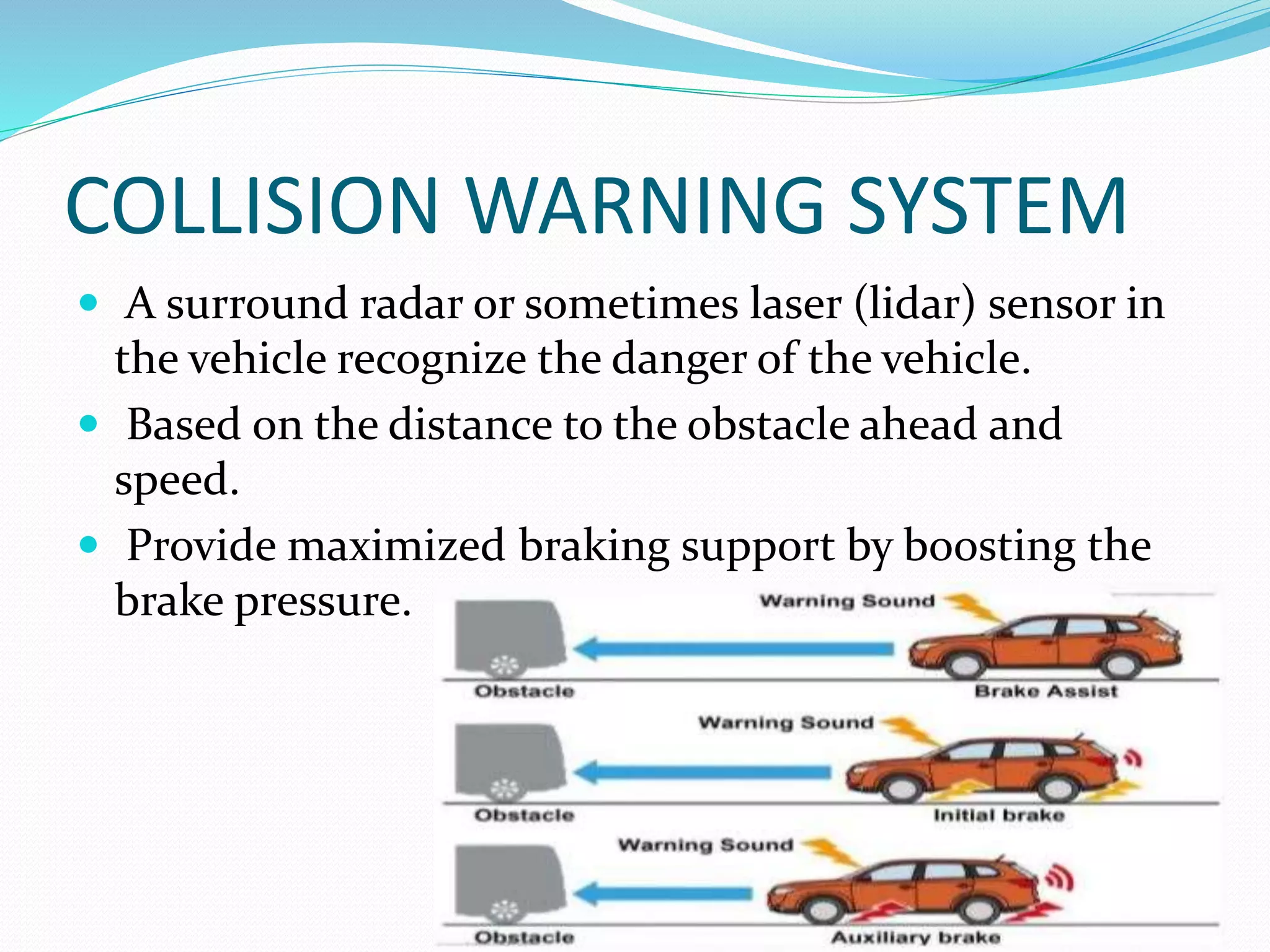
 A surround radar or sometimes laser (lidar) sensor in
the vehicle recognize the danger of the vehicle.
 Based on the distance to the obstacle ahead and
speed.
 Provide maximized braking support by boosting the
brake pressure.
BLIND SPOT DETECTOR
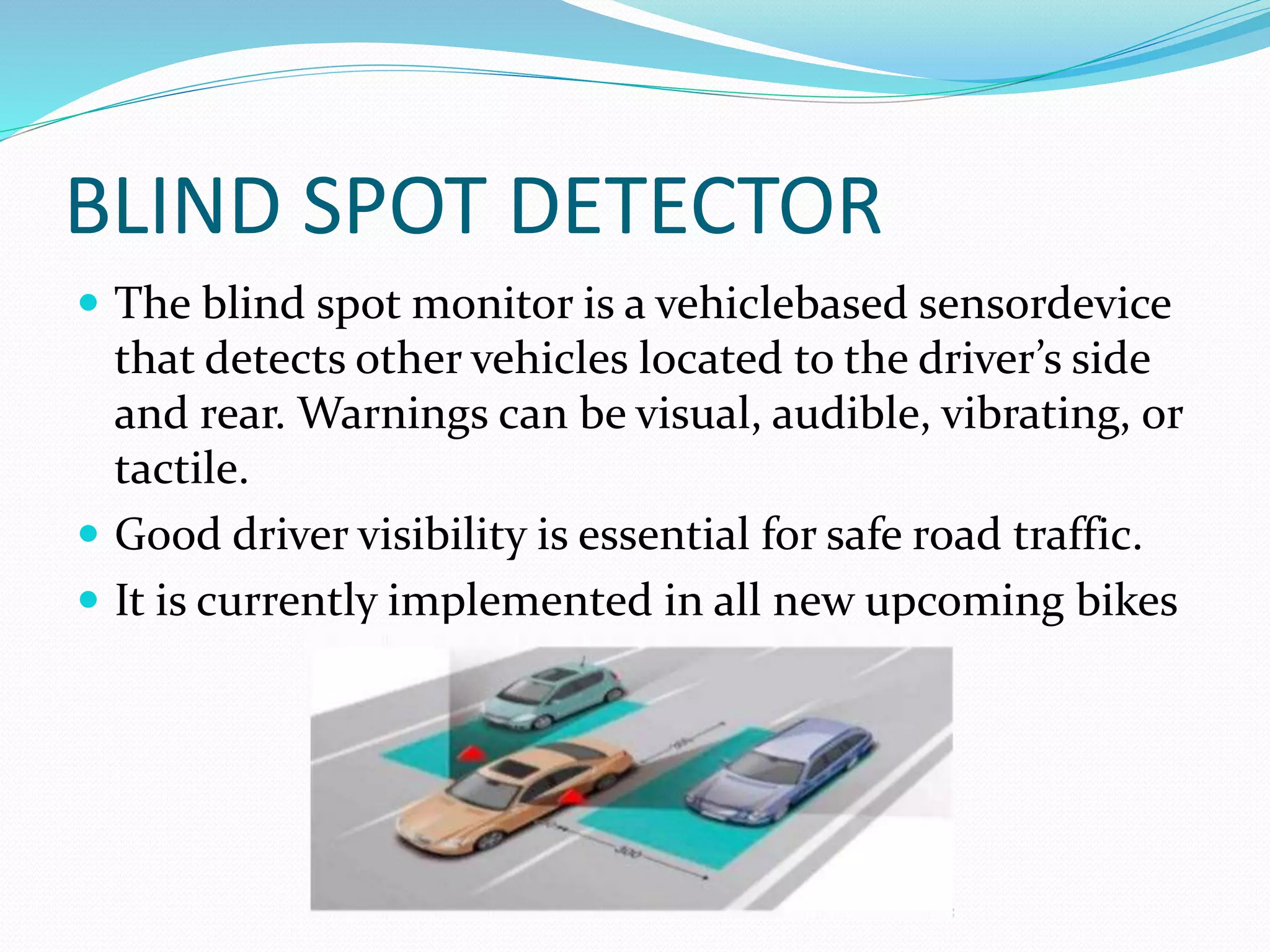
 The blind spot monitor is a vehiclebased sensordevice
that detects other vehicles located to the driver’s side
and rear. Warnings can be visual, audible, vibrating, or
tactile.
 Good driver visibility is essential for safe road traffic.
 It is currently implemented in all new upcoming bikes
ELECTRONIC STABILITY CONTROL
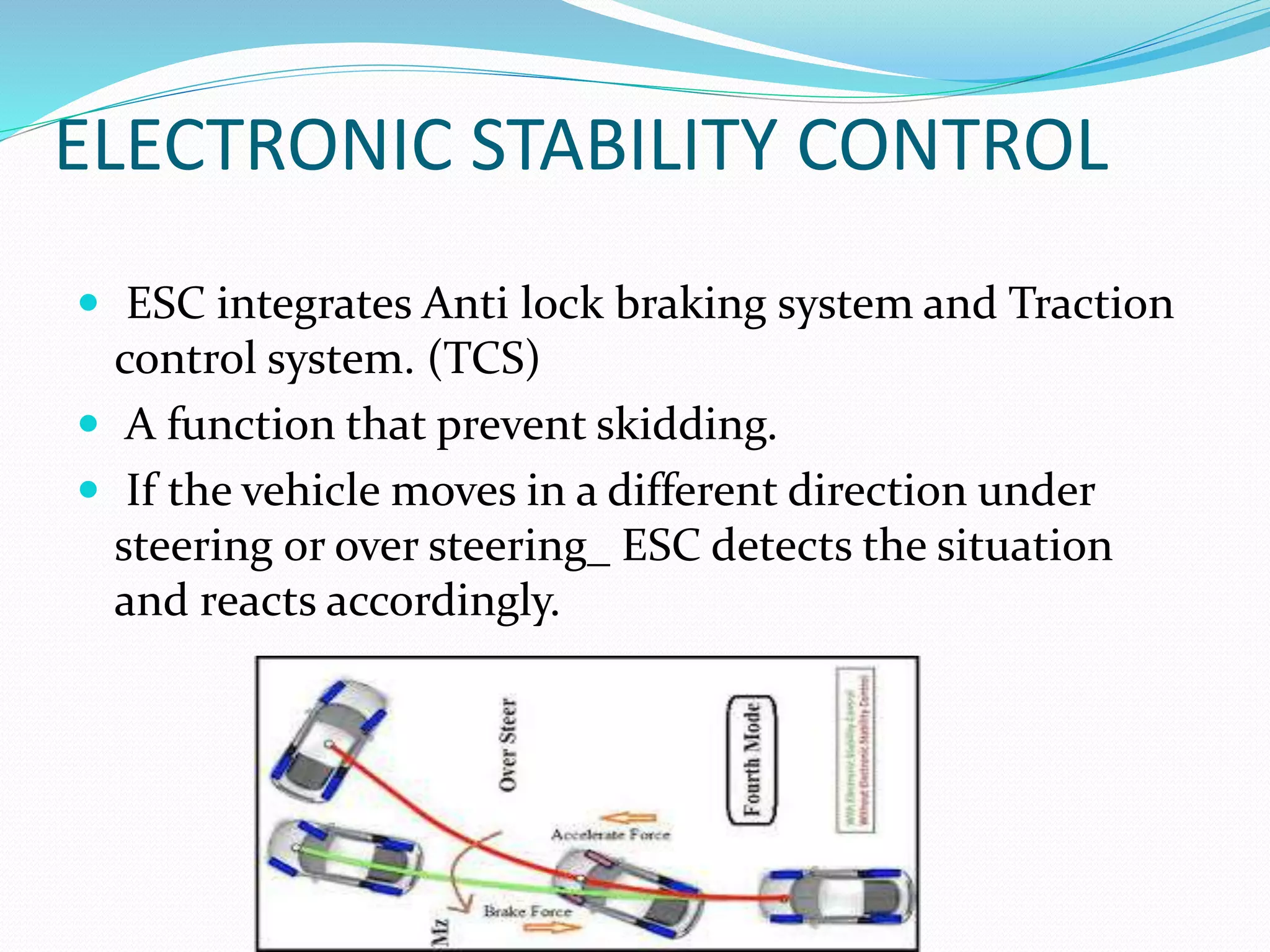
 ESC integrates Anti lock braking system and Traction
control system. (TCS)
 A function that prevent skidding.
 If the vehicle moves in a different direction under
steering or over steering_ ESC detects the situation
and reacts accordingly.
CRUISE CONTROL
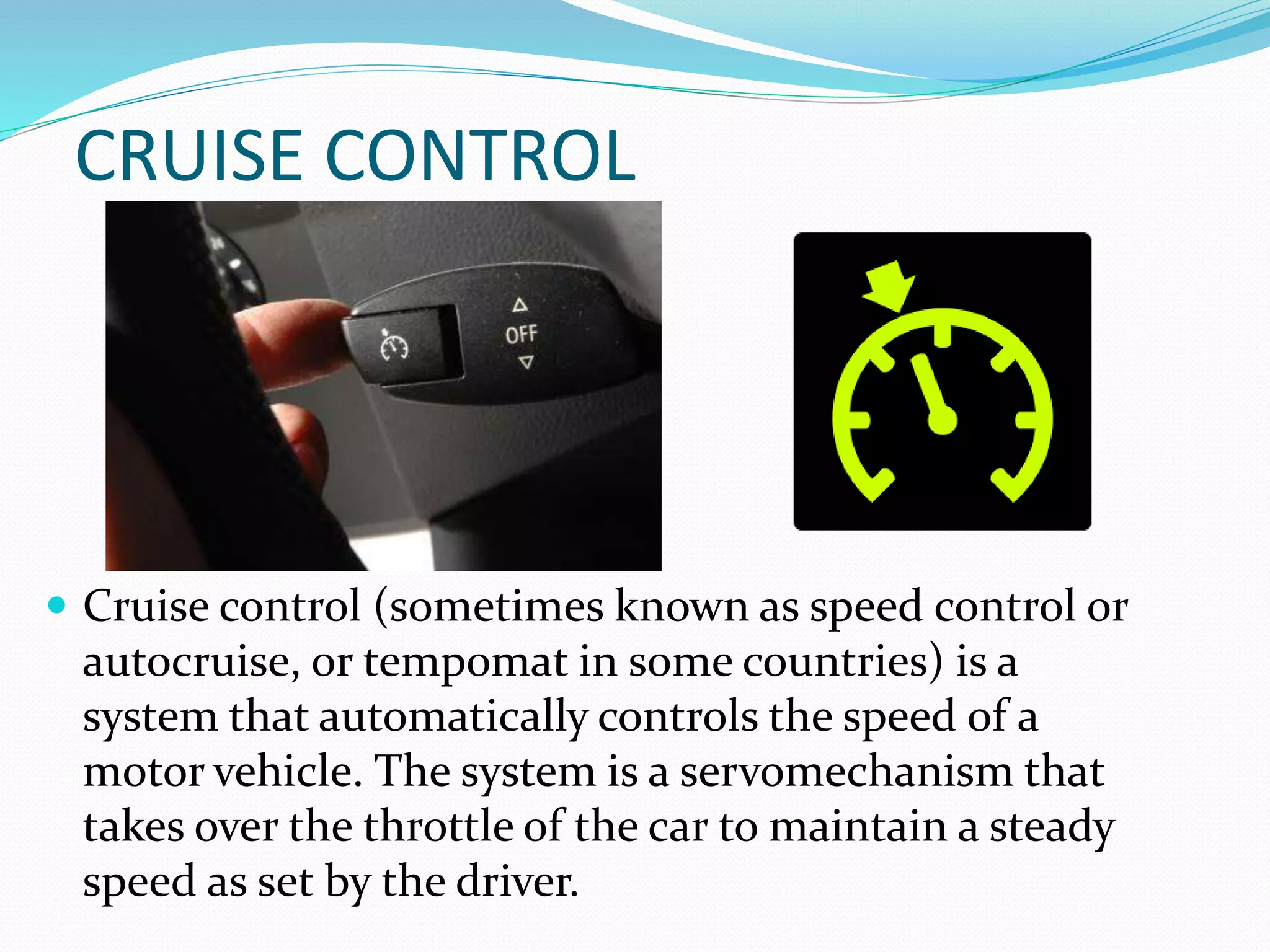
 Cruise control (sometimes known as speed control or
autocruise, or tempomat in some countries) is a
system that automatically controls the speed of a
motor vehicle. The system is a servomechanism that
takes over the throttle of the car to maintain a steady
speed as set by the driver.
THANK YOU

Automobile safety system

  • 1.
  • 2.
    CONTENTS 1)INTRODUCTION 2) TYPES OFSAFETY SYSTEMS  AIR BAGS  SEAT BELT  ANTI LOCK BRACKING SYSTEM  COLLISION WARNING SYSTEM  BLIND SPOT DETECTOR  ELECTRONIC STABILITY CONTROL  CRUISE CONTROL  VECHILE BLIND SPOT
  • 3.
    INTRODUCTION  WHAT?  WHY? WHEN?  WHAT IS AUTOMOBILE SAFETY SYSTEM?  WHY IT IS SO MUCH IMPORTANT OR WHY SHOULD WE ADOPT IT?  WHEN IT WAS FIRST STARTED TO ENHANCE SAFETY SYSTEM?
  • 4.
     Automobile safetyis the study and practice of design, construction, equipment and regulation to minimize the occurrence and consequences of traffic collisions. Road traffic safety more broadly includes roadway design.  However, automobile accidents have still been the leading cause of injuries and death in most countries. Car safety also pertains to necessary car safety features. This is incorporated in our car to protect us and other passengers from injury and death during a collision or crash.  One of the first formal academic studies into improving vehicle safety was by Cornell Aeronautical Laboratory of Buffalo, New York. The main conclusion of their extensive report is the crucial importance of seat belts and padded dashboards
  • 5.
    AIRBAGS  The airbagspecified for automobile use traces its origins to air-filled bladders as early as 1941.  Airbag is the safety system that is used in automobile for the purpose to provide the occupants a soft cushioning and restraint during a crash event to prevent any impact or impact-caused injuries between the flailing occupant and the interior of the vehicle.  The airbag provides an energy absorbing surface between the vehicle's occupant and a steering wheel, instrumental panel
  • 6.
    SEAT BELTS  Seatbelts is a basic safety tool that is used for the safety purpose of passenger inside the car or vehicle.  A seat belt functions to reduce the likelihood of death or serious injury in a traffic collision by reducing the force of secondary impacts.  Seat belts were invented by English engineer George Clayey in the mid-19th century , though Edward J. Claghorn of New York, was granted the first patent on February 10, 1885 for a safety belt
  • 7.
    ABS:- ANTI LOCKBRAKING SYSTEM  An anti-lock braking system or anti-skid braking system (ABS) is an automobile safety system that allows the wheels on a motor vehicle to maintain tractivecontact with the road surface according to driver inputs while braking.  This prevent the wheels from locking up (ceasing rotation) and avoiding uncontrolled skidding
  • 8.
    MAIN COMPONENTS OFABS  Speed sensors  Valves  pump  Controller
  • 10.
    COLLISION WARNING SYSTEM A surround radar or sometimes laser (lidar) sensor in the vehicle recognize the danger of the vehicle.  Based on the distance to the obstacle ahead and speed.  Provide maximized braking support by boosting the brake pressure.
  • 11.
    BLIND SPOT DETECTOR The blind spot monitor is a vehiclebased sensordevice that detects other vehicles located to the driver’s side and rear. Warnings can be visual, audible, vibrating, or tactile.  Good driver visibility is essential for safe road traffic.  It is currently implemented in all new upcoming bikes
  • 12.
    ELECTRONIC STABILITY CONTROL ESC integrates Anti lock braking system and Traction control system. (TCS)  A function that prevent skidding.  If the vehicle moves in a different direction under steering or over steering_ ESC detects the situation and reacts accordingly.
  • 13.
    CRUISE CONTROL  Cruisecontrol (sometimes known as speed control or autocruise, or tempomat in some countries) is a system that automatically controls the speed of a motor vehicle. The system is a servomechanism that takes over the throttle of the car to maintain a steady speed as set by the driver.
  • 14.