Autonomous Vehicles
Computer Architecture
Presented to: Dr. Assad Ali Safi Presented By: Rabiya Khalid
Autonomous vehicles
Definition
 Vehicle that get from one point to another
point without human interaction.
 Autonomous vehicles are also called
driverless cars, robotic cars or self-driving
cars.[1]
 Autonomous Vehicles are capable of
fulfilling main transportation capabilities of a
traditional car.
 Driverless cars move from one place to
another place without drivers.
 These cars plays an important role in
reduction of car accidents[2].
 These cars eliminate the human errors[2].
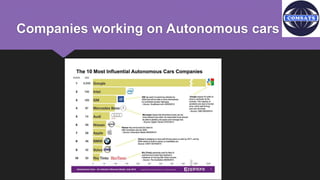
Companies Working on Autonomous Vehicles:
 Top 5 Companies working on autonomous cars are [3]
 Google
 Intel
 General Motors
 Mercedes Benz
 Audi
 Toyota, Nissan and Honda (big three of Japan) will join together to work on autonomous vehicles[4]
Companies Working on Autonomous Vehicles:
 Top 5 Companies working on autonomous cars are [3]
 Google
 Intel
 General Motors
 Mercedes Benz
 Audi
 Toyota, Nissan and Honda (big three of Japan) will join together to work on autonomous vehicles[4]
Companies Working on Autonomous Vehicles:
 Top 5 Companies working on autonomous cars are [3]
 Google
 Intel
 General Motors
 Mercedes Benz
 Audi
 Toyota, Nissan and Honda (big three of Japan) will join together to work on autonomous vehicles[4]
Companies Working on Autonomous Vehicles:
 Top 5 Companies working on autonomous cars are [3]
 Google
 Intel
 General Motors
 Mercedes Benz
 Audi
 Toyota, Nissan and Honda (big three of Japan) will join together to work on autonomous vehicles[4]
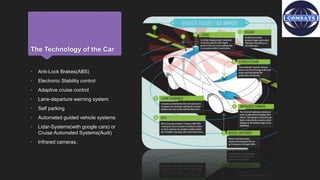
The Technology of the Car
• Anti-Lock Brakes(ABS)
• Electronic Stability control
• Adaptive cruise control
• Lane-departure warning system
• Self parking
• Automated guided vehicle systems
• Lidar-Systems(with google cars) or
Cruise Automated Systems(Audi)
• Infrared cameras.
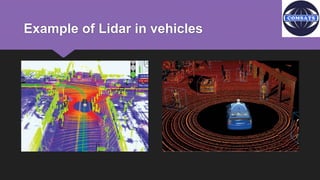
The Lidar System
 Lidar is used to detect obstacles
 Detects obstacles through light and determines
where the vehicle is in relation to those obstacles
 Singapore's Singapore-MIT Alliance for Research
and Technology (SMART) is actively developing
technologies for autonomous Lidar vehicles[5].
 companies that produce lidar sensors commonly
used in robotics or vehicle automation are
Sick[5]and Hokuyo[7].
Example of Lidar in vehicles
Adoptive Cruise
Control Systems
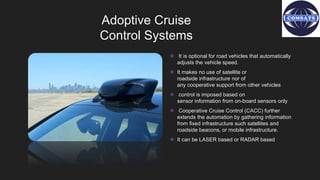
 It is optional for road vehicles that automatically
adjusts the vehicle speed.
 It makes no use of satellite or
roadside infrastructure nor of
any cooperative support from other vehicles
 control is imposed based on
sensor information from on-board sensors only
 Cooperative Cruise Control (CACC) further
extends the automation by gathering information
from fixed infrastructure such satellites and
roadside beacons, or mobile infrastructure.
 It can be LASER based or RADAR based
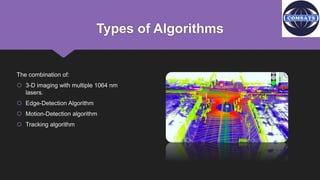
Types of Algorithms
The combination of:
 3-D imaging with multiple 1064 nm
lasers.
 Edge-Detection Algorithm
 Motion-Detection algorithm
 Tracking algorithm
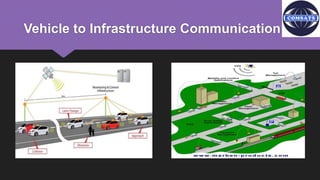
Vehicle to Infrastructure Communication
 Vehicle-to-Infrastructure (V2I) Communications for Safety is the wireless exchange of critical safety
and operational data between vehicles and roadway infrastructure.
 The vision for V2I research is to enable safety applications designed to avoid or mitigate vehicle
crashes, particularly for crash scenarios not addressed by V2V communications alone
 It is based on widespread deployment of a dedicated short-range communications link,
incorporating IEEE 802.11
Vehicle to Infrastructure Communication
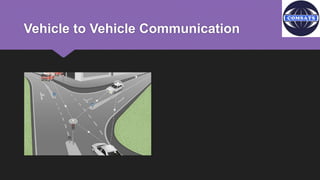
Vehicle to vehicle Communication
 V2V is an automobile technology designed to allow automobiles to "talk" to each other.
 V2V is also known as VANETs. It is a variation of MANETs .
 In V2V vehicles share information related to their speed, direction maneuvers.
 It helps to reduce the road crashes by getting the information of the surrounding.
 The information can be exchanged using DSRC and GPS.
Vehicle to Vehicle Communication
Current Adoption of the Technology
 Google, as mentioned previously
 Cruise Automation
 Tesla Model D announced in 2014
 Car will be able to autonomously pick owners up (on private property)
 Cadillac Super Cruise announced in 2014 for 2017 models
 Hands-free driving in certain conditions
 Vehicle to vehicle communication
 Ford Traffic Jam Assist announced in 2012 gives similar features
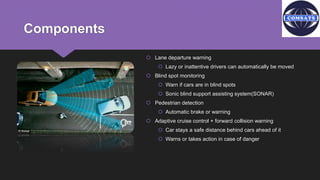
Components
 Lane departure warning
 Lazy or inattentive drivers can automatically be moved
 Blind spot monitoring
 Warn if cars are in blind spots
 Sonic blind support assisting system(SONAR)
 Pedestrian detection
 Automatic brake or warning
 Adaptive cruise control + forward collision warning
 Car stays a safe distance behind cars ahead of it
 Warns or takes action in case of danger
Companies working on Autonomous cars
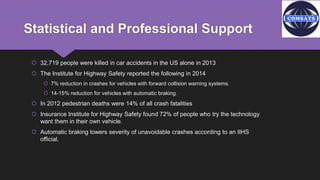
Statistical and Professional Support
 32,719 people were killed in car accidents in the US alone in 2013
 The Institute for Highway Safety reported the following in 2014
 7% reduction in crashes for vehicles with forward collision warning systems.
 14-15% reduction for vehicles with automatic braking.
 In 2012 pedestrian deaths were 14% of all crash fatalities
 Insurance Institute for Highway Safety found 72% of people who try the technology
want them in their own vehicle.
 Automatic braking lowers severity of unavoidable crashes according to an IIHS
official.
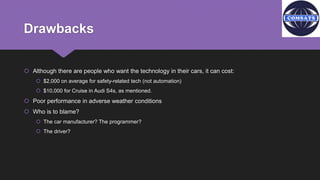
Drawbacks
 Although there are people who want the technology in their cars, it can cost:
 $2,000 on average for safety-related tech (not automation)
 $10,000 for Cruise in Audi S4s, as mentioned.
 Poor performance in adverse weather conditions
 Who is to blame?
 The car manufacturer? The programmer?
 The driver?
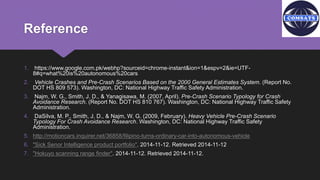
Reference
1. https://www.google.com.pk/webhp?sourceid=chrome-instant&ion=1&espv=2&ie=UTF-
8#q=what%20is%20autonomous%20cars
2. Vehicle Crashes and Pre-Crash Scenarios Based on the 2000 General Estimates System. (Report No.
DOT HS 809 573). Washington, DC: National Highway Traffic Safety Administration.
3. Najm, W. G., Smith, J. D., & Yanagisawa, M. (2007, April). Pre-Crash Scenario Typology for Crash
Avoidance Research. (Report No. DOT HS 810 767). Washington, DC: National Highway Traffic Safety
Administration.
4. DaSilva, M. P., Smith, J. D., & Najm, W. G. (2009, February). Heavy Vehicle Pre-Crash Scenario
Typology For Crash Avoidance Research. Washington, DC: National Highway Traffic Safety
Administration.
5. http://motioncars.inquirer.net/36858/filipino-turns-ordinary-car-into-autonomous-vehicle
6. "Sick Senor Intelligence product portfolio". 2014-11-12. Retrieved 2014-11-12
7. "Hokuyo scanning range finder". 2014-11-12. Retrieved 2014-11-12.

Autonomous vehicles

  • 1.
    Autonomous Vehicles Computer Architecture Presentedto: Dr. Assad Ali Safi Presented By: Rabiya Khalid
  • 2.
    Autonomous vehicles Definition  Vehiclethat get from one point to another point without human interaction.  Autonomous vehicles are also called driverless cars, robotic cars or self-driving cars.[1]  Autonomous Vehicles are capable of fulfilling main transportation capabilities of a traditional car.  Driverless cars move from one place to another place without drivers.  These cars plays an important role in reduction of car accidents[2].  These cars eliminate the human errors[2].
  • 3.
    Companies Working onAutonomous Vehicles:  Top 5 Companies working on autonomous cars are [3]  Google  Intel  General Motors  Mercedes Benz  Audi  Toyota, Nissan and Honda (big three of Japan) will join together to work on autonomous vehicles[4]
  • 4.
    Companies Working onAutonomous Vehicles:  Top 5 Companies working on autonomous cars are [3]  Google  Intel  General Motors  Mercedes Benz  Audi  Toyota, Nissan and Honda (big three of Japan) will join together to work on autonomous vehicles[4]
  • 5.
    Companies Working onAutonomous Vehicles:  Top 5 Companies working on autonomous cars are [3]  Google  Intel  General Motors  Mercedes Benz  Audi  Toyota, Nissan and Honda (big three of Japan) will join together to work on autonomous vehicles[4]
  • 6.
    Companies Working onAutonomous Vehicles:  Top 5 Companies working on autonomous cars are [3]  Google  Intel  General Motors  Mercedes Benz  Audi  Toyota, Nissan and Honda (big three of Japan) will join together to work on autonomous vehicles[4]
  • 7.
    The Technology ofthe Car • Anti-Lock Brakes(ABS) • Electronic Stability control • Adaptive cruise control • Lane-departure warning system • Self parking • Automated guided vehicle systems • Lidar-Systems(with google cars) or Cruise Automated Systems(Audi) • Infrared cameras.
  • 8.
    The Lidar System Lidar is used to detect obstacles  Detects obstacles through light and determines where the vehicle is in relation to those obstacles  Singapore's Singapore-MIT Alliance for Research and Technology (SMART) is actively developing technologies for autonomous Lidar vehicles[5].  companies that produce lidar sensors commonly used in robotics or vehicle automation are Sick[5]and Hokuyo[7].
  • 9.
    Example of Lidarin vehicles
  • 10.
    Adoptive Cruise Control Systems It is optional for road vehicles that automatically adjusts the vehicle speed.  It makes no use of satellite or roadside infrastructure nor of any cooperative support from other vehicles  control is imposed based on sensor information from on-board sensors only  Cooperative Cruise Control (CACC) further extends the automation by gathering information from fixed infrastructure such satellites and roadside beacons, or mobile infrastructure.  It can be LASER based or RADAR based
  • 11.
    Types of Algorithms Thecombination of:  3-D imaging with multiple 1064 nm lasers.  Edge-Detection Algorithm  Motion-Detection algorithm  Tracking algorithm
  • 12.
    Vehicle to InfrastructureCommunication  Vehicle-to-Infrastructure (V2I) Communications for Safety is the wireless exchange of critical safety and operational data between vehicles and roadway infrastructure.  The vision for V2I research is to enable safety applications designed to avoid or mitigate vehicle crashes, particularly for crash scenarios not addressed by V2V communications alone  It is based on widespread deployment of a dedicated short-range communications link, incorporating IEEE 802.11
  • 13.
  • 14.
    Vehicle to vehicleCommunication  V2V is an automobile technology designed to allow automobiles to "talk" to each other.  V2V is also known as VANETs. It is a variation of MANETs .  In V2V vehicles share information related to their speed, direction maneuvers.  It helps to reduce the road crashes by getting the information of the surrounding.  The information can be exchanged using DSRC and GPS.
  • 15.
    Vehicle to VehicleCommunication
  • 16.
    Current Adoption ofthe Technology  Google, as mentioned previously  Cruise Automation  Tesla Model D announced in 2014  Car will be able to autonomously pick owners up (on private property)  Cadillac Super Cruise announced in 2014 for 2017 models  Hands-free driving in certain conditions  Vehicle to vehicle communication  Ford Traffic Jam Assist announced in 2012 gives similar features
  • 17.
    Components  Lane departurewarning  Lazy or inattentive drivers can automatically be moved  Blind spot monitoring  Warn if cars are in blind spots  Sonic blind support assisting system(SONAR)  Pedestrian detection  Automatic brake or warning  Adaptive cruise control + forward collision warning  Car stays a safe distance behind cars ahead of it  Warns or takes action in case of danger
  • 18.
    Companies working onAutonomous cars
  • 19.
    Statistical and ProfessionalSupport  32,719 people were killed in car accidents in the US alone in 2013  The Institute for Highway Safety reported the following in 2014  7% reduction in crashes for vehicles with forward collision warning systems.  14-15% reduction for vehicles with automatic braking.  In 2012 pedestrian deaths were 14% of all crash fatalities  Insurance Institute for Highway Safety found 72% of people who try the technology want them in their own vehicle.  Automatic braking lowers severity of unavoidable crashes according to an IIHS official.
  • 20.
    Drawbacks  Although thereare people who want the technology in their cars, it can cost:  $2,000 on average for safety-related tech (not automation)  $10,000 for Cruise in Audi S4s, as mentioned.  Poor performance in adverse weather conditions  Who is to blame?  The car manufacturer? The programmer?  The driver?
  • 21.
    Reference 1. https://www.google.com.pk/webhp?sourceid=chrome-instant&ion=1&espv=2&ie=UTF- 8#q=what%20is%20autonomous%20cars 2. VehicleCrashes and Pre-Crash Scenarios Based on the 2000 General Estimates System. (Report No. DOT HS 809 573). Washington, DC: National Highway Traffic Safety Administration. 3. Najm, W. G., Smith, J. D., & Yanagisawa, M. (2007, April). Pre-Crash Scenario Typology for Crash Avoidance Research. (Report No. DOT HS 810 767). Washington, DC: National Highway Traffic Safety Administration. 4. DaSilva, M. P., Smith, J. D., & Najm, W. G. (2009, February). Heavy Vehicle Pre-Crash Scenario Typology For Crash Avoidance Research. Washington, DC: National Highway Traffic Safety Administration. 5. http://motioncars.inquirer.net/36858/filipino-turns-ordinary-car-into-autonomous-vehicle 6. "Sick Senor Intelligence product portfolio". 2014-11-12. Retrieved 2014-11-12 7. "Hokuyo scanning range finder". 2014-11-12. Retrieved 2014-11-12.