Disorder of Conjunctiva
Nabina Paneru
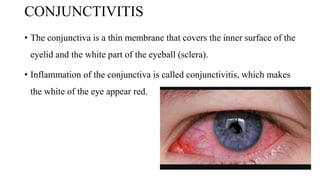
CONJUNCTIVITIS
โ€ข The conjunctiva is a thin membrane that covers the inner surface of the
eyelid and the white part of the eyeball (sclera).
โ€ข Inflammation of the conjunctiva is called conjunctivitis, which makes
the white of the eye appear red.
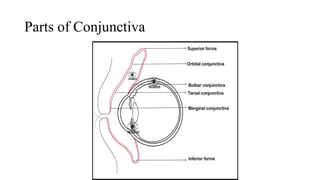
Parts of Conjunctiva
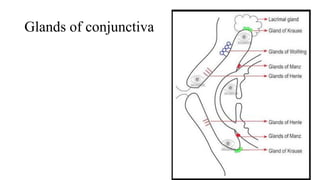
Glands of conjunctiva
Types of Conjunctivitis
1. Infective Conjunctivitis:
๏ƒผBacterial conjunctivitis
๏ƒผChlamydial conjunctivitis
๏ƒผViral conjunctivitis
๏ƒผOphthalmia neonatrum
๏ƒผ Granulomatous conjunctivitis
Contd.
2. Allergic conjunctivitis
๏ƒผSimplex conjunctivitis
๏ƒผVernal conjunctivitis
๏ƒผAtopic conjunctivitis (atopy: higher number of antibodies produced by
body in response to antigens)
๏ƒผContact dermoconjunctivitis
Contd.
3. Cicatricial conjunctivitis
๏ƒผ Toxic epidermal necrolysis
๏ƒผStevens Johnson syndrome (rare, serious disorder of your skin and
mucous membranes)
๏ƒผSecondary cicatricial conjunctivitis
Contd.
4. Toxic conjunctivitis
Bacterial Conjunctivitis
โ€ข Inflammation of the conjunctiva caused by bacterial ( staphylococcus
aureus, Chlamydia trachomatis, Moraxella, Corynebacterium
diphtheriae etc.) infection.
๏ƒผ Can be sporadic and epidemic.
Predisposing factors
โ€ข Flies
โ€ข Hot dry climate
โ€ข Poor Sanitation
โ€ข Poor hygienic conditions
โ€ข Dirty habits
๏ถSymptoms
๏ƒผForeign body sensation.
๏ƒผMucopurulent discharge
๏ƒผSticking of lid during sleep/ more in the morning
๏ƒผColour halos
๏ƒผPhotophobia
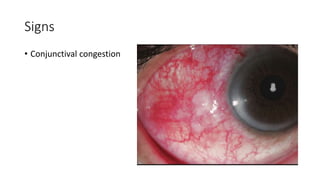
Signs
โ€ข Conjunctival congestion
Contd.
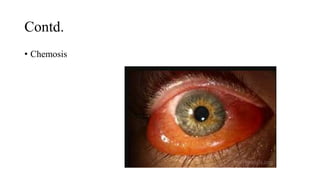
โ€ข Chemosis
Contd.
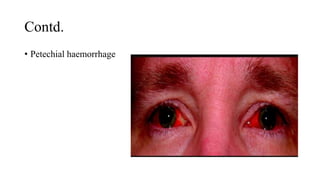
โ€ข Petechial haemorrhage
Contd.
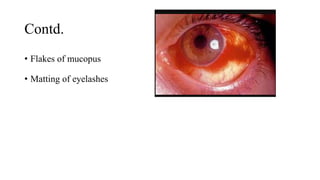
โ€ข Flakes of mucopus
โ€ข Matting of eyelashes
๏ถManagement :
๏ƒผTopical antibiotics
๏ƒผEye drops TID/QID & eye ointment HS
โ€ข Chloramphenical 1%
โ€ข Sulphacetamide 20%
โ€ข Ciprofloxacin 0.3%
โ€ข Tetracycline 1%
Contd.
๏ƒผIrrigation of conjunctival sac with sterile water/saline OD/ BD.
๏ƒผTo prevent photophobia wear dark goggles.
๏ƒผNo steroid
๏ƒผAntiinflammatory and analgesic drugs.
๏ƒผMaintain personal hygiene.
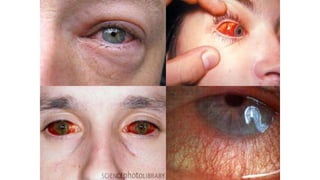
2. Viral conjunctivitis:
๏ƒผInflammation of conjunctiva caused by viral infection which tends to
affect epithelium of both of the conjunctiva and cornea.
๏ถCausative organism:
๏ƒผAdenovirus
๏ƒผHerpes simplex
๏ƒผHerpes zoster
๏ƒผPicorna virus
โ€ข S/S:
๏ƒผAcute onset of red eye
๏ƒผIntense watering
๏ƒผDiscomfort & irritation
๏ƒผForeign body sensation
๏ƒผFollicles
๏ƒผConjunctival congestion
๏ƒผChemosis
๏ƒผEnlargment of pre auricular lymph node.
โ€ข Management:
๏ƒผUsually self limiting
๏ƒผAntibiotic to prevent secondary infection
๏ƒผPrevent spread to others.
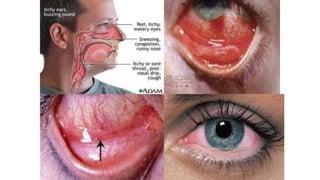
3. Allergic conjunctivitis:
๏ƒผDue to allergen or hypersensitivity mostly sunlight, dust
& smoke.
๏ถClinical feature:
๏ƒผIntense itching and burning sensation
๏ƒผHyperaemia and chemosis
๏ƒผForeign body sensation
๏ƒผPhotophobia
๏ƒผConjunctival congestion
๏ƒผMuddy sclera
๏ถTreatment :
๏ƒผElimination of allergens if possible.
๏ƒผSodium chromoglycate drop 5-4 times a day.
๏ƒผSystemic antihistamine.
๏ƒผTopical steriod (flourmetholone eyedrop 2-3 hrly for 7-14 days.
๏ƒผDark goggles to prevent photophobia.
๏ƒผCold compress & ice pack.
๏ƒผResolve after teenage
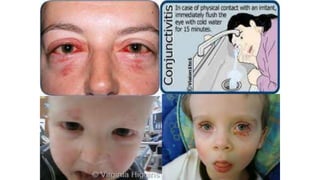
4. Chemical:
๏ƒผChemical eye injury is due to either an acidic or alkali substance getting
in the eye.
๏ƒผAlkalis are typically worse than acidic burns.
๏ƒผSevere burns may cause the cornea to turn white.
๏ƒผLarge volumes of irrigation (Ringer's lactate or saline solution) is the
treatment of choice and should continue until the pH is 6โ€”8.
๏ƒผLocal anaesthetic eye drops can be used to decrease the pain.
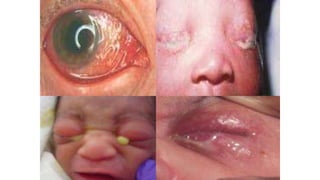
5. Opthalmia neonatrum:
๏ƒผIs an acute purulent inflammation of the conjunctiva occuring in neonatal period
(within 4 wks of the birth).
๏ถCausative agent:
๏ƒผChemical conjunctivitis,
๏ƒผGonococcal infection,
๏ƒผChlamydia,
๏ƒผHerpes simplex
๏ถS/S:
๏ƒผPain & tenderness
๏ƒผMucopurulent discharge
๏ƒผSwollen lids
๏ƒผConjunctival hyperaemia & chemosis
๏ƒผCorneal opacification, ulceration & staphyloma are the complication.
๏ถManagement:
i. Prophylaxis:
a. Prophylaxis antenatal:
๏ƒผ Care of mother/ ANC
๏ƒผ Treatment of genital infection
b. Natal period
๏ƒผ Delivery to be conducted under strict aseptic technique.
๏ƒผ New baby eye should be thoroughly cleaned and dried.
c. Postnatal period use of :
๏ƒผTetracycline ointment 1% or
๏ƒผErythromycin ointment 0.5% or
๏ƒผSilver nitrate 1% solution
Contd.
ii. Curative:
๏ƒผIrrigation of conjunctiva with sterile saline.
๏ƒผTopical antibiotic eye drop/ ointment.
๏ƒผSystemic therapy.
๏ƒผSteroid use is contraindicated.
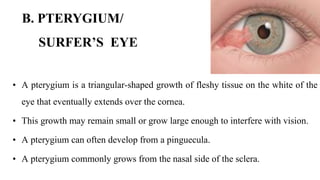
B. PTERYGIUM/
SURFERโ€™S EYE
โ€ข A pterygium is a triangular-shaped growth of fleshy tissue on the white of the
eye that eventually extends over the cornea.
โ€ข This growth may remain small or grow large enough to interfere with vision.
โ€ข A pterygium can often develop from a pinguecula.
โ€ข A pterygium commonly grows from the nasal side of the sclera.
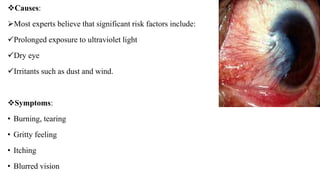
๏ถCauses:
๏ƒ˜Most experts believe that significant risk factors include:
๏ƒผProlonged exposure to ultraviolet light
๏ƒผDry eye
๏ƒผIrritants such as dust and wind.
๏ถSymptoms:
โ€ข Burning, tearing
โ€ข Gritty feeling
โ€ข Itching
โ€ข Blurred vision
๏ถTreatment:
โ€ข Mild symptoms :doesn't require treatment.
โ€ข If a temporary worsening of the inflamed condition causes
redness or irritation, it can be treated with:
๏ƒผLubricating eyedrops or ointments, such as Blink or Refresh
drops.
๏ƒผOccasional use of vasoconstrictor eyedrops.
Contd.
๏ƒผShort course of steroid eyedrops.
โ€ข If lesion cause persistent discomfort or vision interference, surgical
treatment is required.
โ€ข In this procedure, the pterygium is removed and the own client
conjunctiva or amniotic membrane is glued or stitched onto the
affected area.
C. PINGUECULA
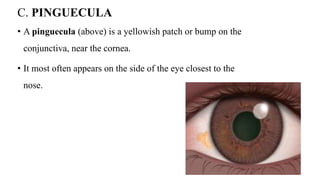
โ€ข A pinguecula (above) is a yellowish patch or bump on the
conjunctiva, near the cornea.
โ€ข It most often appears on the side of the eye closest to the
nose.
๏ถS/S:
๏ƒผTriangular fold of red fleshy growth.
๏ƒผForeign body sensation,
๏ƒผPingueculae become swollen and inflamed.
๏ƒผIrritation
๏ƒผRed eye
๏ถManagement:
๏ƒผSurgical excision and graft.

Conjunctivitis, pterygium, pinguecula

  • 1.
  • 2.
    CONJUNCTIVITIS โ€ข The conjunctivais a thin membrane that covers the inner surface of the eyelid and the white part of the eyeball (sclera). โ€ข Inflammation of the conjunctiva is called conjunctivitis, which makes the white of the eye appear red.
  • 3.
  • 4.
  • 5.
    Types of Conjunctivitis 1.Infective Conjunctivitis: ๏ƒผBacterial conjunctivitis ๏ƒผChlamydial conjunctivitis ๏ƒผViral conjunctivitis ๏ƒผOphthalmia neonatrum ๏ƒผ Granulomatous conjunctivitis
  • 6.
    Contd. 2. Allergic conjunctivitis ๏ƒผSimplexconjunctivitis ๏ƒผVernal conjunctivitis ๏ƒผAtopic conjunctivitis (atopy: higher number of antibodies produced by body in response to antigens) ๏ƒผContact dermoconjunctivitis
  • 7.
    Contd. 3. Cicatricial conjunctivitis ๏ƒผToxic epidermal necrolysis ๏ƒผStevens Johnson syndrome (rare, serious disorder of your skin and mucous membranes) ๏ƒผSecondary cicatricial conjunctivitis
  • 8.
  • 9.
    Bacterial Conjunctivitis โ€ข Inflammationof the conjunctiva caused by bacterial ( staphylococcus aureus, Chlamydia trachomatis, Moraxella, Corynebacterium diphtheriae etc.) infection. ๏ƒผ Can be sporadic and epidemic.
  • 10.
    Predisposing factors โ€ข Flies โ€ขHot dry climate โ€ข Poor Sanitation โ€ข Poor hygienic conditions โ€ข Dirty habits
  • 11.
    ๏ถSymptoms ๏ƒผForeign body sensation. ๏ƒผMucopurulentdischarge ๏ƒผSticking of lid during sleep/ more in the morning ๏ƒผColour halos ๏ƒผPhotophobia
  • 12.
  • 13.
  • 14.
  • 15.
    Contd. โ€ข Flakes ofmucopus โ€ข Matting of eyelashes
  • 16.
    ๏ถManagement : ๏ƒผTopical antibiotics ๏ƒผEyedrops TID/QID & eye ointment HS โ€ข Chloramphenical 1% โ€ข Sulphacetamide 20% โ€ข Ciprofloxacin 0.3% โ€ข Tetracycline 1%
  • 17.
    Contd. ๏ƒผIrrigation of conjunctivalsac with sterile water/saline OD/ BD. ๏ƒผTo prevent photophobia wear dark goggles. ๏ƒผNo steroid ๏ƒผAntiinflammatory and analgesic drugs. ๏ƒผMaintain personal hygiene.
  • 18.
    2. Viral conjunctivitis: ๏ƒผInflammationof conjunctiva caused by viral infection which tends to affect epithelium of both of the conjunctiva and cornea. ๏ถCausative organism: ๏ƒผAdenovirus ๏ƒผHerpes simplex ๏ƒผHerpes zoster ๏ƒผPicorna virus
  • 20.
    โ€ข S/S: ๏ƒผAcute onsetof red eye ๏ƒผIntense watering ๏ƒผDiscomfort & irritation ๏ƒผForeign body sensation ๏ƒผFollicles ๏ƒผConjunctival congestion ๏ƒผChemosis ๏ƒผEnlargment of pre auricular lymph node.
  • 21.
    โ€ข Management: ๏ƒผUsually selflimiting ๏ƒผAntibiotic to prevent secondary infection ๏ƒผPrevent spread to others.
  • 22.
    3. Allergic conjunctivitis: ๏ƒผDueto allergen or hypersensitivity mostly sunlight, dust & smoke.
  • 23.
    ๏ถClinical feature: ๏ƒผIntense itchingand burning sensation ๏ƒผHyperaemia and chemosis ๏ƒผForeign body sensation ๏ƒผPhotophobia ๏ƒผConjunctival congestion ๏ƒผMuddy sclera
  • 25.
    ๏ถTreatment : ๏ƒผElimination ofallergens if possible. ๏ƒผSodium chromoglycate drop 5-4 times a day. ๏ƒผSystemic antihistamine. ๏ƒผTopical steriod (flourmetholone eyedrop 2-3 hrly for 7-14 days. ๏ƒผDark goggles to prevent photophobia. ๏ƒผCold compress & ice pack. ๏ƒผResolve after teenage
  • 26.
    4. Chemical: ๏ƒผChemical eyeinjury is due to either an acidic or alkali substance getting in the eye. ๏ƒผAlkalis are typically worse than acidic burns. ๏ƒผSevere burns may cause the cornea to turn white. ๏ƒผLarge volumes of irrigation (Ringer's lactate or saline solution) is the treatment of choice and should continue until the pH is 6โ€”8. ๏ƒผLocal anaesthetic eye drops can be used to decrease the pain.
  • 28.
    5. Opthalmia neonatrum: ๏ƒผIsan acute purulent inflammation of the conjunctiva occuring in neonatal period (within 4 wks of the birth). ๏ถCausative agent: ๏ƒผChemical conjunctivitis, ๏ƒผGonococcal infection, ๏ƒผChlamydia, ๏ƒผHerpes simplex
  • 30.
    ๏ถS/S: ๏ƒผPain & tenderness ๏ƒผMucopurulentdischarge ๏ƒผSwollen lids ๏ƒผConjunctival hyperaemia & chemosis ๏ƒผCorneal opacification, ulceration & staphyloma are the complication. ๏ถManagement: i. Prophylaxis: a. Prophylaxis antenatal: ๏ƒผ Care of mother/ ANC ๏ƒผ Treatment of genital infection
  • 31.
    b. Natal period ๏ƒผDelivery to be conducted under strict aseptic technique. ๏ƒผ New baby eye should be thoroughly cleaned and dried. c. Postnatal period use of : ๏ƒผTetracycline ointment 1% or ๏ƒผErythromycin ointment 0.5% or ๏ƒผSilver nitrate 1% solution
  • 32.
    Contd. ii. Curative: ๏ƒผIrrigation ofconjunctiva with sterile saline. ๏ƒผTopical antibiotic eye drop/ ointment. ๏ƒผSystemic therapy. ๏ƒผSteroid use is contraindicated.
  • 33.
    B. PTERYGIUM/ SURFERโ€™S EYE โ€ขA pterygium is a triangular-shaped growth of fleshy tissue on the white of the eye that eventually extends over the cornea. โ€ข This growth may remain small or grow large enough to interfere with vision. โ€ข A pterygium can often develop from a pinguecula. โ€ข A pterygium commonly grows from the nasal side of the sclera.
  • 34.
    ๏ถCauses: ๏ƒ˜Most experts believethat significant risk factors include: ๏ƒผProlonged exposure to ultraviolet light ๏ƒผDry eye ๏ƒผIrritants such as dust and wind. ๏ถSymptoms: โ€ข Burning, tearing โ€ข Gritty feeling โ€ข Itching โ€ข Blurred vision
  • 35.
    ๏ถTreatment: โ€ข Mild symptoms:doesn't require treatment. โ€ข If a temporary worsening of the inflamed condition causes redness or irritation, it can be treated with: ๏ƒผLubricating eyedrops or ointments, such as Blink or Refresh drops. ๏ƒผOccasional use of vasoconstrictor eyedrops.
  • 36.
    Contd. ๏ƒผShort course ofsteroid eyedrops. โ€ข If lesion cause persistent discomfort or vision interference, surgical treatment is required. โ€ข In this procedure, the pterygium is removed and the own client conjunctiva or amniotic membrane is glued or stitched onto the affected area.
  • 37.
    C. PINGUECULA โ€ข Apinguecula (above) is a yellowish patch or bump on the conjunctiva, near the cornea. โ€ข It most often appears on the side of the eye closest to the nose.
  • 38.
    ๏ถS/S: ๏ƒผTriangular fold ofred fleshy growth. ๏ƒผForeign body sensation, ๏ƒผPingueculae become swollen and inflamed. ๏ƒผIrritation ๏ƒผRed eye ๏ถManagement: ๏ƒผSurgical excision and graft.