Conjugate Acid - Base Pairs
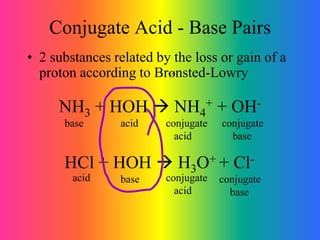
• 2 substances related by the loss or gain of a
proton according to BrØnsted-Lowry
NH3 + HOH  NH4
+ + OH-
base conjugate
acid
acid conjugate
base
HCl + HOH  H3O+ + Cl-
base conjugate
base
acid conjugate
acid
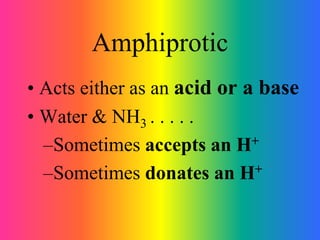
• Acts either as an acid or a base
• Water & NH3 . . . . .
–Sometimes accepts an H+
–Sometimes donates an H+
Amphiprotic
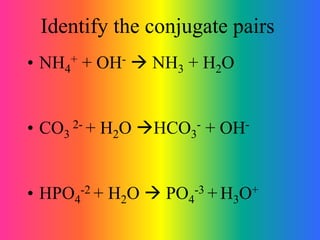
• NH4
+ + OH-  NH3 + H2O
• CO3
2- + H2O HCO3
- + OH-
• HPO4
-2 + H2O  PO4
-3 + H3O+
Identify the conjugate pairs
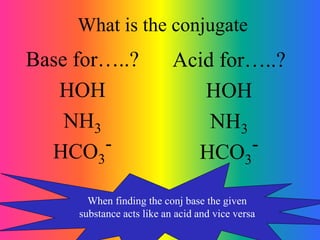
What is the conjugate
Base for…..?
HOH
NH3
HCO3
-
Acid for…..?
HOH
NH3
HCO3
-
When finding the conj base the given
substance acts like an acid and vice versa
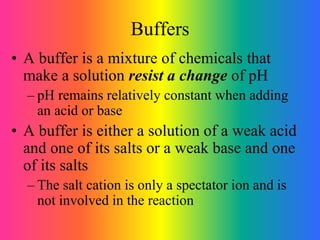
Buffers
• A buffer is a mixture of chemicals that
make a solution resist a change of pH
– pH remains relatively constant when adding
an acid or base
• A buffer is either a solution of a weak acid
and one of its salts or a weak base and one
of its salts
– The salt cation is only a spectator ion and is
not involved in the reaction
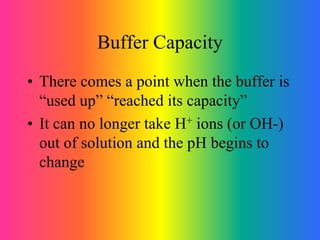
Buffer Capacity
• There comes a point when the buffer is
“used up” “reached its capacity”
• It can no longer take H+ ions (or OH-)
out of solution and the pH begins to
change
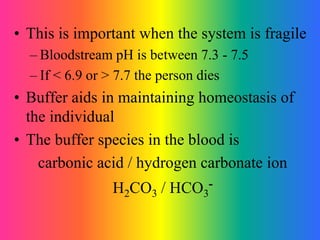
• This is important when the system is fragile
– Bloodstream pH is between 7.3 - 7.5
– If < 6.9 or > 7.7 the person dies
• Buffer aids in maintaining homeostasis of
the individual
• The buffer species in the blood is
carbonic acid / hydrogen carbonate ion
H2CO3 / HCO3
-
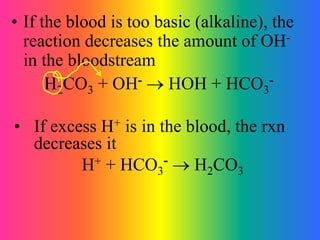
• If the blood is too basic (alkaline), the
reaction decreases the amount of OH-
in the bloodstream
H2CO3 + OH-  HOH + HCO3
-
• If excess H+ is in the blood, the rxn
decreases it
H+ + HCO3
-  H2CO3
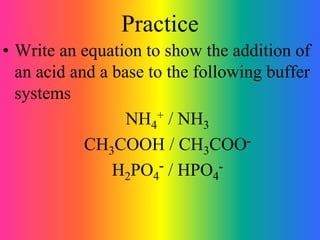
Practice
• Write an equation to show the addition of
an acid and a base to the following buffer
systems
NH4
+ / NH3
CH3COOH / CH3COO-
H2PO4
- / HPO4
-
THE END

Conjugate A B Pairs - Buffers.ppt

  • 1.
    Conjugate Acid -Base Pairs • 2 substances related by the loss or gain of a proton according to BrØnsted-Lowry NH3 + HOH  NH4 + + OH- base conjugate acid acid conjugate base HCl + HOH  H3O+ + Cl- base conjugate base acid conjugate acid
  • 2.
    • Acts eitheras an acid or a base • Water & NH3 . . . . . –Sometimes accepts an H+ –Sometimes donates an H+ Amphiprotic
  • 3.
    • NH4 + +OH-  NH3 + H2O • CO3 2- + H2O HCO3 - + OH- • HPO4 -2 + H2O  PO4 -3 + H3O+ Identify the conjugate pairs
  • 4.
    What is theconjugate Base for…..? HOH NH3 HCO3 - Acid for…..? HOH NH3 HCO3 - When finding the conj base the given substance acts like an acid and vice versa
  • 5.
    Buffers • A bufferis a mixture of chemicals that make a solution resist a change of pH – pH remains relatively constant when adding an acid or base • A buffer is either a solution of a weak acid and one of its salts or a weak base and one of its salts – The salt cation is only a spectator ion and is not involved in the reaction
  • 6.
    Buffer Capacity • Therecomes a point when the buffer is “used up” “reached its capacity” • It can no longer take H+ ions (or OH-) out of solution and the pH begins to change
  • 7.
    • This isimportant when the system is fragile – Bloodstream pH is between 7.3 - 7.5 – If < 6.9 or > 7.7 the person dies • Buffer aids in maintaining homeostasis of the individual • The buffer species in the blood is carbonic acid / hydrogen carbonate ion H2CO3 / HCO3 -
  • 8.
    • If theblood is too basic (alkaline), the reaction decreases the amount of OH- in the bloodstream H2CO3 + OH-  HOH + HCO3 - • If excess H+ is in the blood, the rxn decreases it H+ + HCO3 -  H2CO3
  • 9.
    Practice • Write anequation to show the addition of an acid and a base to the following buffer systems NH4 + / NH3 CH3COOH / CH3COO- H2PO4 - / HPO4 -
  • 10.