Vocabulary Workshop
Level G
Unit 1
Presentation
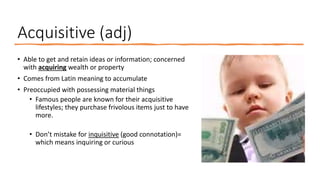
Acquisitive (adj)
• Able to get and retain ideas or information; concerned
with acquiring wealth or property
• Comes from Latin meaning to accumulate
• Preoccupied with possessing material things
• Famous people are known for their acquisitive
lifestyles; they purchase frivolous items just to have
more.
• Don’t mistake for inquisitive (good connotation)=
which means inquiring or curious
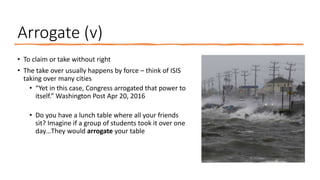
Arrogate (v)
• To claim or take without right
• The take over usually happens by force – think of ISIS
taking over many cities
• “Yet in this case, Congress arrogated that power to
itself.” Washington Post Apr 20, 2016
• Do you have a lunch table where all your friends
sit? Imagine if a group of students took it over one
day…They would arrogate your table
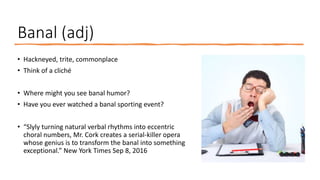
Banal (adj)
• Hackneyed, trite, commonplace
• Think of a cliché
• Where might you see banal humor?
• Have you ever watched a banal sporting event?
• “Slyly turning natural verbal rhythms into eccentric
choral numbers, Mr. Cork creates a serial-killer opera
whose genius is to transform the banal into something
exceptional.” New York Times Sep 8, 2016
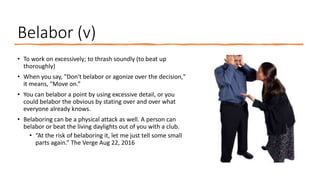
Belabor (v)
• To work on excessively; to thrash soundly (to beat up
thoroughly)
• When you say, "Don't belabor or agonize over the decision,"
it means, "Move on.”
• You can belabor a point by using excessive detail, or you
could belabor the obvious by stating over and over what
everyone already knows.
• Belaboring can be a physical attack as well. A person can
belabor or beat the living daylights out of you with a club.
• “At the risk of belaboring it, let me just tell some small
parts again.” The Verge Aug 22, 2016
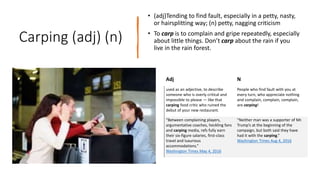
Carping (adj) (n)
• (adj)Tending to find fault, especially in a petty, nasty,
or hairsplitting way; (n) petty, nagging criticism
• To carp is to complain and gripe repeatedly, especially
about little things. Don’t carp about the rain if you
live in the rain forest.
Adj N
used as an adjective, to describe
someone who is overly critical and
impossible to please — like that
carping food critic who ruined the
debut of your new restaurant.
People who find fault with you at
every turn, who appreciate nothing
and complain, complain, complain,
are carping!
“Between complaining players,
argumentative coaches, heckling fans
and carping media, refs fully earn
their six-figure salaries, first-class
travel and luxurious
accommodations.”
Washington Times May 4, 2016
“Neither man was a supporter of Mr.
Trump’s at the beginning of the
campaign, but both said they have
had it with the carping.”
Washington Times Aug 4, 2016
Coherent (adj)
• Comprehensible, meaningful, clear & logical; holding or sticking together
Examples:
- a lawyer’s coherent argument in court will help to win a case
“In the video , in which Peres encourages the public to buy locally made products, he
appears weary but is otherwise alert and coherent.” Washington Post Sep 13, 2016
“Palestinians believe the settlements, scattered all over the West Bank, prevent a
geographically coherent state.” Los Angeles Times Sep 9, 2016
“The saga certainly points to the emptiness of art in our time, its complete lack of
coherent critical values.”
The Guardian Sep 5, 2016
Congeal (v)
[cuhn-jeel]
• To change from liquid to solid, thicken; to make inflexible
or rigid
• comes to us from the Old French word congeler, which
means "to freeze.
• Think of Jell-O! or my milk cups found under the couch –
gross!
Example:
“And our plans will become congealed laws whose errors
will only appear over time.” The New Yorker Sep 3, 2016
“Indeed, you can see the narrative congealing already.”
Salon Feb 17, 2016
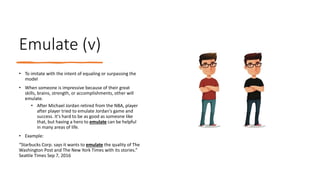
Emulate (v)
• To imitate with the intent of equaling or surpassing the
model
• When someone is impressive because of their great
skills, brains, strength, or accomplishments, other will
emulate.
• After Michael Jordan retired from the NBA, player
after player tried to emulate Jordan's game and
success. It's hard to be as good as someone like
that, but having a hero to emulate can be helpful
in many areas of life.
• Example:
“Starbucks Corp. says it wants to emulate the quality of The
Washington Post and The New York Times with its stories.”
Seattle Times Sep 7, 2016
Encomium (n) [en-CO-mium]
• A formal expression of praise, a lavish tribute
• a fancy word for a formal speech or piece of writing
that warmly praises someone or something.
• Encomium comes from the Greek word enkomion
which is to honor someone or something at a party in a
poetic speech.
• A eulogy will typically be considered an encomium
• Example
“Whether he fully deserved the encomiums showered on
him is another matter.” Washington Post Jan 23, 2015
Eschew (v) [es-
choo]
• To avoid, shun, keep away from
• If you live the bohemian life in the city, like Salinger did,
then most likely you eschew the suburbs.
• to eschew something isn’t simply to avoid it, the way you
would avoid walking in a puddle––it's stronger than that.
You eschew things that you find morally or aesthetically
wrong, or that you have chosen to find wrong.
Example:
“After graduation, he quit football, eschewed the
investment banking route favored by his friends and
headed for California to train to become an Olympic
athlete.” The Guardian Sep 1, 2016
Germane (adj)
[jer-meyn]
• Relevant, appropriate, fitting
• If you are giving a speech on dog training, stick to the
germane, canine stuff. Topics that would not be
germane? Catnip toys, hamster wheels, and the use of a
saddle.
• You might want to bring up all sorts of complaints during
an argument with your best friend, but she says the two
of you should only discuss issues that are germane to
the current fight.
“She and other school advocates say teachers typically balk
at getting political, thinking it’s not germane to teaching.”
Washington Times Aug 15, 2016
Insatiable (adj) [in-sey-shuh-buhl]
• So great or demanding as not to be satisfied
• After being lost in the woods eating only berries for a few days,
you'll find your hunger is insatiable once you finally get to the
table.
• Insatiable comes from the combination of the negative prefix,
in- and the Latin verb satiare, for fill.
• It can be used for spiritual as well as physical desires. Swift's
traveling Gulliver talks about his "insatiable desire of seeing
foreign countries.“
• Perhaps you have an insatiable desire to learn all the words in
the English language.
• “China’s own economy was growing so fast its demand for
aluminum was nearly insatiable.” Seattle Times Sep 13, 2016
Intransigent (adj) [in-tran-si-juhnt]
• Refusing to compromise
• An intransigent three-year-old will never back down from the
position that he wants the lollipop NOW.
• Trans has to do with movement — think transportation, or a
package in transit, i.e. "on the way." The in- of intransigent
means "not," so something or someone who is intransigent is
not moving.
• If one political party wants to raise funds to improve schools but
the other is intransigent on the subject of higher taxes, the
debate will get nowhere.
• “The opponent in this case, my Republican colleagues, appear
just as intransigent as our opponents in the days of
segregation.” Seattle Times Jun 24, 2016
Invidious (adj) [in-vid-
ee-uh s]
• Offensive, hateful; tending to cause bitterness and resentment
• The adjective invidious is used to describe an act, thought,
opinion or critique that is full of ill will or prejudice.
• It comes from a Latin word that means "hostile” or “envious”
• “Anti-immigration sentiment has proved invidious for parties
caught between the embrace of diversity and the protectionist
instincts of many workers.” Economist Jul 30, 2015
Largesse (n) [lahr-jes]
• Generosity in giving; lavish or bountiful contributions
• Think of “Large in giving”
• In response to a massive methane leak in California:
“Those who did not relocate immediately struggled to
find available short-term rental properties, but others
took advantage of the gas company’s largess.” New
York Times Mar 31, 2016
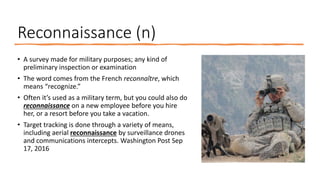
Reconnaissance (n)
• A survey made for military purposes; any kind of
preliminary inspection or examination
• The word comes from the French reconnaître, which
means “recognize.”
• Often it’s used as a military term, but you could also do
reconnaissance on a new employee before you hire
her, or a resort before you take a vacation.
• Target tracking is done through a variety of means,
including aerial reconnaissance by surveillance drones
and communications intercepts. Washington Post Sep
17, 2016
Substantiate (v)
• To establish by evidence, prove; to give concrete or substantial form to
• We’d really like to believe in the Tooth Fairy; however, more evidence is
needed to substantiate her existence (besides that quarter in your
pocket).
• Substantiate is related to the word substantial, which means "solid."
So, to substantiate a claim is to make it solid or believable. If the
evidence given in support of an argument is weak and unconvincing,
that evidence can be described as insubstantial.
• “Most cases have not been substantiated, but accounts of costumed
characters trying to tempt children with candy or cash rattled residents
and prompted increased patrols”. Reuters Sep 15, 2016
Taciturn (adj) [tas-i-turn]
• Habitually silent or quiet, inclined to talk very little
• A taciturn person might be snobby, naturally quiet, or
just shy.
• Having its origin in the Latin tacitus, "silent," taciturn
came to be used in mid-18th-century English in the
sense "habitually silent." Taciturnity is often considered
a negative trait, as it suggests someone
uncommunicative and too quiet.
• When Andy Murray won Wimbledon “The pent up
emotions burst out of him which is unusual for this
very taciturn man.” New York Times Jul 10, 2016
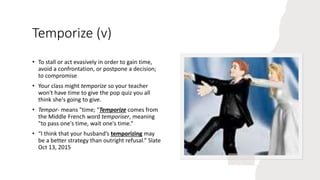
Temporize (v)
• To stall or act evasively in order to gain time,
avoid a confrontation, or postpone a decision;
to compromise
• Your class might temporize so your teacher
won't have time to give the pop quiz you all
think she's going to give.
• Tempor- means "time; "Temporize comes from
the Middle French word temporiser, meaning
"to pass one's time, wait one's time.“
• “I think that your husband’s temporizing may
be a better strategy than outright refusal.” Slate
Oct 13, 2015
Tenable (adj)
• Capable of being held or defended
• Tenable comes from the Latin root tenir
which means "to hold," as in "hold
together."
• To be tenable is to be evidence-based and
well-founded.
• “If there is a strike, commuters would
have few good choices, she said, and
telecommuting is not tenable for most
New Jersey residents.” New York Times
Mar 2, 2016

Vocabulary Workshop Level G Unit 1 Presentation.pptx

  • 1.
  • 2.
    Acquisitive (adj) • Ableto get and retain ideas or information; concerned with acquiring wealth or property • Comes from Latin meaning to accumulate • Preoccupied with possessing material things • Famous people are known for their acquisitive lifestyles; they purchase frivolous items just to have more. • Don’t mistake for inquisitive (good connotation)= which means inquiring or curious
  • 3.
    Arrogate (v) • Toclaim or take without right • The take over usually happens by force – think of ISIS taking over many cities • “Yet in this case, Congress arrogated that power to itself.” Washington Post Apr 20, 2016 • Do you have a lunch table where all your friends sit? Imagine if a group of students took it over one day…They would arrogate your table
  • 4.
    Banal (adj) • Hackneyed,trite, commonplace • Think of a cliché • Where might you see banal humor? • Have you ever watched a banal sporting event? • “Slyly turning natural verbal rhythms into eccentric choral numbers, Mr. Cork creates a serial-killer opera whose genius is to transform the banal into something exceptional.” New York Times Sep 8, 2016
  • 5.
    Belabor (v) • Towork on excessively; to thrash soundly (to beat up thoroughly) • When you say, "Don't belabor or agonize over the decision," it means, "Move on.” • You can belabor a point by using excessive detail, or you could belabor the obvious by stating over and over what everyone already knows. • Belaboring can be a physical attack as well. A person can belabor or beat the living daylights out of you with a club. • “At the risk of belaboring it, let me just tell some small parts again.” The Verge Aug 22, 2016
  • 6.
    Carping (adj) (n) •(adj)Tending to find fault, especially in a petty, nasty, or hairsplitting way; (n) petty, nagging criticism • To carp is to complain and gripe repeatedly, especially about little things. Don’t carp about the rain if you live in the rain forest. Adj N used as an adjective, to describe someone who is overly critical and impossible to please — like that carping food critic who ruined the debut of your new restaurant. People who find fault with you at every turn, who appreciate nothing and complain, complain, complain, are carping! “Between complaining players, argumentative coaches, heckling fans and carping media, refs fully earn their six-figure salaries, first-class travel and luxurious accommodations.” Washington Times May 4, 2016 “Neither man was a supporter of Mr. Trump’s at the beginning of the campaign, but both said they have had it with the carping.” Washington Times Aug 4, 2016
  • 7.
    Coherent (adj) • Comprehensible,meaningful, clear & logical; holding or sticking together Examples: - a lawyer’s coherent argument in court will help to win a case “In the video , in which Peres encourages the public to buy locally made products, he appears weary but is otherwise alert and coherent.” Washington Post Sep 13, 2016 “Palestinians believe the settlements, scattered all over the West Bank, prevent a geographically coherent state.” Los Angeles Times Sep 9, 2016 “The saga certainly points to the emptiness of art in our time, its complete lack of coherent critical values.” The Guardian Sep 5, 2016
  • 8.
    Congeal (v) [cuhn-jeel] • Tochange from liquid to solid, thicken; to make inflexible or rigid • comes to us from the Old French word congeler, which means "to freeze. • Think of Jell-O! or my milk cups found under the couch – gross! Example: “And our plans will become congealed laws whose errors will only appear over time.” The New Yorker Sep 3, 2016 “Indeed, you can see the narrative congealing already.” Salon Feb 17, 2016
  • 9.
    Emulate (v) • Toimitate with the intent of equaling or surpassing the model • When someone is impressive because of their great skills, brains, strength, or accomplishments, other will emulate. • After Michael Jordan retired from the NBA, player after player tried to emulate Jordan's game and success. It's hard to be as good as someone like that, but having a hero to emulate can be helpful in many areas of life. • Example: “Starbucks Corp. says it wants to emulate the quality of The Washington Post and The New York Times with its stories.” Seattle Times Sep 7, 2016
  • 10.
    Encomium (n) [en-CO-mium] •A formal expression of praise, a lavish tribute • a fancy word for a formal speech or piece of writing that warmly praises someone or something. • Encomium comes from the Greek word enkomion which is to honor someone or something at a party in a poetic speech. • A eulogy will typically be considered an encomium • Example “Whether he fully deserved the encomiums showered on him is another matter.” Washington Post Jan 23, 2015
  • 11.
    Eschew (v) [es- choo] •To avoid, shun, keep away from • If you live the bohemian life in the city, like Salinger did, then most likely you eschew the suburbs. • to eschew something isn’t simply to avoid it, the way you would avoid walking in a puddle––it's stronger than that. You eschew things that you find morally or aesthetically wrong, or that you have chosen to find wrong. Example: “After graduation, he quit football, eschewed the investment banking route favored by his friends and headed for California to train to become an Olympic athlete.” The Guardian Sep 1, 2016
  • 12.
    Germane (adj) [jer-meyn] • Relevant,appropriate, fitting • If you are giving a speech on dog training, stick to the germane, canine stuff. Topics that would not be germane? Catnip toys, hamster wheels, and the use of a saddle. • You might want to bring up all sorts of complaints during an argument with your best friend, but she says the two of you should only discuss issues that are germane to the current fight. “She and other school advocates say teachers typically balk at getting political, thinking it’s not germane to teaching.” Washington Times Aug 15, 2016
  • 13.
    Insatiable (adj) [in-sey-shuh-buhl] •So great or demanding as not to be satisfied • After being lost in the woods eating only berries for a few days, you'll find your hunger is insatiable once you finally get to the table. • Insatiable comes from the combination of the negative prefix, in- and the Latin verb satiare, for fill. • It can be used for spiritual as well as physical desires. Swift's traveling Gulliver talks about his "insatiable desire of seeing foreign countries.“ • Perhaps you have an insatiable desire to learn all the words in the English language. • “China’s own economy was growing so fast its demand for aluminum was nearly insatiable.” Seattle Times Sep 13, 2016
  • 14.
    Intransigent (adj) [in-tran-si-juhnt] •Refusing to compromise • An intransigent three-year-old will never back down from the position that he wants the lollipop NOW. • Trans has to do with movement — think transportation, or a package in transit, i.e. "on the way." The in- of intransigent means "not," so something or someone who is intransigent is not moving. • If one political party wants to raise funds to improve schools but the other is intransigent on the subject of higher taxes, the debate will get nowhere. • “The opponent in this case, my Republican colleagues, appear just as intransigent as our opponents in the days of segregation.” Seattle Times Jun 24, 2016
  • 15.
    Invidious (adj) [in-vid- ee-uhs] • Offensive, hateful; tending to cause bitterness and resentment • The adjective invidious is used to describe an act, thought, opinion or critique that is full of ill will or prejudice. • It comes from a Latin word that means "hostile” or “envious” • “Anti-immigration sentiment has proved invidious for parties caught between the embrace of diversity and the protectionist instincts of many workers.” Economist Jul 30, 2015
  • 16.
    Largesse (n) [lahr-jes] •Generosity in giving; lavish or bountiful contributions • Think of “Large in giving” • In response to a massive methane leak in California: “Those who did not relocate immediately struggled to find available short-term rental properties, but others took advantage of the gas company’s largess.” New York Times Mar 31, 2016
  • 17.
    Reconnaissance (n) • Asurvey made for military purposes; any kind of preliminary inspection or examination • The word comes from the French reconnaître, which means “recognize.” • Often it’s used as a military term, but you could also do reconnaissance on a new employee before you hire her, or a resort before you take a vacation. • Target tracking is done through a variety of means, including aerial reconnaissance by surveillance drones and communications intercepts. Washington Post Sep 17, 2016
  • 18.
    Substantiate (v) • Toestablish by evidence, prove; to give concrete or substantial form to • We’d really like to believe in the Tooth Fairy; however, more evidence is needed to substantiate her existence (besides that quarter in your pocket). • Substantiate is related to the word substantial, which means "solid." So, to substantiate a claim is to make it solid or believable. If the evidence given in support of an argument is weak and unconvincing, that evidence can be described as insubstantial. • “Most cases have not been substantiated, but accounts of costumed characters trying to tempt children with candy or cash rattled residents and prompted increased patrols”. Reuters Sep 15, 2016
  • 19.
    Taciturn (adj) [tas-i-turn] •Habitually silent or quiet, inclined to talk very little • A taciturn person might be snobby, naturally quiet, or just shy. • Having its origin in the Latin tacitus, "silent," taciturn came to be used in mid-18th-century English in the sense "habitually silent." Taciturnity is often considered a negative trait, as it suggests someone uncommunicative and too quiet. • When Andy Murray won Wimbledon “The pent up emotions burst out of him which is unusual for this very taciturn man.” New York Times Jul 10, 2016
  • 20.
    Temporize (v) • Tostall or act evasively in order to gain time, avoid a confrontation, or postpone a decision; to compromise • Your class might temporize so your teacher won't have time to give the pop quiz you all think she's going to give. • Tempor- means "time; "Temporize comes from the Middle French word temporiser, meaning "to pass one's time, wait one's time.“ • “I think that your husband’s temporizing may be a better strategy than outright refusal.” Slate Oct 13, 2015
  • 21.
    Tenable (adj) • Capableof being held or defended • Tenable comes from the Latin root tenir which means "to hold," as in "hold together." • To be tenable is to be evidence-based and well-founded. • “If there is a strike, commuters would have few good choices, she said, and telecommuting is not tenable for most New Jersey residents.” New York Times Mar 2, 2016