Slide 1: Introduction
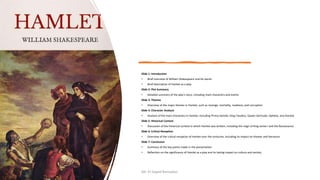
• Brief overview of William Shakespeare and his works
• Brief description of Hamlet as a play
Slide 2: Plot Summary
• Detailed summary of the play's story, including main characters and events
Slide 3: Themes
• Overview of the major themes in Hamlet, such as revenge, mortality, madness, and corruption
Slide 4: Character Analysis
• Analysis of the main characters in Hamlet, including Prince Hamlet, King Claudius, Queen Gertrude, Ophelia, and Horatio
Slide 5: Historical Context
• Discussion of the historical context in which Hamlet was written, including the reign of King James I and the Renaissance
Slide 6: Critical Reception
• Overview of the critical reception of Hamlet over the centuries, including its impact on theater and literature
Slide 7: Conclusion
• Summary of the key points made in the presentation
• Reflection on the significance of Hamlet as a play and its lasting impact on culture and society.
Mr. El-Sayed Ramadan
Introduction
Mr. El-Sayed Ramadan
William Shakespeare (1564-1616) was an English
playwright, poet, and actor widely regarded as the
greatest writer in the English language.
He wrote approximately 38 plays, including classics
such as "Romeo and Juliet," "Macbeth," and "King
Lear," as well as 154 sonnets.
His works have been performed and adapted countless
times, making him one of the most well-known and
influential figures in the history of Western literature.
Despite being written over 400 years ago,
Shakespeare's plays continue to be widely read,
performed, and studied today.
Introduction
Mr. El-Sayed Ramadan
Hamlet is one of William Shakespeare's most famous plays and is considered by many to be one
of his greatest works.
The play is a tragedy that tells the story of Prince Hamlet of Denmark, who is mourning the
death of his father and seeking to avenge his murder.
Through its exploration of themes such as revenge, mortality, madness, and corruption,
Hamlet delves into the complexities of the human experience and raises profound questions
about the nature of existence.
Hamlet is also known for its complex characters, including the titular prince, as well as King
Claudius, Queen Gertrude, Ophelia, and Horatio.
With its powerful dialogue and memorable lines, Hamlet remains a popular and enduring
work of art that continues to captivate audiences to this day.
Introduction
• Hamlet is a tragedy written by William Shakespeare,
believed to have been written between 1599 and 1601.
• The play is set in the Kingdom of Denmark and tells the
story of Prince Hamlet, who is seeking to avenge the murder
of his father, King Hamlet, at the hands of his uncle, King
Claudius.
• The play explores themes such as revenge, mortality,
madness, and corruption, and is known for its complex and
deeply flawed characters, including Prince Hamlet, King
Claudius, Queen Gertrude, Ophelia, and Horatio.
• Hamlet is also noted for its intense emotional and
psychological scenes, as well as its powerful and memorable
lines, which have been quoted and referenced widely in
popular culture.
• Despite being written over 400 years ago, Hamlet
remains one of Shakespeare's most popular and enduring
works and continues to be widely performed and studied
today.
Mr. El-Sayed Ramadan
Plot Summary
• The play opens with the appearance of the ghost of King Hamlet,
who has recently died. The ghost appears to Prince Hamlet and
reveals to him that he was murdered by his own brother, King
Claudius.
• Driven by his desire for revenge, Prince Hamlet feigns madness in
order to investigate the circumstances of his father's death.
• King Claudius marries Queen Gertrude, Prince Hamlet's mother,
shortly after the death of King Hamlet. This causes tension between
Hamlet and his mother, as well as between Hamlet and King Claudius.
• Hamlet's childhood friend, Horatio, informs him of a group of
actors who have come to the kingdom, and Hamlet enlists their help
in putting on a play that reenacts the murder of King Hamlet.
• The play is performed in front of King Claudius, Queen Gertrude,
and other members of the court, and the performance causes King
Claudius to confess to the murder.
• Meanwhile, Ophelia, a young noblewoman who has been courted
by Hamlet, becomes mad with grief after her father is killed by
Hamlet in a fit of madness.
• The play ends with a violent confrontation between Hamlet and
King Claudius, during which both Hamlet and King Claudius are killed.
The play ends with Horatio's lament for the fallen prince.
Mr. El-Sayed Ramadan
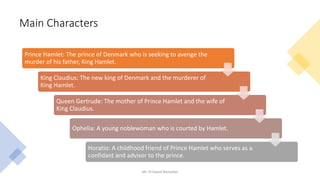
Main Characters
Mr. El-Sayed Ramadan
Prince Hamlet: The prince of Denmark who is seeking to avenge the
murder of his father, King Hamlet.
King Claudius: The new king of Denmark and the murderer of
King Hamlet.
Queen Gertrude: The mother of Prince Hamlet and the wife of
King Claudius.
Ophelia: A young noblewoman who is courted by Hamlet.
Horatio: A childhood friend of Prince Hamlet who serves as a
confidant and advisor to the prince.
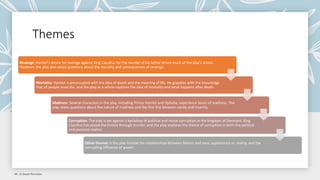
Themes
Revenge: Hamlet's desire for revenge against King Claudius for the murder of his father drives much of the play's action.
However, the play also raises questions about the morality and consequences of revenge.
Mortality: Hamlet is preoccupied with the idea of death and the meaning of life. He grapples with the knowledge
that all people must die, and the play as a whole explores the idea of mortality and what happens after death.
Madness: Several characters in the play, including Prince Hamlet and Ophelia, experience bouts of madness. The
play raises questions about the nature of madness and the fine line between sanity and insanity.
Corruption: The play is set against a backdrop of political and moral corruption in the kingdom of Denmark. King
Claudius has seized the throne through murder, and the play explores the theme of corruption in both the political
and personal realms.
Other themes in the play include the relationships between fathers and sons, appearance vs. reality, and the
corrupting influence of power.
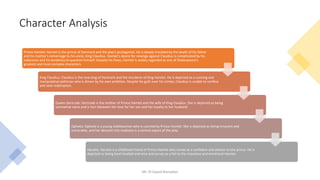
Character Analysis
Mr. El-Sayed Ramadan
Prince Hamlet: Hamlet is the prince of Denmark and the play's protagonist. He is deeply troubled by the death of his father
and his mother's remarriage to his uncle, King Claudius. Hamlet's desire for revenge against Claudius is complicated by his
indecision and his tendency to question himself. Despite his flaws, Hamlet is widely regarded as one of Shakespeare's
greatest and most complex characters.
King Claudius: Claudius is the new king of Denmark and the murderer of King Hamlet. He is depicted as a cunning and
manipulative politician who is driven by his own ambition. Despite his guilt over his crimes, Claudius is unable to confess
and seek redemption.
Queen Gertrude: Gertrude is the mother of Prince Hamlet and the wife of King Claudius. She is depicted as being
somewhat naive and is torn between her love for her son and her loyalty to her husband.
Ophelia: Ophelia is a young noblewoman who is courted by Prince Hamlet. She is depicted as being innocent and
vulnerable, and her descent into madness is a central aspect of the play.
Horatio: Horatio is a childhood friend of Prince Hamlet who serves as a confidant and advisor to the prince. He is
depicted as being level-headed and wise and serves as a foil to the impulsive and emotional Hamlet.
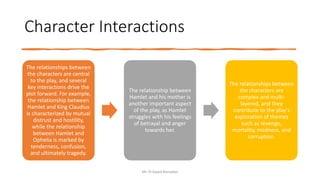
Character Interactions
Mr. El-Sayed Ramadan
The relationships between
the characters are central
to the play, and several
key interactions drive the
plot forward. For example,
the relationship between
Hamlet and King Claudius
is characterized by mutual
distrust and hostility,
while the relationship
between Hamlet and
Ophelia is marked by
tenderness, confusion,
and ultimately tragedy.
The relationship between
Hamlet and his mother is
another important aspect
of the play, as Hamlet
struggles with his feelings
of betrayal and anger
towards her.
The relationships between
the characters are
complex and multi-
layered, and they
contribute to the play's
exploration of themes
such as revenge,
mortality, madness, and
corruption.
Historical
Context
Hamlet was written in the early 1600s, during the reign of King
James I of England. This was a time of great change in England, with
a growing sense of national identity and a revival of interest in
classical literature, learning, and art.
The Renaissance was a major cultural movement that swept across
Europe in the late 1400s and 1500s, and had a profound impact on
the arts and sciences. Shakespeare was a product of this era, and
his works reflect the ideas and values of the Renaissance, such as a
renewed interest in classical literature and a focus on humanistic
values.
The Renaissance also saw a growing interest in individualism and
the inner lives of individuals, which is reflected in the complex and
psychologically nuanced characters in Hamlet.
The
Reign of
King
James I
King James I was a patron of the arts, and he supported the
establishment of the first professional theater companies in
England, including the King's Men, for whom Shakespeare
wrote many of his plays.
James was also known for his interest in the supernatural
and the occult, and several of Shakespeare's plays, including
Hamlet, reflect this fascination with the mysterious and the
macabre.
The political and religious tensions of the time are also
reflected in Hamlet, as the play explores issues of power,
corruption, and the corruption of religion and politics. The
play's themes of revenge and mortality also reflect the
uncertain and often violent times in which it was written.
Critical Reception
Mr. El-Sayed Ramadan
Hamlet is widely regarded as one of William Shakespeare's greatest and
most important works, and it has been the subject of much critical analysis
and interpretation over the centuries.
The play was first performed in the early 1600s and was immediately
popular with audiences. It has been staged numerous times over the
centuries, and it remains one of the most frequently performed plays in
the world today.
Hamlet has had a profound impact on theater and literature, and it is
considered a classic of English literature. Many famous actors have
played the role of Hamlet, and the play has been adapted for film,
television, and other media numerous times.
Interpretations and Analyses
Mr. El-Sayed Ramadan
The play has been interpreted in many different ways over the years, with
different readings focusing on different aspects of the text, such as the
psychology of the characters, the play's themes, and its political and
historical context.
Critics have debated the meaning of the play for centuries, and there is
still no consensus on what Hamlet is ultimately about. Some have
interpreted it as a play about revenge, while others have seen it as a
meditation on mortality, madness, or the corrupting influence of power.
Despite the many interpretations and debates surrounding the play,
Hamlet remains a timeless and universal work that continues to
captivate audiences and inspire new interpretations and analyses.
Summary of the key points
made in the presentation
• William Shakespeare was a playwright and poet who lived in the late 16th
and early 17th centuries and is widely regarded as one of the greatest writers in
the English language.
• Hamlet is a play written by Shakespeare, which tells the story of Prince
Hamlet, who is consumed by grief and rage after the sudden death of his father
and the subsequent remarriage of his mother to his uncle, King Claudius.
• The play is set in Denmark and explores themes of revenge, mortality,
madness, and corruption, as Hamlet struggles to come to terms with his father's
death and decides whether or not to seek vengeance.
• The play features a cast of complex and psychologically nuanced characters,
including Prince Hamlet, King Claudius, Queen Gertrude, Ophelia, and Horatio,
who all play important roles in the unfolding drama.
• Hamlet was written during the reign of King James I and the Renaissance,
and reflects the ideas and values of this time, including a renewed interest in
classical literature and a focus on humanistic values.
• The play has had a profound impact on theater and literature and continues
to be widely performed and studied. It has been the subject of much critical
analysis and interpretation over the centuries, with different readings focusing on
different aspects of the text, such as the psychology of the characters, the play's
themes, and its political and historical context.
• Despite the many interpretations and debates surrounding the play, Hamlet
remains a timeless and universal work that continues to captivate audiences and
inspire new interpretations and analyses.
Reflection on Significance
Hamlet is a play that has had a profound and lasting impact on culture and
society, and its significance cannot be overstated.
The play's themes of revenge, mortality, madness, and corruption
continue to resonate with audiences and readers, and it remains one of
the most widely performed and studied plays in the world.
Hamlet's complex and psychologically nuanced characters, along with its
timeless and universal themes, have made it a classic of English literature
and a touchstone for discussions about the human condition.
The play's impact on theater and literature is also significant, and it has
inspired countless adaptations, reinterpretations, and critical analyses
over the centuries.
Mr. El-Sayed Ramadan
Legacy of Hamlet
In conclusion, Hamlet is a play that continues to captivate audiences and readers and remains one of the
greatest works of English literature. Its complex characters, timeless themes, and lasting impact on culture and
society make it a play that continues to be relevant and significant, centuries after it was first performed.
The legacy of Hamlet extends far beyond the bounds of the play itself, and its influence can be seen in countless works of art, literature, and theater.
The play's themes, characters, and language have been borrowed, parodied, and adapted by writers and artists in many different mediums, and its
impact on popular culture continues to this day.
Hamlet remains an important and enduring work of art, and its significance and impact will continue to be felt for generations to come.

Hamlet tragedy by William Shakespeare.pptx

  • 1.
    Slide 1: Introduction •Brief overview of William Shakespeare and his works • Brief description of Hamlet as a play Slide 2: Plot Summary • Detailed summary of the play's story, including main characters and events Slide 3: Themes • Overview of the major themes in Hamlet, such as revenge, mortality, madness, and corruption Slide 4: Character Analysis • Analysis of the main characters in Hamlet, including Prince Hamlet, King Claudius, Queen Gertrude, Ophelia, and Horatio Slide 5: Historical Context • Discussion of the historical context in which Hamlet was written, including the reign of King James I and the Renaissance Slide 6: Critical Reception • Overview of the critical reception of Hamlet over the centuries, including its impact on theater and literature Slide 7: Conclusion • Summary of the key points made in the presentation • Reflection on the significance of Hamlet as a play and its lasting impact on culture and society. Mr. El-Sayed Ramadan
  • 2.
    Introduction Mr. El-Sayed Ramadan WilliamShakespeare (1564-1616) was an English playwright, poet, and actor widely regarded as the greatest writer in the English language. He wrote approximately 38 plays, including classics such as "Romeo and Juliet," "Macbeth," and "King Lear," as well as 154 sonnets. His works have been performed and adapted countless times, making him one of the most well-known and influential figures in the history of Western literature. Despite being written over 400 years ago, Shakespeare's plays continue to be widely read, performed, and studied today.
  • 3.
    Introduction Mr. El-Sayed Ramadan Hamletis one of William Shakespeare's most famous plays and is considered by many to be one of his greatest works. The play is a tragedy that tells the story of Prince Hamlet of Denmark, who is mourning the death of his father and seeking to avenge his murder. Through its exploration of themes such as revenge, mortality, madness, and corruption, Hamlet delves into the complexities of the human experience and raises profound questions about the nature of existence. Hamlet is also known for its complex characters, including the titular prince, as well as King Claudius, Queen Gertrude, Ophelia, and Horatio. With its powerful dialogue and memorable lines, Hamlet remains a popular and enduring work of art that continues to captivate audiences to this day.
  • 4.
    Introduction • Hamlet isa tragedy written by William Shakespeare, believed to have been written between 1599 and 1601. • The play is set in the Kingdom of Denmark and tells the story of Prince Hamlet, who is seeking to avenge the murder of his father, King Hamlet, at the hands of his uncle, King Claudius. • The play explores themes such as revenge, mortality, madness, and corruption, and is known for its complex and deeply flawed characters, including Prince Hamlet, King Claudius, Queen Gertrude, Ophelia, and Horatio. • Hamlet is also noted for its intense emotional and psychological scenes, as well as its powerful and memorable lines, which have been quoted and referenced widely in popular culture. • Despite being written over 400 years ago, Hamlet remains one of Shakespeare's most popular and enduring works and continues to be widely performed and studied today. Mr. El-Sayed Ramadan
  • 5.
    Plot Summary • Theplay opens with the appearance of the ghost of King Hamlet, who has recently died. The ghost appears to Prince Hamlet and reveals to him that he was murdered by his own brother, King Claudius. • Driven by his desire for revenge, Prince Hamlet feigns madness in order to investigate the circumstances of his father's death. • King Claudius marries Queen Gertrude, Prince Hamlet's mother, shortly after the death of King Hamlet. This causes tension between Hamlet and his mother, as well as between Hamlet and King Claudius. • Hamlet's childhood friend, Horatio, informs him of a group of actors who have come to the kingdom, and Hamlet enlists their help in putting on a play that reenacts the murder of King Hamlet. • The play is performed in front of King Claudius, Queen Gertrude, and other members of the court, and the performance causes King Claudius to confess to the murder. • Meanwhile, Ophelia, a young noblewoman who has been courted by Hamlet, becomes mad with grief after her father is killed by Hamlet in a fit of madness. • The play ends with a violent confrontation between Hamlet and King Claudius, during which both Hamlet and King Claudius are killed. The play ends with Horatio's lament for the fallen prince. Mr. El-Sayed Ramadan
  • 6.
    Main Characters Mr. El-SayedRamadan Prince Hamlet: The prince of Denmark who is seeking to avenge the murder of his father, King Hamlet. King Claudius: The new king of Denmark and the murderer of King Hamlet. Queen Gertrude: The mother of Prince Hamlet and the wife of King Claudius. Ophelia: A young noblewoman who is courted by Hamlet. Horatio: A childhood friend of Prince Hamlet who serves as a confidant and advisor to the prince.
  • 7.
    Themes Revenge: Hamlet's desirefor revenge against King Claudius for the murder of his father drives much of the play's action. However, the play also raises questions about the morality and consequences of revenge. Mortality: Hamlet is preoccupied with the idea of death and the meaning of life. He grapples with the knowledge that all people must die, and the play as a whole explores the idea of mortality and what happens after death. Madness: Several characters in the play, including Prince Hamlet and Ophelia, experience bouts of madness. The play raises questions about the nature of madness and the fine line between sanity and insanity. Corruption: The play is set against a backdrop of political and moral corruption in the kingdom of Denmark. King Claudius has seized the throne through murder, and the play explores the theme of corruption in both the political and personal realms. Other themes in the play include the relationships between fathers and sons, appearance vs. reality, and the corrupting influence of power.
  • 8.
    Character Analysis Mr. El-SayedRamadan Prince Hamlet: Hamlet is the prince of Denmark and the play's protagonist. He is deeply troubled by the death of his father and his mother's remarriage to his uncle, King Claudius. Hamlet's desire for revenge against Claudius is complicated by his indecision and his tendency to question himself. Despite his flaws, Hamlet is widely regarded as one of Shakespeare's greatest and most complex characters. King Claudius: Claudius is the new king of Denmark and the murderer of King Hamlet. He is depicted as a cunning and manipulative politician who is driven by his own ambition. Despite his guilt over his crimes, Claudius is unable to confess and seek redemption. Queen Gertrude: Gertrude is the mother of Prince Hamlet and the wife of King Claudius. She is depicted as being somewhat naive and is torn between her love for her son and her loyalty to her husband. Ophelia: Ophelia is a young noblewoman who is courted by Prince Hamlet. She is depicted as being innocent and vulnerable, and her descent into madness is a central aspect of the play. Horatio: Horatio is a childhood friend of Prince Hamlet who serves as a confidant and advisor to the prince. He is depicted as being level-headed and wise and serves as a foil to the impulsive and emotional Hamlet.
  • 9.
    Character Interactions Mr. El-SayedRamadan The relationships between the characters are central to the play, and several key interactions drive the plot forward. For example, the relationship between Hamlet and King Claudius is characterized by mutual distrust and hostility, while the relationship between Hamlet and Ophelia is marked by tenderness, confusion, and ultimately tragedy. The relationship between Hamlet and his mother is another important aspect of the play, as Hamlet struggles with his feelings of betrayal and anger towards her. The relationships between the characters are complex and multi- layered, and they contribute to the play's exploration of themes such as revenge, mortality, madness, and corruption.
  • 10.
    Historical Context Hamlet was writtenin the early 1600s, during the reign of King James I of England. This was a time of great change in England, with a growing sense of national identity and a revival of interest in classical literature, learning, and art. The Renaissance was a major cultural movement that swept across Europe in the late 1400s and 1500s, and had a profound impact on the arts and sciences. Shakespeare was a product of this era, and his works reflect the ideas and values of the Renaissance, such as a renewed interest in classical literature and a focus on humanistic values. The Renaissance also saw a growing interest in individualism and the inner lives of individuals, which is reflected in the complex and psychologically nuanced characters in Hamlet.
  • 11.
    The Reign of King James I KingJames I was a patron of the arts, and he supported the establishment of the first professional theater companies in England, including the King's Men, for whom Shakespeare wrote many of his plays. James was also known for his interest in the supernatural and the occult, and several of Shakespeare's plays, including Hamlet, reflect this fascination with the mysterious and the macabre. The political and religious tensions of the time are also reflected in Hamlet, as the play explores issues of power, corruption, and the corruption of religion and politics. The play's themes of revenge and mortality also reflect the uncertain and often violent times in which it was written.
  • 12.
    Critical Reception Mr. El-SayedRamadan Hamlet is widely regarded as one of William Shakespeare's greatest and most important works, and it has been the subject of much critical analysis and interpretation over the centuries. The play was first performed in the early 1600s and was immediately popular with audiences. It has been staged numerous times over the centuries, and it remains one of the most frequently performed plays in the world today. Hamlet has had a profound impact on theater and literature, and it is considered a classic of English literature. Many famous actors have played the role of Hamlet, and the play has been adapted for film, television, and other media numerous times.
  • 13.
    Interpretations and Analyses Mr.El-Sayed Ramadan The play has been interpreted in many different ways over the years, with different readings focusing on different aspects of the text, such as the psychology of the characters, the play's themes, and its political and historical context. Critics have debated the meaning of the play for centuries, and there is still no consensus on what Hamlet is ultimately about. Some have interpreted it as a play about revenge, while others have seen it as a meditation on mortality, madness, or the corrupting influence of power. Despite the many interpretations and debates surrounding the play, Hamlet remains a timeless and universal work that continues to captivate audiences and inspire new interpretations and analyses.
  • 14.
    Summary of thekey points made in the presentation • William Shakespeare was a playwright and poet who lived in the late 16th and early 17th centuries and is widely regarded as one of the greatest writers in the English language. • Hamlet is a play written by Shakespeare, which tells the story of Prince Hamlet, who is consumed by grief and rage after the sudden death of his father and the subsequent remarriage of his mother to his uncle, King Claudius. • The play is set in Denmark and explores themes of revenge, mortality, madness, and corruption, as Hamlet struggles to come to terms with his father's death and decides whether or not to seek vengeance. • The play features a cast of complex and psychologically nuanced characters, including Prince Hamlet, King Claudius, Queen Gertrude, Ophelia, and Horatio, who all play important roles in the unfolding drama. • Hamlet was written during the reign of King James I and the Renaissance, and reflects the ideas and values of this time, including a renewed interest in classical literature and a focus on humanistic values. • The play has had a profound impact on theater and literature and continues to be widely performed and studied. It has been the subject of much critical analysis and interpretation over the centuries, with different readings focusing on different aspects of the text, such as the psychology of the characters, the play's themes, and its political and historical context. • Despite the many interpretations and debates surrounding the play, Hamlet remains a timeless and universal work that continues to captivate audiences and inspire new interpretations and analyses.
  • 15.
    Reflection on Significance Hamletis a play that has had a profound and lasting impact on culture and society, and its significance cannot be overstated. The play's themes of revenge, mortality, madness, and corruption continue to resonate with audiences and readers, and it remains one of the most widely performed and studied plays in the world. Hamlet's complex and psychologically nuanced characters, along with its timeless and universal themes, have made it a classic of English literature and a touchstone for discussions about the human condition. The play's impact on theater and literature is also significant, and it has inspired countless adaptations, reinterpretations, and critical analyses over the centuries.
  • 16.
    Mr. El-Sayed Ramadan Legacyof Hamlet In conclusion, Hamlet is a play that continues to captivate audiences and readers and remains one of the greatest works of English literature. Its complex characters, timeless themes, and lasting impact on culture and society make it a play that continues to be relevant and significant, centuries after it was first performed. The legacy of Hamlet extends far beyond the bounds of the play itself, and its influence can be seen in countless works of art, literature, and theater. The play's themes, characters, and language have been borrowed, parodied, and adapted by writers and artists in many different mediums, and its impact on popular culture continues to this day. Hamlet remains an important and enduring work of art, and its significance and impact will continue to be felt for generations to come.